
I was born on July 20, 1944, in the midst of World War II. My father had just returned from Burma where he had been operations officer for the 1st Air Commandos in the China-India-Burma Theater. I, of course, remember nothing about that war — except that my father (on extremely rare occasions) would barely mention what he had gone through but would sometimes take me to World War II movies like The Caine Mutiny and Merrill’s Marauders at local movie theaters.
In a country that has never stopped fighting wars, however, that’s certainly the last one that any American could truly be proud of, the global defeat of Nazi Germany and Imperial Japan.
In fact, we’re talking about a country that, between 2001 and 2024, spent an estimated $21 trillion on its military, which, it turns out, was equal to the military spending of the next 18 — yes, 18! — countries combined (if you can even believe it). And in those years, of course, like the 55 preceding ones, the United States managed to never — no, never — actually win a significant war (or, in truth, even come close). In short, Donald Trump’s present disastrous war with Iran is anything but out of the ordinary when it comes to American military power destroying all too much, but sooner or later finding itself in a remarkably dead-end situation (with an emphasis on dead, of course).
And that should be considered strange indeed. I doubt there’s another example in history of a great imperial power that, for a significant part of its rise (and potential fall) simply couldn’t win a war.
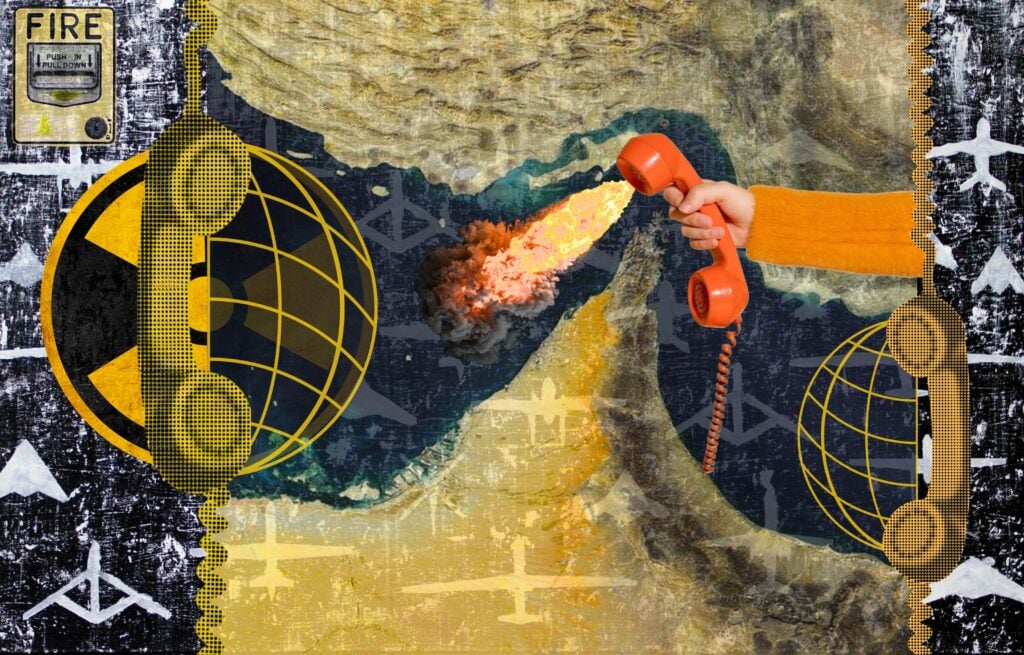
It certainly gives that old song “War (What Is It Good For?)” with the response “absolutely nothing” new meaning. Of course, if you happen to be Donald Trump and you’re the president who simply can’t win a war (which certainly leaves you in good company among American presidents of the last 80 years or so), then the least you can do, when it comes to Iran, is declare that the Strait of Hormuz, through which about 20% of global oil and even more natural gas used to pass and which was closed down by the Iranians in response to his warring acts (distinctly harming the global economy), is now actually U.S. property, or, to be specific, a potential “territory of the United States.” (Phew, that was exhausting!)
And hard as it might be to believe, he really did say that recently. How logical, right? After all, it’s only perhaps 6,500 miles or so from Washington, D.C. So, what could possibly make more sense?
Of course, I’m sure you won’t be surprised to learn that Iran’s Deputy Foreign Minister Kazem Gharibabadi responded that, whatever Trump might think, the Strait “cannot be seized with a tweet, nor with an aircraft carrier, nor by issuing an order, nor through an election speech.” He added, “This strait will only be opened and closed under Iran’s command, and as long as you do not accept the reality of defeat and stop indulging in delusions, Iran will continue to enforce the blockade.”
Defeat Donald Trump? In what world could that possibly happen? How delusional could the Iranians be about our distinctly delusional president?
Oh, but in case you think that’s just so much enemy blather, the fact is that, in the ongoing war with Iran, the U.S. has already lost about one quarter of its crucial Reaper Drones, valued at $30 to $50 million each (or more than $1.3 billion worth of them), mainly around — yes, of course! — the Strait of Hormuz. And many of them have been taken down by Iranian drones valued at $20,000 to $50,000 each.
And while losing so many of its drones, the Trump administration has also been losing other things as well, including its previous insistence that a complete Iranian surrender was the order of the day. No longer, it seems. Now, all that it appears Donald Trump wants (whatever he’s said) is the reopening of the Strait of Hormuz and the free flow of oil and natural gas globally. In other words, what he now yearns for is essentially a return to the very situation that existed six months ago just before he launched his disastrous war.
Or as Vice President J.D. Vance put it recently, all the Trump administration now wants is to ensure “that the Gulf countries continue to send oil and gas to the world economy so that we have energy price stability,” and, of course, to ensure as well that the Iranians won’t ever have a nuclear weapon. No matter that, as far as anyone knows, they are not faintly close to having, no less possibly even trying to develop such a weapon.
On the other hand, the Iranians are now threatening to continue the state of war with the U.S. until the end of Trump’s second term in office in 2028 (and his approval ratings are, of course, already plunging to new lows). As a senior adviser to the commander of Iran’s Revolutionary Guard put it, “One way is to prolong this war until we get to the next term of the presidency and cause attrition, so that if anyone else wants to attack Iran, they will know there is a cost… We have to attain deterrence so that the enemy never dares to attack us, so we can live with security.”
And let’s not forget that, lest you think Donald Trump has learned anything from all of this, he has only recently been threatening to “bomb the shit out of” long-time American ally Oman, if it “gets in the way” of his Iranian plans — and what, I ask you, could possibly go wrong with that? (I can’t even imagine.)
Of course, we’re talking about the rule (or do I mean reign — or perhaps I actually mean rain, or even thunderstorms or tornados?) of Donald Trump, a president for whom, according to a recent poll, only 29% of potential voters in the coming midterm elections approve of how he’s handling the situation with Iran.
And yet, sad to say, what’s new? Not much, it seems. After all, Trump, who may indeed be unique in so many ways, is proving anything but unique as president of the greatest power on planet Earth (in certain ways, perhaps the greatest in history) when it comes to making war all too miserably, even disastrously. In fact, give him a certain amount of credit. After all, despite what anyone, including him, might have learned from American history since 1945, he decided to go to war with Iran anyway in 2026. It evidently mattered not at all to him that the most obvious and self-evident fact about American warmaking since 1945 is that defeat (or minimally nothing faintly approaching victory) would essentially be guaranteed. And yet, he still managed to launch another disastrous all-American war on this distinctly embattled planet of ours.
At the very least, the Iranians should consider renaming the Strait of Hormuz, the Crooked of Donald Trump, and let me just hope that I’ll never have to take one of my grandchildren to a movie about his disastrous war.
This article was produced by Tom Engelhardt.


Tom Engelhardt created the website TomDispatch.com. He is also a co-founder of the American Empire Project and the author of a highly praised history of American triumphalism in the Cold War, The End of Victory Culture. A fellow of the Type Media Center, his sixth and latest book is A Nation Unmade by War.
ZNetwork is funded solely through the generosity of its readers.
Donate

