
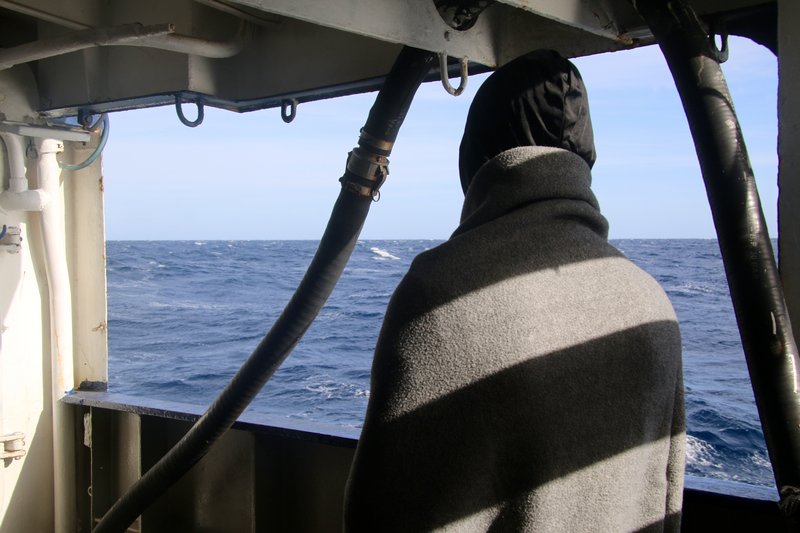
The boat took us all by surprise that morning. It was spotted by a crew member on lookout on our top deck, and soon, what had been a pinpoint on the horizon quickly became a distinct wooden boat, tightly packed with people, all waving and shouting. No one was wearing a lifejacket.
The crew on our boat, Humanity 1, moved fast. I joined them on one of the lifeboats and watched as those being rescued clambered on board one by one – some laughing and smiling, others seemingly in a state of shock.
It felt like a toss of the dice that they’d been found by a German rescue vessel in the wide ocean of the central Mediterranean, one of the world’s deadliest sea crossings. They could just as easily have drowned or been picked up by the Libyan coastguard and sent to one of the country’s brutal detention centres.
This is a reality that one of the survivors, Omar*, knows all too well.
This rescue, in late November, was the seventh time the 18-year-old Egyptian had attempted to cross the Mediterranean in 2025.
On four of those attempts, Omar’s boat was stopped by the Libyan coastguard, while on another, in April, it was intercepted by the Tunisian coastguard, which “sold” those on board to Libyan authorities. Each time, Omar ended up being held in various Libyan detention centres, where he faced severe beatings, starvation, sleep deprivation, overcrowding and extortion for ransoms.
On this latest attempt, Omar believes he only made it so far because his smuggler paid the Libyan coastguard to allow them passage. In his 11 months of trying and failing to leave Libya for Europe, he said he encountered a network of smugglers, police, militia and coastguard all connected through bribes and corruption – all while the European Union turned a blind eye, and even funded Libyan border agents.
Over the past decade, the EU has paid Libyan authorities hundreds of millions of euros to block migrant people from entering Europe on small boats departing from North Africa. An initiative led by Italy – the target destination for most of those who make the journey – has provided further funding and resources, including at least 14 patrol vessels.
The money comes after Italy ended its government-run search and rescue operation in the Mediterranean in 2014, after just one year, citing high costs and a lack of EU support. Since then, more than 22,775 people have died or gone missing on the route.
Civil rescue boats such as Humanity 1 have expanded their patrols of the waters in efforts to prevent loss of life, but are increasingly facing crackdowns from Libya, Italy and other European countries.
Libyan officials on board one of the Italian-donated boats opened fire on a rescue ship in international waters in August. Rights groups urged the EU to suspend funding for the country’s coastguard after the attack, which they said was part of a broader pattern of aggression towards people in distress at sea and rescue crews.
Instead, Italy and the EU have doubled down on their support for Libya’s migration tactics. This week, after we arrived in Italy carrying Omar and the other survivors, Humanity 1 was detained by Italian authorities for not communicating with the Libyan coastguard. The organisation operating the vessel, SOS Humanity, said it suspended communication due to the Libyan agency’s track record of rights abuses at sea.
Marc Tilley, an independent migration researcher focusing on North Africa and the central Mediterranean, told openDemocracy that the EU is looking to expand its support for migration management in Libya, and the UK hopes to join them.
“The UK and the EU are now holding bilateral meetings with [Libyan commander] Khalifa Haftar in eastern Libya,” said Tilley. “This was the first exercise in legitimising eastern Libya [whose government is unrecognised] and recognising them as potential partners in their battle against migration.”
Held for ransom five times
In the six days we were both on board Humanity 1, I often spotted Omar listening to music and laughing with the other Egyptian and Somalian teenagers, the youngest of whom was just 15.
They could’ve been teenagers in any part of the world, except they happened to be on a rescue boat in the middle of the Mediterranean Sea, having escaped a place notorious for torture, forced labour and mass killings.
When I approached Omar on the deck and asked to interview him, I told him that I would need his informed consent to publish his story. He started laughing. “We’re not used to being respected like this, we’re used to being beaten in Libya.”
In March 2023, Omar was on his lunch break at a construction site in Cairo when he heard that his 15-year-old cousin had drowned off the Tunisian coast.
Omar, then 16, had last spoken to his cousin the night before to wish him a safe trip. The two teenagers were living in poverty in the Egyptian capital, Omar said, and planned to travel together to Libya and then find a boat to cross the Mediterranean Sea to Italy in search of a better life.
In the end, though, Omar was refused boarding on the flight to Libya from Egypt. His cousin made the journey alone. “I would’ve died with him,” Omar said.
Less than two years later, Omar decided to try again. “I left Egypt to find a better life,” he said. “I wasn’t afraid by what happened to my cousin.”
He found a smuggler to help him travel overland to Libya in January of this year, where he initially planned to stay and work. He had been recruited over Facebook to work in a sweet shop for 14,000 Libyan dinars a month (£1,900), but when he arrived, he was told he would only be paid the equivalent of £275 a month.
“I was threatened when I asked for my rights. I was cheated out of my salary,” he said. “I couldn’t go home. I felt I had to continue.”
Omar said that each time he attempted the crossing and was intercepted and imprisoned, he was forced to contact family members in Libya or back home in Egypt to beg them to pay for his release, with the ransom demanded by Libyan authorities ranging from 2,000 Libyan dinars (£274) to 16,000 dinars (£2,195).
The longest Omar was held for was 37 days, in the notorious Bir al-Ghanam detention centre. In the end, his father flew to Libya to pay the ransom, which secured his release. On other occasions, he turned to his cousins also living in Libya to help him fund the funds to get out.
“We were 200 people crammed into a cell,” he said of his time in Bir al-Ghanam. “There was no room to even sit down. There were insects everywhere, and guards would come in at all times of the day to beat us with belts or throw water on us.”
He described how people in the cell would collapse onto each other because they were so weak from exhaustion and hunger.
“It was like that every time I was in prison,” said Omar. “But Bir al-Ghanam was the worst. I saw a lot of torture happening there. Some people had been there for over a year because they couldn’t afford the ransom.”
Bir al-Ghanam is an unofficial detention centre south-west of Tripoli, which Tilley said receives “even less scrutiny” than other sites and is known for its “horrific” conditions. “There’s no access, oversight or registration of the people who go there, so they are much more likely to disappear and to be extorted,” said the researcher.
The site has also been flagged by the US State Department’s country report on human rights practices for arbitrarily detaining migrant children.
A 2023 UN fact-finding mission reported found “overwhelming evidence” that migrants are “systematically tortured” in Libya’s detention centres, where “acts of murder, enforced disappearance, torture, enslavement, sexual violence, rape and other inhumane acts are committed in connection with their arbitrary detention”.
Salahadine Juma, a co-founder of activist group Refugees in Libya, has firsthand experience of what happens to those detainees whose families can’t afford to pay. “I was held in a [Libyan] detention centre for a year and a half. I was forced to do hard labour because I couldn’t pay the ransom,” he said.
Juma, who co-founded Refugees in Libya before arriving in France 18 months ago, said its hotline receives between 50 and 80 messages a day from trapped refugees and migrants asking for help to escape the centres. “They [Libyan officers] force them to pay a ransom, and if they can’t pay, they force them to work. Or, if they are women, they are sexually abused.”
Juma said there’s not much the group can do to help them, other than putting pressure on the United Nations High Commissioner for Refugees’ representatives in Libya. “But there are many stories of refugees and migrants being neglected by UNHCR in Libya,” he added.
Italy’s ‘deliberate obstruction’
The journey to Italy from the international waters north of the Libyan coast where we’d picked up Omar’s boat could be done in 13 hours, but it was six days before Humanity 1 finally reached the port of Ortona in central east Italy on 1 December.
During the long journey, many survivors on board asked why we had not yet reached Italy. At one point, we were so close to the shore we could see the details of buildings and wind farms – and yet we were still over 24 hours from arriving.
Since Italy’s adoption of the ‘Piantedosi decree’ in January 2023, rescue ships requesting a safe port to disembark rescued people have regularly been forced to travel to distant ports, sometimes over 600 miles away, or risk their boats being detained for non-compliance. Rescue organisations say the policy is a “deliberate obstruction” designed to limit their ability to rescue people in distress at sea.
When Omar and the other survivors eventually disembarked in Ortona, they were met by the Red Cross and Italian police. This moment marked the start of a new and challenging chapter for them – the start of their asylum processes in Italy. Those from countries that the Italian Ministry of Foreign Affairs have declared to be ‘safe’ (which includes Egypt) could face a fast-tracked detention and a deportation order.
Stefania, the protection representative onboard Humanity 1 said the dangerous sea crossing is “not the only challenge” the rescued people will have to face.
“Under Italian law, some categories are protected, for example, if you’re a victim of torture or trafficking,” she said. “[Otherwise] they could be detained in administrative detention centres [in Italy]. I don’t want to exaggerate but they could look like something they lived through in Libya.”
Bribes in one hand, EU salary in the other
For Omar, arrival in Italy also started the countdown for him to contact the Libyan smuggler awaiting payment.
“The money is due on arrival,” Omar told me before the boat docked. “As soon as I get on shore and have reception, I have to send the smuggler a message on Facebook to tell him I arrived. Then he’ll get in contact with my father to arrange payment.”
Omar owed the smuggler 360,000 Egyptian pounds (£5,650) for the crossing, which was due in full only if he arrived in Europe alive. “The smuggler told me that if the sum isn’t paid, he will kill any of my cousins or brothers in Libya,” said the teenager. “He told me he has contacts in Egypt and could hurt one of my family members there too. He knows who my relatives are, he’s observed me. The thing that matters to him is the payment.”
Omar has good reason to believe these are not empty threats. “The smuggler was always carrying his gun [while we were waiting to cross],” he said. “One time I picked up my phone to send a voice message on WhatsApp and he pointed his gun at me. He told me if you do that again, I will shoot you and bury you here.”
Omar described how most smugglers he interacted with during his time in Libya appeared to be connected to the Libyan internal police. “They have police cars, they’re wearing police uniforms and carrying the guns,” he said. “Those police pay money to the coastguard to get the boats through.”
This claim is difficult to verify, but likely has a measure of truth, according to Juma. “The majority of smugglers in Libya have some connection with the police or coastguard,” said the activist. “They know when the coastguard boats will be at sea, so they know which days to send boats. Some are even members of the coastguard themselves.”
Tilley told openDemocracy that Libyan internal police may not be smugglers “in the traditional sense”, but they could be seen as “facilitators” who turn a blind eye to smuggling, often in exchange for a financial incentive.
The 2023 UN fact-finding mission found “reasonable grounds” to believe that high-ranking staff in the Libyan Coast Guard, Libya’s Stability Support Apparatus and the Directorate for Combating Illegal Migration in Libya had “colluded with traffickers and smugglers.” The report stated that trafficking and smuggling generated “significant revenue” for individuals, groups and state institutions.
“The Libyan coastguard are border guards for Italy, not for Libya,” said Omar. “They get paid bribes by the smugglers, and they get their salaries from Europe.”
Mounir Satouri, a French MEP and chair of the EU’s Subcommittee on Human Rights, said the EU’s continuing support for the Libyan coastguard “only ensures that atrocities are committed in our name and with European taxpayers’ money.” He described the coastguard as “an uncontrollable armed militia that violates international law and tramples on human rights.”
“To tackle both militia abuses and smuggling networks, the European Union must coordinate genuine search-and-rescue operations and open safe pathways for those seeking refuge in Europe,” said Satouri.
“On 13 October, a boat carrying 140 people was attacked, leaving a man between life and death with a bullet lodged in his skull. Just last week, the rescue vessel Louise Michel was targeted. This is unacceptable. This impunity and Europe’s silence must end.”
The EU Commission (Migration and Home Affairs) was approached for comment.
Italian interior ministry was approached for comment.
When I asked Omar if there was anything he would like people to know about the journey, he said his only message was for others looking to make the crossing. “Don’t travel to Europe through Libya,” he said. “Find another way.”
*Name changed for security reasons
ZNetwork is funded solely through the generosity of its readers.
Donate

