
As Argentina eyes large lithium reserves to boost its struggling economy, local assemblies across the country are coming together to protect the ecosystems they depend on.
With the Argentine government recently investing in over 30 new mining projects in the next decade, environmentalists are mobilizing against the country’s expanding extractivist economic model.
Environmental groups are coming together to share knowledge, experiences and forms of resistance against these projects, which they say are being driven from the global north.
Ever since childhood, Freddy Carbonel, an Argentine environmental advocate, has held a deep connection to nature — from his fascination with trees to hiking in the mountainous province of Tucumán and using his video camera to document snowfall in his town.
After the global anti-nuclear push in the 1980s, Carbonel founded an environmental association with a group of like-minded young colleagues called Pro Eco Ecologist Group.
“We came into existence defending trees in a city called Tafi Viejo in Tucumán,” Carbonel explained, as the association began documenting the impact of deforestation on a local mountain.
Over their 30-year existence, the group has pivoted, tackling issues concerning energy, open-pit mining and the rights of Indigenous people. But their biggest challenge — fought alongside other environmental defenders — is an ongoing, protracted battle against the oldest large-scale open-pit mine, located in northwestern Argentina.
The Bajo La Alumbrera mine, located in Catamarca province, began operations with multinational backing in 1997 to mine copper, gold and molybdenum. To operate, the firms had to form a joint venture with Mineral Deposits of the Waters of Dionysius — an Argentine state-run company — and integrate with Catamarca’s government and Tucumán’s National University.
Since 1999, a number of environmental NGOs, including Pro Eco, mobilized against the mine. They acted as plaintiffs and collected data in order to bring a case of alleged environmental crimes against the mine, which led to it ceasing operations in 2018.
After extraction, mining materials were initially processed on site, before being pumped through a several-hundred-mile-long pipeline between provinces, from Catamarca to Tucumán, until reaching a plant in Ranchillos. Next they went to a Santa Fe port, and then the materials were sent overseas for smelting.
Authorities found evidence of contamination during the treatment process of materials in Ranchillos and effluents in local waterways after heavy rains impacted the pipeline. It drove one local resident, Ana Loto and different NGOs to denounce the mine for alleged environmental crimes — with Carbonel providing authorities with video documentation he had recorded.
For movements accustomed to direct action to safeguard the environment, Carbonel said they had to quickly learn how to mount a legal battle. Despite strong pushback and a huge disparity in economic resources, on Sept. 22, a federal court allowed the case to proceed against two former managing directors.
In Argentina each province owns the mineral resources in their jurisdictions. However, individuals and legal entities can obtain “concessions to explore and develop the deposits” from the local authority, which grants rights to private individuals and companies in line with the country’s mining code.
Carbonel argues that this approach leaves “very few beneficiaries,” blighting the landscape, causing contamination, impacting people’s health and leading to repression of land and water defenders. He said Pro Eco’s aim is to change the country’s extractivist economic model to one that is more equitable — with strong legislation that works for Argentina’s development and benefits all citizens.
Victories and setbacks
In Argentina, the Bajo La Alumbrera case has united different movements that are now joining forces in their clamor against extractivist practices, arguing they are leading to environmental degradation.
Rosa Farías, a 59-year-old retired teacher from the town of Andalgalá is a member of a “horizontal” organization made up of local neighbors called the Algarrobo Assembly. In 1998, a few years after the Alumbrera project began, the assembly started to collect information and share experiences about what was taking place at the mine.
Farías said semi-arid Andalgalá has a strong agricultural tradition that is dependent on large amounts of water to produce an array of fruits and vegetables, like potatoes, olives and quince. However, mining has not only polluted water sources, but also exacerbated droughts in the area.
Despite some investment in the surrounding community, employment and other perks offered by mining companies, the assembly has pushed back against the launch of the exploratory phase of Minera Agua Rica-Alumbrera, another initiative to mine gold, copper and silver that’s three times the size of the Bajo La Alumbrera.

The group organized a peaceful march through the streets of Andalgalá every Saturday for two years. They have also taken part in talks with other land defenders, underscoring what they say is the environmental footprint caused by mining that extends to other provinces. Farías described extractivist practices in the region as “the death of our ecosystems, which we depend on.”
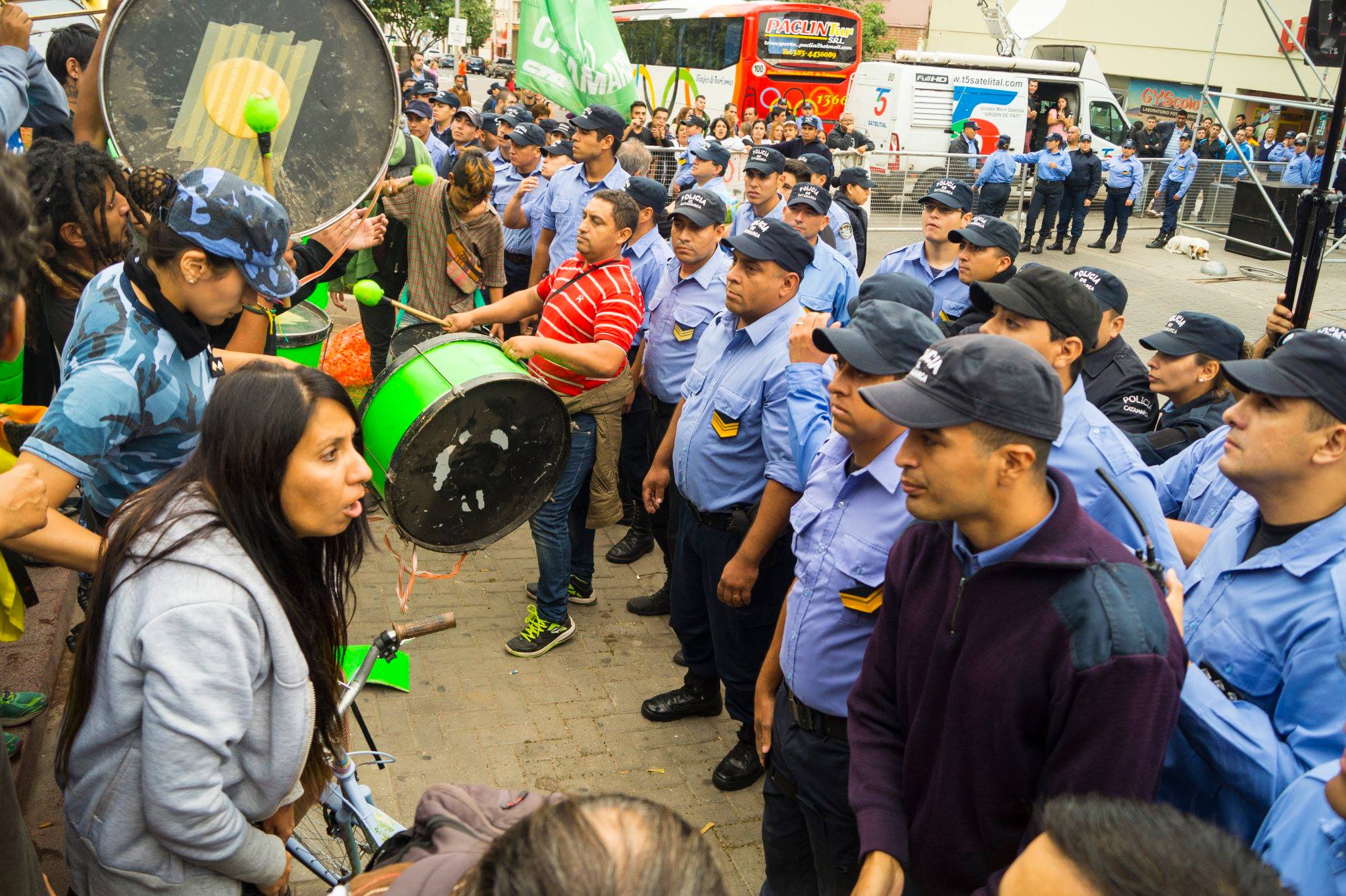
Hundreds have taken part in direct action. In 2012, they blocked two roads for 12 days, aiming to prevent supplies reaching a mine until they were finally stopped by the security forces. Dozens camped out close to the Supreme Court in Argentina’s capital of Buenos Aires in February 2016. In 2022, alongside another assembly, Aguas Claras, they established a resistance camp near the mine for several months. However in October, Carbonel alleged that “people paid by the mining corporation and safeguarded by the local police broke all the resistance camps; they took their tents and water tanks,” among other items.
Some in the assembly have painted protest murals in the town. One notable mural shows a group carrying the Whiphala flag representing the Indigenous peoples of the Andes — from what today make up Argentina, Bolivia, Chile, Colombia, Ecuador and Peru — with the words “Water for the people.”
As a result of this pressure, a law was passed to protect local glaciers from pollution close to the mine. And in 2016, Argentina’s Supreme Court said that mining activity in the area posed a threat to the environment and society, due to potential avalanches, landslides and contaminated water.
However, in December 2020 a provincial court ruled the 2016 Supreme Court ruling was “unconstitutional.” The court used the justification that the province does not have an environmental law to prevent mining operations, which meant that no rights were violated. Argentina’s constitution also upholds mines as “private property of the provinces which are able to grant concessions.” As such the assembly feared this would pave the way for “advanced exploration” and they began blocking trucks and machinery from reaching the mining project.
But security forces allowed the machinery to pass. There were a number of raids, and arrests were made after a demonstration at one of the gates to the mine. Farías said security forces used violent and heavy-handed tactics, evoking memories from Argentina’s dark chapter under “military occupation.”
“The advances of these businesses and these decarbonization projects and the corporate energy transition entails an ecocide in our territory.”
A draft resolution from Argentina’s chamber of deputies in 2021 condemned the provincial court’s ruling, arguing the company and governor were “in clear violation of national laws, court rulings … and municipal ordinances.” It said the Supreme Court’s initial ordinance was the result of the group’s campaign efforts and called for the “end to the harassment and persecution of neighbors and socio-environmental organizations that have been fighting for years in defense of the environment, health and life.”
“It has brought about a lot of pain,” Farías admitted, as the assembly has continued to resist.
In March 2022, five members of the organization marched 800 miles from Catamarca province to Buenos Aires, to pressure two courts to stop the exploratory advances of Minera Agua Rica-Alumbrera. They passed through different provinces on their walk. Along the way, they collected over 1,000 signatures for a petition to close the mine and uphold the 2016 ordinance. Once they arrived in Buenos Aires, they presented the petition to the Comodoro Py federal courthouse and the Supreme Court.
The group’s long-term goal is to prevent full mining operations from advancing in their region.
Lithium sacrifice zones
However, as governments across the world seek to transition to a zero-carbon energy sector by the second half of this century, many eyes are looking to lithium to drive the process forward.
Amid the country’s bleak economic crisis, President Fernández has called lithium mining a “key sector” in the country’s development, amid promises of “inclusive and sustainable development.”
Argentina, Bolivia and Chile are estimated to have 50 percent of the global lithium supply, and the three countries are pushing to fix lithium prices.
In early November, with Catamarca aiming to eventually produce lithium batteries, Argentina’s state-owned energy company YPF and Catarmarca’s government announced a technological cooperation agreement to drive the development and industrialization of lithium. Catamarca’s Gov. Raúl Jalil said “the sustainable use of mining resources is very important for the growth of our province.”
But environmentalists have concerns. “We understand that this ‘business transition’ can’t take us anywhere other than continuing to increase the ecological, economic and climate disaster that we’re going through,” explained Luciana Fernández, an anthropologist, teacher and mother of four children, who belongs to the Assembly of Ancasti for Life.

The assembly is resisting extractivist projects in Ancasti, and works alongside a number of assemblies tied to the Plurinational Observatory of Andean Salt Flats — an organization seeking to protect the region’s salt flats and other Andean ecosystems. They also work to safeguard Indigenous and other communities’ rights in the area.
Since 2002 Argentina has legally guaranteed citizen participation, institutionalizing mandatory consultation procedures or public hearings if activities generate significant negative effects on the environment. Argentine law must also guarantee citizen participation when assessing the environmental impact of projects. As a signatory to the Escazu Agreement, the first global legally binding instrument securing the rights of environmental defenders, the Argentine government has said it will establish “access to information, participation and justice in environmental matters.”
In 2017, there were rumors that local lithium exploration had begun, and Fernández said the authorities had not informed the community of this activity. “So we called a first assembly,” she said, describing the energy transition as “another green capitalist discourse to continue generating new products that get placed in the marketplace — all in the developed world.”
During her field work, Fernández said she saw “subsoil investigations,” the phase before mining begins, close to the homes of women weavers in Santa Gertrudis. “It was there that we realized that they weren’t rumors, but that they were looking for lithium.”
She described Argentina’s push for lithium as a “boom.” Alongside the assembly, she has campaigned against it — knocking door to door at people’s homes, and giving talks at schools and public squares.
With increased global demand for lithium batteries, Fernández said other minerals are needed such as copper, cobalt and rare-earth metals, which further drive extractivist activities.
“It generates a tremendous impact in these zones of sacrifice because they’re really areas that become devastated — both human life and non-human life stops existing,” she said. Water loss can’t be recovered, she added, impacting vegetation that carries out important ecosystem functions like carbon capture.
According to Amnesty International, “in South America, evidence points to lithium extraction posing risks to Indigenous peoples’ water resources and fragile ecosystems.”
“So we understand the advances of these businesses and these decarbonization projects and the corporate energy transition entails an ecocide in our territory,” Fernández said. “That impacts the planet and we cannot disconnect one part of the planet because it is all connected.”

In late October, these different movements came together at a festival in Andalgalá to show their solidarity, speak out publicly against perceived alliances between authorities and companies in the extractivist push, and demand machinery undertaking exploratory work be removed.
Fernández said such meetings allow the movements to “gain strength from each other,” explaining that the gathering allows them to coordinate strategies and to draw more people into the resistance.
While the main focus of the gathering centered on regional resistance, they also discussed other common causes that unite them. They agreed on the need to see a bill pushed through Congress to safeguard Argentina’s biodiverse wetlands region, which has stalled for 10 years, and the implementation of tougher environmental legislation.
Many also spoke about the surrender of their territories to multinational interests. Others denounced what they considered alleged human rights abuses by the state while defending land and water. They underscored the continued importance of raising awareness regarding the situation communities in the Argentina, Bolivia and Chile face in the “Lithium Triangle.” Fernández acknowledged that “the price of lithium is increasing and therefore the dangers are going to increase.”
ZNetwork is funded solely through the generosity of its readers.
Donate