

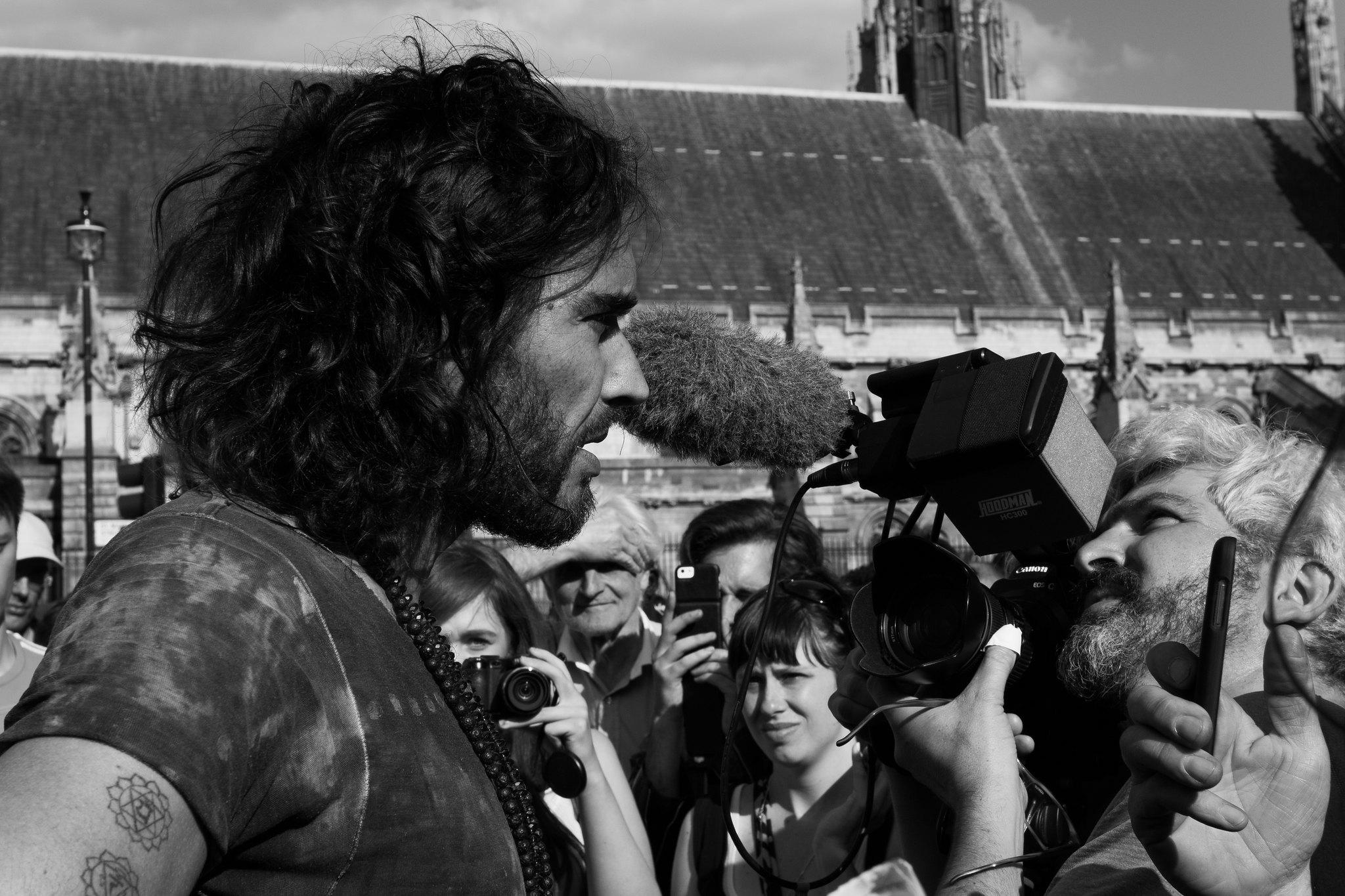
Russell Brand has taken a unique path to politics. He made his name as an actor in films like Forgetting Sarah Marshall and as a stand-up comedian. He soon grew disenchanted with the hollowness of Hollywood and started blogging on YouTube about politics and spirituality. For his over six million viewers, Brand has offered unsparing criticism of political elites who he has charged with increasing inequality and weakening democracy.
He has also been criticized giving air to anti-vaccine politics and conspiratorial views. Brand spoke to Jacobin editor-at-large David Sirota about the establishment, conspiracy theories, and whether we should move past the opposition between Left and Right. This transcript has been edited for length and clarity.
David Sirota
You’ve led a really eventful life with a career that has spanned all sorts of mediums. I think most people were probably introduced to you as an actor and a comedian in the early 2000s, in movies like Forgetting Sarah Marshall. Since then you’ve written books and articles, hosted podcasts and TV shows, and evolved into what some describe as kind of a thought leader — a free thinker with an online following of over six million people. What would you say your primary goal is with the work that you’re doing now?
Russell Brand
Our primary goal now is to help people recognize that old taxonomies of Left and Right, as we once understood them, are atrophying to a point of redundancy, and that there is a requirement for a new political discourse that includes an understanding of personal spirituality. But we’re further advanced down the pathway to materialism, individualism, and a kind-of unconscious tyranny than perhaps we realize; there is an obligation to question centralized media narratives and establishment ideals and interrogate them wherever we find them — to approach with humility complex subjects, recognizing that no one has a monopoly on truth, and to encourage new forms of alliances, whether that’s between people from previously divergent backgrounds and beliefs and ideals, or between previously disparate ideas, such as spirituality and politics. Our aim is to bring about a new populist reckoning, so that the establishment power has to be held to account by some genuinely new, rigorous voices.
David Sirota
How do you think we got to this place where everything is ramrodded into so-called Right and Left, and how have the old ideologies, as you call them, atrophied to the point of redundancy? When did that happen? What is responsible for that happening? And has it accelerated in the last few years?
Russell Brand
It has accelerated in the last few years. And, of course, there are so many ways that story could be told. The only version of it that I’m qualified to speculate on is the conflation between liberal ideals and traditional economic, financial, and corporate interests that probably began to accelerate around the administrations of Tony Blair in Britain and Bill Clinton in the United States. These developed as a repackaged neoliberalism that showcases ethical and moral issues while ultimately supporting the same kind of financial interests that conventionally would have been regarded as corporate and right-wing.
David Sirota
Let me ask about where we are today. It seems to me that there is a lot of questioning of establishment power out there. There’s clearly an appetite for people to not really believe what the establishment is selling. But there’s also this fear, and I think it’s a legit fear, that being rightly skeptical of what the establishment is saying can turn into being skeptical of anything that is a verifiable fact.
This is at the core of the whole debate over misinformation and so-called disinformation. If we’re aiming to get at the truth, in a lot of these debates, whether it’s about the pandemic, whether it’s about vaccines, whether it’s about how the economy should work or how it shouldn’t work . . . I don’t know where the middle ground is between not simply accepting what the establishment says and inadvertently tipping over into not accepting verifiable truths. How do you think about that push and pull?
Russell Brand
I feel that the obligation ultimately lies with the powerful. What I mean by that is this set of elite establishment interests that broadly coalesce around control of media, financial interests, and the state. Many of the arguments that are being advanced around misinformation and disinformation are an attempt to censor narratives that are adversarial to preferred centralized agenda-led narratives. Of course, not all of it is an attempt to shut down dissent and smear dissenting voices. I think there’s an overt attempt to conflate the more hysterical and baroque aspects of counter-establishment narratives with a more reasonable and inquiring argument.
But where do people draw the line? I don’t really know. Personally, my tendency is somewhat antiestablishment. And it always has been. That meant that, a few years ago, when I wrote that book, Revolution, I was kind of regarded as a febrile lefty and almost a communist. But it’s never clear whether we [critics of the establishment] are crossing the line or if the line crossed us at some point. Previously mainstream views started being regard as antiestablishment — started being associated with a totally different set of beliefs.
David Sirota
Let’s take an issue like climate change. You’ve got 99.9 percent of science from all over the world saying, “Yes, climate change is happening.” I’m only using climate change as an example. Yes, climate change is happening. Yes, humans have contributed to it, prompted it, etc., etc. There’s a small number of scientists that say “No, this is just natural.” There’s certainly variation among the majority of scientists about how severe the crisis will be; it’s hard to predict the future.
Most official establishment sources would say, “Yes, climate change is real. Yes, it is human caused.” But there has been an effort to draw attention to the 0.1 percent of scientists and use that to make claims about the uncertainty of future projections and say, “Aha! Climate change isn’t actually a big deal! It may not be human caused!”
Both things can be true at the same time. Yes, we don’t know exactly how intense it’s going to be, but yes, we can say with certainty that it is happening. I think the fear from folks who don’t want to see climate denialism affect policy is that you’ve got opportunistic folks out there, whether it’s within the oil and gas industry or anyone else who wants to take the small amount of uncertainty and blow it up into a justification for denial. You have an impulse from folks who feel like they’re standing with the science to try to suppress, or shadow ban, that kind of speech.
I’m not for suppressing free speech. But there’s this concern that the public isn’t mature enough, isn’t adult enough, if you will, to accept and to listen to both sides of the argument and get closer to the truth. And I can admit, I’m not sure the public is; I’m not sure we’re living in a society where we can deal with nuance. What do you think about all that? How do we deal with the fact that society has trouble processing any kind of nuance?
Russell Brand
I think the problem that you’re circling around is one of enormous distrust — I would say legitimate distrust — of the establishment. Whatever the issue, whether it’s the pandemic, the current conflict in Ukraine, climate change — take any one of a number of the issues that tend to determine the cycle of most news outlets. When it comes to policy, what interests me is, are the policies that are being proposed advantageous to a set of establishment elite interests or not? Elites never respond to these crises by insisting that there’s gonna be less opportunity for profit for Big Pharma, less opportunity for profit and power for Big Tech, and more ability for citizens to regulate by the state.
The barometer for where the truth is in this stuff should be: Are the solutions being proposed ultimately going to penalize ordinary people? Are they like, “Oh, we’re gonna have to impose this tax where ordinary people are gonna get taxed; we’re gonna have to introduce these measures where ordinary people are not going to be allowed to travel”? Or is the average person going to be alright?
We should respond to this by saying that we’re ending lobbying. We’re ending profits for these corporations that are monopolizing institutions. We’re nationalizing these municipal facilities, collectivizing them, making them democratic. We’re going to ensure that workers for Big Tech companies have the right to unionize, are encouraged to unionize, and have correct conditions.
David Sirota
How do we know how who to make common cause with or alliances with? Some have suggested in recent years that you’ve drifted to the right. Your show is on Rumble, which is the same platform that hosts some conservative folks. Why do you think critics say that? And do you ever worry that righteous opposition to the establishment can slip over into alliances with far-right movements that you don’t want to be a part of or that you don’t want to be affiliated with or that fuel an antidemocratic movement?
Russell Brand
I think we have to focus as best we can on outcomes and inclusivity. I know that things I believe in are the rights of ordinary workers to earn good money, the demonopolization of all corporate power; I believe in freedom of speech and freedom of expression. I think that you should be free to have a traditional lifestyle if that’s what you want or a progressive lifestyle. Increasingly, I think these barriers are falling away. When you get Noam Chomsky saying that Donald Trump is one of the only viable anti-war voices, when Tucker Carlson is one of the only people in the media that’s willing to talk about monopolization, you have a deep problem.
Those of us who have had affiliations with what was once known as the Left must acknowledge that the establishment is now using the aesthetics of liberalism in order to mask corruption. Bernie Sanders was right to go on Fox News and talk about Big Pharma. His doing that was inconceivable ten years ago, that a figure to the left of the center of the Democrat Party is appearing on what would have once been regarded as a right-wing outlet. Perhaps you still regard it as that — I don’t really care.
Look at the newly elected president Lula of Brazil: he just said stuff about [Ukrainian president Volodymyr] Zelensky that, if I were to say anywhere other than Rumble, I’d be a heretic. And I don’t really like the feeling of political vagrancy that’s been brought around, but I would rather be a vagrant than not be able to speak the truth. Those appear to be the options now. Frankly, I think that this is caused in part by the smearing of dissenters.
When we discuss Chris Smalls on our show, someone who’s heading up a unionization drive at Amazon, I do that because I believe that low-paid workers have the right to unionize. I’m against the collusion that’s taken place between the state and Big Tech and social media platforms during the last few years.
I may be wrong from a spiritual perspective; I’ve tried to continually recognize if I don’t know what I’m talking about. I just want to be open and stay connected to what are called Sesame Street values: kindness, compassion, openheartedness. And there is no advantage in cutting other people out of the debate. I know that my heart is about democracy, that I don’t know what’s right for you and your community in your family. And I don’t even know what’s right for myself, sometimes. What I want is the ability to assess information openly and not to sense continually that there’s a thumb on the scale, that the only information that we’re given is information that will lead to advantages for elites.
David Sirota
It seems to me that the effort and the ability to marginalize dissent is as powerful as ever. I don’t necessarily want to say it’s more powerful than it has been. There were obviously brutal efforts to suppress things like the civil rights movement and other social movements. But it seems to me, in this technological world we live in, the ability to censor and crush and marginalize dissent is as powerful as ever.
When you are out there, speaking undebatable truths about — let’s use what you just said, workers being crushed — that’s obviously happening. You’re out there, you’re talking about it. And because of who you are and what you’re saying, there is an effort to marginalize you, almost gaslight you, to portray you as some kind of crazy person. How do deal with that internally?
Russell Brand
I remember that, first and foremost, my beliefs are spiritual rather than political: my political beliefs are a reflection of my spirituality. I believe in God. I come from a background where I’ve experienced poverty, where I’ve experienced the addiction. I’ve been through this giddy carousel of fame and accessed its abundance, its voluptuousness, the saccharine treats that it offers you. In its own way, it’s sort of delightful, and it’s certainly distracting. But I’ve never forgotten — you can’t forget, it’s stitched into you — who you are and where you’re from.
When I witnessed the condemnation that took place during Brexit and Trump, something didn’t sound right to me, something didn’t feel right — the attempt to demonize and marginalize ordinary working people — to find critiques that would justify the silencing of those voices made me sick. I’m not politically adept enough to understand whether or not Brexit was the right thing to do, whether close ties with the European Union is economically advantageous for the majority of Britain. But what I do know is that I do not like to hear great swathes of the population have their interests condemned and neglected and their beliefs criticized.
The professional elite establishment decided that they don’t like working people and that they’re not willing anymore to stand up for their rights. And if that means demonizing them, and finding ways to say that their rights should be neglected, then so be it. So, I feel like a necessary component of being an effective voice is facing the ire of the establishment. And I know what I want, I know what my shortcomings are, I know that I can be vain and self-interested. But I also know that I care about people and that I’m willing to be of service and I’m willing to change, that I’m not so caught up in being right about this stuff that I’m not willing to be open. I don’t think that we should be contributing to the ongoing polarization that’s taking place. We have to move toward each other in a somewhat openhearted way.
In a sense, that’s happening culturally anyway, because of necessity. A few years ago, you wouldn’t have had Chomsky describing Trump as one of the only antiwar voices. You wouldn’t have had Bernie Sanders appearing on Fox News. Some people argue that the terms that we ought to be using today should be centralized authority versus peripheral dissent.
The problem facing voices of peripheral dissent is we often come with critiques and without solutions. Maybe the real problem is that we’re unwilling to face, at this point in history, that centralized authority, at this scale, is no longer tenable — that you can’t live in nations of 300 million people or 60 million people. Democracy ought to be as absolute as possible, and power ought be devolved. To live in a nation or on a planet means having to cohabitate with people whose views you do not share.
David Sirota
I remember when I worked on Bernie Sanders’s campaign, there was this uproar about his doing a town hall on Fox News. I remember working on the campaign and saying, “But he’s running for president of the whole country; he has to try to meet people where they are and talk to them where they are.” And I would say that not just about Bernie Sanders, I’d say that about any candidate running for any national office, and it was considered scandalous that he did it. But he did it anyway, and it actually was pretty successful. To your point, the idea that these labels [of Left and Right] have become tribal silos that are imposed on the on the public seem right.
I think, in a lot of ways, both sides try to create that frame and that frame is breaking down. I agree with you; I think that’s a good thing.
Russell Brand
I think what you’re saying became clear when Marianne Williamson, former Democratic candidate, came on my show. By the way, that was lovely. She came on our show, and she said that she felt that the Democrats would rather lose and have Trump than win and have Bernie. Do you think that’s true?
David Sirota
I would say that the folks who run the Democratic Party . . . I think if you ask them, would we rather lose the election to Donald Trump and have a fundraising juggernaut under a Trump presidency that we could play against, or would we rather have Bernie Sanders as president? Boy, that’s a tough call. I think there’s a lot of people who, in their heart of hearts — maybe they wouldn’t come out and say it — would rather have had Donald Trump.
It’s better for them in the short term, even in the medium term, because they understand that Bernie Sanders and whatever he represents is a threat, not only to the sort of broad, large establishment, but to the political consulting class. He represents a threat to the lobbying class; he represents a threat to the Washington swamp.
Again, I want to underscore it’s not just him as an individual, it’s what he represents. And I think Marianne Williamson isn’t necessarily wrong.
Now, I don’t think the people at the top of the Democratic Party will come out and admit that. They will act that way, indeed, but they won’t actually come out and say that. That’s the subterfuge of Democratic politics, writ large. The Democratic Party is very good at issuing press releases and saying that it really supports workers, while not actually supporting workers. It’s part of this bait and switch. Frankly, I think a lot of people across the country are recognizing that bait and switch.
The ultimate issue here is that the Democrats right now are in a position where they can rely on playing off of Republican extremism. The Republican Party is like a circus at this point — it’s a total freak show. So, I think the top of the Democratic Party, in a certain sense, at least for now, is more powerful than its ever been in controlling its party, because they’ve got such an extreme Republican Party to play off against. I’m sitting here as a person who’s reported on this for a long time and saying, if the only options are a bait-and-switch Democratic Party and an extremist Republican Party, where’s the place for everybody else, for regular people who think, who don’t want to live in an economic dystopia, who don’t want to live in a corporate-establishment-run country and society?
Russell Brand
I think we have to create a new political movement. You’re not gonna have so many people flocking to the periphery of any political movement, if they feel they have a home somewhere in the center. I believe we have to create a new political movement that is perhaps international and certainly decentralized, that represents exactly the class of people that you’re describing.
If you remember the hysteria that surrounded the election of Joe Biden on the Left, it was as if some geriatric messiah had risen like Lazarus from the grave to save us all. But Biden ended up appointing people with ties to Big Pharma. How can Biden be what you’re offering and, at the same time, you’re saying we beat Big Pharma this year, and then expect people to argue that liberal democracy is working?
We know that if we were to ban lobbying, if we were to ban members of Congress from owning stocks and shares in the in the companies that they regulate, we would see a completely new configuration that will change the political class forever. Why are these ideas not being offered to the electorate? We know why. Because that will change things.
I don’t want to be reductive. But one of the things that I picked up as a kid was, if voting changed anything, they’d ban it. When I said publicly, “What’s the point in voting?” the reformists came out and said, “It might be a small gap, but millions of people live and die in that gap.” We’ve seen what that leads to now: it leads to the rise of demagoguery.
ZNetwork is funded solely through the generosity of its readers.
Donate

