

The projects have sparked renewed civic engagement in rural areas and small towns—stories that inspire David and Goliath comparisons. Residents ignite with fury upon finding out their local elected officials have made deals in the dark to bring data centers to town. They come out in force to city council meetings, zoning hearings, and protests in an effort to confront the power of major utility companies and multinational tech corporations with billions of dollars at their disposal.
This growing opposition has forced Michigan’s elected officials to reconsider the wisdom of the state’s 2024 decision to hand out tax breaks to data center constructors.
Abdul El-Sayed, an epidemiologist and former Wayne County public health official running in the August 4 Democratic primary for U.S. Senate, tells Barn Raiser that the corporations building data centers aren’t straightforward about their development plans.
“There’s been so little transparency on the part of the corporations themselves and the part of the utilities,” he says. “It has raised the hackles of folks who’ve learned not to trust a lot of these bigger corporations when they tell them everything’s going to be okay.”
El-Sayed is locked in a fierce contest that has accentuated divides within the Democratic Party. El-Sayed, whose parents immigrated from Egypt, has pledged not to accept corporate PAC money, has called for eliminating arms sales to Israel and supports universal health care and abolishing Immigration and Customs Enforcement (ICE). Haley Stevens (D-Mich.-11) is a vocal supporter of Israel who has accepted money from corporate PACs, outside groups like the American Israel Public Affairs Committee (AIPAC) and has the support of party leader Sen. Chuck Schumer (D-N.Y.). Michigan state Sen. Mallory McMorrow, a third challenger in the race, suspended her campaign July 5.
An April Emerson College poll shows data centers could be among the deciding issues in the election. Emerson’s poll of 519 likely Michigan primary voters found that a majority, or 55%, opposed data centers being built in or near their community, versus 27% who supported them. Opposition to data centers was much higher among likely Democratic primary voters, with 63% opposed versus 45% among likely Republican primary voters.
Dark money spending and support for Israel remains another flashpoint in the campaign, gaining national attention. The Associated Press reported AIPAC and its affiliated groups have spent close to $30 million backing Stevens, which is their largest investment ever in a single race.
In January, El-Sayed released a terms of engagement proposal for data centers, which includes a guarantee for local jobs, a freeze on consumer electricity rate hikes and community benefit agreements. In recent weeks, he has shown support for a system of federal oversight and public ownership of AI companies, a proposal first advanced by Sen. Bernie Sanders (I-Vt.), who has endorsed El-Sayed.
Stevens has not laid out any similar positions. At a Democratic primary debate in July, Stevens connected data center construction with job creation, saying it will put Michigan “on the forefront of innovation and manufacturing,” but she has also called for protecting Michiganders from data center costs.
In an email statement to Barn Raiser, Stevens wrote, “when it comes to data centers and AI infrastructure, my top priority is making sure costs don’t go up for Michigan families and that we are protecting good-paying union jobs. We cannot allow utility companies like DTE to pass new costs onto consumers while these projects move forward.”
Stevens did not answer Barn Raiser’s question regarding Michigan residents’ concern about AI potentially resulting in less jobs.
“ Part of the problem with our politics is too often corporations are buying and selling politicians in the first place. In the case of DTE, our local utility, they’ve given to 93% of state legislators,” says El-Sayed, referencing McMorrow, who eventually dropped out. DTE was McMorrow’s top donor in her 2022 state Senate reelection campaign. El-Sayed’s current opponent, Stevens, has received money from DTE since her first U.S. House reelection campaign in 2020.
McMorrow was among the 38 state senators to vote for a Senate bill that exempted hyperscale data centers from sales and use taxes on their equipment. The bill was signed into law by Gov. Gretchen Whitmer (D) in 2025.
In hindsight, El-Sayed says a more extensive review process should have occurred before state legislators approved laws to entice data center development in the state.
“I think we should have spent a bit more time to hold the particular utilities accountable ahead of laying out the red carpet, as our state has done,” he says.
Data centers have split support amongst unions and their endorsements. The United Auto Workers (UAW), which has over 400,000 members nationwide, endorsed El-Sayed in June. In an April press conference with Bernie Sanders and other labor leaders, UAW president Shawn Fain compared AI to NAFTA because of the risks it poses to workers and communities. “The same greedy corporate power brokers today want us to believe that killing millions of jobs in the name of AI will be a good thing, and the working class knows better,” he said. Several of the building trades unions, on the other hand, view data centers as a catalyst for job creation, with many, including Plumbers Local 98 and Pipefitters, Steamfitters, Refrigeration & Air Conditioning Service Local Union 636, having endorsed Stevens.
Michigan’s chapter of the AFL-CIO, the nation’s largest federation of labor unions, has not made an endorsement in the Senate race. In June, the AFL-CIO released a policy agenda for the next five years. It included demands that data centers and AI infrastructure be “built by and run on union labor,” while requiring that “data centers pay their fair share of costs and taxes” and that working-class families and communities “are protected and included every step of the way, including regulations over water and power use.”
Construction workers may be the only local residents who stand to benefit from the data center boom. A Citizens Research Council of Michigan report on data centers found that the economic benefits of data centers largely occur during the construction phase and concluded that the projects aren’t long-term drivers of economic development. In June, Bloomberg reported that data centers account for 2.3% of all construction spending in the United States.
In a July debate, El-Sayed and Stevens clashed over their approaches to AI and data centers. El-Sayed reiterated his community engagement plan and added, “I think we have to be serious about the fact that these pose real dangers,” he said. “And the people who are pushing them are the richest, most powerful corporate CEOs in the history of our economy.”
Stevens did not speak directly to citizens’ concerns about AI but pledged to entice data centers to pay for utilities and rate increases. “I also want to secure Michigan being on the forefront of innovation,” she said in a statement to Barn Raiser.
Michigan state Rep. Dylan Wegela (D-Garden City) voted against the tax breaks for data centers when the Michigan House of Representatives voted on the bill in 2023. Wegela had concerns about the environmental impact of data centers from the beginning, he says, but hadn’t anticipated the magnitude of the pushback against using hyperscale facilities to drive AI developments.
“I think there are a lot of concerns with that industry right now and concerns about what the technology, unregulated as it is now, might do to working-class people,” Wegela says. “And I think that is one of the many reasons this is becoming so controversial now.”
For Wegela, data centers are an issue that unites people across party lines. “In areas that these data centers are coming to, you have these coalitions of people on the left and the right coming out to fight together against data centers,” he says. “That’s working class versus Big Tech.”
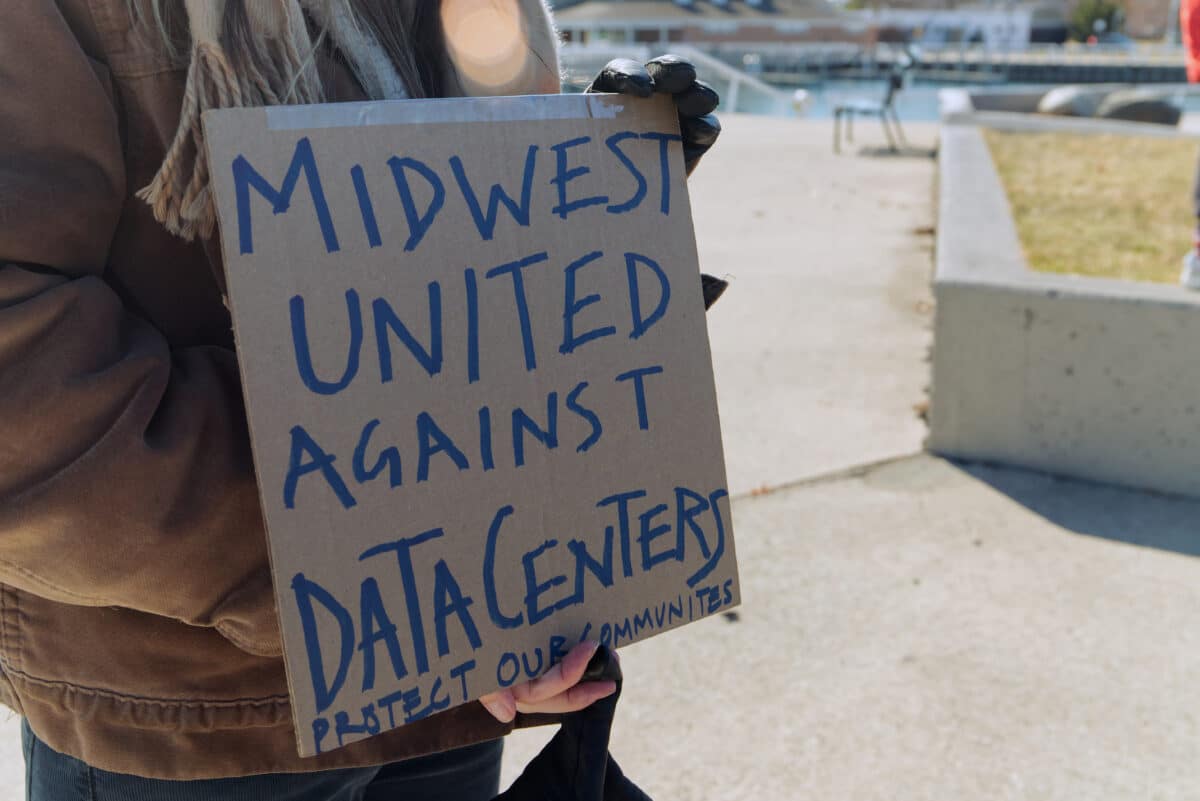
That coalition of residents was on display on a sunny Saturday morning in Traverse City, Michigan. About 40 protesters showed up to oppose data center construction across Michigan, one of several anti-data center protests that took place across the state on April 11. At the Traverse City protest, attendees brought signs decrying data centers and signs in support of Lake Michigan’s freshwater supply. Speakers voiced their opposition to AI in schools and expressed skepticism about the number of local jobs that data centers would generate.
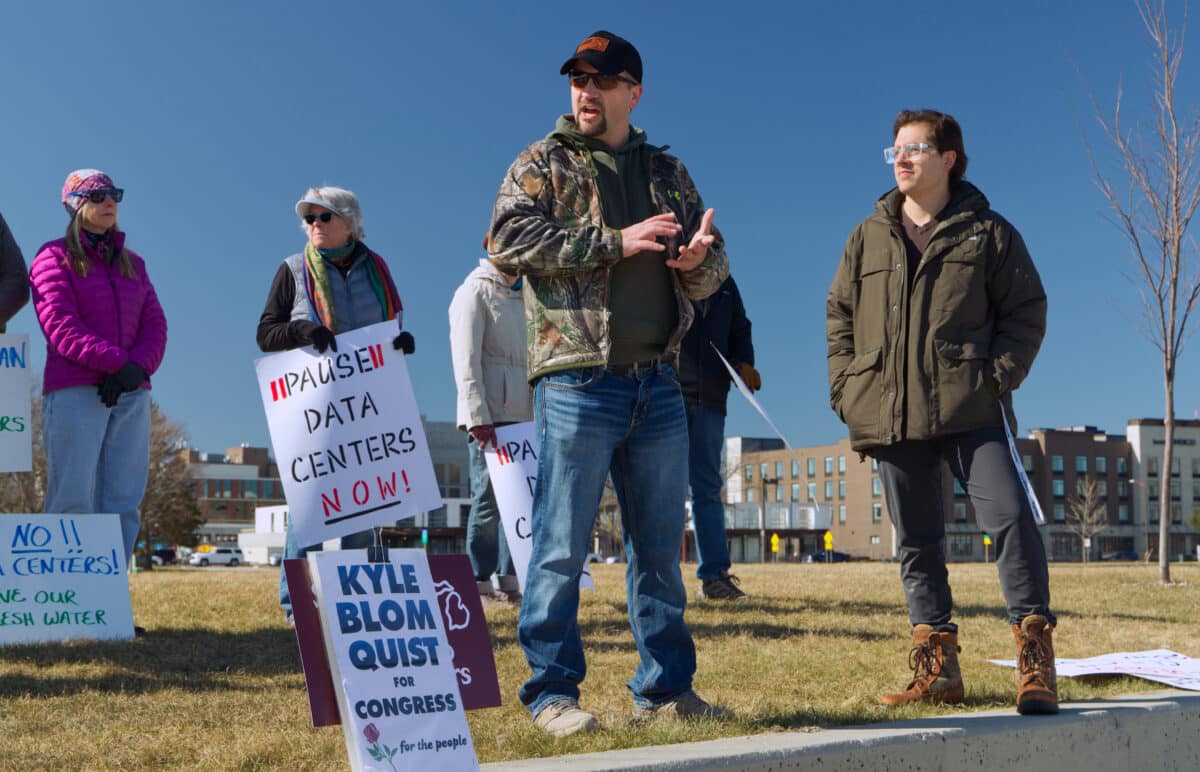
Ryan Wagner, the Kalkaska County GOP party chair, appeared alongside Mitch Distin, who helped organize the protest and is running as a Democrat for state representative in Michigan’s 104th district.
Wagner voiced his discontent with the Make America Great Again movement after continuous campaign promises broken by the Trump administration, like financial gain for working-class Americans, and he found common ground with Democrats seeking to maintain natural resources and oppose AI companies. “I feed my kids off this land. I don’t want Big Tech to poison it,” Wagner told the crowd.
In November, a company called Rocklocker—a subsidiary of oil and gas company Reefworks—proposed building a data center in rural Kalkaska County, just east of Traverse City, on 1,440 acres of land owned by the Michigan Department of Natural Resources. But community backlash was fierce. At meetings to discuss the proposal, residents didn’t buy the economic benefits claimed by Rocklocker and they were wary of the environmental impact.
“The scientific literature is abundantly clear that none of the benefits are distributed or trickle down to local communities, they’re the ones who ultimately pay the price for data centers,” Distin told the protestors. “The only people who are benefiting from this are big tech CEOs and the legislators.”
If a data center is abandoned by a company, it’s unclear who will be responsible to pick up the pieces. “What happens if the company goes bankrupt?” says Wegela. “You’ve seen factories across the state for the automotive industry and cities have been on the hook for cleaning those up or maintaining those. And I just think these are things that aren’t being talked about enough.”
“Democrats should be leading the opposition to unchecked data center growth,” says Michelle Deatrick, chair of the DNC Climate Council. “That’s not because we oppose technology, it’s because we believe growth needs to serve the public interest, it needs to serve the people, and that’s in both the short and the long term.”
One tactic used by local organizers has been to implement moratoriums. For instance, residents in Livingston County, north of Detroit, successfully pushed Howell Township to approve a six-month moratorium on data center projects, including the $1 billion, 1,077-acre data center proposed backed by Meta, which owns Facebook.
Michigan State Representative Jennifer Wortz, a Republican in the 35th District, introduced a bill in February that would place a moratorium on data center construction across the state until April 2027.
Towns, counties, cities and states across the country are deciding how to respond. An analysis from The Information, an online news source, found more than 300 bans or moratoriums across the United States. (Datacenterbans.com has an interactive map and updates a tracker on data center policy around the country.) On July 14, New York enacted the nation’s first statewide one-year moratorium on data center construction following an executive order signed by Gov. Kathy Hochul (D). Maine nearly became the first state to do so in April, when the state legislature passed a moratorium, but Gov. Janet Mills (D) vetoed the bill.
As communities sour on data center projects, they’re also turning away from AI. A Quinnipiac University poll from March 2026 found that 81% of millennials were concerned about AI. The poll also found that 55% of Americans believe AI will do more harm than good, up from 44% in April 2025.
“ I don’t know if everybody in the public space has connected that the data center and the AI fight is one and the same,” says Wegela.
In the workplace, AI is meeting resistance. Futurism reported that some workers are intentionally sabotaging their employer’s AI deployments. Fears over the direction of AI are also turning violent. In April, a Houston man traveled to San Francisco and hurled a Molotov cocktail at OpenAI CEO Sam Altman’s house.
“The fear and anxiety about AI is justified,” Altman wrote on his blog in the wake of the attack. “We are in the process of witnessing the largest change to society in a long time, and perhaps ever.”
Kyle Blomquist, an architect running for Congress in Michigan’s rural 1st congressional district, says the data center tax breaks handed out by Michigan should be repealed. “I’m surprised by the fact that our state has decided to incentivize the location of data centers in the state through these various different tax abatement programs and cuts,” says Blomquist.
When Michigan first legalized medical marijuana, local governments had to set ordinances about marijuana store zoning before any business was allowed to set up shop. Blomquist says he would have liked to see a similar process play out with data centers.
Instead, the Wild West of data center growth has exposed a need for towns and counties to update their zoning ordinances. Many of the towns where data centers have been proposed have never had such large developments set up shop before.
“ I would’ve liked more caution with the data centers, more along those lines where you give the communities the opportunity to set their own conditions as to whether or not they want them located there at all,” says Blomquist. “Instead, it’s kind of a free-for-all.”
This story was supported by a grant from the Lumpkin Family Foundation.
ZNetwork is funded solely through the generosity of its readers.
Donate

