
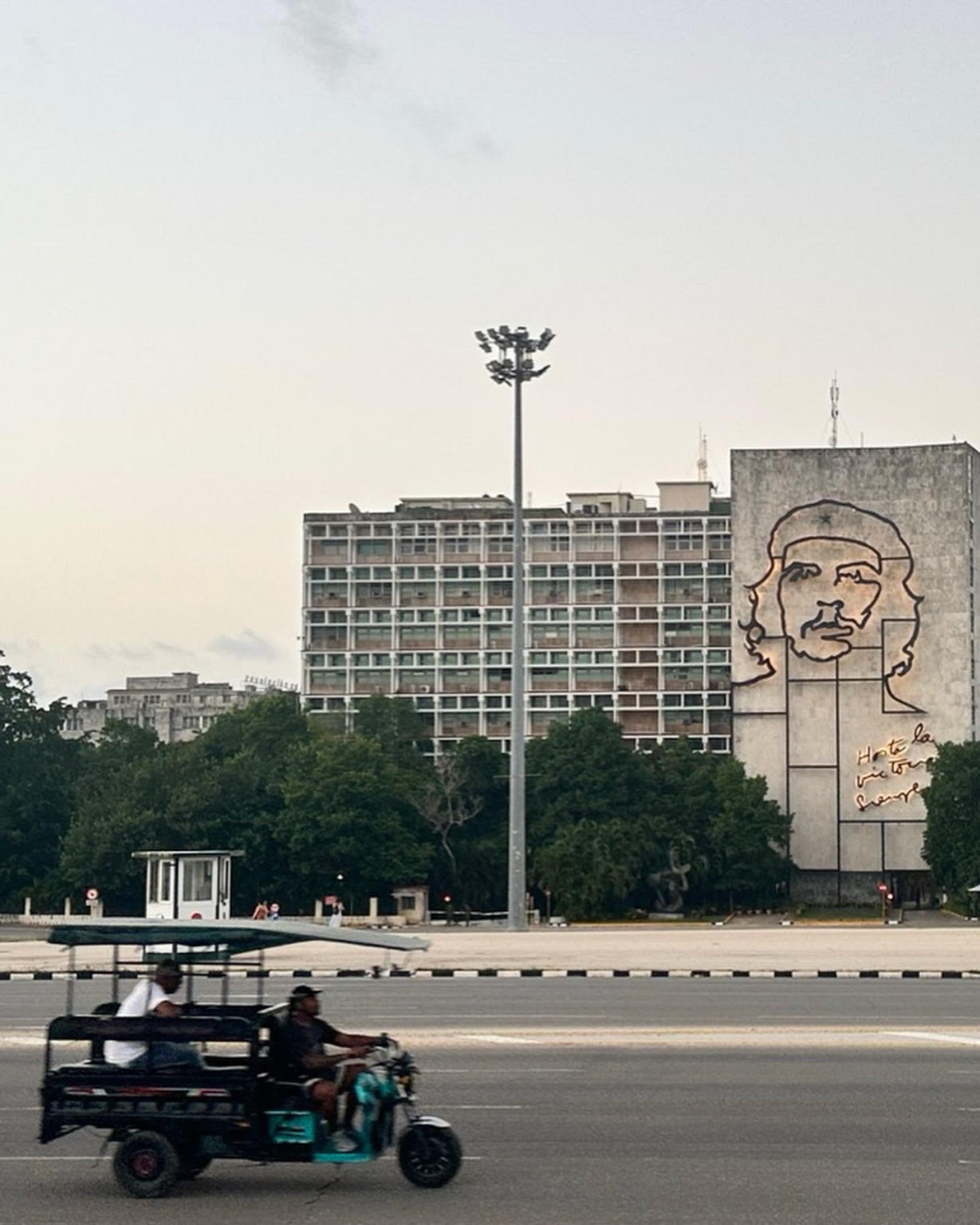
Despite centuries of colonial domination and the subsequent US blockade, Cuba has achieved great things, guided by anti-imperialism, revolutionary internationalism and solidarity among peoples. Today, as it faces one of the darkest periods in its history, it is time to stand with Cuba and give back everything it has given the world.
Today the very existence of beautiful Cuba is being radically put at stake, a country whose magnificent history has given the world invaluable gifts.
Cuba has given its body and blood to the struggles for independence and liberation of many peoples, from Angola, Namibia and South Africa to the Congo and Guinea-Bissau. It has placed its boundless solidarity, grounded in the internationalism of its Revolution, at the service of the most vulnerable. It has sent doctors and health cooperation to Nicaragua, Venezuela, Mozambique, Brazil, Mexico and Haiti. It has received and treated, free of charge, thousands of children affected by the Chernobyl nuclear disaster. It has helped fight blindness through Operation Miracle and confronted Ebola in West Africa. Over more than six decades, it has sent medical brigades to 165 countries, with the participation of more than 600,000 health workers.
Even towards the country that has spent decades trying to destroy it, Cuba responded with solidarity. After Hurricane Katrina in 2005, it offered to send the United States more than 1,500 doctors to care for the victims. Naturally, the empire, in its immense self-worship, rejected the help.
Even while going through one of the hardest and darkest periods in its history, comparable even to the so-called Special Period that followed the collapse of the Soviet Union, just a few months ago Cuba once again gave its body and blood beyond its borders. During the US attack on Venezuela and the kidnapping of President Nicolás Maduro, 32 Cubans lost their lives while carrying out security and defence missions in that country.
Cuban internationalism draws on two great legacies. One is the humanist, sovereign and anti-imperialist thought of José Martí, for whom “Homeland is humanity”. The other is the revolutionary and proletarian internationalism of the Marxist tradition, grounded in solidarity among peoples.
The Cuban Revolution, with Fidel, turned both traditions into a concrete and permanent practice. Cuba is perhaps one of the most powerful examples of this thought put into action, something so deeply needed in our time.
What country managed, in barely a year, to virtually eradicate illiteracy and make education and knowledge a right, so that the child of a peasant or a worker could reach university and become a doctor, scientist, artist or professional?
What country made health a universal right and, as a small Caribbean island, was able to develop an extraordinary scientific and biotechnology industry, create its own vaccines and achieve internationally recognised health outcomes?
What country in Latin America has reached such heights in sport, training generations of athletes able to compete with the great powers and accumulating 244 Olympic medals, 86 of them gold?
What country, subjected for generations to a blockade designed to suffocate it, continues to defend knowledge and culture as the rights of its people? It sustains schools, universities, libraries and book fairs that, even in the midst of a devastating crisis, continue to carry millions of books across the entire country.
What country had the audacity to carry out a Revolution to transform its society at the root and to challenge, through its example, the great US empire?
Those who do not know the greatness of Cuba, of its people and of its Revolution are missing an extraordinary historical epic: the struggle of a people to win and defend its sovereignty against immensely superior powers.
Those who regard Cuba with suspicion perhaps fail to grasp what it means to have lived for centuries under colonial rule, subjected to foreign interests, exploited and denied the right to decide one’s own destiny. Until one day Cuba rose up.
And it did not rise up only to win its independence. It dared to imagine that it could build another path, profoundly transforming structures of exploitation and racial segregation. Inherited from centuries of slavery and colonialism, those structures had kept the Afro-Cuban population subjected to deep social and economic discrimination. Therein lies a fundamental part of its audacity.
Located barely 150 kilometres from the coast of the United States, Cuba decided to transform its society from the root and to defend its right to do so against the most powerful nation in the world. Its Revolution rose as a cry in defence of its sovereignty and as a hope for all those seeking to free themselves from colonial and imperial domination.
That is why they feared Cuba, and fear it still. Not for its economic or military power, but for the force of its example: because it showed that a nation could rebel against Goliath and build another kind of society.
For more than six decades they have not let Cuba breathe. From the very first day of the Revolution’s triumph, Cuba has paid dearly for its decision not to bow down. That has been its great “crime”: daring to decide for itself.
The United States has subjected Cuba to an economic, commercial and financial blockade that constitutes the longest-running system of unilateral coercive measures in contemporary history. It is not simply, as we are so often led to believe, that the United States has decided not to trade with Cuba. The blockade’s reach extends far beyond US borders.
The blockade pursues financial transactions, hinders Cuba’s access to international credit, and obstructs the purchase of essential goods, fuel and spare parts. It reaches even banks and companies in third countries that maintain legitimate commercial relations with the island. Its extraterritorial character turns a US decision into a mechanism of pressure over much of the international economic system.
In 2026, this policy of asphyxiation has intensified even further in the energy sphere. The United States established a mechanism to impose tariffs on countries that supply oil to Cuba, deepening an energy crisis that cuts across every aspect of life on the island.
We are not speaking of a geopolitical abstraction, but of human lives. We are speaking of families subjected to blackouts that can last for days, and of communities that have gone months without electricity. We are speaking of hospitals in need of energy, medicines and technology. And we are speaking of an ever-deepening food crisis, in which there is not enough food to meet the population’s needs, and in which the thousands of tonnes of food aid sent by countries such as Mexico and China remain insufficient.
Among many other things, it is this growing food insecurity that makes this blockade an utterly criminal blockade, for its consequences fall directly on the life of an entire people.
By what right can a foreign power subject another people to such strangulation because it does not accept the political system that people chose to build?
The future of Cuba is for Cubans to decide. They will have to debate their government, their institutions and the country they wish to build. No one else.
The United States has no right to use hunger, energy, trade and financial power as instruments to impose its own idea of democracy on another people. First end the blockade; then Cubans will be able to debate what future they want. But it must be a future that honours their own history, not the history others seek to impose on them.
It is profoundly dishonest to judge Cuba, its government, its state and its history as if it had been able to develop under normal conditions. And of course there have been mistakes. What country, what government, what people does not make them when trying to build its own path? Again and again Cuba is presented as a “failed state”. But how can a nation fully flourish when it has been subjected for generations to such economic, commercial, financial and energy pressure? How can its shortages be held up as proof of its failure while the very conditions designed to produce them are kept in place? How can anyone speak of freedom while punishing an entire people for exercising theirs?
Cuba’s history cannot be judged by the standards of so-called Western democracy while it is denied one of the most elementary principles of any democracy: the right to self-determination.
If everything Cuba has given the world has been great and generous even under these conditions, we will never know how far it might have gone without the weight of a blockade that has brutally limited its possibilities for development. Let it live. Let it breathe. Let it build, make mistakes, transform itself and decide for itself. But let it do so in freedom.
Cuba is going through one of the most painful and difficult moments in its history. Without food on the plate there can be no Revolution. If the material conditions that sustain life are not effectively transformed, the social gains won by the Revolution will hardly be able to survive.
People are hungry. They are tired of resisting. Inflation hits families and shortages pervade everyday life. We cannot romanticise suffering or ask a people to live forever on its heroic memory. The Revolution must also be able to sustain itself in the concrete lives of its people. But surrendering would mean renouncing a history built with enormous sacrifice and abandoning a struggle of generations. It would mean allowing the strangulation imposed from outside to finally determine Cuba’s destiny.
The legacy of the Revolution and of Fidel is today a compass for a time in which nations are once again attacked, assaulted and subjugated. The struggle for sovereignty is once again essential. It is essential not only for Cuba but for the rest of the world and, above all, for Nuestra América, Our America, as Martí called it.
The dream of Martí and Bolívar has yet to be fulfilled. We still face the task of building a truly sovereign Latin America, capable of deciding its own destiny and of freeing itself, once and for all, from the imperialist domination that seeks to subjugate it, strangle it, seize its resources and crush its peoples.
Enough of the ongoing plunder of the Global South, of colonial and neocolonial domination! Fidel said it with extraordinary lucidity more than six decades ago: “Let the philosophy of plunder disappear, and the philosophy of war will have disappeared!”
How much we need that courage today, and how much we need leaders capable of naming injustice head-on: without calculation, without euphemism and without fear of the political consequences of doing so.
Fidel did so in defence of oppressed peoples and, among so many other examples, in the case of Palestine. In 1979 he denounced before the United Nations the “dispossession, persecution and genocide” of the Palestinian people. For Fidel, internationalist solidarity was not a slogan but a way of understanding the Revolution and humanity. Perhaps that is why his thought is so necessary at this moment.
Today more than ever, all revolutionaries, all humanists, all of us who defend humanity have a duty to place our thought and our action at the service of this struggle. We must stand shoulder to shoulder in defence of Cuba and let the Cuban people know that they are not alone and that we will not abandon them.
It is our duty to return to Cuba the invaluable solidarity it has given the world for so many decades. With the strength of our hearts and of our unity, from different corners of the planet, we will fight together to end the criminal blockade imposed on this free and sovereign land.
In times when humanity’s most elementary values are in decline, the Cuban Revolution is an example of courage, dignity and resistance. Its flame of solidarity and its great lesson will remain alive, inspiring the consciences of all who defend the dignified struggle of peoples for their freedom.
Cuba is not alone. We will be there to protect its noble heart and to stand beside its people. Because Cuba has no intention whatsoever of being a US colony, but a free and sovereign island.
Beloved Cuba, may your people and your struggle continue to inspire humanity. May you always be a beacon for Latin America and for the world, for the liberation and peace of all peoples.
This essay was first published in Spanish by Diario Red on 21 September 2026 under the title “Cuba o la osadía por la libertad”.
ZNetwork is funded solely through the generosity of its readers.
Donate