

Politics is wearying. The constant parade of outrages in the news can have the effect of collapsing your personal beliefs into a series of reactions, a big cloud of affirmation or anger tied to specific people, policies, and events. This is the deluge that grinds concerned citizens down into mere red-or-blue party voters; without some other ideological anchor for our politics, people understandably latch on to parties to prevent being overwhelmed.
The problem is that this is a bad way to interpret reality. I write often about America’s overarching crisis of economic inequality, and how it was enabled by a decline in worker power, and how unions are vital as the tool to turn that around. But even that risks getting coded as just one more Good Thing, to be tossed up on our political mood boards next to Saving the Whales and Energy Efficient Motor Vehicles.
For Labor Day, I want to try to put a finer point on it. All of that stuff is embedded in an even bigger, more fundamental political dynamic that you can use to guide almost your entire ideological life.
Most people work for a living, one way or another. A smaller segment of people live off of the proceeds of ownership—of stocks, of businesses, of investments of all types. Every dollar of profit that every business makes ultimately accrues to either the people who do the work (labor), or the people who own the place, including shareholders (capital). For decades now, capital has been taking a bigger and bigger piece of the pie. Capital seeks, always, to first protect itself, and then to grow. It is winning this zero sum game. Labor is getting less. Capital is getting more. Almost all other political and economic and social trends that you care about are driven by this. Assuming you are a progressive, everything you want is downstream of reversing this trend.
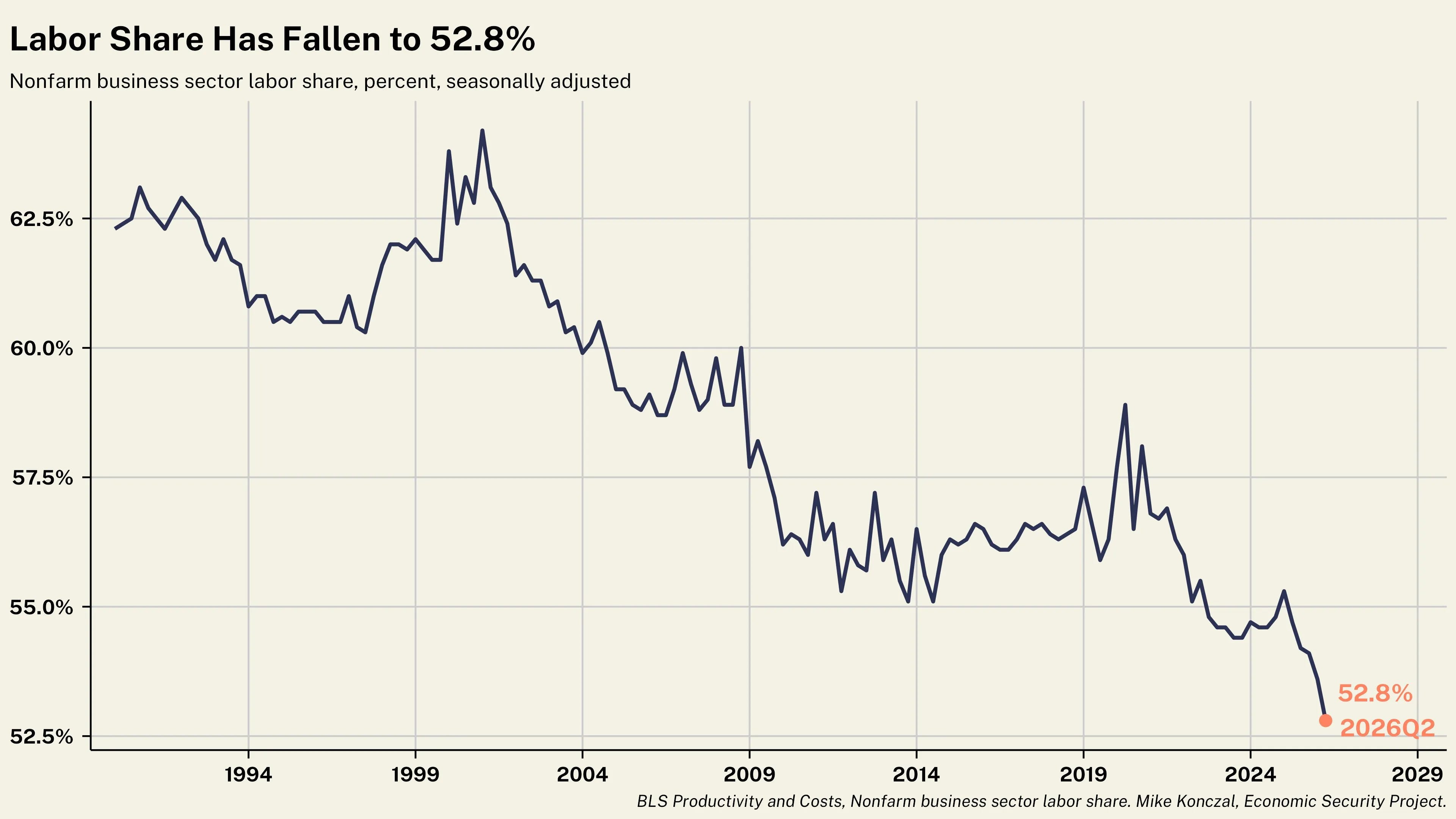
“The labor share, which is the percentage of output that accrues to workers in the form of compensation, was 52.8 percent in the second quarter of 2026, the lowest level in the series, which begins in the first quarter of 1947,” the Bureau of Labor Statistics reported this week. Here is a chart from the economist Mike Konczal:
Here is a longer term chart of the same measurement dating back to 1947, from a recent INET report:
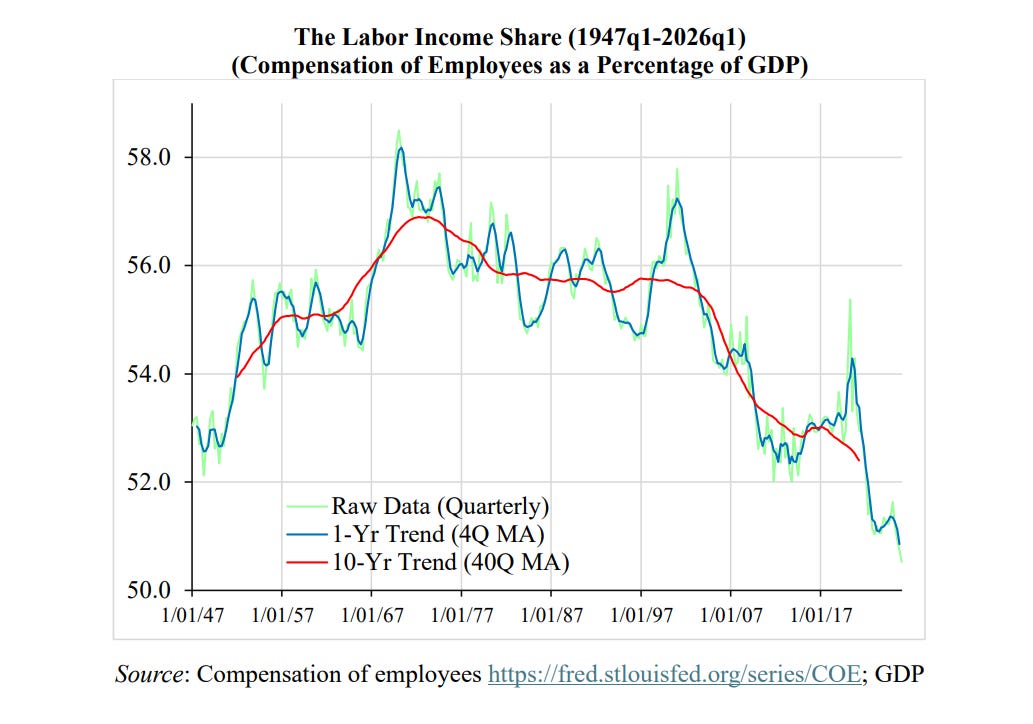
The red line, a ten-year average which smooths out short term ups and downs, is particularly clear.
Here is a chart of the S&P 500, the most common index of large US stocks, showing a cumulative 43,607% increase since 1985:
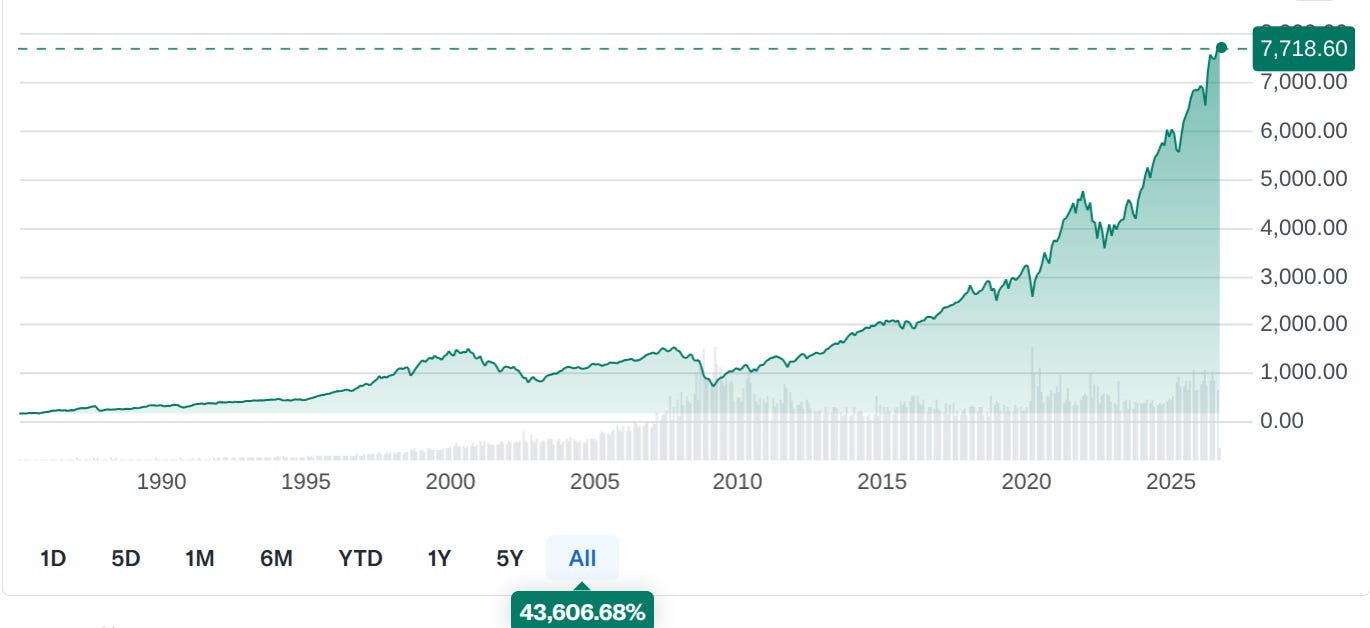
The corporate profits that play the largest part in driving stock price increases are the money that is left over after all expenses—including labor costs—are paid. “Labor costs” are what corporations call the wages that you earn to live. Have wages increased in tandem with corporate stock prices?
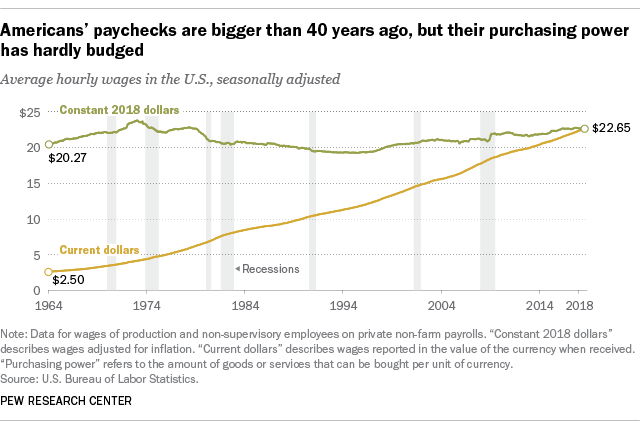
They have not. That is a trick question. One of the reasons that stock prices have soared is because companies have successfully been able to prevent wages from rising in tandem with profits. By doing so, companies are able to reserve most of the increasing profits for the ownership class, which can be thought of as everyone who owns the stock. The declining power of unions (which means fewer workers can collectively bargain and strike) since the middle of the 20th century, which I blah blah about so much, is a primary contributor to the lack of bargaining power that workers have that has therefore allowed companies to keep more of their own profits. Here, also from INET, is another view on that:
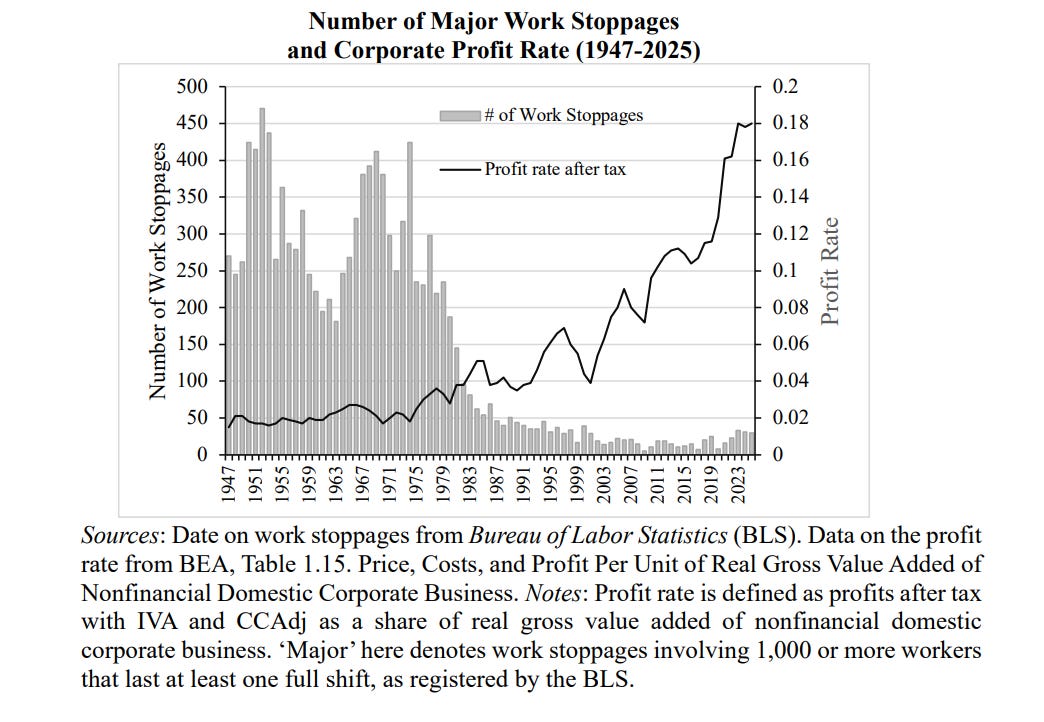
We are all mad at the billionaires and whatnot but let’s be very clear about the mechanism driving all of this: American companies are making more money than ever and they don’t have to share it because workers don’t have the power to claim their fair share, and because some of the money has been used to purchase political influence to prevent the government from stepping in, and so therefore the money accrues to the owners, which is to say, to the rich. The richest ten percent of Americans own close to 90% of America’s stock market wealth.
This isn’t too hard to understand. I obviously didn’t invent this analysis—this is just grade school Marxism. But to reach these conclusions you don’t need to read any theory or know any buzzwords. You just need COMMON SENSE. All the money that businesses make will go either to the workers or to the owners. The goal of capital, of businesses, the logic of capitalism itself, is for businesses to try to take as close to 100% of the profits as possible for themselves. (Indeed, an amusing new economics paper shows that going to business schools causes managers to pursue exactly this mandate). This is the nature of a corporation. It will always do it, just like a fire will always want to burn. Our problem is that we have not kept corporations properly contained. So, like fire, they will consume everything.
It is far more accurate, more useful, and more true to understand politics as a battleground between capital and labor than as some sort of Democratic vs. Republican thing. Politics is just another arena for capital to organize in order to maximize its own growth. This is why it is so frustrating to be a person who assumes that voting the correct way will result in properly regulated capital. No. Labor, which is to say working people collectively, is the opposite force that can check the power of capital. The politicians just end up as tools of one or the other. A marked increase in union density would result in more political power for working people in the same way that increasing corporate profits result in more political power for capital.
My point, my very unoriginal point, is that you will do your own thinking and your own political outlook a great favor by seeing America as a power struggle between capital and labor, which capital has been winning for the past half century, than by thinking of it as a bunch of discrete issues that you can pick and choose from in order to create your own personal political menu suited to your exact tastes. Unfortunately all that shit doesn’t matter. The story of America is that increasingly powerful corporations are organizing all aspects of our world in order to maximize corporate power. Other things that happen are a result of, or a side effect of, or an obstacle to that. Even oligarchy itself is just the human winners of this dynamic living out their human nature while a vast and dangerous amount of capital flows into their own hands.
We need to tax the rich, yes, but the real political project is to take power away from capital, period. Everything from reforming labor law to increasing union density to regulating corporate behavior to campaign finance reform to Medicare for All to Social Security to tax policy to AI policy to immigration policy is a part of this larger goal. Each separate issue is a small contested battle in the bigger war over whether we will allow capitalist logic to organize our nation, or whether we will allow human logic to do so. I hate that 80 years of red-baiting combined with academia’s poor communication skills have conspired to make people think that all of this is some sort of weird ideological debate remote from their own lives.
The real economic divide in this country is between the majority who earn a living from work and the minority who earn a living by owning assets. This, the source of your personal wealth, defines whether or not the entire suite of economic policies of all the respective political subgroups are good or bad for you. Catering to the good of asset owners for many decades now has made a certain percentage of Americans very rich at the cost of trapping the majority of Americans in a sort of dystopian trap of wage labor from which it is impossible to economically escape unless you can scrape together enough money to start buying assets yourself. It is not a good way to run a country.
Are you a capitalist? No. You are a human. Stupid question. Humans are all on one side of this struggle. Some of them just haven’t realized it yet.

Hamilton Nolan is a labor writer for In These Times. He has spent the past decade writing about labor and politics for Gawker, Splinter, The Guardian, and elsewhere. More of his work is on Substack.
ZNetwork is funded solely through the generosity of its readers.
Donate

