
When is it possible to declare that a society has moved from liberal democracy, however imperfectly realised, to authoritarian rule? Is there a moment when it is suddenly obvious the change has occurred? Does authoritarianism announce its arrival?
Or is it a process that gradually unfolds, where restraints on executive power are dismantled piece by piece until the tide cannot be reversed?
Is the turn to authoritarianism something that can only be understood after the event, when all opportunities to halt the slide have been missed?
And how do we admit to ourselves that we have been stripped of our most basic and cherished freedoms – of speech, assembly and protest – when we are no longer free to speak, meet or protest?
The unpalatable truth is that Britain is already far down this path. And if you are unaware of the earthquake that has been taking place, that may be because – just as you might expect when authoritarianism comes calling – the very first to be smothered are the voices sounding the alarm.
A media owned by billionaires and the state – the parties that, in an age of growing popular discontent, have most to gain from the accretion of executive power and the silencing of dissent – have no reason to illuminate the encroaching darkness.
An ostensible Labour government under the outgoing Keir Starmer has done much of the foot work to usher in the new, ominous political climate.
It was precisely Starmer’s credentials as a human rights lawyer that provided the British state with the cover story it needed for an unprecedented assault on the freedoms fought for by earlier generations.
There are few signs that his successors, whether it be a new figurehead in the genocide-supporting Labour Party or Nigel Farage’s immigrant-bashing Reform, will change direction.
The logic driving Britain’s slide towards authoritarianism is being set not just by politicians, but by a British establishment that needs to sell its collusion in genocide and illegal wars abroad and to find easy scapegoats – immigrants – to blame for its failures at home.
The job of the main political parties, reliant on billionaire donors who also own the corporate media, is to shore up these narratives.
Surveillance state
It was Starmer’s home secretary, Shabana Mahmood, who incautiously gave the clearest expression to the British state’s vision of our future.
In a speech in January she laid out her ambition to harness new developments in AI to create an all-powerful, all-seeing “Big Brother” surveillance state of the kind foretold by George Orwell in his dystopian novel 1984.
Mahmood even compared this future to the “panopticon” – a reference to 18th-century philosopher Jeremy Bentham’s perfect prison: a central watchtower (the state) surrounded by a circle of windowed cells where the inmates (the public) would be visible at all times.
Bentham understood that this was not just about physical control. As he observed, the sense of being constantly observed would be a “new mode of obtaining power of mind over mind”. The inmates would police their own behaviour to avoid punishment.
Starmer’s successor, Andy Burnham, is reportedly keen to keep Mahmood a key figure in his government. But this isn’t about a single government minister.
Mahmood is the symptom of a deeper malaise, not its cause. The architecture of the new systems of control, as well as the erosion of freedoms and the cultural traditions that supported them, were already well advanced when she was appointed to the Home Office.
Whoever holds the reins of power in the months and years to come will be able to exploit these existing powers to the maximum, and then extend them further.
Once the spirit of authoritarianism takes hold, it becomes ever harder to stuff it back into the box. Only concerted mass protest can remind the state where ultimate power resides. And it is precisely this kind of protest that is being demonised and criminalised one step at a time.
Political trial
If it is possible to identify a single moment when the new authoritarianism moved out of the shadows, it was some 15 years ago. That was the moment the state launched its protracted campaign against Julian Assange to vilify and incarcerate him.
The founder of the whistleblowing platform WikiLeaks had incensed the United States and its loyal British sidekick by publishing details of war crimes in Afghanistan and Iraq both wanted to be kept secret.
It was probably no coincidence that, at the time, Starmer was head of the Crown Prosecution Service and making repeated trips to meet Washington’s most senior law officers. Contrary to protocols, records of these discussions were destroyed by his officials.
We will never know what instructions Starmer was given by the US regarding Assange. But a possible clue survived the further, and highly irregular, destruction by Starmer’s department of related correspondence between UK and Swedish prosecutors from that time.
One of the few surviving emails is revealing. It shows that Sweden was considering dropping an investigation into Assange for lack of evidence, as he was holed up in the Ecuadorian embassy in London fearful of what lay in store.
Starmer’s staff, who were supposed to be neutral arbiters between Sweden and Assange’s legal team, angrily told the Swedes: “Don’t you dare get cold feet!!!”
In another email, the same CPS official told Swedish counterparts: “Please do not think this case is being dealt with as just another extradition.
Later, with the active connivance of the UK and its courts, the US showed its true hand. Washington began extradition proceedings on the preposterous grounds that Assange had committed “espionage” by publishing details of its war crimes.
Assange was caged in a high-security prison in London for years, often unable to meet his lawyers, his health failing, on a trumped-up, nakedly political charge.
This was a terrifying, unprecedented assault on the right of journalists to publish evidence of state wrongdoing in the public interest. And yet the billionaire-owned media could barely stifle their yawns.
Reality inverted
There was a two-fold gain from Assange’s decade-long abuse and the trampling of his legal rights.
First, it established a very visible precedent in which the rule of law was turned on its head. The roles of victim and victimiser were reversed.
Assange, who had published incontrovertible evidence of US and British war crimes, was the one behind bars. British officials who approved and hid those crimes not only evaded justice but were free to hound and smear Assange.
This has been the theme ever since, as the British state has intensified its curbs on speech and protest, with Israel’s slaughter of Palestinians often serving as the testing ground for authorising this new crackdown.
In the second half of the 2010s, Jeremy Corbyn – Starmer’s predecessor as Labour leader – found himself and his supporters roundly vilified as “antisemites”.
Why? Because they tried to bring attention to Israel’s criminal actions – a forewarning of what was to come, as Israel unleashed what legal experts, Holocaust scholars, human rights groups and United Nations investigators have all concluded is a genocide in Gaza.
In a properly functioning democracy, those who smeared Corbyn and other critics of Israel would have been permanently discredited.
Instead, UK officials – the same officials colluding in Israel’s current crimes by shipping arms to Israel, by carrying out surveillance flights to guide Israel’s bombing campaigns against Gaza’s civilians, and by offering diplomatic cover – simply stepped up the demonisation campaign.
As millions of Britons took to the streets, the Starmer government – and the British state behind it – not only labelled them as antisemites but radically rewrote the statute books to criminalise opposition to Israel’s genocide.
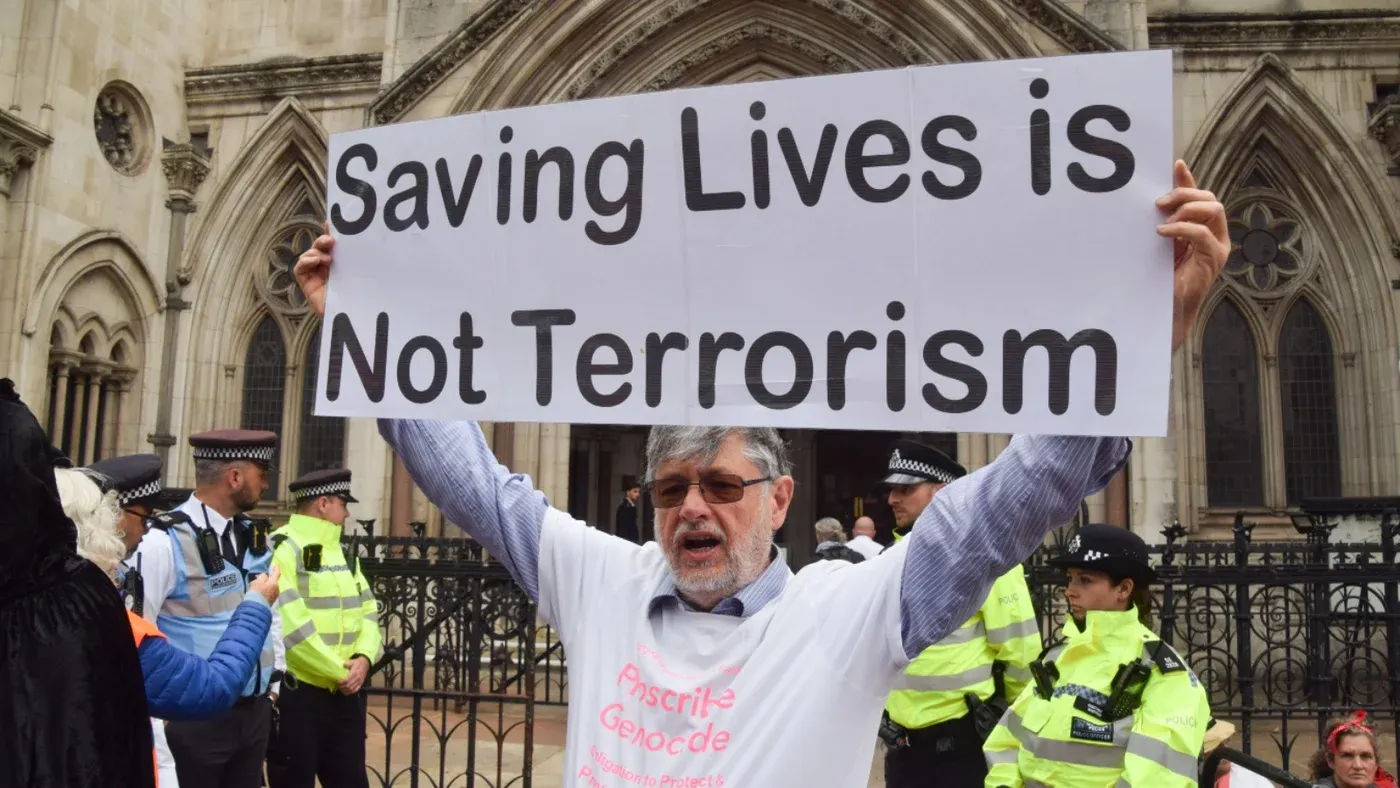
Direct action group Palestine Action, which had been targeting Israeli arms factories operating on UK soil, was proscribed as a “terrorist” group equivalent to al-Qaeda and Islamic State.
Holding placards protesting the genocide, as thousands of respectable British citizens did, became “support for terrorism”, risking a jail term of up to 14 years.
Reality was once again inverted.
Britain continues to actively support Israeli state terrorism.
But it was those ringing the alarm – those trying to stop these shipments, those opposed to British collusion in Israeli state terrorism, or those simply appalled by the undermining of basic rights to protest – who were arrested and charged as terrorists.
Meanwhile, documents show Elbit Systems continues to enjoy unrestricted access to British government officials.
‘Fake news’
Second, in stigmatising and isolating Assange for publishing details of US and UK war crimes, the British state was able to draw its own fake distinction between “good” and “bad” journalism – a distinction the billionaire-owned media was only too happy to embrace.
Assange, whose independent platform WikiLeaks had held Washington and London’s feet to the fire for committing war crimes, had in the process shamed the establishment media for their unwillingness to do likewise.
He exposed the extent to which corporate journalists, dependent on access to the rich and powerful for stories, conspire in the covert, unaccountable ways power is exercised by the state.
The media are not watchdogs; they are lap dogs, representing the interests of the billionaire class.
The British state – and its security services – made clear they would not tolerate truly independent or critical media that could expose their hypocrisies or bring them to book.
In response, the billionaire-owned media not only hung Assange out to dry. It joined the government in a chorus of claims that independent outlets were either peddling “fake news” or serving as “Kremlin assets” spreading “disinformation“.
It amplified the pressure from politicians on social media platforms, the billionaires’ new plaything, to tighten their algorithms to hide independent journalists, and stymie these dangerous new competitors in the battle for truth.
Similarly, corporate media cheerled the government’s decision to ban Russia Today, the Russian state’s news channel. It quickly became all but impossible for UK audiences to hear Russia’s version of events in the mainstream media, as Britain and European states built the case for permanent confrontation with Moscow.
The European Union imposed an even more draconian ban – upheld this month by the EU’s Court of Justice – that makes it a criminal offence to repeat any information reported by RT, and other banned outlets, even if demonstrably true. The law’s purpose is to supposedly “protect public order and safety”.
In recent weeks, two prominent US commentators, Cenk Uygur and Hasan Piker, have been denied entry to the UK over their criticisms of Israel. Uygur was due to speak at an Oxford University debate.
Enlightenment reversed
In this new authoritarian climate, truth is defined as whatever the state wants their citizens to know. Meanwhile, disinformation – “Russian propaganda” or “antisemitism” – is whatever those same states insist their citizenry must not hear.
This is a brazen reversal of 350 years of the western Enlightenment, with its professed belief both in the primacy of reason and that ideas must be tested through debate and critical scrutiny.
Now it matters not what is being said, but only who is saying it.
And unsurprisingly, the billionaire-owned, western media has endorsed this new regime. After all, its voice – representing the interests of the super-rich – is guaranteed a hearing.
No surprise, then, that this same privileged media corps has continued to meekly accept its exclusion from Gaza by Israel as the biggest crime in modern history unfolds – even now, in the midst of a supposed ceasefire that Israel keeps breaking.
Because what matters is who is allowed to speak: Israel, not Gaza’s Palestinians, whether what Israel says is true or, as invariably turns out to be the case, a lie.
In line with this precept, the billionaire-owned media has barely raised a murmur as Israel has slaughtered Gaza’s journalists in unprecedented numbers – killing more of them than in two world wars, Vietnam, the Yugoslav wars and Afghanistan combined.
The lives of Palestinian journalists – like the reporting they have had to do alone under Israeli bombardment – count for nothing in the western media because of who they are.
Genocide – the what – has been erased as a crime because it is we – the West – who are helping to carry it out.
The Committee to Protect Journalists, reportedly facing a political and donor backlash, scrapped last year its annual Global Impunity Index – which measured where journalists are murdered with impunity – after it became clear Israel would top the rankings.
Now the same committee is being accused of caving in to these pressures by raising doubts about who counts as a journalist in Gaza – doubts that will serve to embolden Israel, which claims that Palestinian journalists, indeed all Palestinians, are terrorists in disguise.
The who has to be rewritten because the what cannot be denied.
The same story is unfolding in the UK, where independent British journalists have been detained at the airport or had their homes raided at dawn by counterterrorism police for “wrong-think” about the Gaza genocide and British complicity in it. They too face up to 14 years in jail.
That has sent a chilling message to other journalists, those that lack the protection of a billionaire patron or the state, about what can be said.
Creeping authoritianism
None of this is, or will be, confined to Gaza. The upending of Enlightenment values, as should be clear by now, is part of a much bigger political project to normalise and entrench this creeping authoritarianism.
The proscription of Palestine Action and placard-holding has paved the way for the British state to designate any opponent – challenging its lawbreaking or contesting its right to dictate truth – as a criminal or a supporter of terrorism. A precedent has been set, and now approved by the UK courts, that will be hard to reverse.
The state has many tools at its disposal, some of which it is already wielding, again to no protest from billionaire-owned media “watchdogs”.
A particularly powerful one is “debanking”: forcing individuals or groups who disrupt the narrative of western state moral and legal authority out of the financial system, driving them into a kind of purdah that makes it near-impossible for them to function in the modern, western world.
Notably again, Assange and WikiLeaks were an early victim of the use of debanking as a political weapon. Washington imposed sanctions in late 2010, shortly after WikiLeaks exposed US and British war crimes in Afghanistan and Iraq, cutting off almost all of its donor revenue.
Sanctions – what some describe as a “financial death penalty” – have already been imposed on several judges and staff of the International Criminal Court over the issuing of an arrest warrant against Israeli prime minister Benjamin Netanyahu for committing crimes against humanity in Gaza.
UN legal expert Francesca Albanese, at the forefront of highlighting western complicity in Israel’s genocide, has also been debanked.
In Britain, Palestinian and Islamic-run charities have long faced harsh restrictions on their ability to operate financially, usually on the basis of claims that they may be funnelling donations to proscribed groups.
But this has gradually expanded to mainstream Palestine solidarity organisations and to individuals caught up in the ban on Palestine Action.
In an even more disturbing, if predictable, development, Lloyds Bank has now debanked the Canary, a leftwing publication whose criticisms of Labour’s capture by Big Business have long proved a thorn in the party bureacracy’s side. The Canary can no longer pay staff, and its news operation is in jeopardy.
This is the same Canary that the Labour Together project led by Morgan McSweeney – who propelled Starmer to power on behalf of the billionaire-friendly, pro-genocide Labour right – identified early on as a threat. His mantra was reportedly: “Destroy the Canary or the Canary destroys us.”
As investigative journalist Paul Holden sets out in his book The Fraud, which documents Labour Together’s covert, law-breaking operations, McSweeney almost succeeded in destroying the Canary. He created an astroturf group, Stop Funding Fake News, that lobbied advertisers to boycott the publication.
Labour Together under McSweeney’s successor, Josh Simons, would then launch a smear campaign on Holden and refer him to British security services as a supposed Kremlin asset.
Like a bad penny, Simons has turned up again, this time giving up his Makerfield seat for Andy Burnham to return to Westminster. Simons is now one of Burnham’s political advisers.
Political retaliation
This systematic assault on the right to scrutinise the British state’s actions has been extended to the legal profession too.
Last month, Dan Kovalik, a respected US human rights lawyer and professor, was detained at Liverpool airport by counterterrorism police and questioned over his criticisms of western foreign policy in Gaza and Iran.
Fahad Ansari, a British human rights lawyer, was detained by police last year on return to the UK from a family holiday in Ireland under Schedule 7 of the draconian Terrorism Act of 2000.
Both men had their electronic devices seized, despite protests that this was unlawful and violated their privileged lawyer-client communications.
Ansari’s detention appears to be a blatant act of political retaliation and intimidation. He had made legal representations challenging a Home Office decision in 2021 to expand the proscription of Hamas to its political wing. Hamas has never launched a military operation in Britain.
For the submission, Ansari had assembled a group of experts to argue that the expanded proscription – long desired by Israel – was having a profoundly chilling effect on the work of lawyers, scholars, human rights groups and journalists in documenting and discussing Israeli crimes in Gaza.
Five UN legal experts wrote protesting the abuse of Ansari’s rights as a lawyer, warning that “such measures threaten to criminalize, stigmatize and have chilling effects against lawyers and legal associations carrying out lawful work in national security and counter-terrorism matters”.
That seems to be precisely the point. Harassing lawyers is a feature, not a bug, of Britain’s new authoritarianism.
An even more visible victim of this new assault on the legal profession is the highly respected barrister Rajiv Menon.
He has worked on some of the most important human rights cases of modern times, challenging failures and abuses of power by the state in relation to the murder of black teenager Stephen Lawrence, the deaths of nearly 100 Liverpool football fans at Hillsborough, and the 72 victims of the Grenfell Tower fire.
He is currently facing contempt of court proceedings after making a closing speech in January that persuaded a jury not to convict six Palestine Action defendants of any of the charges brought by the British state against them. In 2024, the six had targeted an Elbit factory.
It is believed to be the first time that a lawyer has been prosecuted for contempt of court over a closing speech. Garden Court Chambers, where Menon has practised for three decades, said the proceedings had sent “shock waves through the legal profession”.
It warned of a severe chilling effect on barristers, who might be more reluctant to mount a strong defence, especially in politically charged trials, for fear of reprisals.
All of this should be seen in the context of the government’s equally unprecedented moves to erode the cornerstone legal principle of the right to trial by jury.
Authoritarian states permit no meaningful restraints on their ability to impose their will. Independent-minded lawyers and juries are just such a brake.
Protest criminalised
But perhaps the most sustained assault by the British state has been on the rights to protest and assembly, making it increasingly dangerous to express a view in the public space.
Since some two million people took to the streets to oppose Britain’s illegal invasion of Iraq in 2003, new ways have been sought to restrict the ability of ordinary citizens to raise their voice against the abuse of governmental and state power.
Recent legislation allows police to ban protests because they are “too noisy” or cause “serious unease”. Disruption has been redefined to now include hindrance to any daily activity. Protests can be barred if they have a “cumulative” impact.
These are all inherent features of protest. The mass demonstrations against Britain’s illegal attack on Iraq were noisy, disruptive and repeated – as have been the marches against Britain’s collusion in Israel’s genocide in Gaza.
By judging the legality of protest according to these selective and largely subjective criteria, the state has given the police huge latitude to decide which protests should be criminalised and which allowed. It is hardly surprising then that the police are currently concentrating their efforts on the anti-genocide marches, which highlight British collusion in Israel’s crimes.
Facial recogition technology – pioneered by Israel against Palestinians – is being rolled out too, normalising the Panopticon state so beloved by Mahmood.
Where is all of this leading? The answer is to a new piece of legislation that was hurried through parliament by the home secretary.
The National Security (State Threats) Act gives the state unprecedented powers to proscribe groups, as it did with Palestine Action, but now without having to claim to have evidence of a terrorist threat.
The home secretary can make such a designation unilaterally, without any parliamentary oversight, simply because he or she claims the group is a “hostile” foreign state actor that poses a threat to national security or public safety.
Mahmood has already done so with the Iranian Revolutionary Guard Corps (IRGC), effectively Iran’s military.
Further, anyone who works with or receives a “material benefit” – defined to include “information” – from a proscribed group can be jailed for up to 14 years. That includes expressing support for the group or sharing information it has provided.
Simply hosting an event where someone expresses support for the group could open one to prosecution, as could posting something on social media that the British state claims is a hostile foreign state “talking point” – whether or not the information is true.
Ban on search for truth
Once again, this is an assault on the most fundamental of Enlightenment values.
In the National Security Act, it matters only who is passing on the information, not what the information is, or whether it is truthful. There is no public-interest defence, such as exposure of criminality by the British state or its allies.
There is no exemption for journalists, lawyers, scholars or human rights groups. It will be impossible for them to do the most essential part of their job: digging out information, testing claims from one side against the other’s, and allowing audiences to determine the truth.
Assuming Hamas is declared a hostile foreign actor, as seems all but certain, journalists will be barred from collecting details of Palestinian casualties from Gaza’s health ministry or speak to doctors there. Why? Because the Hamas government runs the health ministry and hospitals.
Worse, it would be impossible for journalists to visit Gaza to investigate Israeli crimes – something that will delight Israel – because such a visit would need to be organised through the Hamas government. To do so would risk 14 years in jail.
The same will be true for reporting from Iran or Russia, if the home secretary so decides.
The only apparent carve-out will be for journalists who get approval from the British government beforehand.
That should ensure that only the most compliant, access-driven journalists, belonging to state and billionaire-owned media, will be able to engage with “hostile” foreign actors – in ways the British state can be sure will best represent its interests.
Under this new law, the search for truth, and potentially the truth itself, will be criminalised.
Inside the Panopticon
The National Security Act systematises all the other developments we noted earlier. It gives the state carte blanche to criminalise anyone who scrutinises or challenges its moral or legal authority.
Who should be in uproar over this monstrous legislative assault on the right to search for truth, to hold the state accountable, to act as a watchdog on the abuse of power?
If the billionaire-owned media did any of the above, news outlets would be leading the pushback. As it is, they are mostly silent – because they do none of these things.
It will be independent journalists, commentators, lawyers and human rights activists who will be picked off one by one, sending a message to everyone else to keep their heads down.
Starved of real information and critical scrutiny of the British state’s actions, the public, so it is hoped, will become more ignorant, more docile, more passive as their rights are steadily stripped away.
As the climate crisis intensifies, as resource wars accelerate, as austerity at home bites deeper, the finger will be pointed not at the real culprits – the super-rich, their media and the captured state – but at earlier victims of the West: those fleeing from the wars we initiated, from an increasingly unstable climate our inflated consumption provoked, and from a paucity of resources following centuries of colonial theft.
While we are encouraged to blame “the immigrants”, or “the Muslims”, or “the left”, or “the Israel haters”, the state is in a race to erect a scaffolding of control to protect itself before we wake up to the deception.
Time is running out on all fronts. The lack of urgency to address these crises is not because the crises don’t exist, but because our passivity has been engineered. The truth is we are already in the Panopticon, and our minds are already deeply fashioned for obedience.

Jonathan Cook is a British independent journalist, who has covered issues of Palestine and Israel for much of his over 20-year career. He formerly wrote for the Guardian and Observer newspapers and is a winner of the Martha Gellhorn Special Prize for Journalism.
ZNetwork is funded solely through the generosity of its readers.
Donate


4 Comments
Orwell’s novel is called ‘Nineteen Eighty-four’, not ‘1984’.
Ironically and tragically, this development has already completed in Russia. Any independent journalist or activist can be persecuted on any pretext even for past “violations” before a law came into effect. Watch out. And don’t lament banning of RT. You cannot fight state disinformation with another state’s disinformation. Find more reliable and progressive sources of Information. The same is true for Iran. Find and listen to the voices or resistance, not IRGC. And, finally, all these articles will not stop the Big Brother, but a united left front might. This is the only resort, not craving and crying for liberal freedoms. Protests will not help. Only rapid consolidation of the true, pro-socialist left forces while it’s still a readily available option.
“And don’t lament banning of RT. You cannot fight state disinformation with another state’s disinformation.”
What sense does that make? Do you ban every person you meet because they might say something that differs from what you’ve been led to believe? Why can’t we hear what the Russian/Iranian/Venezuelan/Cuban state thinks? Who is deciding what your “reliable” media is?
“Protests will not help. Only rapid consolidation of the true, pro-socialist left forces”
How do you consolidate leftist forces without protesting? What do these consolidated forces do if protests do not help? What are the “true” left forces?
When you say “persecuted”, do you mean “prosecuted”?
I thought that was purpose of publications such as Z and its writers such as Jonathan Cook.
Rick Langtree