
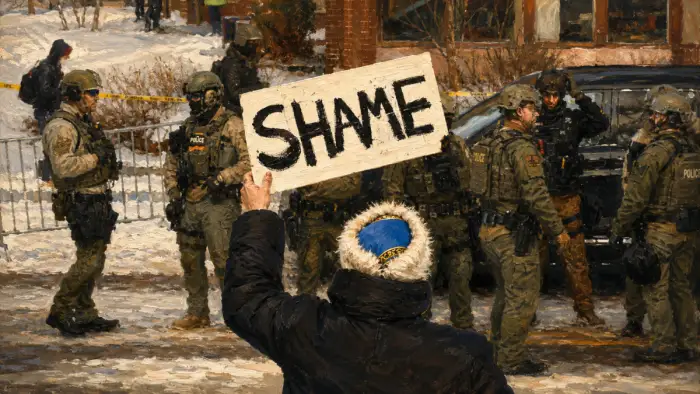
The blood continues to flow —in the streets, in detention centers, in prison camps, and in communities terrorized by militarized raids. Bullet-riddled cars, people killed on the way to work, grieving families, children left without parents, lives reduced to statistics: these are the human costs of a politics that has made cruelty into public policy. More than fifty people have died in ICE detention in recent years, while countless others have been brutalized, disappeared into a sprawling carceral apparatus, or forced to live in fear. Violence has become policy, glossed over by silence in the mainstream media, and buried beneath the cowardly ethical tranquilization of GOP politicians.
The silence of moral zombies who live in the shadow of the horrors of history creates the conditions for war crimes. Maine’s own Susan Collins, who represents the community where the killing of Joan Sebastian Guerrero took place, “not only voted for the additional $70 billion in ICE, CBP and DHS funding” but justified with the hypocritical remark “They are keeping us safe.” Tell that to the families, friends, neighbors, and children of the more than 10,000 people 10,000 people, many of whom are abducted and not afforded due process rights, who have been “arrested by ICE in a five-day surge at the end of June.” In another stunning display of ideological necropolitics, Representative Derrick Van Orden when asked about the Texas ICE shootings responded with “I’m incredibly proud of our ICE officers.” Following Guerrero’s killing, Department of Homeland Security Secretary Markwayne Mullin repeated the familiar official justification, claiming that Guerrero had “weaponized” his vehicle—a rationale also invoked after the killing of Rene Good despite evidence that challenged the government’s account. As public outrage over these deaths intensified, the Trump administration quietly ordered ICE to curtail most vehicle stops.
As Jack Crosbie observed in Rolling Stone, “No one should be shot while driving to work or driving home.” Yet restricting vehicle stops is, at best, a cosmetic reform. It leaves untouched an immigration apparatus that continues to brutalize migrants, kill innocent people, and carry out mass deportations on an extraordinary scale—a machinery of state violence that evokes, in disturbing ways, the logic of authoritarian repression associated with Pinochet’s Chile and Nazi Germany. Fear is governance. Silence is its endorsement. Terrorism with impunity has become the language of the state—yet accountability is nowhere to be found. How much longer will we tolerate it?
These are not isolated abuses. They are symptoms of a broader authoritarian project now reshaping American society. The storm clouds of fascism have gathered once again, casting their shadow across the American landscape. Gestapo-like abductions carried out in broad daylight, white supremacists marching through city streets in Klan-inspired hoods, masked agents in unmarked black vans disappearing people into an expanding archipelago of ICE detention camps—these are no longer isolated spectacles of cruelty but the visible architecture of an authoritarian state in the making. Freedom is increasingly defined through the exclusionary creed of white Christian nationalism, while those cast outside its boundaries are rendered disposable, stripped of rights, dignity, and even the recognition of their humanity.
This is a politics in which moral collapse, organized forgetting, censorship, and state violence converge into a machinery of repression. ICE prisons proliferate across the nation as fear becomes a governing principle and terror becomes public policy. At the same time, violence is repackaged as entertainment, sanitized into Disneyfied cartoons, memes, and celebratory videos that transform suffering into spectacle and cruelty into amusement. In this grotesque theater of authoritarianism, the spectacle does more than distract—it anesthetizes conscience, erases truth, legitimates injustice, and teaches a society to celebrate what should fill it with shame. Democracy does not simply erode under such conditions; it is methodically dismantled as a culture of cruelty becomes the organizing principle of public life.
The United States is increasingly at war with itself, at war with immigrants, dissenters, Black and Brown people, the poor, the vulnerable, and all those who refuse the demands of an exclusionary white nationalist politics rooted in racial hierarchy, white supremacy and religious fundamentalism. Nor is this violence confined within national borders. It reaches outward, extending the logic of disposability wherever power can be exercised without restraint.
From detention facilities to city streets, from armed raids to traffic stops, the trail of blood and suffering continues to grow. The names now include 26 year-old Joan Sebastian Guerrero, shot and killed in Maine, and Lorenzo Salgado Araujo, fatally shot in Houston only days earlier. These are not abstractions. They were human beings with histories, loved ones, aspirations, and futures stolen by a machinery of state violence.
What is perhaps most terrifying is not only the violence itself, but the speed with which it is becoming ordinary, followed by ethically numb responses, if not outright lies, by the Trump regime. Every democracy dies twice: first through the destruction of its institutions, and then through the collapse of its moral imagination. The greatest victory of authoritarianism is achieved when people cease to be shocked by what once would have been unthinkable.
We need a new political language for this age of repression. Euphemisms can no longer conceal what is unfolding before our eyes. Words such as enforcement, security, and deterrence cannot disguise the realities of militarized policing, indefinite detention, state terror, and the systematic devaluation of human life. We must recover a language that refuses indifference, speaks truth to power, and names violence without apology.
Such a language is necessary because the United States increasingly resembles a racial carceral state. It does not merely govern; it rules through organized fear, coercion, surveillance, corruption, and violence. It does not deepen democracy; it erodes its foundations. It wages war not only against bodies but against memory, historical consciousness, and the civic imagination itself.
If democracy is to have a future, education must once again become central to politics—not as an instrument of indoctrination but as a practice of critical consciousness, historical memory, civic courage, and collective resistance. Language must emerge from lived experience, resonate with hopes struggling to be born, and summon the courage to imagine a society organized around justice rather than cruelty.. Hope is not a retreat into optimism; it is the discipline of refusing despair. It is the courage to imagine otherwise and to act on that imagination.
Silence is not neutrality. Forgetting is not innocence. Democracy cannot survive when violence becomes ordinary, conscience becomes optional, and fear replaces solidarity.
The struggle before us is not only political; it is pedagogical. It is a struggle over memory, language, truth, and the capacity to imagine a future in which every human life matters. Every name remembered is an act of resistance. Every act of solidarity refuses the normalization of cruelty, state terror, and the expanding carceral state. The future will belong either to those who normalize barbarism or to those who refuse it with the courage, imagination, and solidarity that democracy demands

Henry Giroux (born 1943) is an internationally renowned writer and cultural critic, Professor Henry Giroux has authored, or co-authored over 65 books, written several hundred scholarly articles, delivered more than 250 public lectures, been a regular contributor to print, television, and radio news media outlets, and is one of the most cited Canadian academics working in any area of Humanities research. In 2002, he was named as one of the top fifty educational thinkers of the modern period in Fifty Modern Thinkers on Education: From Piaget to the Present as part of Routledge’s Key Guides Publication Series.
ZNetwork is funded solely through the generosity of its readers.
Donate

