
There is a painful truth in Balochistan that rarely reaches the outside world. Families who barely survive on low incomes still gather all their strength to send their children to study. A father sells his wife’s gold. A mother cuts back on her own needs. A family sacrifices comfort so their children can reach a place of learning. They hope that education will lift them from the weight they live under. But inside Balochistan’s institutions, that hope often collapses. These spaces have become unsafe and unregulated, and the problem is not one teacher or one department but the system itself.
The recent harassment case at Bolan Medical College (BMC) has brought this reality to public attention. A Baloch female student from Lasbela, referred to as “I” to protect her identity, was harassed by the Head of the Pathology Department, Ishaq, during her viva exam. According to classmates, Ishaq attempted inappropriate acts when she was alone, but she escaped safely thanks to the timely intervention of a security guard. The student later shared her experience with peers and student organizations. “I was terrified and didn’t know where to run,” she recounted.
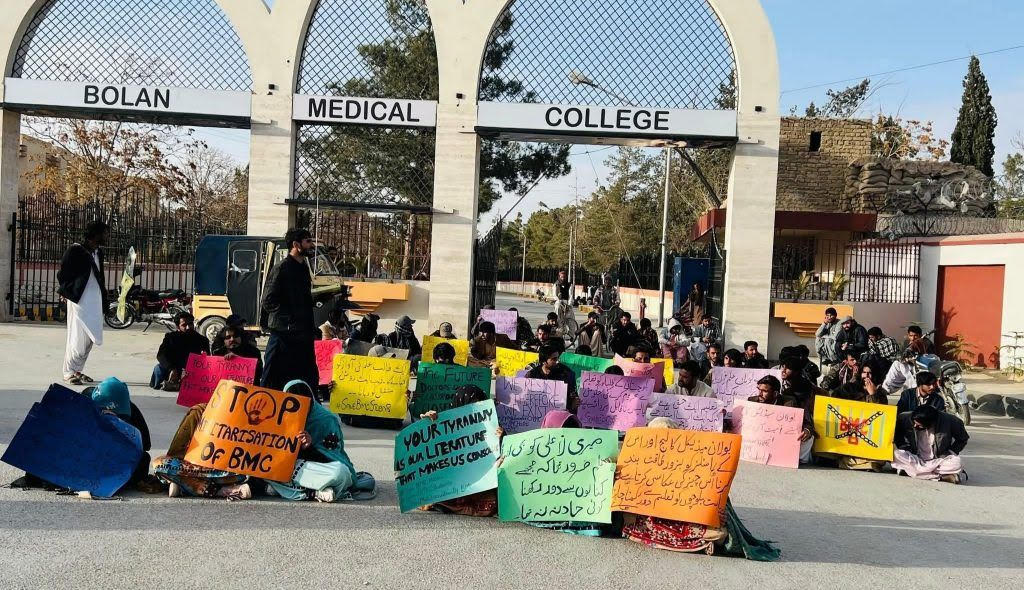
Following the incident, students held a sit-in inside the BMC premises, demanding immediate action against the professor and reforms to make campuses safer. They said this is not a minor issue because a professor harassed a student during an exam. Instead of protecting her, the administration and principle tried to silence her and pressured her to withdraw her statement, warning that her education could be at risk if she did not comply.
After the protest, the Balochistan Health Department ordered the BMC administration to conduct an immediate investigation, prompting students to temporarily pause their protest for three days. They warned that if their demands are not met promptly, they would escalate it further.
According to students, this incident is just one example of problems that have persisted for years. One student shared that the college is “our second home” but does not provide “a secure and supportive environment,” and that students have long suffered “silently” due to harassment, unfair exams, and blackmail.
A 21-year-old Baloch female student from Kech district, who is studying MBBS at Bolan Medical College (BMC) and requested anonymity, said that a teacher’s mood can determine whether students pass or fail. She added that classmates have been texted and threatened with failure unless they complied with sexual demands. “This is not something new for us,” she said, “but if we speak out, we become defamed in our society.” She further explained that many innocent female students have been forced into sexual activity by faculty and cannot say anything because the system always protects the powerful.
Students report enduring hostel issues, examination problems, unfair results, blackmail, and years-long continuous suppression. They say they have suffered silently and normalized everything because of a lack of trust in the administration and in themselves to challenge the system. “Despite being the oldest and most preferred medical college in Balochistan, we face mental stress due to harassment, blackmail, and threats of being failed in exams for personal interests of faculty,” one Baloch female student at BMC said in a video message shared on social media.
Many batches of students’ experience unfair viva exams that stretch until evening, where internal marks are ignored, and teachers’ authority is misused for personal gain, forcing students into silence out of fear of being victimized. This year, students report that no functions, sports, or other programs were allowed, further restricting their ability to express themselves and grow academically. “Gradually, we are losing our status as bold and confident students due to this suppressed environment,” the student said in her video message.
“Just a few days ago, one of my friends was being forced by a faculty member who threatened to destroy her career if she did not comply with his demands. This is how we face abuse in our second home, which has become a nightmare for us,” she said, “The friend who was recently targeted is now thinking of leaving her studies and returning home, and it hurts me deeply to see her go because she is helpless against the powerful,” the 21-year-old MBBS student told me.
The 2019 University of Balochistan Scandal
The BMC case reminds of the 2019 scandal at the University of Balochistan (UOB), one of the most serious and worst cases ever exposed in Pakistan which exposed systematic harassment and blackmail of female students. Surveillance cameras installed in the name of security were used to monitor students and record their movements, including inside washrooms. Officials identified girls walking with classmates and then used those images to blackmail them. Female students were threatened that their families would be shown these recordings if they refused demands ranging from money to sexual favors.
Many families immediately withdrew their daughters from the university to protect them. The scandal deeply undermined trust in educational institutions and discouraged parents from sending children to study outside their home districts. The incident also showed how power was concentrated in the hands of a few officials who faced little or no accountability.
One of the key culprits in the UOB scandal, the then Controller of Examinations at UOB, Prof. Dr. Abdul Malik Tareen was appointed as Vice Chancellor (VC) of University of Makran in Panjgur , and is currently serving as VC at Lasbela University of Agriculture, Water and Marine Sciences (LUAWMS). Local reports and students say similar harassment has continued, and yet his past never stopped him.
The Baloch Students Action Committee (BSAC) also condemned the appointment of Malik Tareen as Vice Chancellor of Lasbela University, stating that he had previously been implicated in the University of Balochistan scandal. The organisation called his appointment a “travesty of justice” and described it as an attack on the already fragile educational system in Balochistan.
Students often remain silent out of fear of retaliation, while perpetrators continue their actions with impunity. One girl’s education ends, but a professor’s career goes on. This is the reality of how the colonial system works.
Systemic Neglect and Unchecked Power
The problem at BMC and UOB is not limited to individual misconduct. Students and activists point out that these issues are embedded in a broader system of unregulated authority. Waleed Majeed, a student at BMC responding to the government inquiry letter about BMC scandal wrote on X, “The real problem cannot be solved by investigating individual cases. The root cause lies too deep in the unregulated authority over students’ lives, where the mood of a Head of Department (HOD) can decide your future.”
BSAC warned that harassment in universities has become a disturbing norm. Spokesperson of BSAC said institutions in Balochistan are “held hostage by various elements,” allowing abuse to flourish unchecked. According to BSAC, lack of transparent investigations and weak punishment emboldens perpetrators and ensures that similar incidents continue to happen across colleges and universities.
Despite fear, students are beginning to speak up. One student said, “It is high time we realize our power as students and unite for a better academic space.” On this Monday, students at BMC gathered peacefully to demand reforms in viva exams, accountability for abusive staff, and safer hostel facilities.
Dr. Sabiha Baloch, reflecting at the time on the 2019 University of Balochistan scandal, said the issue was not only about a few individuals but a whole system that blocks Baloch students from education. She wrote, “This incident is part of the chain of obstacles on the path of education, and the solution to overcoming it is to raise our voices against every link in that chain.” She also emphasized that keeping Baloch girls away from books is deliberate, saying, “Keeping me away from books was no accident.” Her words show that harassment, blackmail, and fear inside universities are all connected to a wider pattern of repression in Balochistan.
A Colonial Legacy in Education
The situation faced by Baloch students comes from a long history of political control. Many Baloch believe these problems are rooted in a colonial-style system that restricts and suppresses the population. Since the 1948 forceful annexation of Balochistan, governance has often treated people as subjects to monitor or exploit instead of citizens to protect. Extrajudicial killings, enforced disappearances, harassment, unemployment, road accidents, and barriers to education all share the same origin designed to control rather than protect them.
In this context, educational institutions have become sites of control. Students’ futures, families’ sacrifices, and young women’s dignity are repeatedly threatened by the same structures that allow harassment to flourish. Transfers, suspensions, and temporary inquiries cannot fix a system built on oppression.
For Baloch society, the solution must go beyond individual complaints. Students, families, elders, and activists must recognize that only by asserting collective power and demanding systemic change can harassment end. Unity and collective action against harassment and repression are moral responsibilities for Baloch society. The courage of students at BMC shows that change is possible, but it must be supported by society as a whole.
Education is supposed to create hope and opportunity. But as long as the same structures stay in place, students will continue to bear the burden. Baloch students are fighting for more than personal rights, as their struggle carries the dignity and future of Balochistan.
Now it is the Baloch who should decide how to end this serious issue, because until they are colonized, such cases of harassment and exploitation will continue.
ZNetwork is funded solely through the generosity of its readers.
Donate