
A potentia is a possible future; a different form of social organisation; a better world; a society organised to prioritise human flourishing and environmental sustainability. A potentia is similar to a utopia but rooted in the here and now; it is possible to imagine the steps that would take us from the present to a Potentia’.
The exhibition Start Where You Are: Second Degree Potentias opens at Bloc Projects, Sheffield, on 10 September. There will be flags, a model village made of chocolate, diagrams, reflections, research into a 21st century Eden, 20 hypothetical cities, a plan to fundraise with a giant wind turbine, Stonehenge made of filter tips, pinkness, a reading room, The Dispossessed, and an official project cocktail – Consensus on the Beach.
Danielle: Tell me a bit about the term ‘potentia’
Jane: A Potentia is a form of social organisation that prioritises human flourishing and environmental sustainability. By sustainable, I mean something like ‘not depleting the natural environment and conserving resources for future generations of humans and non-humans’. A lot of definitions of sustainability seem to put human needs at its centre, but I don’t privilege human needs over those of the rest of the natural world.
In Latin the word Potentia refers to force, power and might. But we weren’t aware of that when we came up with it. It turns out that there is also a phrase from the latin, in potentia, which also functions as an adverb, meaning ’as a possibility; potentially’. Which is very appropriate!
It’s easy, as an artist, to represent what’s wrong in the world, and think that by doing that you’re having some kind of political effect. But I think it’s also important to present possibilities of how things can be different. It’s important to remind people that the way things are now – with a neoliberal economic system – is very recent; it’s presented as the only realistic way of organising things economically, but it is just the current phase and won’t be like this for ever, or probably even for much longer.
Danielle: Very apt! So, why ‘second degree’?
Jane: A second degree burn is the second least serious burn; So it implies the possibility for greater depth. I see this exhibition as potentially the start of a longer term project – a possible next step would be to make another exhibition or event but embedding non-hierarchical ways of organisation more deeply within it, or modelling a Potentia more fully, or being more rigorous in our use of resources when making the work. So, potentially, there might be a Third Degree Potentias next year where we only use fully sustainable or found materials, or public and low carbon transport while making the work.
Danielle: The move to third degree next year would imply that, as the years go on, the ‘burn’ becomes more serious and hopefully, maps your progress in making a difference through the project as you increase the severity of the project. So, can I ask, why not start with ‘first degree’?
Jane: It was also partly a reference to myself; when I was finishing my degree I was focussed and productive in a way that I haven’t been since, and so setting up a project with a long timescale I saw as making a second degree show. Though it hasn’t turned out quite like that – organising at the same time as making work has taken up a lot more time than I anticipated!
Danielle: One of your participating artists – Ellie Harrison – has caused some controversy this year by using funding to keep herself from leaving her locality in Glasgow (in the name of art and environmental responsibility). Has this affected what she proposed to exhibit in the show?
Jane: At one point I was talking to Ellie about making new work and participating in the workshop process that we used to develop ideas, but her commitments in Glasgow, and the fact that she couldn’t leave the city meant that that wasn’t possible, so she’s showing some work relating to the Radical Renewable Art + Activism Fund, a project that will provide funding for art activism from wind-generated electricity – a very Potentian project!
Danielle: There are a number of events accompanying the show which are particularly geared towards active practices (for example the Art Possibility Action workshop). Is this important for the exhibition/project?
Jane: Yes, I didn’t want it only to be a gallery exhibition, and I very much wanted to open up discussion about how art can contribute to change. There are a lot of artists who want to make work that has some political or social effect, and there are a lot of different ways to go about doing this. If you’re making ‘political art’ that is only shown within the art world, I think it’s important to be realistic about how much effect it can have. Not that you necessarily know what the knock-on effects are on the people who see it, but I think it’s also important to think beyond the gallery walls. Which is something that I’m aware that I haven’t been doing much this year, as I’ve been so focussed on this project! I’m hoping the workshop will help participants make links, with campaign groups, community organisers and activists as well as with other artists. Art strategies have been used really effectively in situations such as the campaign to prevent the Welsh Streets in Liverpool from being demolished or the campaign to end BP sponsorship of the Tate.
At the same time, as an artist, it is important not to instrumentalise your work too much. There’s a difficult balance between making work that is satisfying and making work that has an effect. I have been involved in various forms of activism in the past and since studying I have been trying to integrate my desires as an artist and my desires as a citizen – and I don’t think I’ve really worked out how to do that yet. Sometimes I just want to play with materials and make pretty things.

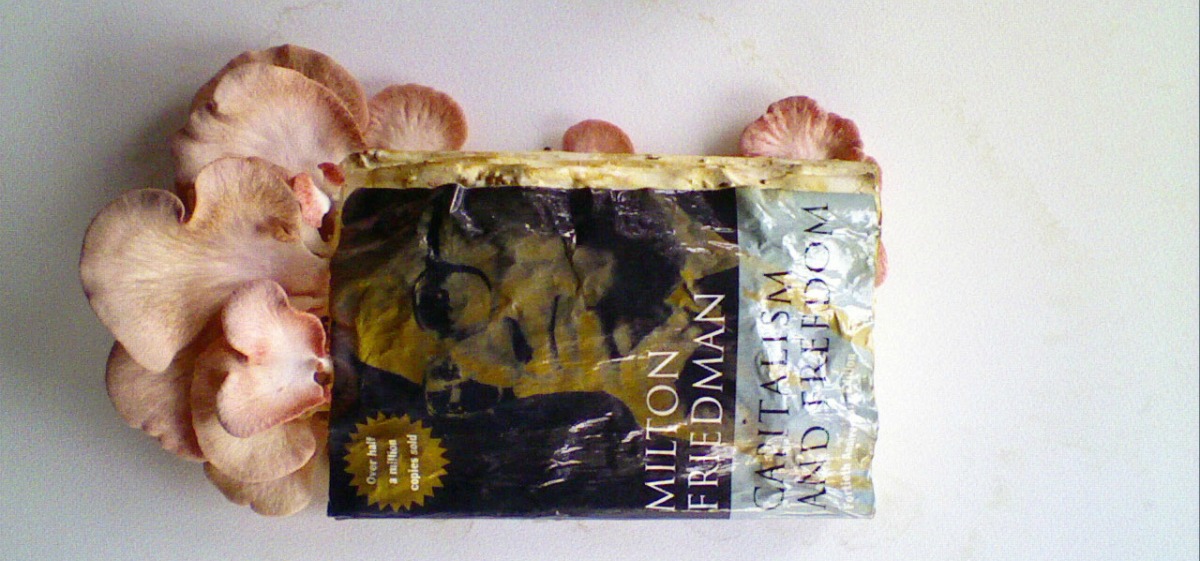
Danielle: It sounds like you’re managing this balance though. Your 2014 work Detoxification of Capitalism and Freedom (in which Jane detoxifies a copy of Milton Friedman’s book Capitalism and Freedom using oyster mushrooms) has a political resonance but is also poetic and, dare I say, ‘pretty.’
I’m also reminded of Thomas Hirschhorn’s distinction between ‘making political art’ and ‘doing art politically.’ ‘Political art’ has become more popular in recent years and there’s a danger in it becoming another ‘ism.’ How do you think contemporary artistic practice can assist political or social justice action?
Jane: In a variety of ways. Art strategies have been effective in saving the Welsh Streets from demolition, allied however with traditional campaigning, lobbying, making submissions to select committees. At a talk last year, Nina Edge said that the two areas in Liverpool that were saved from demolition under the Pathfinder scheme, out of the nine planned, were the ones that used art strategies. Obviously I don’t know enough about what went on to know whether there were other factors that affected which campaigns succeeded and which ones didn’t.
Danielle: The artist Christoph Schäfer was involved with a project called Park Fiction (1994-2005) in the St Pauli area of Hamburg, Germany which effectively stopped a piece of green public land being redeveloped and turned into office blocks. Through showing how the community used the land – ah hoc cinema screenings, picnics etc. – the local residents association managed to convince the city not to sell the property. I think these practices have a potential and make a difference.
Jane: That sounds brilliant! It reminds me also of Raaivo Puusemp’s work as mayor of Rosendale in 1975. Here’s a quote from a good article on eflux:
“In 1975, the village was plagued by an overbearing tax structure and problems with municipal utilities. Following his election and throughout his tenure, Rosendale’s residents were not aware of Puusemp’s practice as a conceptual artist, his early interest in phenomenology, nor his later experiments with group dynamics and socio-political processes. Puusemp’s approach to the post was, however, an artistic one. He believed that in politics, influence and concept could come together compatibly. Employing conceptual strategies to tackle the village’s issues, Puusemp viewed the situation as an artwork in the form of a political problem. He drew upon previous works—which he called ‘influence pieces’—in which the artist would steer subjects into unconsciously executing his ideas.”
In-Situ are working in a slightly similar way in Brierfield, a milltown north of Burnley. Network rail were going to demolish the signal box, but In-Situ have been working with local people to save it – at the moment the plan is to move it and rebuild it. They’ve also collected rainwater from the roof of the derelict Brierfield Mill and used it to power a cinema, and an artist working with them recently, Jin Bells, made a series of performances on the site of 100 houses that were demolished as part of the Pathfinder programme; the money ran out before replacement houses could be built.
Danielle: It’s incredible to think that rainwater (and let’s face it, we get a lot in the North West) has the potential to power a cinema. I think sometimes it needs creative thinkers to see the possibility of these types of projects. It’s also somehow poetic.

Jane: The Laboratory of the Insurrectionary Imagination have been very effective in using creative tactics and performance-based strategies to create tools and scenarios for civil disobedience, for example in facilitating the Bike Bloc at the 2009 COP15 climate change protests in Copenhagen. Liberate Tate have also been very effective in using performance in their work. Then there have also been the puppets used in, for example, artists involved in occupations, such as the shops in Lambeth Walk that the local council wanted to demolish.
Though I think it may be less a question of contemporary artistic practice, and more a question of using the tools of creativity; being involved in contemporary artistic practice can give you a wide repertoire of creative tools and ideas to draw upon.
And providing information is also useful and important. Artists have a lot of leeway in how they operate – they’re not subject to the same constraints as academic researchers – which can be handy. And we can make our skills available; for example, a couple of years ago I made a diagram showing the different undercover police units that had been spying on activists since 1968, for Bristling Badger.
Danielle: Yes, I note the contemporary aspect because these are becoming increasingly visible with groups such as Liberate Tate and the other Art Not Oil groupings having such a presence on social media. But, yes, the alignment of creative practice and activism is a much longer history.
Jane: Often framing something as art can give the confidence, or the ‘permission’, to experiment in public. I’m thinking of Clare Bonetree’s Democracy Outside, which she developed while doing an MA in Social Sculpture and which is basically an outdoor spectrum exercise where people hear a question or statement and are then invited to place themselves on a continuum from Yes to No. They are then invited to explain why they have placed themselves where they are, and they can move around in response to what other people say. Clare started the MA because she had started to feel trapped as an activist – that her activism had become about saying no to things, and she wanted to open up possibilities. She feels that with art you can provide questions rather than making statements. Also, because many people feel excluded by the term ‘activist’ and don’t feel that it’s something they can, or want to, get involved in, whereas doing street theatre and street art provides a simple way for people to get involved in discussions.
Danielle: It sounds like you have covered a lot of bases with the project, which goes beyond the exhibition
Jane: One thing that came out really strongly during the workshop process, when we were discussing different forms of social organisation, is that, if you want to change things, you have to start with what you’ve got (hence the name of the exhibition); you can’t fast forward to Utopia – and when people have gone for the Year Zero option it’s generally involved a lot of mass murder, repression and horror. The artists in this show include people with a whole range of levels of political experience and involvement, and in that I think it’s been quite a true reflection of the experience of working for social change; people broadly in agreement about how they’d like things to be, but with very different perspectives on how to get there or what ‘a better society’ might look like in practice.
Start Where You Are: Second Degree Potentias runs at Bloc Projects, Eyre Lane, Sheffield S1 4RB from 10-17 September and the workshop Art, Possibility, Action, featuring Nina Edge, Mel Evans, James Marriott and Kerry Morrison, takes place on Saturday 5 November.
ZNetwork is funded solely through the generosity of its readers.
Donate

