
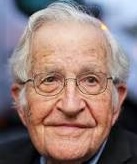
Washington DC based History Teacher Dan Falcone and New York City English Teacher Saul Isaacson sat down with Professor Noam Chomsky to discuss current issues in education and American domestic and foreign policy issues. They also discussed the place of the humanities in education and how it relates to activism, definitions of terrorism, and how education impacts the perceptions of the political process in the US.
Dan Falcone: We are here again at MIT to discuss education, history, and politics with Noam Chomsky. Thank you for having us. I was just wondering if you could discuss some of the challenges you hear about from the friends you have in the educational field?
Noam Chomsky: A friend of mine was doing some interesting work in Falmouth. He works in a Falmouth school system. He was a Harvard cognitive scientist, but he’s now working with the schools. He started working with the kids that they have in a special track. I forget what they call it, but the ones who aren’t academically functioning. And when he began to look into it, he found that these kids come to school on a bus with maybe an hour bus ride. They haven’t had breakfast. But when they come into school they go crazy and he started doing some really simple things like giving them candy because he discovered that they have a low glucose level. And that’s having an effect, and when they come into school instead of starting in a math class he just puts them somewhere where they can just go crazy and run around. He’s gotten to the point that these kids are out-performing the main kids in the main schools.
Dan Falcone: Interesting, so just through simple techniques he’s been able to help these students. Shifting gears, I wanted to ask you about the place of the humanities in education. So, on the one hand I see this need to foster creativity and challenge prevailing business models of education or narrowing the technocratic mold of education –
Noam Chomsky: – I’ll give you an answer. This morning’s MIT newspaper there’s a wonderful article about the destruction of education in the United States but they are very upbeat about it. Take a look at the new majors.
Dan Falcone: MIT introduces four new majors, seven new minors. Business analytics, finance, mathematical economics, minor in computer science design, entrepreneurship –
Noam Chomsky: The four majors: Business First Management, Business Analytics, Finance, mathematical economics, which is trading. That’s it.
Dan Falcone: Yeah, I’ve seen this type of thinking before. The school that I’m in now is changing the department. It’s including more advanced placement test-driven subjects whereas it used to be a place where you could go to –
Noam Chomsky: – Think about things.
Dan Falcone: Yes, so the other reason I bring it up, is the other side of the humanities debate with critical theory and cultural studies, where there’s a tendency for the humanities to reject forms of objectivity or to deny truth as sort of this trendy, fashionable, academic entity whereby it winds up reinforcing power or does little in the way of contributing to activism. Could you comment on that?
Noam Chomsky: It’s bad enough here but the place where it’s even more destructive is in the Third World because here, if intellectuals just waste their time, okay, it matters, but it might not matter that much. But in Third World countries they need intellectual contributions more proportionately.
I’ve seen some amazing cases. I once gave a talk at Birzeit, the Palestinian college in the West Bank, and a Palestinian friend of mine was sitting in the audience. They wanted me to talk about the current political situation and so I talked about it and as we walked out I asked my friend what his feeling was about the audience reaction [to the talk], and he said he was sitting next to a student that didn’t like it much.
She said it was all about this kind of old-fashioned [naïve] business of embracing truth and fact and that is not what is really important. And you see that all over the Third World. It’s a very destructive tendency. And it’s also intellectually just pure garbage.
Dan Falcone: Right, and a lot of times it’s well intentioned, left-leaning people –
Noam Chomsky: – People are well intentioned but I think if you look at the roots of it – it’s very cynical. It mostly comes from Paris and I think it mostly has to do with the collapse of French civilization. France has not been able to come to terms with the fact that it’s not a major power anymore. I mean even before the Second World War Paris was one of the main centers of intellectual and cultural life. But now Paris is a kind of subsidiary of Germany, their traditional enemy and they can’t come to terms with it.
They’ve tried to create one crazy thing after another to try to be exciting, each one more lunatic than the last, and this is one of them. And it’s picked up here in mostly literature departments and some humanities departments. It kind of gives the impression of being serious. Like you use big words and you have complicated sentences and there’s things nobody can understand, so we must be like physicists because I can’t understand them and they can’t understand me.
Back to the previous point you raise regarding the business model; at a place like MIT it’s really shocking because this used to be a research university. The idea that what’s driving kids is how can I make money is just devastating, even more so the fact that there’s no comment about it. Look at the comment of the dean [in the MIT press]. He thinks it’s great.
Dan Falcone: How do students react to this?
Noam Chomsky: [The new majors and course selections] just came out this morning [in the MIT press] and I mentioned it in a class this morning. They kind of thought about it but I don’t think they would have reacted to it otherwise.
Dan Falcone: I recently saw a friend of yours speak in DC, Phyllis Bennis, from Institute for Policy Studies who participated in Democracy Awakening. I was also talking to Medea Benjamin. They were both giving a talk on resistance, peace, organization, and getting money out of politics. The one quote they gave was from Charles Freeman. He’s an American diplomat. You don’t normally hear those two quoting diplomats but his quote is, “The United States has now been engaged in a cold war with Iran, Persia, for 37 years. It’s conducted various levels of hot war in Iraq for 26 years. It has been in combat in Afghanistan for 15. America has bombed Somalia for 15 years, Libya for five and Syria for one and a half. One has led to another. None has yielded any positive result and none shows any signs of doing so. In none of these wars is there an end in sight.” This is not to mention the Israeli crimes that we fully support.
Noam Chomsky: It’s interesting from him because he’s quite conservative, but he’s a kind of an old-fashioned, mainstream establishment figure. He’s been an ambassador for many years. His attitudes are pretty reactionary. When he says it “hasn’t yielded any positive result” he means for us. We maybe, destroyed them but who cares about that, no positive result for us. So the fact that people like him are saying it, and he’s very well respected, has meaning. Another one is Andrew Bacevich. He’s a military historian. He’s also quite conservative but he’s considered a leftist because he says this from the US perspective.
Dan Falcone: It made me think about the global war on terror and I started looking at a textbook and the definition as outlined by the curriculum I use. I also tried to trace it back to see what students were learning previously about terrorism in terms of our global war on terror as defined by the United States, United Kingdom and NATO as “us against a force somewhere else.” But could you just talk about how that definition is complicated and how it isn’t complicated. You traced it since the early ’80s and so it’s a pretty reliable definition in the context you wrote it.
Noam Chomsky: Yeah, Reagan started it. It’s pretty interesting. I mean terror became a big issue when the Reagan Administration came in. They immediately announced [their plans] and kind of disparaged Carter’s alleged human rights programs. The main issue is state-directed international terrorism. Right at that time that big industry developed. That’s when you start getting the academic departments on terrorism. You get UN conferences trying to define terrorism. Journals, you know, big explosion of interest in terrorism. I started writing about it more at that time as did Ed Herman. But we actually had been writing about it before and we picked up after that.
But the stuff that we write can’t enter the canon for a very simple reason. We use the official definitions of terrorism. The definitions in the U.S. code, in British law, in U.S. Army manuals and so on. And if you use those definitions it follows instantly that the United States is the leading terrorist state in the world. So since you can’t have that conclusion you have to do something else. And if you look at all this academic work in the conferences and so on there’s a constant theme that terrorism is extremely hard to define and we therefore have to have a deep thinking about it. And the reason it’s hard to define is quite simple. It’s hard to find a definition that includes what they do to us but excludes what we do to them. That’s quite difficult. So it takes a global war on terrorism.
The worst terrorist crimes going on right now are the drone campaigns. But you can’t include that obviously. So you have to try to define it. I mean if Iran was carrying out an assassination campaign killing anyone around the world who Iran thought might harm them someday we’d go crazy. But that’s the drone campaign.
There’s been a big problem now, for 35 years, in trying to define a way to restrict the concept of terrorism to things that those guys are doing to us. Take a look at the Supreme Court decision that just authorized an effort by U.S. claimants against Iran for terrorist acts. What are the terrorist acts? The terrorist acts are bombings of U.S. military installations in Lebanon and Saudi Arabia, which Iran is claimed to have something to do with. Well suppose they did. That’s not terrorism. I mean if we have a military base in Lebanon that while we’re shelling Lebanese naval ships, the Navy is shelling Lebanese installations and somebody attacks [that’s not terrorism].
But that’s the way you’ve got to craft the concept and it runs right through the whole ideological system. Kind of interestingly one of the exceptions is the international law community. So there’s an interesting review article in the latest issue of the American Journal of International Law, a very conservative journal, which basically does, or comes pretty close to calling the drone campaign terrorism. But it’s not in the mainstream of course or in the textbooks.
In fact if you look at Reagan’s global war on terrorism it very quickly turned into a massive terrorist war: [by us] Central America, South Africa, the Middle East, all U.S.-backed terrorism. That’s one of the reasons why it disappeared from history and why the standard line is that Bush 43 declared the war on terror. Actually he just repeated what Reagan had said 20 years earlier.
Saul Isaacson: Speaking of presidents it looks like most people seem to believe that Hillary Clinton is inevitable now. And I wonder if you can give us an overview of how she’ll affect the situation in the Ukraine. The last time I was here I asked you about Steven Cohen’s statement that he fears nuclear confrontation and civil war. Will Hillary Clinton exacerbate the situation with her policies, which seem to the right of Obama, sometimes even to the right of Trump?
Noam Chomsky: I think she’ll probably be a more hawkish version of Obama. But it’s very serious, the Ukraine situation. It’s not just Ukraine now, it’s the Baltic region. I mean you take a look at the whole Russian border and NATO. Obama just announced recently that they’re quadrupling the NATO military installations on the Russian border. The Russians are of course reacting, and that’s extremely tense. I mean that could blow up at any moment and it all has to do with NATO expansion, which is under Clinton.
Saul Isaacson: It seems Clinton wants to take that even further in the future.
Noam Chomsky: Well, what actually happened is the first Bush started it by moving to East Berlin, contrary to what they promised. But then Clinton basically moved it all the way to the Russian border and Bush kind of added more. Around 2008 and again in 2013 NATO officially offered the Ukraine the opportunity to join NATO. That’s something no Russian government is ever going to accept. It’s right at the geopolitical heartland of Russia. Clinton I suppose will pursue that I guess if she’s crazy enough. I mean it’s almost a declaration of war. I know people like George Kennan and others warned about this right away, way back in the early ’90s.
Saul Isaacson: Did it frustrate you that Sanders didn’t speak out about this more?
Noam Chomsky: He doesn’t talk about it.
Saul Isaacson: But it drove me nuts. It seemed like Clinton would be vulnerable on these issues.
Noam Chomsky: She would be vulnerable except that it’s popular. You know, why should we let the Russians get away with it? Take a look at last Sunday in the New York Times Magazine. It was devoted to how terrible Putin is. You look at Foreign Affairs, the main foreign affairs journal. The current issue is almost always dedicated to Putin’s crimes. And it goes all the way down to the newspapers; everything is the Russians. Sure he’s not a nice guy but the fact is he’s pretty defensive. There’s a pretty good book on it, a very good book in fact, by a British East European scholar, Richard Sakwa, which is the most balanced study that I’ve seen called the Frontline Ukraine, a very serious book.
Saul Isaacson: What about the coup in Honduras and Clinton’s behavior? I don’t think she really labeled it a coup. Obama did.
Noam Chomsky: Clinton did too and the State Department immediately moved to support the coup regime, which they never called a military coup of course because that would have meant cutting off arms.
Saul Isaacson: It’s different. Coup versus military coup . . .
Noam Chomsky: Yeah, they worded it to say coup but not military. There was a technical reason, because if they say that, they got to cut off the arms flow.
Saul Isaacson: Sanders never mentioned Honduras.
Noam Chomsky: He keeps away from foreign policy pretty much.
Dan Falcone: Is that wise?
Noam Chomsky: I think it’s honest. I don’t think he cares that much. If you look at his record it’s domestic. It started kind of local in Burlington. But the issues that he talks about are basically domestic and on international issues he hasn’t said much. In fact, I think in his whole career he hasn’t done much.
Saul Isaacson: It’s worrisome in a president.
Noam Chomsky: I mean I suspect he’s not going to be president. But if he were, he’d probably be a little less adventurous but I think the same is really true of Trump. Crazy as he is, he seems to wants a kind of America first, a huge military but only to protect us from all of them.
Saul Isaacson: He seems so unpredictable, Trump.
Noam Chomsky: He seems very unpredictable.
Saul Isaacson: Oddly to the left of Clinton on some issues.
Noam Chomsky: On some issues like the Social Security, Medicare. He kind of vacillates.
Dan Falcone: The support that Sanders is generating in the domestic issues is coming from the young people, younger citizens, I would say that indicates a good sign. Would you agree?
Noam Chomsky: I agree.
Dan Falcone: It is often where it comes from anyway, the students.
Noam Chomsky: Well, in fact if you look at the Trump voters, you take a look at their attitudes it’s not all that different. In some respects they’re similar. They’re an older version of the Sanders people. So a lot of it is racist and you have that sort of thing, but if you look at their views on say health, education, and so on, it’s kind of the same as Sanders.
Dan Falcone: And usually these movements come from students, all of the things that make us a more civilized society, it was often young people.
Noam Chomsky: It often comes from students for a good reason. They, students have a degree of freedom that nobody else has.
Saul Isaacson: Do you think this movement is around to stay now, the Sanders movement?
Noam Chomsky: I think a lot of it’s up to him. I mean what they should have been doing all along is kind of marginalizing the focus on elections, which is secondary, and using the opportunity to build or sustain the ongoing movement which will pay attention to the elections for 10 minutes but meanwhile do other things. Now it’s the other way around. It’s all focused on the election. It’s just part of the ideology. The way you keep people out of activism is get them all excited about the carnival that goes on every four years and then go home, which has happened over and over. The Rainbow Coalition [had this effect].
Saul Isaacson: One thing we always say about our students is that they’re apolitical. But this election seems to belie that idea.
Noam Chomsky: That’s not a good thing because the time to be political is not when you have parties and carnivals, it’s kind of a show, the election. It affects something but not that much. And focusing all the attention on it is I think a mistake. You can’t ignore it obviously and it has some effect. I mean my feeling is that if any Republican was elected it would be almost a death knell for the species literally, just because of their attitude on climate change. They are already preventing any action internationally and that’s why there’s no international treaty because they’re [not voting on it] in Congress, and every one of them says they want to get rid of the EPA.
Dan Falcone: This truism or concept that our political system is basically weak, where maybe once in a while you might have a good candidate, and you might want to even vote, but overall the idea that students associate citizenship with participating in elections is problematic.
Noam Chomsky: That’s right, that’s the ideology. Citizenship means every four years you put a mark somewhere and you go home and let other guys run the world. It’s a very destructive ideology. Look, the United States doesn’t have political parties. In other countries, take say Europe, you can be an active member of the political party. Here, the only thing in a political party is gearing to elections, not the other things you do. So it’s basically, a way of making people passive, submissive objects.
Saul Isaacson: Can teachers play a role in politicizing students?
Noam Chomsky: Yeah. You ought to teach kids that elections take place but that’s not politics. If you want to know how legislation is made it doesn’t come from elections.
Even the issue of campaign funding has been a little misleading in this respect. There’s a lot of talk about, you know, both parties spend a huge amount on campaign funding. One of them loses so it looks as if they’ve wasted their money but they haven’t because the point of funding is basically to buy access, not necessarily – you’d like to have your candidate win but you want access. If they know you’re funding them they’re going to give you time. Time means you send your corporate lawyers to write the legislation that the representative will then sign without reading.
That’s pretty much the way it works. So most of the representatives don’t know what the hell’s going on. They’re mostly raising money or kissing babies or something like that. They have to sign legislation. Their staff may know something about it but their staff is getting the information from corporate lobbyists, who buy access through campaign funding. The end result is to get the kind of legislation we see. I think all of this should be a part of civics, becoming a citizen, learning how the country works.
Saul Isaacson: Of course we don’t offer that anymore.
Dan Falcone: Yeah, it’s not even a class.
Noam Chomsky: No. It doesn’t help keeping a job.
ZNetwork is funded solely through the generosity of its readers.
Donate