Fritt fall – finanskrisen og utveier
Description
Pubdebatt:
FRITT FALL – Finanskrisen og utveier
Milliardene ruller ut av statskassen til krisepakker. Samtidig har regjeringen ikke tatt tak i årsakene til finanskrisa. Attac foreslår i en ny bok en rekke tiltak som kan demokratisere finansmarkedene, og hindre at vi får stadig nye finanskriser. Hva bør regjeringen gjøre? Helene Bank, nestleder i Attac Norge og bokredaktør
Magnus Gustavson, Civita
Per Olaf Lundteigen, stortingsrepresentant, SP (invitert)
Møteleder: Astrid Sverresdotter Dypvik, journalist i Dagbladet Boka "FRITT FALL – Finanskrisen og Utveier" kan kjøpes til rabattert pris på møtet. Boka er et samarbeid mellom Attac Norge og Res Publica Photos
No one has uploaded any photos.
Videos
No one has uploaded any videos.
Links
 Your RSVP
Other Information
Other Invites
Maybe Attending (8)
Awaiting Reply (93)
Event Type
This is an open event. Anyone can join and invite others to join.
Admins
___________________________
 Economic Crisis the Inevitable Result of “Capitalism’s Self-Inflicted Apocalypse”
JUAN GONZALEZ: Treasury Secretary Timothy Geithner has unveiled a sweeping new plan that calls on the United States and other nations to offer billions more to bail out economies in crisis around the world. The news comes days after the World Bank warned the world is falling into the first global recession since World War II. The economic crisis is projected to push around 46 million people into poverty this year. Geithner said the Obama administration will ask Congress to make $100 billion more available to the International Monetary Fund to aid struggling nations.
The debate over how to rescue the global economy is setting up a clash of ideas, as finance chiefs meet for international talks in London this weekend to work out a unified approach to the crisis. AMY GOODMAN: Amidst the economic turmoil, Geithner appeared on the PBS Charlie Rose Show this week for an extensive interview. Near the end of the interview, Charlie Rose asked Geithner, "Will capitalism be different?" CHARLIE ROSE: Will capitalism be different?
TIMOTHY GEITHNER: I think capitalism will be different, and the financial system will be dramatically different. It’s already dramatically different. Again, if you look at the scale of adjustment and restructuring in the financial, it’s already happened. It’s profound in scope already. So if you just look at the system today relative to what was true three years ago, in terms of the institutions that existed then, and their basic shape has changed dramatically. And there’s going to be more changes ahead. But I think it will emerge stronger. This will clean out a lot of the excesses and bad practices. And those that don’t get cleaned out just by experience and knowledge now, better regulation and oversight, better rules of the game, enforced more cleanly, we’ll fix.
AMY GOODMAN: That’s Treasury Secretary Tim Geithner. Well, our next guest argues "free-market corporate capitalism is by its nature a disaster waiting to happen." Michael Parenti is a longtime political analyst, author of twenty books, including Democracy for the Few and Superpatriotism. His latest article on the financial crisis, "Capitalism’s Self-inflicted Apocalypse." He joins us now in our firehouse studio. He gave a talk last night at Fordham called "Wealth, Poverty, and Empire." Welcome to Democracy Now! MICHAEL PARENTI: Hello, Amy. Hello, Juan. AMY GOODMAN: What should we understand right now, Michael Parenti? MICHAEL PARENTI: Well, we should understand that the problem we’re facing is one which has to do with equity and fairness, that when the foundation gets consumed, the apex gets bloated, it’s going to collapse. And that’s just what’s happened. We had eight years of a president telling us that the economy was doing very well, and for his guys, it was doing very well. But in those eight years, wages remained flat or actually declined. And what we had here is so much money and nowhere to put it anymore. But that’s because there were no people below able to consume and buy the things they were supposed to buy. The assumption was that the housing market would just continue to go up and up and up, so you can do all these finaglings, but there weren’t enough people to buy these new houses. You had, in 2006, five people doing the work. By 2007, four workers were doing the work that it took five to do in 2006. That was a 20 percent increase in productivity, but there wasn’t any 20 percent or ten or five or three percent increase in income to those workers. People are just working harder and harder for less and less. And the goal really—the goal is really to bring America to a closer resemblance to Indonesia . The goal is to avoid Denmark and get Indonesia . I mean, they say things like that. In 1978, a number of these financiers came out and said, "This country is just heading for a social democracy, and we don’t want that." I mean, they used the term "social democracy." They’re aware of these things. A few months ago in The New Yorker, there was an article about how Republicans had a loss for issues, and one of them said, "Well, the reason we’re at a loss is because we’ve accomplished all we wanted to. We’ve destroyed the social democracy." And that’s their goal. And if you listen to them now, I mean, it’s fascinating and outrageous. They’re talking about doing nothing, just putting a cap on all spending, that the market is in a stage of correction. They use terms like "correction" or "adjustment." They don’t mind recessions. Recessions are fine. It allows them to buy up smaller companies at bargain prices. It disciplines labor. It humiliates and beats back people. And this, I think, is what we’re facing. And I’m infuriated by the Republicans in the Congress and the way they’re going at this. The only passion they show is to protect the tax cuts for the super rich. That seems to be the only interest they have. JUAN GONZALEZ: Michael Parenti, I’d like to ask you, in terms of this—we’re almost a year now into this—into the beginning of the unraveling of this crisis, yet there’s been no attempt so far to have any kind of reforms, of regulation. We still have a situation where a huge portion of the financial system is consumed with all of these derivatives and credit defaults, while it’s not even in your normal banking procedures. How do see this, in terms of your sense of a self-inflicted apocalypse of finance capital? MICHAEL PARENTI: Well, I argue that one of the functions of a capitalist state is to defend capitalism from itself, to defend capitalism from the capitalists. It was Marx—dare we mention him? I hear he’s coming back in style. It was Marx who said one capitalist will kill many other capitalists, that the system begins to consume itself. We see that with Bernard Madoff and the like. And it’s not merely because of a number of wicked personalities, because these personalities are brought to the fore. Those are the people who get the rewards. Those are the people who—yes, and what we need are drastic sets of regulations, and there hasn’t been enough talk. We just got a vague reference to it here, Geithner referencing and saying, well, it’s going to be a little bit of a different camp, a little more responsible, accountable maybe. But as far as actual regulations, we haven’t seen it. The free market does not work. It’s not free. It’s not really a market; it’s a plunder. And it has to be done away with. AMY GOODMAN: Talk about the Democrats and Republicans. You said you’re infuriated by the Republican response, because they just want tax cuts for the rich. But what about the Democrats—I mean, just now we were playing for you Tim Geithner, the Treasury secretary—and the approach to this crisis? MICHAEL PARENTI: Oh, it’s insufficient. I mean, that’s what’s coming out with your questions. It’s insufficient. They’re not dealing with systemic questions. There’s all this debate about the stimulus package. Hardly a word has come out about the Federal Reserve giving away two-and-a-half trillion dollars, just giving it away unaccountably. AMY GOODMAN: Explain that. MICHAEL PARENTI: The Federal Reserve just went—while we had this $750 billion stimulus package, which was passed by Congress, the Federal Reserve printed up—it can print up money and create money—and handed out over $2 trillion to the financial community in America, with no accountability, no debate in Congress and very little notice. AMY GOODMAN: So, what’s the significance of that? MICHAEL PARENTI: Well, the significance is that we’re going to—I mean, that’s our money, that it becomes real money when it becomes debt, and we’ve got to pay it. You see, the Republicans were never against debt; they were the biggest debt spenders there ever was. When Ronald Reagan came into office, the national debt was $800 billion. When he left office, it was $2.5 trillion. I mean, it was OK with him to spend. He also put in the biggest tax program that ever was, but it was a regressive tax. It was a Social Security tax on tens of millions of people. When George Bush, Sr. came in, the national debt went from $2.5 to $5 trillion. Clinton—I’ll give him credit for that one thing—he did try to go for solvency. But when you got to George Bush, Jr., for eight years, the debt has gone from $5 trillion to $10 trillion. And these Republicans were voting for that all along. All these spending bills were theirs. So, you see, they don’t mind debt, because debt is really a way of upward distribution. You tax the common people, and you give the money to rich creditors. It’s a very regressive way of redistributing wealth upward. So debt is fine with them. JUAN GONZALEZ: I’d like to ask you, given the increasingly global connections of our banks and other multinational corporations, the issue of how you remedy a crisis in one country. For instance, I heard last night on C-SPAN the hearing that Congressman Kucinich had of the bailout. He had an oversight hearing yesterday. And he questioned the Treasury Department over the fact that the bailout money has been going to banks that, in some cases, are then using the bailout money to invest overseas, a $6 billion— MICHAEL PARENTI: Right. JUAN GONZALEZ: —investment in Dubai, an $8 billion investment in a company in China— MICHAEL PARENTI: China, I was just going to say, right. JUAN GONZALEZ: —I think by Bank of America, so that—and Kucinich was asking, what are we doing giving money to bailing out banks who say they can’t lend in the United States, but then they use the money in investments abroad? How do you reconcile the global connections of these companies with the need in one particular country to stem the financial crisis? MICHAEL PARENTI: Well, I mean, you’ve got to stop these kinds of examples that you’re giving, that the money should be spent where it has to be, and the money should come with lots of strings attached to it. And actually, it should be the government making direct investments. The government should go directly into production. It should be the government that’s building housing. It should be the government that gives healthcare. Healthcare is a perfect example of that, where you—health coverage is terrible. So to give everybody health coverage will put us all still fighting these private insurance companies for money and not getting it and such. And the insurance companies get nothing—give nothing, do nothing. They just are toll. They just get billions of dollars that comes through and perform nothing. If you had single payer, it would just come right from the government, like Medicare does or something like VA Hospital, and that would be it. And so, with the banks, perhaps we should start nationalizing banks. We should start bringing a closer link between the financial system and what’s called—very revealingly called the "real economy," where people still need to work and consume and live. And that might be a way. What do we do internationally? I don’t know. You’ve had some good people on. You’ll have to ask them next time. AMY GOODMAN: What do you see is the future of capitalism, Michael Parenti? MICHAEL PARENTI: I see it as a future in which there’s going to be a lot of suffering. I see it—the goal is to have more and more Indonesias and fewer Denmarks and such. AMY GOODMAN: And that means? MICHAEL PARENTI: That means that even in the social democracies in Western Europe, there are going to be cutbacks, there’s going to be privatization, deregulation, greater—growth of inequities, rollbacks of human services and such, in countries that were pretty decent, countries where capitalism was reined in and held in line, to some degree, anyway. AMY GOODMAN: And aside from the brutality of Indonesia, what it means when you say "and more Indonesias"? MICHAEL PARENTI: Well, Indonesia, I mean it’s a free market paradise. They talk about free market. In Indonesia, there are no consumer protections, there are no regulations, there is no public medical care, there’s no public education. People just die younger. AMY GOODMAN: Do you see mass riots happening? MICHAEL PARENTI: No. Well, one thing is that people can become so demoralized and such, and it’s a pretty repressive state, so it’s not that easy. AMY GOODMAN: Michael Parenti, we want to thank you for being with us. His latest article on the global economic meltdown, "Capitalism’s Self-Inflicted Apocalypse." MICHAEL PARENTI: I hope next time I’ll have better news for you, we’ll have a nicer subject to be discussing.
IV Online magazine : IV410 – March 2009
World Social Forum
A New Start with the 2009 WSF
An interview by Pauline Imbach
Éric Toussaint The Belém declaration is different. It includes a fundamental diagnosis of the crisis of the capitalist system and a clear position as to how to move out of it. Its title and subtitle sum up this new approach: We won’t pay for the crisis! The rich have to pay for it! Anti-imperialist, anti-capitalist, feminist, environmentalist and socialist alternatives are necessary!
Some talked about a new start for the movement for another globalization with the World Social Forum in Belém. Do you think this is the case?
Since the World Social Forum (WSF) went through difficult moments in 2006, 2007, and 2008, we can really call this 9th edition a new start. It was a huge success in various respects. Moreover a large majority of participants were under 30. All those young people massively attended the various events. Another element that contributed to the Forum being a success is the visible and active presence of indigenous peoples, mainly from the Amazon and the Andes. What is also indicative of a new start is that most participants were keen to find in-depth explanations for the various aspects of the current crisis and to draw their own conclusions, while eager to act and implement alternatives. This is an obvious change compared with the Nairobi WSF in 2007, where the movement seemed to be running out of steam and unable to raise fundamental questions. This turns this Forum into the first major international mobilization against the crisis of capitalism that started in 2007. This new start for the WSF and the alter-globalization movement is in stark contrast with the World Economic Forum (WEF) in Davos mourning capitalism. President Lula, who had in former years spent one day at the WSF before flying to the WEF, decided that this time he would only be seen at the WSF and would not go to Davos. This is most significant since it illustrates the depth of the crisis. Lula understood that his social liberal management, which already leads to a lot of questioning from the grassroots, would be even more negatively perceived if he went to Davos. To clip the wings of any criticism on his left he chose to stay in Brazil. Similarly no other Latin American left-wing or centre-left president went to the Swiss ski resort, though several of them were invited. The economic Forum was a sorry spectacle since no significant representative of the Obama administration had bothered to go. Only Vladimir Poutine, the Chinese Prime minister (which says a lot!), and Angela Merckel were there to discuss the survival of capitalism. Nicolas Sarkozy himself had decided against going to Davos. If Lula had gone, or if Obama had sent a high-ranking official Sarkozy would surely have been there! We must also emphasize the media bias. One of the world’s leading financial dailies, the Financial Times, did not print one line about the WSF in Belém while it devoted two special issues to Davos and had over ten pages coverage in its regular issue. By contrast a number of newspapers, TV and radio channels had sent special correspondents (there were about 3,000 journalists) who reported on the event. Some rightly stress the ’reawakening’ or ’second wind’ of the alterglobalization movement. All the daily papers in the State of Para ran five to eight pages about the Forum every day. The international TV channel AlJazira largely covered the event and gave CADTM delegates the opportunity to speak (see the English video at http://www.cadtm.org/spip.php?article4012 ). What were the major concerns at the WSF? Second, the crimes of the Israeli army against the Palestinian people. The Palestinian issue, though Belém lies over 12,000 km away from Palestine, was very much with us. From day one, with the opening march, a 20 meter long Palestinian flag was unfolded and carried by young people of ENLACE, a far-left current in the Brazilian PSOL party. Several people carried tokens of solidarity with the Palestinian struggle. Though participants had come with different concerns, they insisted on showing their solidarity with the Palestinian people. With this specific situation it was all the wars of aggression that were targeted, such as the war on Iraq or on Afghanistan. All agreed on the demand for withdrawal by the army of occupation. A third priority issue was the struggle of indigenous peoples in Amazonia and the Andes. The Forum’s first day of work was entirely dedicated to the Amazonian area (an area that extends beyond Brazil and includes part of Ecuador, Bolivia, Venezuela, Peru, and Colombia – not forgetting Guyana, French Guiana and Surinam). The indigenous peoples issue covered the relationship with nature and the part they play in preserving it, as well as the assertion of their cultural identity and the way they are affected by capitalist globalization. Indigenous people have a lot to teach other peoples, especially with respect to their approach to the world (this has already been partly integrated in the new Constitutions voted in Ecuador in 2008 and in Bolivia in 2009). We could only be impressed by the contribution of delegates of indigenous peoples to the Forum’s discussions and proposals. They played a major part. They gave the Forum its particular touch as they focused discussions on the issue of Amazonia and the Andes, and so placed the challenge of climate change at the core of socialist and environmental considerations. Next to these three central issues we discussed a number of significant questions. For instance, thanks to the dynamic of the World March of Women the feminist approach was more visible than in former editions. What is the significance of the declaration by the Assembly of Social Movements? Moreover the declaration conveys immediate demands: We must contribute to the largest possible popular mobilization to enforce a number of urgent measures such as nationalizing the banking sector without com ZNetwork is funded solely through the generosity of its readers. Donate
Selim Gool
Completed high-school at Alexander Sinton High School in Athlone, Cape Flats, matriculated in 1966.
One year at University-College of Durban, Sailsbury Island, in 1967 (philosophy, politics, languages). Petrol station manager in Surry Estate/Welcome Estate on the Cape Flats. Computer operator trainee and programmer for Management Compter Services (MCS) Cape Town, 1968-9.
Enrolled at the Royal University of Lund, Sweden and completed a Fil. Kand. exam (B.A.); Master of Social Sciences (M.S.Sc.) in 1974 and a Ph.D. degree in 1983 in Economic and Social History - with a thesis on "Mining Capitalism and Black Labour in the Early Industrial Period in South Africa - a critique of the new historiography".
Teacher's training diploma at the University of Oslo (Pedagogisk Seminar) in 1983. High-school and college lecturer since then in Norway and South Africa. High school teacher in Porsgrunn, Telemerk district, Norway, from 1984-1993; lecturer in Macroeconomic at Bedriftsøkonomisk Institutet (BI) and lecturer and facilitator for adult education programmes through Friundervisningen, Kvinner og Ledelde and Statens Yrkes-Pedagogiske Høyskole in Telemark, 1983-93. Economics co-ordinator at Khanya College, Cape Town Campus, 1994. Tutuor and pedagogic facilitator at University of Cape Town (UCT) 1997-2000. Biographer and blog writer since 2001 (under name 'selcool' in
, et alia) and am writing a biography/autobiography on the 'The Gool Family of Cape Town - A Muslim Family in Search of Radical Modernity?'. On my parents: "Goolam Hoosen Gool and Hawa Halima Ahmed Nagdee Gool were active in the Anti-CAD, All African Convention, National Liberation League, Non-European Unity Movement, Worker's Party of South Africa, The Fourth International Organisation of South Africa, and a host of social-political and educational/upliftment bodies in the Western Cape and nationally from the mid-1930s.
Halima H. Gool (1918-1992) was a journalist from 1934 and a dedicated member in a wide variety of organizations in Articles for ZNet and some other major publications:
Selim Yusef Gool: ‘Notes on the Development of Capitalism in South Africa and its strategic implications for the Liberation Movements', Studies on South African Imperialism, Part II, by The Southern Africa Research Group, Report No. 18, Dept. of Peace and Conflict Research, Uppsala University, Sweden, May 1977. [first presented at a ANC Youth meeting in London, 1974, and also published in Swedish, Danish and Finnish by the United Nations Youth Organisations].
Selim Yusef Gool and Ragna Veslemøy Wiese: A SAREC Yearbook? A Survey of Development Research. Special Report Series, Nr. 1, Dept. of Peace and Conflict Research, Uppsala, 1977.
Selim Yusef Gool: ‘År av eld, år av aska' [‘Year of Fire, Year of Ash'],Review Article of E. Harsch, B. Hirson, B. Magubane, S. Marks/A. Atmore, No Sizwe and K. Luckhardt/B. Wall, Bokcaféts Månadsbulletin, Nr. 54, Jan-Feb. 1981, Lund, Sweden [translated by Kent Lindkvist].
Selim Yusef Gool: ‘Formation of a South African Nationalist Consciousness amongst the African élite during the pre-1948 period', unpublished seminar paper, Uppsala,.[1980-82].
Selim Yusef Gool: Mining Capitalism and Black Labour in the Early Industrial Period in South Africa: A critique of the new historiography, Ph.D. thesis, LundUniversity, 1983. Order online only.
Selim Yusef Gool: ‘COSATU: Black Union Re-Alignment Challenges Apartheid Rulers', conference paper delivered to the Review of African Political Economy (ROAPE) conference, Liverpool, 1986 [unpublished].
Selim Yusef Gool: ‘Whither Reforms in South Africa?', Seminar paper to ‘The Africa Days', at the Nordiska Afrikainstitutet, Institute for African Studies, Uppsala, June 22, 1986.
Selim Yusef Gool: ‘A Balance-Sheet of 100 Years of Struggle' [a collective Review of ‘From Protest to Challenge Vol.1-IV ' by T. Karis and G. Carter plus other works on the National Liberation and the workers' struggle from the late 1970s-early 1980], in Nytt från Nordiska afrikainstitutet, Nr. 5, Uppsala, 1980.
Selim Yusef Gool: Bibliografi over Motstand og Kamp i Sydaftika [Bibliography of works on Resistance and Struggle in South Africa],Det Nye Verden, special issue on Det Sørlige Afrika, Centre for Utviklingsstuidier (CUF), Copenhagen, 1982.
Selim Yusef Gool: Review of Alan Jeeves: Migrant Labour in South Africa, in International Journal of African Historical Studies, Boston C, 1983. Order online only!
Selim Yusef Gool: ‘Black and White Writers in South Africa', Afrika Informasjon, bulletin of the Fellesrådet for det sørlige Afrika, Oslo, 1986. [on the contextual style, semiotics and content in ‘white' and ‘black' writing in S.A.]
Selim Yusef Gool: ‘Book Review of: Popular Struggles in South Africa', (eds) W. Cobbett and R. Cohen, in Frontline Worker (Azanian Workers' Tendency), London, 1989.
Selim Yusef Gool: ‘Review of Elling Njål Tjønneland: Pax Pretoriana - the Fall of Apartheid and the Politics of Regional Destabilisation', The Scandinavian Institute of African Studies, 1989, Discussion paper 2, 1989, in Nytt fra Nordiskaafrikainstitutet, Vol. 4, Nr 24, Uppsala, Sweden.
Selim Yusef Gool: ‘The Crisis of Capital Accumulation in South Africa', in Gordon Naidoo (ed): Reform and Revolution: South Africa in the nineties, Skotaville Publications, Johannesburg, 1991; Also as seminar paper at the Centre for African Studies' weekly seminar series, UCT, June 1991.
Selim Yusef Gool: Book review of Phyllis Ntantala's: A Life's Mosaic: The Autobiography of Phyllis Ntantala, David Philip, Cape Town, 1973, in Agenda: A Journal about Women and Gender, nr. 19, Durban, 1993. Available online (order only!)
Selim Yusef Gool: "Continuities and Discontinuities in the Political Thought and Practise of Dr. A. Abdurahman and Mrs. Z. ‘Cissie' Gool, 1905 - 1963: A Study in the Making of a South African non-White Political Dynasty", Outline of a research project, work-in-progress, Cape Town, 2002.
Selim Yusef Gool: ‘Mbeki Following in Mugabe's Footsteps: Behind the rhetoric in South Africa today', http://www.zmag.org/content/ForeignPolicy/Gool.cfm
, Zmag.org, April 2003. Selim Yusef Gool: Thaboléon: http://www.zmag.org/racewatch
, 2004. Selim Yusef Gool: "An Odyssey: From Cape Town to The Far Beyond" (draft of autobiogtaphy): Online version - http://sa.indymedia.org/news/2006/029737.php Politically active in exile in the African National Congress, Youth & Students; various Solidarity Groups [Anti-Apartheid Movement and Anti-Racist Movements] & Left formations in Scandinavia and currently member of the Sosialistisk Venstre Parti (SV), Telemark, and soon to be retired (well that's another matter, eh?) and can then devote my time to writing and looking after my grandchildren in Norway (my twin daughgters have given birth recently) ... Well, Hanne-Jasmina has given birth Johannes Hodne-Wiese, a boy ,on the 1st April 2008 (see picture above of grandparent Selim with Johannes), in Oslo, and he and parents are doing just great. Eline-Fatima, twin sister, gave birth to a daughter, Ada Sæther-Wiese, on the 26th June and she and parents, Jon and Eline are all doing fine. The kids and their parents and grandparents mostly live in the Oslo area. We all have just spent the most relaxing and calm Christmas festive season together in Rauland, in the mountains of the municipality of Telemark in southern Norway and are looking forwards to the new year with GREATEXPECTATIONS ... In July 2012, in the Norwegian/Scandinavian summer holidays (rain and wet, also cold this year!) the extended families of the Wiese and Moum clans, plus moi, were able to meet up at the "Summer Place" in Lysekil, Western Sweden, near to Uddevalla and north of Gothenburg, south of Strömstad, 3 hours from Oslo:

|
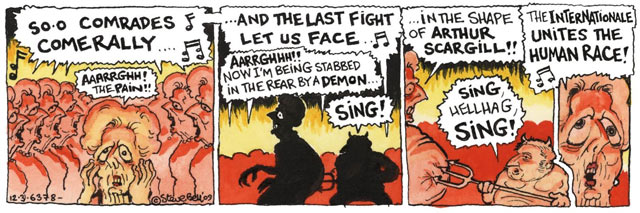
Aggrh! The Pail!!!
By Selim Gool