
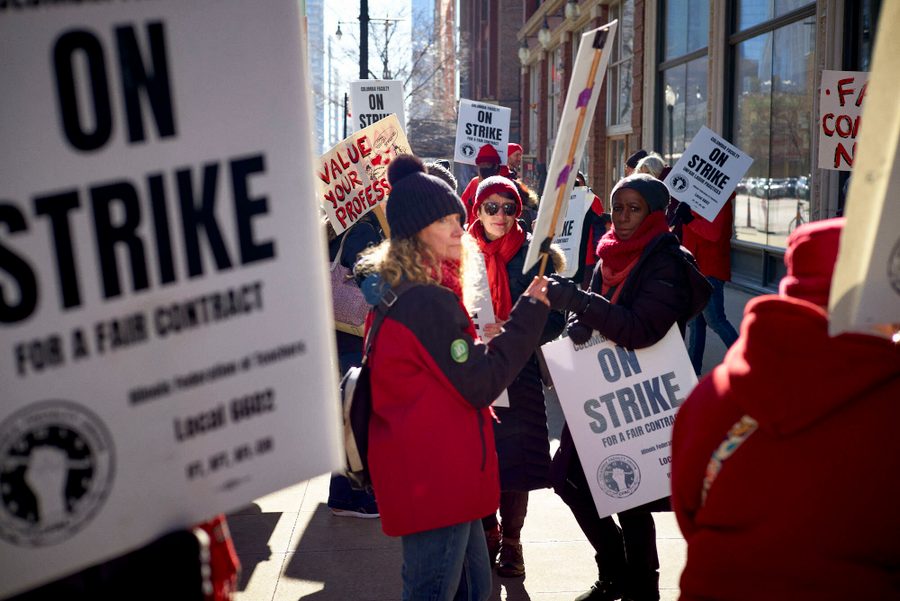
The longest adjunct strike in U.S. history ended this week after part-time faculty at Columbia College Chicago voted overwhelmingly in favor of ratifying a new four-year contract that will grant them greater job security and more decision-making power over their working conditions.
The 49-day strike was led by the Columbia College Faculty Union (CFAC), which represents approximately 600 part-time adjunct instructors at the private, arts-and media-focused institution in Chicago’s South Loop. The tentative agreement was reached on December 17. Eighty-five percent of the membership participated in the ratification vote, with 99.7% approving.
“I’m so proud of this contract,” says Diana Vallera, a photography instructor and president of CFAC. “A strong commitment to the collective bargaining process with a strong solidarity of membership is how you get a good outcome.”
In addition to a 16% raise, ratification bonus and supplemental healthcare benefit, Vallera says the new agreement gives adjuncts seats on college governance committees and guarantees them a percentage of the teaching work each semester based on an existing seniority structure — crucial victories for part-time instructors, who make up 72% of Columbia’s faculty.
“They’re not just treating us as discardable anymore,” Vallera tells In These Times. “We’re truly integrated into the institution. We’re integrated through these committees, through curriculum.
At the heart of the dispute was the Columbia administration’s plan to significantly reduce the number of classes offered during the 2023-24 academic year—cutting 53 sections in the fall and 317 sections in the spring — while also raising caps on some class sizes. The plan was announced in August, shortly before CFAC’s previous contract expired.
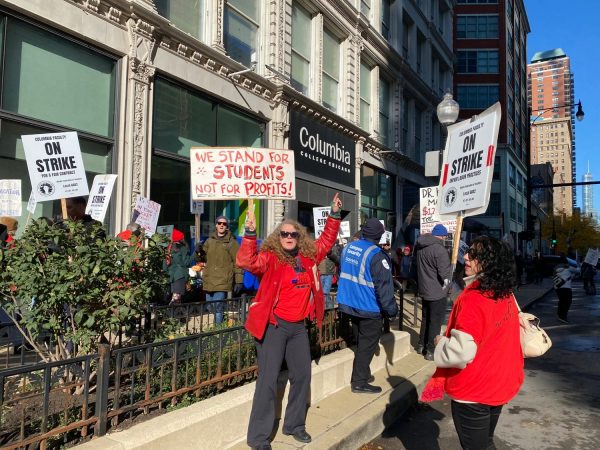
“It’s sort of like a classic management speedup: Offer less classes and have the people remaining do more work,” says Richard Grossman, an adjunct who has taught Latin American history at Columbia for 30 years.
The administration cited a $20 million budget deficit as the reason for the changes. Meanwhile, the college president (who also has the title of “CEO”) received a $300,000 bonus in 2021, on top of his over $799,000 salary.
“This all happened with a top-down decision; there were no [union] voices in the room,” Vallera explains.
Adjuncts have long been central to Columbia College’s education model, which offers students the opportunity to take small classes and learn hands-on from working professionals in fields such as filmmaking, music, journalism, creative writing, dance, photography and advertising.
“When I first started, it was a very vibrant liberal arts college; there was really a focus on ensemble, working together, creating stuff whether you were part-time or full-time, and it was just really exciting,” says Joe Janes, a CFAC member who has taught comedy and improv classes at Columbia for 18 years. “And then over the last decade, it’s shifted more toward a corporate, for-profit type of model, and it’s really sucked the life out of the place.”
The strike started on October 30, about two months into the fall semester, impacting an estimated 1,000 classes. Within a couple weeks, the administration allegedly locked strikers out of their online learning management systems, asked the 221 full-time faculty members — who are not unionized — to step in and teach the striking adjuncts’ classes, and told students they were expected to attend those classes after the Thanksgiving break.
“We could look up our course schedules online and see that a different teacher was taking over our class,” says Janes, whose improv course was taken over by the chair of the theatre department.
In response, CFAC filed an unfair labor practice charge accusing the college of illegally appropriating strikers’ intellectual property by using their course materials without their permission. Vallera tells In These Times that this and other unfair labor practice charges filed by the union during the strike are still pending.
According to Janes, in many departments, chairs were listed as the instructor of record for dozens of sections. “In some cases, it was 20, 30, 40 classes, which you know they can’t do,” he says. “A lot of it was either a shield for somebody coming from outside to teach, or a class became asynchronous and then the chair was just [having students do] some assignments.” He notes that students in his own class were allegedly told they only had to attend three improv workshops to complete the course, which is “[not] the way it was meant to be delivered.”
Janes adds that “a lot of feelings were hurt” when many of the adjuncts’ full-time colleagues crossed the picket line to replace them, which he contends only served to prolong the strike. “If people refused to do any scabbing, I think this whole thing would’ve been wrapped up in just a few weeks, if that long,” he says.
Columbia College did not respond to a question about the use of scabs and the union’s unfair labor practice charges but confirmed that a tentative agreement was reached on December 17.
Grossman’s Latin American history sections were taken over by a replacement instructor who he says was not qualified “on an academic level” to teach them, which he says happened in many classes where a replacement teacher was brought in. “You can assign me to teach a dance class, but that ain’t gonna work,” he says.
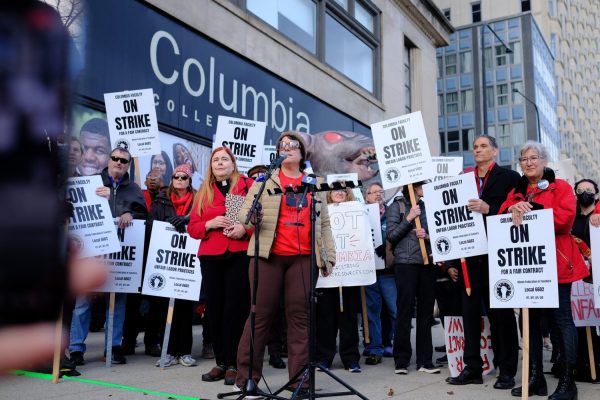
In a message sent on December 3, the school’s deans assured students that all replacement instructors were qualified to teach the courses they were assigned. “Many faculty are stepping in to teach classes they have previously taught — and in some cases designed,” read the statement.
At times, negotiations at the bargaining table reportedly seemed contentious. A federal mediator was brought in, and at one point, the administration revoked some of its previous offers as the strike continued late into the semester.
A former staffer with the United Farm Workers in the 1970s, Grossman says that by reassigning their sections, the administration was “trying to scare” strikers into returning to work, but “they seriously underestimated our determination.”
“People stayed out,” he says. “With all the hardships, people didn’t go back. I think that amazed the administration,” forcing them to reach an agreement with CFAC.
The new contract restores at least 50 of the 317 spring courses that were slated to be cut and compensates adjuncts whose classes were eliminated in the fall or who will be teaching fewer sections this spring than in previous spring semesters. Further, it creates a new Class Size Committee and Advisory Council on Adjunct Faculty Affairs to give part-time instructors a voice in the college’s future decision-making on registration caps, courses offerings and other matters related to teaching and curriculum.
Perhaps most importantly for a workforce of non-tenured employees, the contract locks in job security to adjuncts, based on seniority, with at least 650 course sections guaranteed each fall and 585 sections guaranteed every spring, with the number of guaranteed sections to increase as student enrollment increases.
“The only way to really have academic freedom is through job security,” says Vallera. “With job security, you have the ability to voice concerns about quality of education, about grading, about curriculum — and you can do it without fear of losing your job.”
She adds that “it’s the closest you’re going to get to a tenure system” for adjuncts. “That is the path I hope all adjunct faculty take — a movement toward job security so we can have that voice.”
In addition to making concessions to CFAC, the Columbia administration has also told students whose classes were affected by the strike that they will receive a $500 tuition credit. “We are serving the working-class families of Chicago,” says Vallera. “That is what this contract was all about, to make sure that these students matter, that they get quality education.”
With the contract ratified, adjuncts will return to work and courses will resume as normal at the start of the spring semester.
“Solidarity does work, if you’re willing to stick to it,” Grossman says. “If you hold out, you can win.”
ZNetwork is funded solely through the generosity of its readers.
Donate