
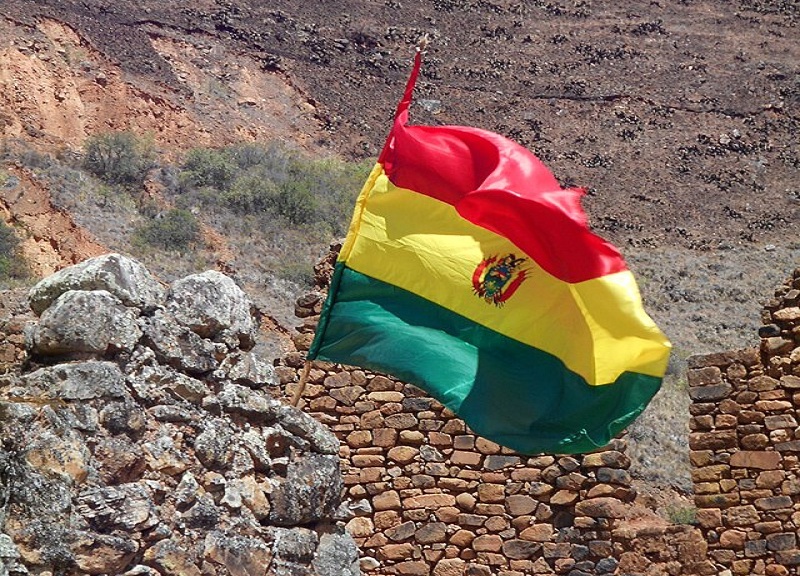
Bolivia has been rocked since early May by strikes, mass marches, and road blockades across the country as people demand the resignation of center-right president Rodrigo Paz. Paz’s election last fall brought an end to the two-decade-long political dominance of the left-wing Movement for Socialism (MAS) party and was viewed as another sign of a rightward political shift across Latin America. Yet Bolivia’s Indigenous groups, miners, urban workers, teachers, and peasants rose up again after the president broke a series of campaign promises and returned to the neoliberal agenda of austerity and political repression imposed on Bolivia prior to the MAS’s coming to power.
Though Paz reached an agreement with the country’s main union federation, a couple of days later, on June 20, he declared a state of emergency and ordered police and armed forces to clear roadblocks. Protest leaders say they nonetheless will keep up the pressure on the government.
To learn more about the protests and what the future may hold, Hammer & Hope spoke in early June with a Quechua Indigenous woman who is a protest leader and member of the National Confederation of Indigenous Peasant Women of Bolivia–Bartolina Sisa.
Hammer & Hope What led to the wave of protests?
Quechua activist To win our vote, President Paz made commitments to the working people who make up the majority of the country. He promised to resolve the fuel crisis, the dollar shortage, and the crises in health and education.
But he didn’t keep his promises. The government cut the fuel subsidy and provided very poor-quality fuel — total garbage — and it ruined many machines, tools, and vehicles. That caused deep anger not only in the transport sector but also among those who work in agriculture and production — basically everyone who uses fuel.
Popular organizations of Indigenous people, women, and workers repeatedly requested hearings and dialogue. Instead, Paz responded with repression. So people began to mobilize more and more, day after day. The government has never had the humility to listen to the people, not even to acknowledge that the people voted for them. Paz has repaid the people who voted for him with rubber pellets and tear gas. This government speaks of dialogue but offers only political persecution, including kidnappings of women leaders from the doorsteps of their homes.
HH In the face of the protests, Paz repealed Law 1720, an agrarian reform measure that the legislature had passed just one month earlier and he had previously supported. What would the law have done?
QA The government wanted to offer peasants the possibility of taking out loans and mortgaging their land as collateral. Peasants marched from Pando and Beni to La Paz to protest the proposal, but the government didn’t listen to them. [Pando and Beni are remote areas in northern Bolivia.] This government has no heart at all and treats workers worse than animals.
HH The uprising continued even after apparent concessions, including the agrarian law’s repeal, the replacement of government ministers responsible for energy policy, and Paz’s creation of a new Economic and Social Council meant to appease the protesters. Why do workers’ organizations consider these measures insufficient?
QA The council is made up of people who do not represent workers. They are public officials and relatives of members of the government. The country is completely shaken by protest. Workers, campesinos, and Indigenous people have been blockading roads for almost two months, but the government continues abducting them and violating Bolivians’ constitutional rights.
HH On June 8, President Paz signed a law that allows the government to take extraordinary measures when a state of emergency is declared. The armed forces can now intervene in internal conflicts, including using troops to dismantle roadblocks. How do you view this new law?
QA That law is not going to solve anything. On the contrary, the situation is going to get worse. What do you think the protesters are going to do? They are not afraid of it, and they remain strong at all the roadblocks currently set up in Bolivia. The Plurinational Legislative Assembly that approved the law is not made up of representatives of the workers, chosen from our communities, but rather of the elites, a small minority of the population. That is why we are demanding that those representatives of the elites must leave together with Rodrigo Paz. They are the enemies of the people.
HH How do the popular organizations propose to solve the political crisis?
QA This government has to go. The vice president has to assume the presidency constitutionally and call new elections. That way, we can have a new government for the people.
HH What is the role of the former president Evo Morales, the Indigenous militant who led the MAS for many years, in the current popular uprising?
QA Comrade Evo is not leading this uprising. The mobilizations are led by representatives elected organically by their bases.
The people recognize that Evo was a better president, and that bothers the government. That is why government officials blame him for everything and wash their hands of responsibility. He is facing severe repression. In the small town where he lives, Lauca Eñe in Cochabamba, his supporters have maintained a constant security watch to protect him from violence for almost two years. They fear that Evo might be kidnapped or arrested, as happened with Maduro in Venezuela. He offers moral support, but saying that he is behind everything is completely false. Blaming him is part of a political attack meant to confuse people, including the international press.
HH The United States, together with the governments of Bolivia, Argentina, Chile, Ecuador, Paraguay, and seven other Latin American and Caribbean countries, issued a joint statement condemning the workers’ actions as antidemocratic and an attempt to undermine the elected government. How do you view foreign interference in Bolivia today?
QA Bolivia possesses many natural resources, such as lithium; minerals, including rare-earth metals; fresh water; and forests. That is why those countries have their eyes on us. They want to plunder our wealth. In 2019, there was a coup d’état over control of lithium resources. The mobilizations today are also a response to the international threat. Indigenous peoples will not allow interference, because we do not want to gamble away our children’s future.
These countries talk about drug trafficking, but that is a pretext to try to bring the U.S. Drug Enforcement Administration back into the country, something the Bolivian people do not accept. That would serve to open the door to the plunder of our natural resources. Indigenous peasant peoples have a clear position: Those resources must be respected and preserved for the future, especially lithium. That is why, today more than ever, the people are standing up.
This article was produced by Hammer & Hope
ZNetwork is funded solely through the generosity of its readers.
Donate