
When Nayib Bukele was inaugurated as El Salvador’s new president on June 1, the ceremony—open to the public for the first time—was, like several other opening gambits of the new administration, more symbolic than substantive. Held outdoors in the historic center of downtown San Salvador just blocks from the bustle of street vendors and the wheeze of city buses, the event was squarely on brand with Bukele’s populist messaging and widely promoted as the first glimpse of a “new era” of governance in El Salvador: inclusive, accessible, and transparent.
However, as Bukele marks his first 100 days as president and the substance of his administration begins to take form, Salvadoran popular movement organizations warn that far from any “new ideas” (for which Bukele’s party, Nuevas Ideas, is named), Bukelismo signals a return to the all-too-familiar neoliberal program of wealth reconsolidation and acquiescence to empire, albeit rebranded in the populist, “post-ideological” rhetoric of our times.
Bukele’s first public address post-election was delivered at the ultraconservative U.S. Heritage Foundation, where he assured the right-wing crowd that the Salvadoran people “want the same thing Americans want,” like “free enterprise and limited government.” On the heels of that speech came a broad invitation to foreign investors to “come to the banquet” of opportunity laid out for them in El Salvador. During his inauguration, Bukele spoke of El Salvador as a “sick child” whose cure would require “bitter medicine,” “individual responsibility,” and “sacrifice.” Neoliberal tropes like these set the social movement on edge, as they infer from them a return to the austerity measures, paternalism, and bootstrap ideology of previous Nationalist Republican Alliance (ARENA) administrations (1989-2009) that triggered the economic and social crises that continue to keep much of El Salvador in poverty.
Three short months in office have confirmed social movement fears. Within weeks of assuming power, President Bukele launched a massive layoff campaign that eliminated hundreds of public sector workers under the guise of “rooting out corruption.” Several government agencies have been dissolved entirely, including, ironically, those responsible for social inclusion, citizen participation, and government transparency—precisely the things his new era of government has promised to deliver. Beyond the direct and immediate material damage to public sector workers and unions, however, the social movement fears that these cuts lay the groundwork for an even more radical project of state restructuring, one which the International Monetary Fund and the U.S. Embassy have been pushing for years through mechanisms like the proposed Public Services Law.
On matters of immigration and security, Bukele has openly signaled concession to the United States.
On matters of immigration and security, Bukele has openly signaled concession to the United States. When the lives of Oscar Alberto Martinez Ramírez and his 23-month-old daughter, Valeria, were taken crossing the Rio Grande River, instead of denouncing U.S. migration policies that criminalize refugees and routinely subject them to violence, Bukele put the blame on Salvadorans, calling the deaths “our fault.” Extending this sentiment to policy, he recently initiated a new phase of cooperation with the U.S. Department of Homeland Security to patrol El Salvador’s borders and unleashed a massive increase of “anti-gang” forces in its streets. This last measure has prompted sharp outcry from human rights leaders, especially in light of the broad prohibition of military participation in domestic security enshrined in the 1992 Peace Accords. Nonetheless, this increase in police and military presence will likely be welcomed by incoming U.S. Ambassador Ron Johnson, who arrives directly from the U.S. Armed Forces Southern Command. In sum, Bukele appears fully on board with the Trump Administration’s war on the citizens of Central America.
None of these developments come as surprise, however, to social and popular movement organizations in El Salvador who warned well before the election of a wolf in sheep’s clothing. As Bukele marks 100 days in office, CISPES revisits a conversation we convened with social movement leaders on the eve of the inauguration: Onidia Gomez from the Salvadoran Foundation for Local Development and Democracy (FUNDASPAD) discusses human rights, corruption, and impunity; activist and scholar Sara Garcia from the Citizen’s Group for the Depenalization of Abortion addresses women’s and reproductive rights; and Bernardo Belloso from the Development Association of El Salvador (CRIPDES) takes up defense of the environment.
What follows is our conversation, translated from Spanish and lightly edited, about what grassroots leaders in El Salvador anticipate from their new president, what they demand, and how they plan to navigate the distance between the two.

A person carried a flag reading, “El Salvador of the people, not of the empire or its puppets.” (Photos by CISPES)
CISPES: Onidia Gomez, what do you see as the main challenges to the social movement under the new administration in terms of government transparency, corruption, and the like?
Onidia Gomez: The last ten years of progressive government under the FMLN gave us important and significant changes, not just in social indicators but also around transparency and corruption, specifically. Before 2009, we didn’t really have any measures against corruption. It wasn’t until 2010 that we saw a law guaranteeing access to public information [the Law for Transparency and Access to Information]. Before the law, we had no way to know how the national budget was distributed among various government agencies, salaries, or projects – or really how the central government was operating at all.
One is the way Bukele has used social media to denounce or promote certain individuals, without proof either way. If there is an accusation, it should be made through the Attorney General’s office; people should not be tried on social media.
With the new government, we are worried about some specific issues regarding transparency. One is the way Bukele has used social media to denounce or promote certain individuals, without proof either way. If there is an accusation, it should be made through the Attorney General’s office; people should not be tried on social media. The latter will only lead to a lynching of public figures, and that’s not really transparency, in terms of carrying out government; in fact, it’s circumventing all the mechanisms of transparency.
CISPES: Can you talk about what you see in the new president’s stance toward the United States?
OG: The truth is that this is one of the most concerning situations we’re facing. For example, after the election in February, the U.S. Ambassador to El Salvador was invited to participate in the transition of government. For the United States to accompany or work alongside a transition is one thing, but to be considered part of the transition team is another. This is something we’ve never seen. Likewise, the role that the United States Embassy has taken regarding many national issues that we face is also highly concerning.
First is the Public Service Law, which challenges the right of the public sector to unionize at the government level. The main force behind this law is the U.S. Embassy. This is a major concern because it jeopardizes the ability of unions to fight for job stability and to collectively bargain, which are hard-won battles that we hope will not be undone. One of the interventions that we’ve heard a lot about from the United States is the need to “modernize” ourselves. To do this, it’s even been suggested that we return to a twelve-hour workday to increase productivity.
Other issues where we see strong U.S. influence is in the call to vote this way or that way—with the National Reconciliation Law, for example [Editor’s note: Following the 2016 Supreme Court ruling to overturn the Amnesty Law, the right-wing dominated Legislative Assembly has debated a replacement law as the court mandated]. The U.S. has been very “active,” let’s say, on this issue, taking a strong position on it and how justice should operate in El Salvador. We don’t think this is the role that an embassy should play. It’s up to us as Salvadorans to come to agreements on these issues.
If at some point the U.S. would be interested in actually contributing to this issue of national reconciliation, perhaps they’d like to extradite Elliot Abrams, who was involved in the El Mozote massacre. Perhaps they’d like to acknowledge his role in El Salvador’s war and the role of the U.S. in funding and training a brutal military that killed so many of our people. That is at the root of the reconciliation that our country needs. But perhaps they are not interested in contributing to reconciliation in that way.
The role of the Embassy also raises concerns about transparency, as the new government is not saying just how far they intend to allow the U.S. government to participate in our own affairs. Bukele has already made a number of statements in favor of international commitments, and we know that part of the geopolitical strategy of Trump’s presidency has sought out the support of the incoming president. So this is concerning. These types of decisions should not take place behind closed doors but should be presented to our people.
CISPES: Sara Garcia, where is El Salvador in its struggle for women’s rights and reproductive rights?
Sara Garcia: El Salvador has an absolute abortion ban, no exceptions. The context of the current situation in El Salvador involves profound structural and social violence against women. This is borne out by sobering statistics: In 2018, there were 353 femicides, and to date in 2019 there have been 131 femicides in El Salvador. There are over 19,120 pregnancies of girls and adolescents [yearly]. The number-one cause of maternal death among teenagers in El Salvador is suicide. These things are part of the concrete Salvadoran reality, and the numbers cry out the injustice that we’re facing. Our fight to decriminalize and depenalization abortion takes place in this environment.
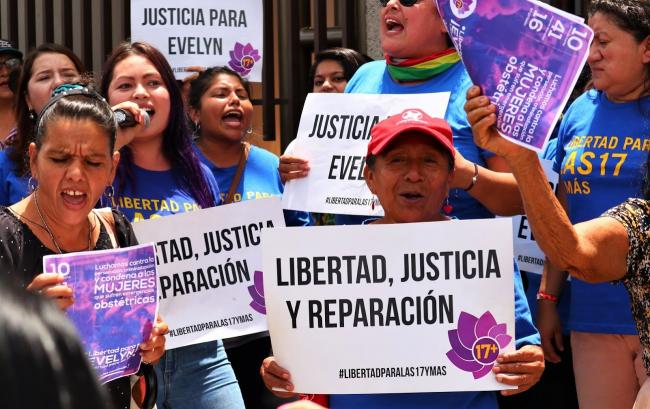
El Salvador’s feminist movement protest for the release of Evelyn Hernandez, August 19, 2019. (Photo by CISPES)
CISPES: Thoughts going forward under a new administration?
SG: Bukele has said he believes in decriminalizing abortion when the woman’s life is in danger. However, “life and health of the mother” entails a much wider context than many people understand. If you’re in favor of saving the life and health of the mother, it’s necessary to remember that we’re often talking about violence towards and violation of young girls, which clearly threatens their lives and health as well.
There are also other aspects of women’s lives and health that justify the right to abortion; these are the “four causes” [under which we are advocating that abortion be permitted—when the women’s health is at risk, in cases of rape, when the fetus is nonviable, and in girls who are underage, especially when the pregnancy is a result of rape]. So, the struggle and the issue is beyond the personal beliefs of the candidates.
The previous Ministry of Health took a very clear and powerful position on the issue of abortion. And so the very minimum that the new government should do is to take up and advance that same strong position. We will fight to prevent any rollbacks of our progress. And we will fight in solidarity with the feminist movement across Latin America and in the Caribbean because our struggles are connected; it’s a regional struggle.
Additionally, we believe it’s important not just for the president to take up the proposals of the social movement but also to enter into dialogue with our movement, because without dialogue there will not be democracy. We require freedom of expression, specifically in this context.
CISPES: Bernardo Belloso, what are some of the concerns regarding the environment and natural resources in El Salvador?
Bernardo Belloso: When ARENA won the biggest bloc of seats in the Legislative Assembly last year, they immediately wanted to reform Article 105 of the Constitution, which establishes the limit of the amount of land that a person can hold in El Salvador. They want to make that land available to transnational corporations as well as to big business within El Salvador. This is a central concern. Likewise, right-wing parties in the national assembly want to reverse the 2017 ban on metallic mining. This is a very real threat because the right wing has a [super] majority of seats. Part of our struggle now is to attach the mining ban to the constitution so it can’t be repealed.
The other big issue that we’ve been fighting against is the privatization of water resources. This is a struggle that we’ve been fighting since 2006, 2007 because of the policies of [ARENA] president Tony Saca. Now that the right-wing parties have an even stronger majority in the legislature, they have begun again to try to privatize water in El Salvador. The social movements continue to advocate for the General Water Law, which would ensure the right to water.
So far, Bukele’s positions tend to favor economic interests over popular interests.
One of the big challenges for us regarding the new government is how or whether it will support these environmental objectives. So far, Bukele’s positions tend to favor economic interests over popular interests.
CISPES: With regard to environmental concerns, how do you view the relationship between the Trump administration and the Bukele administration?
BB: The relationship between the U.S. government and the incoming Salvadoran government is deepening and this will affect the lives of our population. The geopolitical influence that the United States seeks to maintain in El Salvador in order to strengthen economic and military power across Latin America violates our sovereign and constitutional right to govern ourselves. Greater U.S. involvement will without a doubt have consequences, especially among more vulnerable social and economic classes in El Salvador. We see the impact of U.S. involvement in other areas of Latin America, in Venezuela, for example, where the people’s right to choose their own leaders and decide their own future is being challenged. We interpret this as an intention on the part of the United States to build a new axis of power in Latin America that will serve the political interests and neoliberal policies of the United States. Meanwhile, we have populations here in Central America, particularly indigenous people, who are being massacred, their natural resources taken, and Bukele has not spoken out about it.
The new government is in alliance with the U.S. government and with multinational, transnational private industries. What we expect is a new state of criminalization, like we’re seeing [elsewhere in Central America] where entire communities are being criminalized by repressive governments on behalf of private industry. There is also the threat of the anti-terrorism law, which was created by ARENA but is still in effect, being used to squash any actions that we might take as a movement. That’s a concern.
What that means is that the people of this country have to continue resisting. It’s important to keep fighting for what we’ve already won and to recognize that we’ve won our victories in the streets – they weren’t given to us by anyone. So if we’re seeing bad governance, we’re going to have to mobilize. We will see if Bukele is going to work for the majority of Salvadorans—if he responds to the needs of the many, or for the minority.
The Committee in Solidarity with the People of El Salvador (CISPES) is a grassroots solidarity organization that has been supporting the Salvadoran people’s struggle for social and economic justice since 1980.
ZNetwork is funded solely through the generosity of its readers.
Donate

