
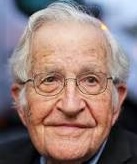
With the recent insertion of Russian military power into Syria and the continued use of American air power in the region, the situation in Syria has gotten tenser than ever, especially since the allegedly accidental September 17, 2016, attack on a Syrian military position that killed dozens, followed by the dismissive comments about the incident that U.S. Ambassador to the UN, Samantha Power, made at a UN press conference on September 17. Former acting CIA Director Michael Morell recently said, “The Russians and Iranians need to pay a little price for their actions in support of Assad.” In light of these developments, New York City teachers Saul Isaacson and Daniel Falcone recently sat down with Noam Chomsky to discuss Syria and U.S. foreign policy.
ISAACSON/FALCONE: In light of recent developments in the propaganda blitz against Syrian President Bashar al-Assad, are you concerned that a Clinton presidency would seek to confront Russia on Syrian soil—are we now seeing the opening salvos?
NOAM CHOMSKY: I pretty much doubt it. The Russians have an impregnable position. What they’re doing is pretty horrible, but there’s no way to impede it except by a nuclear war, which no one’s going to do. So I think the West will watch.
You don’t see Syria as the next place to install a democracy “regime change,” as they call it?
Only if you want to destroy the world. There is a major Russian military presence, and you can’t confront that.
So it’s the old Cold War doctrine. There is a great deal of concern among progressive writers that a Clinton presidency would lead to a confrontation with the Russians.
I think the concern was misplaced. I don’t like Clinton at all, but I think she’s was demonized. She’s no worse than the European leaders. So, for example, in Libya she was terrible, but former French President Nicolas Sarkozy and former UK Prime Minister David Cameron were worse. And on some things, she’s surprisingly dovish. There’s a leak of a private discussion that she had with a couple of anti-nuke people, national security specialists who were critical of the nuclear buildup—not defense secretary for President Bill Clinton William Perry, but former Defense Department official] Andrew C. Weber—she was probably accommodating to them, but the statements she made were not bad.
She expressed some skepticism about Obama’s trillion-dollar nuclear modernization plan. She came out in opposition to the most dangerous part of it—the development of smaller nuclear-tip missiles, which can be adapted, scaled down for battlefield usage. She opposed that and made a couple of other reasonable comments, which were probably in reaction to her audience, since politicians say what people want to hear, but it’s something that she could have been pressed on by popular movements—“OK, you’re on the record for this, so stop this.”
Many observers are defending Assad, saying this is not a place to build a new regime, and sometimes they give the example of Libya and Iraq.
That’s a separate question. Gaddafi was not a nice guy either, but it was no reason to destroy the country. In this case, it’s not even an option. If you tried anything like what was done in Libya, you’d have a world war.
Recently, Obama sent something like 250 more troops to Iraq. Does that concern you?
It does, but for reasons that were pretty well expressed in an op-ed in the New York Times by Jamal al-Dhari. The fact is that when the U.S.-backed forces attacked Ramadi and Fallujah, they practically destroyed them. Now these are the main Sunni cities and Mosul is the last Sunni city. This is what he said: If you just wipe the place out, it’ll lay the basis for a much more vicious conflict. If you just destroy things without looking at the roots of what’s there, it’s going to get worse. That’s why ISIS grew out of al-Qaeda in Iraq. Smash up one thing, don’t deal with the sources, the result will be worse. It’s not easy to say what to do. ISIS is pretty awful, but you just have to deal with the roots of it—the whole ethnic sectarian conflict, which was an outgrowth of the Iraq War. And the Sunni populations do feel threatened by the Shiite majority and the Shiite militias. Unless something is done to lead to an accommodation, it’ll be pretty brutal out there.
Is there any hope for working with Russia on this?
There may be some hope. In the case of Syria, there’s simply no realistic alternative, short of destroying Syria, to having some kind of transitional government with Assad certainly involved, maybe in power. It’s ugly, but there’s no alternative. My good friend Gilbert Achcar has an article in The Nation that says as long as Assad remains in power, the opposition will continue to fight until the death of Syria. So he says we have to do something to get Assad out of power, but that can’t be done. That’s the problem.
That’s such a grim set of alternatives.
It’s pretty grim. And for Syria, it’s horrendous. The one saving grace is, if you look at history at the end of the First World War in Syria, it was just about as bad as what’s happening now. They probably had the worst casualties per capita of any country in the world during the First World War. It was very brutal, with hundreds of thousands killed. It was a much smaller country then, but they recovered somehow, so it’s conceivable, but it’s pretty awful. It’s hard to think of any recommendations. I don’t know what Obama could’ve done that’s better than what he did do.
Z
Daniel Falcone is an independent journalist, activist, and teacher. He writes for several publications and teaches in New York City. Saul Isaacson studied at Columbia and has taught English at Trinity School in New York for over two decades. The original interview is from Truthout.
