
N
oam
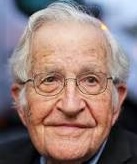
Chomsky, professor at the Massachusetts Institute of Technology,
founder of the modern science of linguistics and political activist,
spoke on the phone with V. K. Ramachandran about the current
U.S.attack on Iraq.
V. K. RAMACHANDRAN:
Does the present aggression
on Iraq represent a continuation of United States’ international
policy in recent years or a qualitatively new stage in that
policy?
NOAM CHOMSKY: It represents a significantly new phase. It is
not without precedent, but significantly new nevertheless. This
should be seen as a trial run. Iraq is seen as an extremely
easy and totally defenseless target. It is assumed, probably
correctly, that the society will collapse, that the soldiers
will go in, and that the U.S. will be in control and will establish
the regime of its choice and military bases. They will then
go on to the harder cases. The next case could be the Andean
region, it could be Iran, it could be others.
The trial run is to try and establish what the U.S. calls a
“new norm” in international relations. The new norm
is “preventive war.” Notice that new norms are established
only by the United States. So, for example, when India invaded
East Pakistan to terminate horrendous massacres, it did not
establish a new norm of humanitarian intervention, because India
is the wrong country, and besides, the U.S. was strenuously
opposed to that action.
This is not pre-emptive war; there is a crucial difference.
Pre-emptive war has a meaning, it means that, for example, if
planes are flying across the Atlantic to bomb the United States,
the United States is permitted to shoot them down even before
they bomb and may be permitted to attack the air bases from
which they came. Pre-emptive war is a response to ongoing or
imminent attack.
The doctrine of preventive war is totally different; it holds
that the United States—alone, since nobody else has this
right—has the right to attack any country that it claims
to be a potential challenge to it.
The doctrine of preventive war was announced explicitly in the
National Security Strategy last September. It sent shudders
around the world, including through the U.S. establishment,
where, I might say, opposition to the war is unusually high.
The Security Strategy said, in effect, that the U.S. will rule
the world by force, which is the dimension—the only dimension—in
which it is supreme. Furthermore, it will do so for the indefinite
future because if any potential challenge arises to U.S. domination,
the U.S. will destroy it before it becomes a challenge.
This is the first exercise of that doctrine. If it succeeds
on these terms, as it presumably will, because the target is
so defenseless, then international lawyers and Western intellectuals
and others will begin to talk about a new norm in international
affairs. It is important to establish such a norm if you expect
to rule the world by force for the foreseeable future.
I shall mention one precedent, just to show how narrow the spectrum
is. In 1963, Dean Acheson, who was a much respected elder statesperson
and senior adviser of the Kennedy administration, gave an important
talk to the American Society of International Law, in which
he justified the U.S. attacks against Cuba. The attack by the
Kennedy administration on Cuba was large-scale international
terrorism and economic warfare. The timing was interesting—it
was right after the Missile Crisis, when the world was very
close to terminal nuclear war. In his speech, Acheson said that
no “legal issue” arises when the United States responds
to a challenge to its “power, position, or prestige,”
or words approximating that.
Is
it also a new phase in that the U.S. has not been able to carry
others with it?
That is not new. In the case of the Vietnam War, for example,
the United States did not even try to get international support.
Nevertheless, you are right in that this is unusual. This is
a case in which the United States was compelled, for political
reasons, to try to force the world to accept its position and
was not able to. Usually, the world succumbs.
So does it represent a “failure of diplomacy”
or a redefinition of diplomacy?
I wouldn’t call it diplomacy—it’s a failure of
coercion. Compare it with the first Gulf War. In the first Gulf
War, the U.S. coerced the Security Council into accepting its
position, although much of the world opposed it. NATO went along
and the one country in the Security Council that did not—Yemen—was
immediately and severely punished.
In any legal system that you take seriously, coerced judgments
are considered invalid, but in the international affairs conducted
by the powerful, coerced judgments are fine—they are called
diplomacy.
What is interesting about this case is that the coercion did
not work. There were countries—in fact, most of them—who
stubbornly maintained the position of the vast majority of their
populations.
The most dramatic case is Turkey. Turkey is vulnerable to U.S.
punishment and inducements. Nevertheless, the new government,
I think to everyone’s surprise, maintained the position
of about 90 percent of its population. Turkey is bitterly condemned
for that here, just as France and Germany are bitterly condemned
because they took the position of the overwhelming majority
of their populations. The countries that are praised are countries
like Italy and Spain, whose leaders agreed to follow orders
from Washington over the opposition of maybe 90 percent of their
populations.
That is another new step. I cannot think of another case where
hatred and contempt for democracy have so openly been proclaimed,
not just by the government, but also by liberal commentators
and others. There is now a whole literature trying to explain
why France, Germany, the so-called “old Europe,” and
Turkey and others are trying to undermine the United States.
It is inconceivable to the pundits that they are doing so because
they take democracy seriously and they think that when the overwhelming
majority of a population has an opinion, a government ought
to follow it.
That is real contempt for democracy; just as what has happened
at the United Nations is total contempt for the international
system. There are now calls—from the
Wall Street Journal
,
people in government and others—to disband the United Nations.
Fear of the United States around the world is extraordinary.
It is so extreme that it is even being discussed in the mainstream
media. The cover story of the upcoming issue of
Newsweek
is about why the world is so afraid of the United States.
The
Post
had a cover story about this a few weeks ago.
Of course, this is considered to be the world’s fault,
that there is something wrong with the world with which we have
to deal somehow, but also something that has to be recognized.
The idea that Iraq represents any kind of clear and present
danger is, of course, without any substance.
Nobody pays any attention to that accusation, except, interestingly,
the population of the United States. In the last few months,
there has been a spectacular achievement of government-media
propaganda, very visible in the polls. The international polls
show that support for the war is higher in the United States
than in other countries. That is, however, quite misleading,
because if you look a little closer, you find that the United
States is also different in another respect from the rest of
the world. Since September 2002, the United States is the only
country in the world where 60 percent of the population believes
that Iraq is an imminent threat—something that people do
not believe, even in Kuwait or Iran.
After
the September 11 attack, the figure was about 3 percent. Government-media
propaganda has managed to raise that to about 50 percent. If
people genuinely believe that Iraq has carried out major terrorist
attacks against the United States and is planning to do so again,
well, in that case people will support the war.
This has happened after September 2002. September 2002 is when
the government-media campaign began and also when the mid-term
election campaign began. The Bush administration would have
been smashed in the election if social and economic issues had
been in the forefront, but it managed to suppress those issues
in favor of security issues—and people huddle under the
umbrella of power.
This is exactly the way the country was run in the 1980s. Remember
that these are almost the same people as in the Reagan and the
senior Bush administrations. Through the 1980s they carried
out domestic policies that were harmful to the population and
which, as we know from extensive polls, the people opposed.
But they managed to maintain control by frightening the people.
So the Nicaraguan army was two days’ march from Texas and
the airbase in Grenada was one from which the Russians would
bomb us. It was one thing after another, every year, every one
of them ludicrous. The Reagan administration actually declared
a national emergency in 1985 because of the threat to the security
of the United States posed by the government of Nicaragua.
If somebody were watching this from Mars, they would not know
whether to laugh or to cry.
They are doing exactly the same thing now and will probably
do something similar for the presidential campaign. There will
have to be a new dragon to slay, because if the Administration
lets domestic issues prevail, it is in deep trouble.
You have written that this war of aggression has dangerous
consequences with respect to international terrorism and the
threat of nuclear war.
I cannot claim any originality for that opinion. I am just quoting
the CIA, other intelligence agencies, and virtually every specialist
in international affairs and terrorism.
Foreign Affairs,
Foreign Policy
, the study by the American Academy of Arts
and Sciences, and the high-level Hart-Rudman Commission on terrorist
threats to the United States all agree that it is likely to
increase terrorism and the proliferation of weapons of mass
destruction.
The reason is simple: partly for revenge, but partly for self-defense.
There is no other way to protect oneself from U.S. attack. The
United States is making the point very clearly and is teaching
the world an extremely ugly lesson.
Compare
North Korea and Iraq. Iraq is defenseless and weak; the weakest
regime in the region. While there is a monster running it, it
does not pose a threat to anyone else. North Korea, on the other
hand, does pose a threat. North Korea, however, is not attacked
for a very simple reason: it has a deterrent. It has amassed
artillery aimed at Seoul and if the United States attacks it,
it can wipe out a large part of South Korea.
So the United States is telling the countries of the world:
if you are defenseless, we are going to attack you when we want,
but if you have a deterrent, we will back off, because we only
attack defenseless targets. It is telling countries that they
had better develop a terrorist network and weapons of mass destruction
or some other credible deterrent; if not, they are vulnerable
to “preventive war.” For that reason alone, this war
is likely to lead to the proliferation of both terrorism and
weapons of mass destruction.
How do you think the U.S. will manage the human and humanitarian
consequences of the war?
No one knows, of course. That is why honest and decent people
do not resort to violence—because one simply does not know.
The aid agencies and medical groups that work in Iraq have pointed
out that the consequences can be very severe. Everyone hopes
not, but it could affect up to millions of people. To undertake
violence when there is even such a possibility is criminal.
There is already—that is, even before the war—a humanitarian
catastrophe. By conservative estimates, ten years of sanctions
have killed hundreds of thousands of people. If there were any
honesty, the U.S. would pay reparations just for the sanctions.
The situation is similar to the bombing of Afghanistan. It was
obvious the United States was never going to investigate the
consequences.
Or invest the kind of money that was needed.
No. First, the question is not asked, so no one has an idea
of what the consequences of the bombing were for most of the
country. Then almost nothing comes in. Finally, it is out of
the news, and no one remembers it any more.
In Iraq, the United States will make a show of humanitarian
reconstruction and will put in a regime that it will call democratic,
which means that it follows Washington’s orders. Then it
will forget about what happens later and will go on to the next
one.
How have the media lived up to their propaganda-model
reputation this time?
Right now it is cheerleading for the home team. Look at CNN,
which is disgusting—and it is the same everywhere. That
is to be expected in wartime; the media are worshipful of power.
More interesting is what happened in the build-up to war. The
fact that government-media propaganda was able to convince the
people that Iraq is an imminent threat and that Iraq was responsible
for September 11 is a spectacular achievement and, as I said,
was accomplished in about four months. If you ask people in
the media about this, they will say, “Well, we never said
that,” and it is true, they did not. There was never a
statement that Iraq is going to invade the United States or
that it carried out the World Trade Center attack. It was just
insinuated, hint after hint, until they finally got people to
believe it.
Look at the resistance, though. Despite the propaganda,
despite the denigration of the United Nations, they haven’t
quite carried the day.
The United Nations is in a very hazardous position. The United
States might move to dismantle it. I don’t really expect
that, but at least to diminish it, because when it isn’t
following orders, of what use is it?
You
have seen movements of resistance to imperialism over a long
period. What are your impressions of the present resistance
to U.S. aggression? We take heart in the extraordinary mobilizations
all over the world.
There is nothing like it. Opposition throughout the world is
enormous and unprecedented and the same is true of the United
States. Recently, for example, I was in demonstrations in downtown
Boston. The first time I participated in a demonstration there,
at which I was to speak, was after the United States had started
bombing South Vietnam. Half of South Vietnam had been destroyed
and the war had been extended to North Vietnam. At that time,
we couldn’t hold a demonstration because it was physically attacked,
mostly by students, with the support of the liberal press and
radio, who denounced these people who were daring to protest
against an American war.
On this occasion [2003], however, there were massive protests
before the war was launched and once again on the day it was
launched—with no counter-demonstrators. That is a radical
difference. If it were not for the fear factor that I mentioned,
there would be much more opposition.
The government knows that it cannot carry out long-term aggression
and destruction as in Vietnam because the population will not
tolerate it. There is only one way to fight a war now. First
of all, pick a much weaker enemy, one that is defenseless. Then
build it up in the propaganda system as either about to commit
aggression or as an imminent threat. Next, you need a lightning
victory. An important leaked document of the first Bush administration
in 1989 described how the U.S. would have to fight war. It said
that the U.S. had to fight much weaker enemies and that victory
must be rapid and decisive, as public support will quickly erode.
It is no longer like the 1960s, when a war could be fought for
years with no opposition at all.
In many ways, the activism of the 1960s and subsequent years
has made a lot of the world, including this country, much more
civilized in many domains.
This interview
appeared in
Frontline
.
