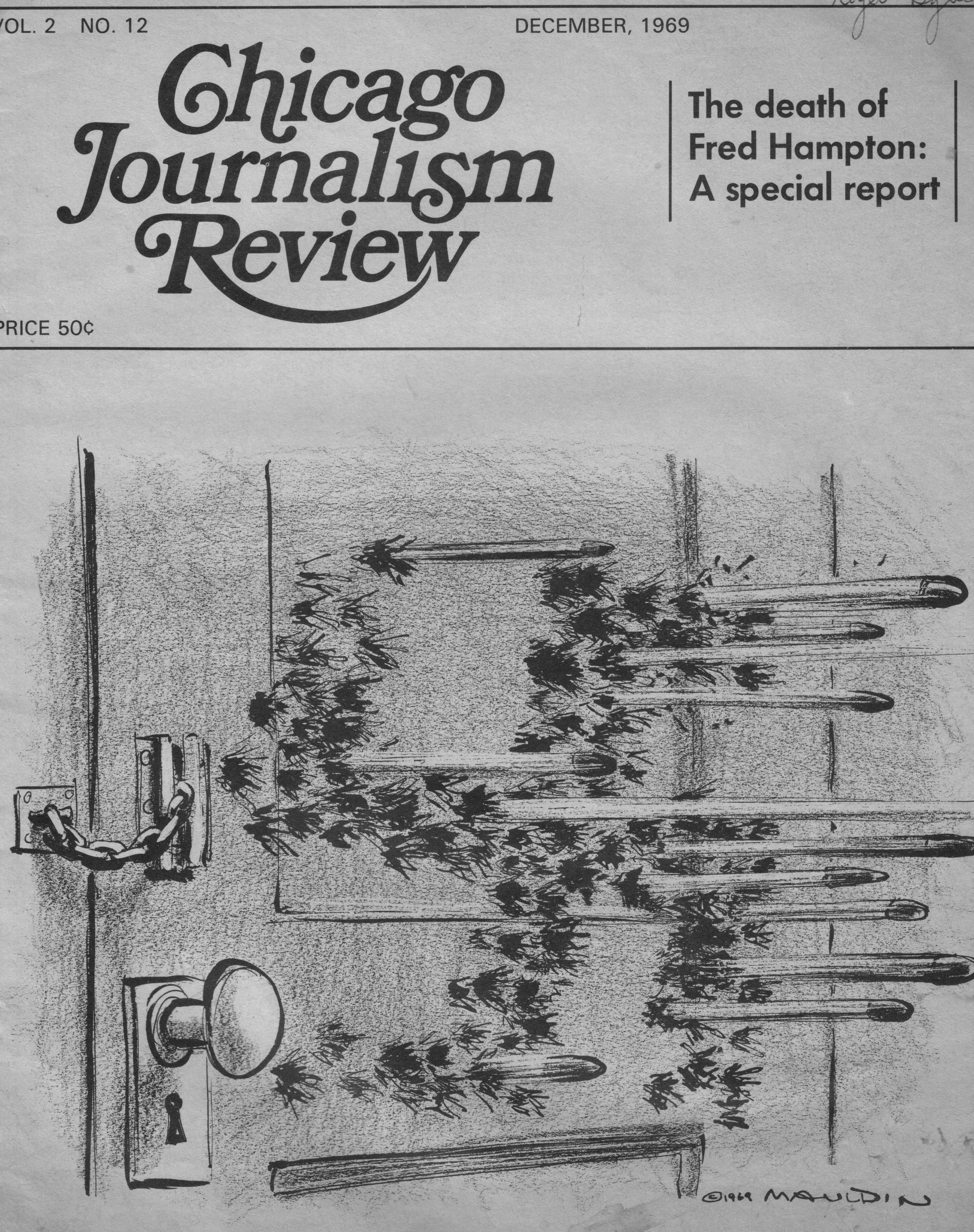
Jeffrey Haas, author of The Assassination of Fred Hampton provides some useful insights in his recent Monthly Review interview on the anniversary of Fred Hampton’s murder by Chicago police and the FBI. Here’s a perceptive excerpt:
JH:Chicago has a large black community, which has operated both inside and outside the power structure of the Democratic machine. In fact, it was the reaction to Hampton’s death that created the independent coalition of blacks and liberal whites that resulted in the election of Harold Washington as Chicago’s first black mayor. Some argue that Barack Obama is a direct descendant and beneficiary of that legacy, and certainly his campaign would never have obtained traction in Chicago had not the black community obtained substantial power within the Democratic Party.
MR: Sectarians often criticize the Black Panthers as “militarist” and the Weather Underground as “adventurist.” To what extent would you agree? If your experience permits you to say, how does the younger generation of the politically aware, those born after the 1960s and ’70s, see the Black Panthers and the Weather Underground?
JH: The more I studied the sixties, the more I came to believe that the Panthers and Weather Underground were both the natural — and perhaps necessary — development of the movements of the era. The Panthers sought to remedy the ineffectiveness of Dr. King’s religious and nonviolent movement to change the conditions of blacks outside the South, and to channel the youthful rage of the many urban riots, into a progressive and cohesive force for political and revolutionary change. Similarly, the Weathermen evolved after years of increasingly militant protest, which nevertheless failed to stop the Vietnam war or stop the attacks on the black movement. To say that the emergence of these groups was inevitable does not mean that their strategies and tactics should not be reexamined today. However, to criticize what they did, based on the contradictions of today, rather than on what they knew and faced in the sixties, is shallow and prevents an understanding of their critical roles in the history of the movement.
I'm teaching in Labor Studies at Penn State and the University of Illinois in on-line classes. I've been continuing with my work as freelance writer, with my immediate aim to complete a book on corporate media coverage of globalization (tentatively titled The Giant Sucking Sound: How Corporate Media Swallowed the Myth of Free Trade.) I write frequently for Z, The Progressive Magazine's on-line site, The Progressive Populist, Madison's Isthmus alternative weekly, and a variety of publications including Yes!, The Progressive, Foreign Policy in Focus, and several websites. I've been writing a blog on labor issues for workinginthesetimes.com, turning out over 300 pieces in the past four years.My work specializes in corporate globalization, labor, and healthcare reform... I've been a progressive activist since the age of about 17, when I became deeply affected by the anti-war and civil rights movements. I entered college at University of Wisconsin Milwaukee just days after watching the Chicago police brutalize anti-war demonstrators at the Democratic Convention of 1968. I was active in a variety of "student power" and anti-war activities, highlighted by the May, 1970 strike after the Nixon's invastion of Cambodia and the massacres at Kent State and Jackson State. My senior year was capped by Nixon's bombing of Haiphong Harbor and the occupation of a university building, all in the same week I needed to finish 5-6 term papers to graduate, which I managed somehow. My wife Carolyn Winter, whom I met in the Wisconsin Alliance, and I have been together since 1975, getting officially married 10/11/81. Carolyn, a native New Yorker, has also been active for social justice since her youth (she attended the famous 1963 Civil Rights march where Dr. King gave his "I have a dream speech"). We have two grown children, Lane (with wife Elaine and 11-year-old grandson Zachary, who introduced poker to his classmates during recess) living in Chicago and Rachel (who with her husband Michael have the amazing Talia Ruth,5, who can define "surreptitious" for you) living in Asbury Park, NJ. My sister Francie lives down the block from me. I'm a native of the once-heavily unionized industrial city of Racine, Wis. (which right-wingers sneeringly labeled "Little Moscow" during the upheavals of the 1930's), and both my grandfathers were industrial workers and Socialists. On my father's side, my grandfather was fired three times for Socialist or union activity. His family lost their home at one point during the Depression. My mom's father was a long-time member of UAW Local 72 at American Motors, where he worked for more than 30 years. Coming from impoverished families, my parents met through a very low-cost form of recreation: Racine's Hiking Club.
ZNetwork is funded solely through the generosity of its readers.
The Wind Cries Freedom, the new book from Z co-founder Michael Albert, is a sweeping oral history of a future American revolution.
Through thirty interconnected chapters, it draws out the strategies, failures, turning points, and hard-won wisdom of a movement that called itself the Revolutionary Participatory Society. These are not the polished memoirs of politicians: they are the unfiltered accounts of people who organized in neighborhoods, hospitals, universities, stadiums, courthouses, and places of worship, and kept a shared vision alive through cynicism and exhaustion.
The result is speculative political fiction that reads like history: messy, human, and quietly hopeful in the way that only real experience and long thought can produce.
Get your copy and peruse more features on the book’s website below.
“Read it, argue with it, but don’t look away. The future it recalls is one we must still fight to deserve.”
Yanis Varoufakis
“The most unusual and intriguing combination of prophecy, manifesto, and movement building manual that I have ever encountered.”
Bill Fletcher Junior
“This work fills a huge gap in our social movement literature.”
Cynthia Peters
This is your article this month.
We’re glad you keep coming back. If Z’s work has informed, challenged, or inspired you, that’s no accident: there are no paywalls, no ads, and no billionaire owners here, and there never will be. Independent media survives because readers choose to support it.
Billionaires fund their own media. We fund ours. Help us reach 1,000 sustaining donors:
Your reading count is stored only in your browser and is never sent to us.
Sound is muted by default. Tap 🔊 for the full experience
CRITICAL ACTION
Critical Action is a longtime friend of Z and a music and storytelling project grounded in liberation, solidarity, and resistance to authoritarian power. Through music, narrative, and multimedia, the project engages the same political realities and movement traditions that guide and motivate Z’s work.
If this project resonates with you, you can learn more about it and find ways to support the work using the link below.
Independent media is not disappearing because the ideas are weak.
It is disappearing because platforms reward speed, outrage, and algorithmic visibility over thoughtful analysis.
More than 100,000 people read Z every month, free of paywalls, ads, and billionaire owners. It takes fewer than 1 in 100 of them to fund all of it: 1,000 donors who keep Z independent, for everyone, and build what comes next.