
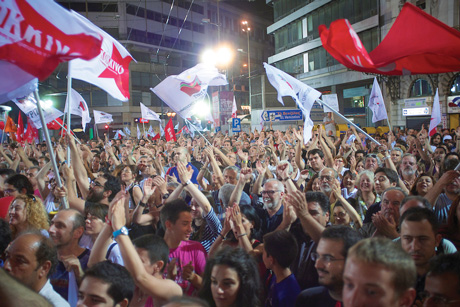
Mehran Khalili/http://www.redpepper.org.uk
The victory of Syriza in Greece is an important moment.1 Indeed, I think it is going to be a historic turning point for Europe and the world, for better or for worse. Syriza defines itself explicitly as “as a party of the democratic and radical Left,” and radical it is. It’s comprised of “many different ideological currents and left cultures,” “has its roots in popular struggles for Greek independence, democracy and labour and anti-fascist movements,” and includes serious and influential socialist, marxist, and generally anti-capitalist currents.2 As Catarina Príncipe remarks: “The success of Syriza is the success of the Left that refused compromises with liberalism.”3 Thus the rise of Syriza corresponds to the collapse of Pasok [acronym for Panhellenic Socialist Movement], the Greek “Socialist”–i.e., liberal capitalist—party, which went from the largest party in Greece to 13% of the vote (2.6% among 18-24 year olds). It’s a sudden and dramatic shift of working-class voters to the left. To put this in American terms, imagine the Green Party winning the next election, with the Democrats reduced to 20% of the vote.
Everyone understands, then, that Syriza’s victory represents the Greek people’s rejection of the devastating austerity program that has been imposed on Greece and Europe by all the major capitalist-to-the-core political parties, no matter what name they go by.
In a wide-ranging interview with Jacobin (which I recommend to everyone), Stathis Kouvelakis, a member of Syriza’s Central Committee and its Left Platform, emphasizes Syriza’s radicalism thusly:
[W]hat Syriza is putting forward has very little to do with any agenda of any European social democratic party today. It is an agenda of really breaking with neoliberalism and austerity. Syriza appears as bringing a type of political culture that is linked to a social, political, and even ideological radicalism still very much inscribed in the DNA of the party….
Syriza is an anticapitalist coalition that addresses the question of power by emphasizing the dialectic of electoral alliances and success at the ballot box with struggle and mobilizations from below. That is, Syriza and [its component] Synaspismos see themselves as class-struggle parties, as formations that represent specific class interests.4
So there we have Kouvelakis’s portrait of the radical Syriza as a new type of political movement that will use a synergistic dialectic of electoral victories and popular mobilizations to break with neoliberalism and austerity.
Syriza’s 40-point program from 2012 reflects this radicalism, with demands that include: nationalization of the banks, audit of the public debt and renegotiation of interest, suspension of debt payments, restoration of the minimum wage to pre-austerity levels, a 75% income tax on incomes over €500,000, a tax on financial transactions, re-nationalization of privatized public services and utilities, a 30% mortgage subvention for poor families, demilitarization of anti-insurrectional troops and prohibition of police firearms or masks during demonstrations, ending military cooperation with Israel, cutting the defense budget, and the closure of all foreign bases in Greece and withdrawal from NATO.5
This is the Syriza everyone on the left is hoping for, and, given the depth of the crisis and the breadth of popular support, the potential for it is there.
We don’t need a guarantee of success. There is no such thing. We don’t need the fulfillment of all demands at once. We all know that the anti-capitalist left has not yet won hegemony. But we do need to see a definitive break from the capitalist TINA (There Is No Alternative) consensus, and determined moves toward building a new social order. We need to see a political movement that will embrace the possibilities inherent in a generalized crisis of capitalism that is pissing everybody off, and that opens new opportunities for real, systemic change.
If Syriza realizes its potential, if it fights the battle using the new strength it has won, with determination and conviction, it will energize populist left forces elsewhere in Europe, starting in Spain, where Podemus has already been energized by Syriza’s victory. As Kouvelakis put it, a fighting Syriza “will provoke an enormous wave of support by very large sectors of public opinion in Europe, and it will energize to an extent that we cannot imagine the radical left in countries where you have the potential for it to intervene strongly.” It’s easy to imagine the momentum moving quickly to Italy, and possibly soon thereafter to France. A fighting Syriza, a Syriza that inspires the working people across Europe to reject the capitalist management of their lives, can change the balance of class forces in Europe radically and quickly, and make it possible to build the alternative that is not supposed to be possible.
It is for better or worse, this decisive turning point. It’s an historical point that will change European politics for a long time, and from which the whole of Europe will move either strongly left or strongly right. Per Frederick Douglass: “It must be a struggle.”
As Principe says, the generalized crisis “has heightened the tension between left- and right-wing ideas: the rise of the Left has been accompanied by the rise of fascism.” And, as Kouvelakis remarks, speaking of Greece, but describing the whole of Europe: “If Syriza fails then the prospects for the country will be very reactionary and authoritarian,” and “people are aware, over a much broader spectrum of forces now, that this is the only real possibility, and that, if we are defeated, then this will be a defeat for a whole forthcoming historical period.” Syriza’s election victory has created a “Syriza moment” that now is the game for radical left populism, and if the Greek and European left do not build and extend on that, decisively and militantly, toward a new socialist alternative, radical right populism will move into the vacuum. The left will have been setback, again, “for a whole forthcoming historical period.”
In their 40-point program, Syriza quipped that “The exit from the crisis is on the left.” But there is what looks like an exit on the right also–Marine Le Pen is turning the knob–and the battered working classes might well take it if the door on the left is never opened.
That is why the very worst defeat here would not be to fight and “lose” (whatever they could mean), but not to fight at all. If Syriza ends up accepting some kind of slightly modified neo-liberal austerity program, the result will signal to people throughout Europe that the purportedly new radical left still believes There Is No Alternative to the bankster capitalist plutocracy that is ravaging their lives. If, despite its pretensions, Syriza in power becomes another version “of any European social democratic party,” it will demoralize whatever real left remains, and leave the field open for a powerful tide of right-wing, neo-fascist populism that will sweep across Europe.
To be fair, we have to recognize that there is no good choice for Syriza or for Greece. Defying the Troika (the European Commission, the IMF, and the European Central Bank), rejecting its financial diktats, means bringing the full wrath of international capital down upon Greece. Proclaiming that you will refuse to pay unpayable debts, take more “extend and pretend”” loans, or enforce austerity and privatization policies, means nothing if it is not backed by a willingness to defiantly exit, or accept being rudely ejected from, the Eurozone, if that’s what it takes. Such an outcome–the dreaded “Grexit”–will bring enormous pain to the Greek people. It may well, in the short run, be at least as bad as the austerity policies. So, sure, we have to give the Syriza leadership some room to obfuscate, dissemble, defer, and ambiguify with their various powerful interlocutors.
But time for that is running out very quickly. Bills are due, and the capitalist powers-that-be are cracking the whip. In response, Syriza’s immediate tactic is to get a six-month “bridge loan” unencumbered by austerity conditions, allowing time for further negotiations. Sounds to the Troika (and to me) like: “Give us another six months to try and talk you out of the austerity agenda once and for all.” I guess Syriza’s theory is that kicking the can down the road for that short a time doesn’t count as “extend and pretend.”
But the Troika isn’t buying.
As Yves Smith points out, in a Naked Capitalism post titled “Eurogroup Ministers to Syriza: Drop Dead,” German Foreign Minister Wolfgang Schäuble says that, if Greece doesn’t want the final tranche of its bailout on the ECB’s austerity terms, “it’s over,” and ECB Governor Jens Weidmann has rejected Greek efforts to get some kind of six-month bridge financing as “a non-starter.”6
Angela Merkel and the German and French bankers—the real Eurozone authorities—seem to “prefer to take the hit from default rather than concede Greek demands for debt relief and fiscal spending without any Troika-type conditions.” As Michael Roberts notes: They “do not want to show that their fiscal probity can be breached by a ‘profligate’ Greece led by a ‘rabidly leftist’ government. And they do not want the likes of Portugal, Spain or Italy to get similar ideas …. So they may opt for Grexit if the Greeks do not back down.”
Of course, the Eurozone powers face their own considerable risk:
On the other hand, Grexit could lead to the unravelling of the whole Euro project if it confirms to an increasingly sceptical electorate that the Euro project is not a union of equals but really a Franco-German imperialist project (which it broadly is, of course). The precedent would be set that member states could leave or be thrown out and Euroscepticism would get renewed strength.7
The prospect of the dissolution of the Eurozone, and possibly the EU, also unnerves the uber-imperialist power on a number of levels. As one of Yves Smith’s correspondents notes:
A Greek implosion would derail U.S. recovery, send the USD to the sky … and make Putin the happiest man on the planet. Putin’s plans and ambitions, long term, would get an incredible boost if/when the EU starts to unravel.
And, sure enough, as the New York Times reports, Syriza has started toying with this card:
To keep their financial options open, Greek officials have been courting Russia and China. The overtures appear intended to put pressure on European creditors to make the kinds of concessions the Greeks have been demanding to avoid letting Moscow or Beijing drive a wedge between Athens and the rest of the European Union.8
Thus, we now see various proposals, including from Bernie Sanders, for the US Federal Reserve to step in, and provide relief for Greece with some kind of end-run around the ECB, in a way that might embarrass Merkel & Co’s presumed authority over the Eurozone.
But, hey, there is a pecking order to imperialist authority. Undermining the Euro or the ECB is one thing, but undermining the imperialist order itself…well, turns out, it’s the same thing. It’s Obama, not Merkel, who’s the big dog, and who has overall responsibility for the hegemony of Euro-American capitalism and US/NATO imperialism. This is something to keep in mind when we see the current frantic negotiations between Merkel and Obama (and Merkel and Holland and Putin) over Ukraine. You know, the Ukraine where, last Spring, Jack Rasmus (and I) pointed out: “an IMF bailout would almost certainly replicate the still continuing Austerity crisis in Greece.”9 A circle jer, er, game.
The economics are, as always, the politics as well. The problems of Syriza, Greece, the Euro, Ukraine, bailouts, austerity, and civil war are all the same capitalist crisis–today’s version of the generalized crisis that the capitalist system recurrently and inevitably engenders, throwing the world into chaos and war. Thus, what happens in Greece is a matter of geo-strategic significance for the masters, and the minions, of that system.
Thus, too, whatever Syriza, Merkel, or Obama do in Greece will not stop the ongoing crisis. As Yves Smith points out: “This pitched battle [in Greece] is a symptom that the failure to address the fundamental contradictions of the Eurozone cannot be delayed much longer. Even if Syriza capitulates in the next few days, the even bigger threat of Marine Le Pen looms.” (We won’t even get into the threats that are looming in Ukraine.)
But if Syriza cannot stop, it can change the course of how this crisis develops. After all the proclamations, promises, and posturing, Syriza is going to have to be, as the man said, as radical as reality. Or not. End of day—which means in a week or two?—Syriza will have to choose confrontation or capitulation. It will either subordinate the demands of the Greek people to the primacy of the Euro and the institutions of European capitalism, or take another, radical and, in the short-term at least, painful path. And it will be quite clear which it has chosen. Syriza will either upend the established capitalist European order, or it will submit to it—and watch some other force do the upending.
Cassandra
We do not know how this is going to turn out. Everybody’s platforms and promises are going to give way to real decisions based on a shifting balance of force. Because of the potential it represents, I think Syriza deserved electoral support. I think it can, and I hope it will, move quickly and decisively in the direction of building a political and social alternative for Europe. We will see.
I have to say, however, that I am not optimistic.
Here are some reasons why:
Syriza is not the definitively “anticapitalist coalition” that Kouvelakis describes above. It is, as we might expect of a recently and quickly formed electoral coalition, an unstable, conflicted, even contradictory political alliance, a house divided against itself in many ways.
First of all, it is divided on the institutional level, with the leadership prone to act in ways that ignore or undercut the expressed will of the base–which means undercutting the whole, very important, notion of “the dialectic of electoral alliances … with struggle and mobilizations from below.” Kouvelakis himself tells us this, in the course of the full Jacobin interview (really worth reading), and emphasizes its “serious risk.” He recounts, for example, the “Platform of the Fifty-Three,” signed by fifty-three central committee members and MPs representing “the left of the majority,” which
strongly criticized [party leader Alex] Tsipras’s attempts to attract establishment politicians, and for leading a campaign that didn’t give a big enough role to social mobilizations and movements, for developing a campaign style that was very centered on him as a person and structured around PR techniques and tricks, and also for softening some crucial edges of the program — more specifically on issues such as the debt, the nationalization of the banks, and so on.…
According to Kouvelakis, this tendency plays out a number of ways in the party:
Unfortunately, the majority of the leadership has autonomized itself yet further from the party and disregarded the party decisions. I’m not here talking about some kind of simple divide between the base and the leadership — I mean autonomous from the party as a whole. And that is, of course, a very serious risk for the future.
[I]t is more and more the case that crucial decisions are made in a very opaque way,…
[The] political …[of] Tsipras or the majority of the leadership during this last period tended to give a much more limited role to social movements and mobilizations.
Tsipras and the party leadership, it seems, have cultivated the art of speaking with forked tongue:
[T]he discourse of the party became a kind of double- or triple-level discourse. Tsipras or the leadership of the party have developed many levels of discourse.
The two main economists of the party — and they are the real representatives of the most rightist tendencies within Syriza, Giannis Dragasakis and George Stathakis, … — developed their own distinctive approaches to the economic issues, which were systematically different from the decisions of party congresses or the official position of the party.,,,
[They] made statements that a Syriza government would never move unilaterally on the position of the debt, but the decision of the party congress explicitly says that all weapons are on the table and that nothing can be ruled out…
The two of them have been unclear at times, depending on the interlocutor or the audience they had in front of them, even about the issue of canceling the memorandums or whether Syriza was demanding a write-off of all or just part of the debt…
So … when [Tsipras] went to New York and spoke at the Brookings Institute, he made repeated references to the New Deal and Franklin Roosevelt. When he went to Austin, TX he said that Syriza would never abandon the euro, whereas the position of the party — and also what he himself also said later — was that we do not want to stay unconditionally in the euro…
All this created the impression that on the very crucial, strategic issues Syriza is not completely clear, and that it has different levels of discourse, thus provoking skepticism about the real intentions of Syriza and how determined it is to resist the pressure which every sensible person is aware a Syriza government will have to face.
Uh-oh. Not sounding good.
Being cagey and evasive in Troika negotiations, as long as you can, is one thing, but within its organization and with its popular base, Syriza cannot have anything but clear, transparent lines of authority and debate. Its political positions have to flow upward, from constant interaction with its working-class base, which has to help determine—and certainly to know, with complete confidence—who is speaking for them and what they are saying
So I get itchy, I get the feeling that we’ve seen this film before, when I read Kouvelakis description of Alex Tsipras’s leadership tendencies. And I positively break out in hives when I read what’s being said about, and by, Syriza’s star left-wing economist, and Greece’s new Finance Minister, Yanis Varoufakis.
If Tsirpras is the political face of Syriza, Varoufakis is its intellectual voice. As such, he provides the clearest indication of what Syriza stands for, and where we can expect it to go. Yanis Varoufakis writes the song of Syriza.
Varoufakis is an Australian-born, British-trained economist who holds dual Australian-Greek citizenship. He has a long career that included a stint as an advisor to the Pasok government of George Papandreou. He resigned that post in 2006, becoming Pasok’s “staunchest critic” because “Papandreou’s party…. presided over the most virulent neoliberal macroeconomic policies.” In Veroufakis’s own words, his academic and political career “does not have a whiff of Marxism in it,”” but he did “come out” in 2013 as an “erratic marxist,” attesting that “Karl Marx was responsible for framing my perspective of the world we live in, from my childhood to this day.”10
During the Greek election, this “confession” made him the bête noire of the Right, and even of Pasok, who tried to use his association with the M word to scaremonger Greek voters and the Western political and media elite about Syriza. Clearly, that didn’t faze Greek voters. As for the Western political and media elite, now that Varoufadis is the Finance Minister and Greece’s official interlocutor in crucial European negotiations—well, the reaction is, I do not think I exaggerate, astounding.
Really. Take a look at: “Greece’s Varoufakis becomes unlikely heartthrob in Germany.” Reuters reports on how the German magazine Der Stern “gushes: about how: “He rattles around Athens on a big, black motorcycle, never tucks his shirts in and radiates a sort of classical masculinity that you only usually see in Greek statues.” German public TV channel ZDF compares him to “Hollywood tough guy Bruce Willis…Visually, he’s someone you could imagine starring in a film like ‘Die Hard 6.’” Even the host of a ZDF parody show, in the course of “ridicul[ing] his ‘lovestruck’ colleague …admitted: ‘He is an incredibly attractive man.’” Fashion magazine Stylebook proclaims: “His cool style is something you can’t miss,” in a story entitled “poor but sexy.” The conservative German newspaper Die Welt raves that “A star is born,” as “the economics professor is shaking up the suits in Europe with a casual appearance and cool stare.” Die Welt describes how “his balding head, cool style and muscular Yamaha motorcycle” are, as the headline puts it, “What makes Yanis Varoufakis a sex icon.” He’s even been enshrined as the hero of a video game (Syrizaman vs. Dr. Troika). To make sure everyone understands, he English-language magazine, The Week, proclaims flatly: “Yanis Varoufakis is the most interesting man in the world.”
Astounding.
The first thing to say here, as an erstwhile member of the tribe, is: Kudos to Yanis for achieving a status aspired to by every Marxist professor: sex icon.
Second thing is: As much fun as busting his chops about this is, we cannot blame Varoufakis for the image our media culture makes of him (until and unless he signs the contract for the reality show with Kim and Kanye).
Third thing, getting more serious, is: Wow! Take a moment to marvel at the absorptive power of our contemporary ideological apparatus, at the omnivorously voracious maw of a celebrity culture that does not shrink from trying to ingest and digest any figure who comes along, no matter how seemingly oppositional—as long as s/he has, or can be made to project, the right looks, style, memetic cues, i.e., production values. All this is what we used to call co-optation or what Marcuse called “repressive tolerance,” on viralizing electronic steroids. Just Wow.11
Fourth thing to say is that this co-optative mediazation drive is happening because Vaouflakis does got talent. He is a very smart, world-class economist and social thinker with a seriously left-marxist intellectual formation and a mastery of mainstream economics. This is a species of public intellectual who is normally kept way out of the media frame. As the Finance Minister of a key European country, however, he cannot be simply rejected or ignored. He foresaw the potential for co-option in that posture: “I know that I run the risk of… indulging a feeling of having become ‘agreeable’ to the circles of ‘polite society.’” They’ve got to make something “agreeable” of him that distracts from the real intellectual and political challenges he might pose. So he anticipated the flattery, and we’ll see how he reacts to that.
More important than his fate as a celebrity, however, is the intellectual-political position he has crafted, and what that, as the cornerstone of the Syriza government it now clearly is, portends for the prospects of radical progressive change in Greece.

www.marxist.com
There’s no question that Varoufakis derives a lot from Marx.12 Still, in his academic career he “largely ignored Marx.” He dedicated himself, rather, to a thorough understanding of mainstream capitalist economics. His radical intellectual strategy us what he calls “immanent criticism,” which “accept[s] the mainstream’s axioms and then expose[s] its internal contradictions.” Actually, he insists that he’s done this not “despite” but because of, Marx’s influence, since, as he correctly points out: “This was, indeed, Marx’s method of undermining British political economics.”
With this grounding, Varoufakis gives a trenchant analysis of the problems Greece and Europe are facing. He insists correctly that there is no “Greek” crisis; there’s a European crisis. Greece would not have the problems it does if it were not in the Eurozone, and if the Eurozone were not organized around the financial hegemony of Germany. Europe, he says, wants to fix local blame and avoid confronting what is a European-wide systemic crisis like that which, after 1929, “unloosed forces that destroyed” the continent.
Varoufakis is particularly shrewd when speaking to the French. He points out that France itself is suffering from the “vassalization” of France to the Bundesbank, with the French Socialist Party making itself an “accomplice” of what he calls a “post-modern Vichy.” Evoking the looming threat from right-wing populism, he insists that Syriza is “the last chance for François Hollande” to change a situation that will “only profit the National Front.”
He goes further, situating the Eurozone’s problems in the context of the world since the United States destroyed the Bretton Woods regime in 1971. As Varoufakis puts it, the U.S. “reorganized the world capitalist economy around its deficits” and the recycling of dollars to Wall Street. The European economy, centered on Germany, became a sub-zone of this financial process created to make sure the big dog was happy. He even writes a book around a nice metaphor of America as a Minotaur feeding off the surpluses of other countries. Until the day when Theseus (The post-2008 crisis? Syriza?) comes along to slay the beast.
Greece, Varoufakis says, is “not big enough to change the world, but…can force Europe to change.”13
So, cool and smart. Varoufakis certainly has an intellectual formation, and an understanding of the Greek-European crisis, that goes way beyond your normal neo-liberal Finance Minster or Eurocrat.
He also has a perspective on the solution to that crisis that is quite clear and quite limited. Here it is, in short: “to retain in our sights capitalism’s inherent ugliness while trying to save it, for strategic purposes, from itself.”
And here, slightly elaborated:
[T]he Left must admit that we are just not ready to plug the chasm that a collapsing European capitalism will open up with a functioning socialist system, one that is capable of generating shared prosperity for the masses. Our task should then be twofold: To put forward an analysis of the current state of play that non-Marxist, well meaning Europeans who have been lured by the sirens of neoliberalism, find insightful. And to follow this sound analysis up with proposals for stabilising Europe – for ending the downward spiral that, in the end, reinforces only the bigots and incubates the serpent’s egg. Ironically, those of us who loathe the Eurozone have a moral obligation to save it!14[His exclamation point.]
Crystal clear.
For Varoufakis: “[T]he current indefensible European socio-economic system” is “indefensible …anti-democratic, irreversibly neoliberal, highly irrational, [with] next to no capacity to evolve into a genuinely humanist community within which Europe’s nations can breathe, live and develop.” It is “everything a radical should admonish and struggle against:” And yet, he is “tirelessly striv[ing] in favour of schemas the purpose of which is to save that system.” He would “much rather be promoting a radical agenda whose raison d’être is about replacing European capitalism with a different, more rational, system – rather than merely campaigning to stabilise a European capitalism at odds with my definition of the Good Society,” but he cannot, because his “agenda [is] founded on the assumption that the Left was, and remains, squarely defeated.”
In such a conjuncture, “it is the Left’s historical duty…to save European capitalism from itself and from the inane handlers of the…crisis.” As much as Varoufakis has the mission to persuade the Troika to change their austerity policies, he has another mission, which is “to convince radicals that we have a contradictory mission: to arrest European capitalism’s free-fall in order to buy the time we need to formulate its alternative.” [His italics.]
He’s an ironic Marxist. How po-mo.
Please note that, according to Varoufakis’s logic here, Syriza’s maximum program, beyond which it cannot, and must not try to, go, is some kind of partial restoration of Old Europe’s social democracy. What good-hearted European banker can’t get behind that? Especially when it means concretely, according to Varoufakis, a program like—I kid you not—Food Stamps!
In the U.S., food stamps (bons d’alimentation) have allowed hundreds of thousands of household to get out of poverty. Why not use the profits of the Eurosystem, the network of central banks in the Eurozone, to finance such food stamps in Europe?15
While we’re at it, maybe we replace the public healthcare systems the banksters are destroying with EurObamacare.
So Tsipras’s forked tongue reflects Varoufakis’s “contradictory mission,” and all of it reflects not just a cagy discourse for negotiations with the Troika, but a deliberate ambiguity about what the political objectives of the party are, and a simmering contradiction between the “defeat” the leadership of the party has already assumed, and the momentum of the class forces who are not in this to lose yet again, and are not going to be satisfied with food stamps.
On the one hand, Syriza thinks it will persuade the Troika do give up the substance of its austerity agenda once Varoufakis “demonstrates of the internal inconsistency of their own models,” which is for him “the only thing that can destabilise and genuinely challenge mainstream, neoclassical economists.” He will say, in his words: “I shall not contest your assumptions but here is why your own conclusions do not logically flow on from them,” and German Foreign Minister Wolfgang Schäuble, ECB Governor Jens Weidmann Merkel, IMF Head Christine Lagarde will say: “Wow, I never thought about it like that before. You are right. We’ll do things your way. We’ll get right on the phone with Angela and Barack, and let them know.”
Varoufakis really does seem to think going into the Eurozone negotiations is like entering a colloquium, where collegial rationality rules the day, and “immanent critique” works like a charm. He is certain that he will make an argument that is, in their own economic terms, better than any of the Eurocrats’. And I am sure he will. And I’m sure they won’t give a damn. Because it is not about right, but power. Not about what’s the better policy, even in their own economic terms, but about who controls power and wealth. The point isn’t who has the best argument; the point is who gives the orders. Hey, Yanis: You’re right and we don’t care.
Patrick L. Smith puts it nicely: ”It is not about a logical way out of the euro-crisis, which is perfectly possible. It is about the neoliberal war against alternative thought and the elevation of the market above all other values, including democratic process and ordinary decency. The commanding generals in this case are headquartered in Brussels, Frankfurt and Berlin.”16 Nobody, not even Syrizaman can “force Europe to change” by force of argument.
In fact, Syriza already has given the Eurocrats a proposal that is “immanently” better than their policy. As Jack Rasmus points out, with a proposal to make loan payments dependent on economic growth, “Varoufakis and Syriza have cleverly turned the Troika’s formula of more austerity in exchange for more Troika loans on its head. Now it’s end austerity if you want any repayments of debt!” There would be some relief in that arrangement, even though it sounds to me like “extend and pretend,” part deux. Let’s see if they’re persuaded.17
If it’s going to be anything more radical than a committee of social democratic beggars, however, Syriza will need a strategy about what to do if negotiations with the Troika fail, a strategy that wide segments of their political base understand, have helped to formulate, and are prepared to defend advance, knowing full well the dangers that it entails. Syriza cannot be the new type of political movement it presents itself as, and cannot win any of its substantial demands from the Eurozone banksters, except on the basis of this kind of energizing, trustworthy, dialectic with mass movements.
Syriza needs an “or else.” If Syriza is not willing to take the Greece out of the euro, they are all bluff. Varouflakis himself has said: “Simple logic dictates that if you cannot even conceive the possibility of leaving a negotiation, then it is preferable never to enter one.”
So Varoufakis talks tough one minute, rejecting the EU’s €240bn bailout plan of Monday, February 16th as “absurd” and “unacceptable.” But he goes on to say that he is “prepared to agree a deal but under different condition,” and expresses confidence that “Europe…will pull a good agreement or an honourable agreement out of what seems to be an impasse.” And he tells the BBC when asked if Syriza would really write off half of Greece’s debt, as previously proposed: “No, no, no, there is a lot of posturing before every negotiation…there has been a bit of posturing on our side.”18 After all, as Syriza’s foreign minister, Nikos Kotzias, put it: the party is “in the mainstream…not the bad boy,.” (Did I mention that Syriza has hired U.S. investment bank Lazard to advise it on debt negotiations with the troika?)
In his New York Times Op-ed of Monday, Varoufakis, known for his research in game theory, insists that he is not engaging in “bluffs [and] stratagems,” and that “The lines that we have presented as red will not be crossed. Otherwise, they would not be truly red, but merely a bluff.” Those lines are? Modified, as shown in bold and italics in the following sentences: “The ‘extend and pretend’ game…will end. No more loans — not until we have a credible plan for growing the economy in order to repay those loans, … No more “reform” programs that target poor pensioners and family-owned pharmacies while leaving large-scale corruption untouched.” So some form of extended loans (with all the pretend-upayable principal intact?), and some form of “structural reform” (with food stamps for pensioners?) will be OK? Red lines fading to pink? The Syriza government is “not asking our partners for a way out of repaying our unpayable debts,” just for “a few months of financial stability that will allow us to embark upon the task of reforms that the broad Greek population can be persuaded to swallow own and support, so we can bring back growth and … pay our dues.” We do not have “some radical-left agenda,” and our “major influence” is the other “German philosopher”—definitely not Karl Marx, who taught that history is class struggle, but “Immanuel Kant, who taught us” about reason and freedom and “doing what is right.” After all, we’re all “honorable” people, who can “dissolve the creditor-debtor distinction in favor of a pan-European perspective [that] places the common European good above petty politics “19
Is this a powerful statement of principle, or more old-fashioned posturing-cum-wishful thinking post-modern “erratic” Marxism. Maybe I’m being too cynical and snarky, and I will absolutely delight in finding that to be so, but I think this is all bluff, and I do not trust this guy as far as I can throw his motorcycle. We’ll know soon enough.
Empiricus
My skepticism also derives from what Syriza is actually already doing, when it’s not talking tough about radical demands and red lines.
Disarming police during demonstrations? The first day in office, the Interior Ministry announced: “The police will have weapons at protests.” Demilitarization of anti-insurrectional troops, reigning in defense spending, and withdrawal from NATO? In his first statement, the new Defense Minister, Panos Kammenos of the right-wing Independent Greeks Party (ANEL), “pledged to find funds for new armaments programmes, maintain current ones and review new threats to security.” Mortgage subvention, restoration of the minimum wage, restoration of public health serrivces? “There would be no explosion in public spending by the new administration,” Varoufakis “pledged” to the Financial Times.
Don’t dismiss police and defense issues as not-so-relevant to the urgent anti-austerity agenda. First of all, they are quite important for the political situation in Greece. Brining right-wing party like ANEL into the governing coalition is troubling in its own right, and, as one commentator notes: “The implications of a right-wing figure like Kammenos overseeing the military—in a country where, as recently as 1974, a CIA-backed military regime was in power—are ominous.” Maintaining militarized police, in a country where 40-50% of police officers are thought to vote for the fascist Golden Dawn party is also not very comforting. But defense-related issues are also directly relevant to any anti-austerity agenda. As the Wall Street Journal reported: “Greece…is the largest importer of conventional weapons in Europe — and [i]ts military spending is the highest in the European Union as a percentage of gross domestic product. That spending was one of the factors behind Greece’s stratospheric national debt.” The Defense Ministry has been involved in a multi-billion dollar bribery scandal involving secret payoffs to the former Defense Minister.20
But perhaps the most troubling indication of where Syriza’s money is in relation to its mouth involves the pledge to stop and reverse the privatization of Greece’s national assets. As Patrick L. Smith remarks, praising what Syriza promised:
Among the more rigorous conditions required by the EU and the IMF is the privatization of numerous state-held assets, including airports, rails and the entire port of Piraeus. Naturally (or otherwise), Athens is supposed to divest of the most profitable of these first. Tsipras and Varoufakis refuse. They have already begun dismantling the program.
But Michael Roberts reports, via the WSJ, what Syriza has done:
Greece’s new government is backtracking on its plans for Greece’s ports, according to The Wall Street Journal. Syriza, which won Greece’s election in late January, had promised to stall the Port of Piraeus’ privatisation, but it will now go ahead.
Here’s The Journal:
Selling the state’s 67% stake in the Piraeus Port Authority is one of the biggest divestments of an ambitious privatization plan agreed to by the previous conservative government with the so-called troika of creditors…
[Piraeus is] the de facto home of Greece’s giant shipping industry and is one of the largest ports in the Mediterranean.
“The Piraeus sale is on. It will proceed as planned,” a senior finance-ministry official told The Wall Street Journal.21
So, Syriza’s 40-point program? Never mind. There’s a lot of posturing, you know.
No one was expecting socialism in one country, but a lot of people were led to expect some decisive moves in a socialist direction that would energize a movement throughout Europe, and open radical new possibilities. I tend to think that public ownership of key industries, and especially of banks, would need to be part of such a program. So, OK, Syriza didn’t want to go there right now. But couldn’t they at least have stuck with the anti-privatization agenda they did promise?
As Stathis Kouvelakis advises, the “moderate” position within Syriza, the cagy, ambiguous discourse, “is understandable up to a certain point,” but “the problem is that it doesn’t prepare the people in society for what will inevitably come … namely that decisions to implement completely [Syriza’s] program will turn out to be very confrontational, both internally and with the rest of the European Union.” Does it look like Syriza has much stomach for that confrontation?
In the coming days, Syriza will either become the new type of political movement “really breaking with neoliberalism and austerity” that it claims to be, and the world left wishes it to be, or it will become just another European social democratic party.
What’s ahead for Syriza and the Greek populace, what they are in right now, is a social battle, not an economics colloquium. Smart analyses, logical arguments, and shrewd rhetoric in negotiations are necessary and important weapons, but this is a battle that will be won by force, not logic. If the Eurocrats concede on austerity in any significant way, it will be if and only if they fear effective power mobilized in the street, not because they were persuaded by brilliant economic arguments in a conference room. And “street” means the Athens, Madrid, Rome, Paris, European, street. Syriza and every other would-be revolutionary party of the left need to adopt the ex-slave’s still indispensable advice: “It must be a struggle,” because the masters of capital “will concede nothing without a demand. They never did and they never will.”
To put it another way, there’s a choice between, on the one hand, a strategy that sees the intellectual skills of your smartest cadres as your primary strength, capable of persuading your interlocutors to give you what you want, if supported by carefully-managed mass mobilizations, and, on the other, a strategy the understands mass mobilizations as the primary source of a power capable of forcing your elite enemies to concede what you demand, if carefully supported by smart and determined leaders. The choice: Negotiators support the people, not vice-versa.
One does not have to succumb to a “great man” theory of history to recognize that leaders are important, that differences in the quality of leadership can change the course of a movement. (Whatever one thinks of Trotsky vs. Stalin, a lot of important things would have gone very differently.) Leaders gotta lead. They have the responsibility to get out in front, to make important decisions that will affect the course of a struggle. In the relationship between leaders and the popular base of a movement, ideally reciprocally-reinforcing but always imperfect, leaders will, and must, have a strategic perspective that may conflict with the day-to-day perceptions and actions of various popular forces. This is an inevitable tension that will never, anywhere, by any formula, be finally resolved. So let’s give considerable slack to leaders who have been crucial to advancing such an important political movement. Still, it’s a good guiding principle for a left, democratic party: Negotiators support the people, not vice-versa.
Indeed, one thing that undercuts the “great man” theory, highlighting all the other pesky contingencies (cultures, ideologies, etc.) in play, is that history seems to show us that it’s easier for bad leaders to derail a movement than for good leaders to set it right.
SYRIZA: Greek for TINA?
Unfortunately, insofar as Yanis Varoufakis is the voice of Syriza’s leadership, it does not just lack, but refuses on principle, to have a fighting strategy even to try “replacing European capitalism with a different, more rational, system”—because any such attempt is defeated in advance, and will inevitably lead to the victory of the even-more-fascist right.
We know this, according to Varoufakis, because it has happened before: “What good did we achieve in Britain in the early 1980s by promoting an agenda of socialist change that British society scorned while falling headlong into Mrs. Thatcher’s neoliberal trap? Precisely none.”
Let’s do some immanent critique of Varoufakis’s logic.
Of course, Varoufakis could be right in his prediction: a determined fight for a socialist alternative could end up losing to right-wing forces. In any situation of social crisis, however, that will always be the case. This idea that you should not fight for socialism until and unless you know you can win is politically ridiculous. There are no guarantees in politics.
To say—in a crisis-ridden Greece where the people have just made an unprecedented choice for the left, with a movement that is, as so many in his party and the world are saying, energizing left forces throughout Europe, where socialist programs are an urgent practical necessity—to say in such a conjuncture that we should presume such a struggle would inevitably lose to the right is…well, in Varoufakis’s own words, there is “more than a kernel of truth” to the charge that he is “defeatist.”
More certain, I think, is the obverse point, which Stathis Kouvelakis and others on the left make: Not fighting for a radical left alternative will ensure the ascendancy of the radical right.
Varoufakis, and those who accept his argument should acknowledge that they are really giving up altogether on building “a functioning socialist system, …capable of generating shared prosperity for the masses.” For them, that battle is always-already lost. It’s a perfectly circular argument that goes like this: The working classes will not move toward socialism while living in a relatively prosperous social-democratic capitalist economy; on the other hand, if there’s a real social struggle in a crisis-ridden capitalist economy, they will inevitably be seduced by the radical right. Since you can never know that you will win, there is never a propitious time to fight for socialism, and we are always limited to stabilizing and improving capitalism. It comes down to TINA.
It’s true that Marx is a master of the poignant, dialectical irony of history. It’s also true that the constant repetition of “It’s only because I’m so committed to socialism that I’m telling you we must—we have the ‘moral obligation,’ the ‘historical duty’—to save capitalism!” quickly becomes a poor parody of that masterful irony. I concur with Michael Roberts: more erratic than Marxist.22
If Syriza saves capitalism from itself, the result won’t be to make socialism more possible. It will be to ensure the “indefensible …anti-democratic, irreversibly neoliberal, highly irrational” rule of capital for a very, very long time.
And in a worse form. The idea that you’re going to talk the commanding generals of neo-liberal capitalism back into social democracy is… well, the pipe dream of a nostalgic social democrat. It certainly ignores the history of the last thirty years. Wasn’t neo-liberalism in Europe precisely a war on social democracy? Wasn’t it carried out, as Varoufakis himself says, with the connivance of the social democratic parties, of Pasok in Greece, the Socialist Party in France, etc.? Once the masters of capital did away with whatever post-capitalism the USSR represented, did they not turn to administering the coup de grâce to European social democracy? Who, of the neo-liberal executioners Syriza will be talking to, is about to let any of it back from the grave they put it in? The only thing that will incline them to that, in fact, is precisely some real threat of left socialism. It’s not: “If you want socialism, fight for capitalism,” but: If you want some kind of revived social democracy, fight militantly for a more radical socialist alternative.
Do you think you’re going to persuade the liberal—i.e., center-right—capitalists by scaring them with the specter of the radical right? They will never fear and reject the right as much as the left, precisely because they figure (perhaps incorrectly!) that the right is pro-capitalist, or at least controllable with money. These are the people who put Nazis into power in Ukraine! (And with what economic rationality!) Would they have considered supporting any insurrection, anywhere, that was half as radical on the left? The only people you’re going to scare with the bugaboo of the right are your educated liberal—i.e., center-left—academic colleagues.
So, regarding Syriza and Messrs. Tsipras and Varoufakis, sure, nothing is inevitable, and I’ll give it as long as it takes, but I am withholding my enthusiasm.
Ah, yes, I remember it well!
We have seen something like this before. Here is a front page from May 10, 1981 in France. the day François Mitterand was elected President, with an absolute majority for his Socialist Party:

“Socialism’s Time Has Finally Come”
http://flipbook.archives-socialistes.fr/index.html?docid=12127&language=fra&userid=0
(Or not.)
Look at that photo! It was not staged. The joy on those faces is real. I remember vividly my French girlfriend at the time showing me this headline, with a glowing smile like that on her face. I withheld my enthusiasm.
Thirty years later, under the pull quote “I remember it like it was yesterday,” Le Monde did a retrospective on that day, which still burns in the memory of a whole generation in France as a moment of great hope. One guy named Olivier recounts how he was the first passenger on a bus that day. When he boarded, the driver asked: “So?” and he responded: “Mitterand!”—at which point the driver pulled out a bottle of champagne and said “Tell me where you’re going and I’ll take you there!” Which he continued to do with every passenger. It was a long, celebratory bus ride.
“Thus began one of the most beautiful nights of my life,” Olivier said, thirty years later. “When I think of all the disappointments that followed, I remember that bus driver’s face, his look of happiness, the symbol of a ‘today, everything is possible’ – which, sadly, only lasted a short moment.”23
We all know what happened. Mitterand became the best bud of Reagan and Thatcher, and turned the Socialist Party of France into one of the midwives of neo-liberalism in Europe.
Today, many people in Greece, Europe, and even the United States, are greeting the victory of Syriza in Europe with, not the same (we all know too much), but a similar sense of hopeful, if not quite joyful, expectation. What will they be thinking thirty years from now?
Messrs. Tsipras and Varoufakis: You have a grave responsibility.
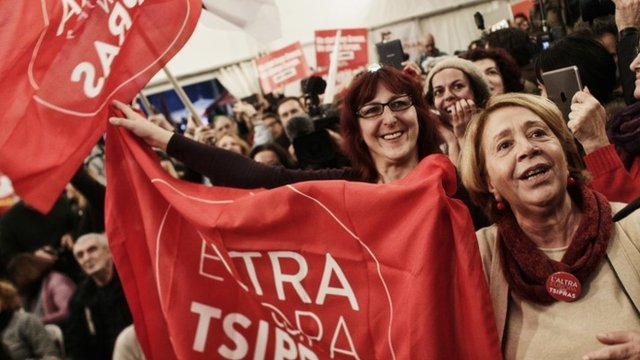
BBC
_______________________________
[1] ZYRIZA is an acronym for Coalition of the Radical Left, and, as such should be all caps, but I find that annoying and will dispense with it.
[2] ΣΥΡΙΖΑ Συνασπισμός Ριζοσπαστικής Αριστεράς
[3] Catarina Príncipe, First Days, First Decisions | Jacobin
[4] Sebastian Budgen with Stathis Kouvelakis, Greece: Phase One | Jacobin
[5] Greece: SYRIZA’s 40-point program | Links International Journal of Socialist Renewal
[6] Eurogroup Ministers to Syriza: Drop Dead | naked capitalism
[7] Greece and the Euro face-off | Michael Roberts Blog
[8] Eurozone Finance Ministers Hold Emergency Meeting on Greece Bailout – NYTimes.com
[9] The Ukraine Economic Crisis » CounterPunch: Tells the Facts, Names the Names
The Polemicist: Good for the Gander:Ukraine’s Demise Accelerates
[10] Confessions Of An Erratic Marxist In The Midst Of A Repugnant European Crisis | Yanis Varoufakis
[11] Varoufakis himself does some cultural critique. In his “Confession,” he riffs nicely on The Matrix and Invasion of the Body Snatchers. Seeing this mediazation of him, I think of the “15 Million Merits” episode of the fine new series (on Netflix), Black Mirror, which is a haunting take on the power of cultural appropriation in celebrity culture.
[12]I’m not happy with all of his interpretations, but he describes nicely Marx’s key argument that wealth is not “privately produced and then appropriated by a quasi-illegitimate state, through taxation,” as standard capitalist ideology would have it, but “collectively produced and then privately appropriated through social relations of production and property rights” that depend precisely on that capitalist ideology for their reproduction. [His emphasis.]
He also understands that “Marx was adamant” in insisting that “the problem with capitalism is not that it is unfair but that it is irrational, as it habitually condemns whole generations to deprivation and unemployment and even turns capitalists into angst-ridden automata.” We might prefer to say “not just that it is unfair”; there’s no need to counterpose justice and rationality. But Varoufakis is correct in emphasizing Marx’s critique of capitalism’s systemic irrationality, against all those, Left and Right, who mistakenly think that Marxism is an altruism.
[13] «La Grèce peut forcer l’Europe à changer» | La Tribune. My translations. Varoufakis’s book is: Le Minotaure planétaire – L’ogre américain, la désunion européenne et le chaos mondial, Editions Enquêtes & Perspectives (2014)
[14]Confessions, op.cit.
[15]«La Grèce peut forcer l’Europe à changer», “Aux Etats-Unis, les bons d’alimentation ont permis de sortir de la pauvreté des centaines de milliers de ménages. Pourquoi ne pas utiliser les bénéfices de l’Eurosystème, le réseau des banques centrales de la zone euro, pour financer de tels bons en Europe? »
[16] Neoliberalism is our Frankenstein: Greece and Ukraine are the hot spots of a new war for supremacy – Salon.com
[17] Syriza vs. the Troika » CounterPunch
[18] BBC News – Greece bailout: Varoufakis ‘willing’ as talks collapse, Syriza Hands Greek Defence Ministry to Right-wing Nationalist | Global Research, BBC News – Profile: Yanis Varoufakis, Greek bailout foe
[19] Yanis Varoufakis: No Time for Games in Europe – NYTimes.com
[20] Greek debt, austerity and past military contracts | Workers World, Syriza Hands Greek Defence Ministry to Right-wing Nationalist | Global Research.
[21] Greece government port Piraeus privatisation EU commission – Business Insider
[22] Yanis Varoufakis: more erratic than Marxist | Michael Roberts Blog
[23] 10 mai 1981 : “Je m’en souviens comme si c’était hier”

Blogging at www.thepolemicist.net . Also publishing on CounterPunch, Op-Ed News, Reader-Supported News.
ZNetwork is funded solely through the generosity of its readers.
Donate


