
John Lee Anderson rambled on for over 7,600 words in a New Yorker article about Venezuela. I’ll highlight some quotes from Anderson’s article and respond to them below:
In all, a hundred and twenty protesters died in the fighting, and on two occasions National Guardsmen and chavista loyalists stormed the National Assembly to assault opposition legislators.
VenezuelAnalysis.com did a careful tally of the protest-related deaths. Their information comes largely from Venezuela’s department of justice while it was run by Luis Ortega Diaz, who had clearly turned against the government by the time of the protests. She went from threatening to sue the US government in 2015 (when she assumed or possibly knew she had been sanctioned by the U.S government) to recently collaborating with US prosecutors against Maduro’s government.
Anderson is wildly off the mark:
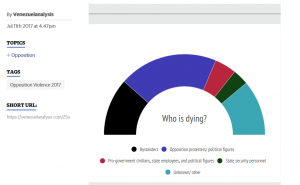
Anderson also said that “several” people died during violent protests in 2014. In fact, forty people died and it was about evenly divided among government supporters, government opponents and bystanders.
In February, 1992, Chávez launched a coup attempt, which failed at the entrance to Miraflores, when a team sent to kill the President was captured by loyal military forces.
Bart Jones, in his book about Chavez, explains that there were two coup attempts in 1992. Only one of them was led by Chavez. Chavez was in prison when the second coup attempt took place in 1992. Chavez’s plan was to capture, not assassinate the Venezuelan president at that time. The Chavez-led coup attempt failed and left 20 people dead – 14 soldiers, five police and one civilian. The second coup attempt that year led to way more deaths which is why anti-chavistas have eagerly conflated the two. For similar reasons the 60 people who died fighting to restore Chavez while Pedro Carmona was briefly in power in 2002 thanks to a U.S.-backed coup are never mentioned.
Capriles had frequently clashed with the chavistas. In 2004, when he was serving as the mayor of one of Caracas’s districts, he was imprisoned for four months, after a state prosecutor accused him of allowing antigovernment mobs to attack the Cuban Embassy.
Capriles participated in the 2002 coup which was briefly successful. That is when the attack on the Cuban Embassy took place. Either through dishonesty or ignorance, Anderson totally obscures when the Embassy attack took place and Capriles’ role in the coup. Capriles and Leopoldo Lopez both led the kidnapping of Chavista minister during the coup (details here).
Maduro said that Julio Borges, one of his most vociferous political rivals, had openly called for a U.S. invasion. (In fact, Borges and his allies had urged foreign countries to apply economic pressure on the government. In one statement, they said, “Sanctions against those who are vagrants, human-rights violators, and looters of public resources will always have our support.”)
Borges and the rest of the US-backed opposition leadership have not just applauded and “urged” sanctions on Venezuela. That would be more than repulsive enough, but Borges has gone much further by making thinly veiled legal and “reputation” threats against private banks as well as governments who loan to Venezuela – basically leveraging the international media’s vilification campaign and the US government’s belligerence to aggravate Venezuela’s economic crisis. Even an opposition-aligned pollster (that the international media often cites about Maduro’s approval rating) has said that Borges’ tactics are rejected by most Venezuelans (see polls cited here).
Borges seemed to hint that even more drastic measures than economic sanctions are required in Venezuela. His exact words (video here) follow
“ese problema social de las migraciones… ese problema migratorio, que ya es un problema de la región, se ve acompañado por otros problemas como crimen organizado, militarismo, paramilitarismo, tráfico de drogas, incluso el tema del terrorismo. De tal manera que Venezuela hoy es el foco de la inestabilidad y de todo lo que significa la degradación social, que puede ser una enfermedad contagiosa en toda América Latina”.
Translation:
“…this social problem with migrations…that is already a problem for the region, is accompanied by other problems like organized crime, militarism, paramilitarism, drug trafficking and even terrorism. In this way Venezuela today is a focal point of instability in the region and everything that comes with social degradation that can be a contagious disease for all of Latin America.”
Elections should be a cakewalk for government opponents during an economic crisis like Venezuela’s, but not with leaders like Borges who compare their own people to a contagious disease.
Joe Emersberger is co-author of “Extraordinary Threat: The US Empire, the Media, and Twenty Years of Coup Attempts in Venezuela.”
ZNetwork is funded solely through the generosity of its readers.
Donate

