
Levels of inequality in Europe are fast approaching extremes last seen during the peak of European colonialism. In 1910, the richest 10 percent of French people owned nearly 90 percent total French wealth. This value declined for much of the twentieth century, largely as a result of the introduction of minimum wages and progressive taxation. Since the 1980s, however, rich people’s share of French wealth has once again trended upwards. Today, 10 percent of French people own nearly 60 percent of total national wealth. The picture is quite similar in other European countries, including Germany and Sweden.
The situation in Europe may not be quite as bad as it is in the United States, where 10 percent of citizens own about 75 percent of the wealth, but that does not mean Europe should grow complacent. After all, the same factors that led to such extreme inequality in the US are at play in Europe: essentially, governments have been giving money to their wealthiest citizens, making the rich richer and the rest of us poorer. One of the main ways in which governments give the rich money is through tax cuts. Another, even more blatant method for governments to give money to the rich is through government subsidies. If governments subsidize, say, home renovations, the rich only need renovate their existing properties to receive cash.
Where do governments get the money to give to the rich in this way? One method to is simply to raise taxes shouldered by the working majority or cut welfare services. If the majority is taxed more or given less, governments have more money to give to the rich. Another way to fund gifts for the wealthy is for governments to go into debt. The trouble, of course, is that debt needs to be repaid eventually. If governments pay back the debt created to give money to the rich by taxing the majority and cutting welfare services — a policy mix widely known as austerity — then, in effect, we as a society are paying the rich.
Reversing the Flow
This, in a nutshell, explains the rise in the share of wealth owned by the rich in Europe. It constitutes a redistributive policy whereby wealth is moved from one part of the population to another. Let us divide, say, the German population into three groups: the bottom 50 percent of incomes who earned on average 10,000 euro in 2023, the top 10 percent who earned on average 170,000 euro, and the 40 percent in the middle. In that year, the German government granted a tax-free allowance (Grundfreibetrag) for annual incomes under 10,908 euro. Thus, on average, the bottom 50 percent paid no income taxes.
Nevertheless, by raising the price of services and products (e.g., public transport) and cutting services they need (e.g., social housing), the government can take money from them anyway. The top 10 percent gains from this policy, because those cuts are used to finance tax cuts and subsidies that favour them. The middle class is not seriously affected by the cuts that impact the bottom 50 percent — rise in the price of train tickets, for instance, affects them marginally. But they also do not receive the spoils that benefit the top 10 percent, as their wealth is mostly in real estate, which does not tend to benefit from the tax cuts that investment funds — where the top 10 percent keep their money — get.
The good news is that this cash flow can be reversed. Thes same policy tools used to give money to the rich can be used to give to the rest of the population instead. The most straightforward way to grant tax cuts to the bottom 50 percent is to increase the tax-free allowance. This would only benefit above-average earners in the bottom 50 percent, however, since most of them are exempt from income tax already. But, again, there are other taxes that the bottom 50 percent pays, including taxes on products and services such as public transport tickets. Moreover, states can redirect government spending to aid the bottom 50 percent, such as by subsidizing food costs or funding job training. A housing-first approach to homelessness — whereby homeless people are provided with a home with no priori requirement to meet — has proven particularly promising, along with direct cash transfers.
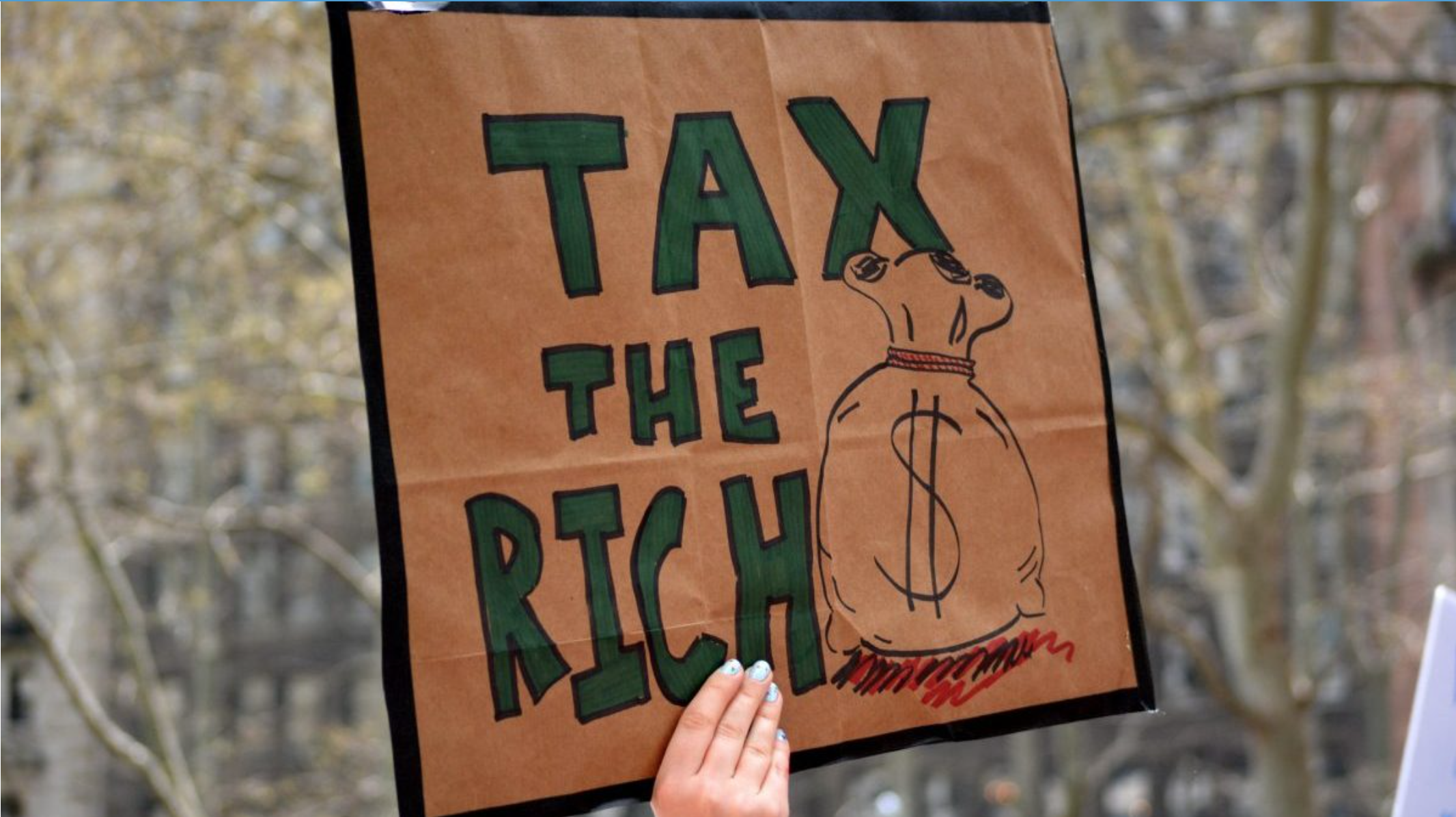
The European Left would be wise to learn from these experiences and place a more explicit proposal on taxing the rich at the heart of its political agenda.
Where could governments find the money for such spending? Here, again, the same policy tools used to finance the wealthy’s largesse can also be used to find money to give to the bottom 50 percent. Governments can increase taxes on the rich, cut subsidies, and even go into debt, which they can pay off by further taxing the rich.
Getting money to flow from the top 10 percent of incomes to the bottom 50 percent should be a core priority for any progressive or left-wing movement. Theoretically, one could expect even the Christian Democrats to agree on this. After all, the Bible does state that, “It is easier for a camel to go through the eye of a needle than for a rich person to enter the Kingdom of God.” One would imagine that a party supposedly based on the values of Christianity would be keen on redistributing the wealth of the rich. Either way, at the very least, left-wing movements should make it one of their central tenets.
The reasoning behind the centre-left’s opposition to this proposal seems to be that people would never get behind the idea, because they fear a wealth tax would also target them. Europeans would never vote for a politician proposing to tax the rich, the centre-left seems to suggest, because they are worried that their own property — real or imagined — might be at risk. It hardly seems likely that people in today’s Germany earning 10,000 euro would worry that a tax on the rich intended to increase their salaries might harm them. But even if a kind of cognitive dissonance led people in the bottom 50 percent to vote against their own interests, this would not be a reason for the left to abandon the principle of taxing the rich — it would be a reason to challenge this cognitive dissonance.
Moreover, if the rising popularity of left-wing politicians like Heidi Reichinnek in Germany or Zohran Mamdani in New York — both of whom campaign heavily around taxing the rich — is any indication, taxing the rich is a very popular proposal indeed. Die Linke doubled its presence in the German parliament at the last national elections, in large part thanks to its tax-the-rich demand, and Mamdani has broken through decades of business-friendly centre-left consensus in New York with the same politics. Far from antagonizing voters, it appears that taxing the rich is a powerful mobilizing tool.
Given this, it is all the more puzzling that the most recent policy paper from the Party of the European Left only mentions the idea of taxing the rich in passing, without articulating a concrete proposal beyond a general statement calling for a “European wealth tax to fund climate and poverty-related investments”. The European Left would be wise to learn from these experiences and place a more explicit proposal on taxing the rich at the heart of its political agenda.
Three Pillars
What could such a proposal look like? At its core, it should be structured around three pillars. First, taxation aiming to redistribute wealth to the bottom 50 percent should not just tax capital gains and labour, but also tax capital itself. In EU member-states like Romania, where no progressive income tax as such exists, one should be introduced — but that alone is not quite enough. In addition to progressive income taxes, Europe needs a tax on large net wealth. The wealth that we want to redistribute is already part of the estates of the richest — 10 percent of the French people already own 60 percent of French total wealth. If we want to change this, we cannot just redistribute what the rich add to their massive fortunes every year, but need to target what they already have.
The second pillar has to do with the amount that fortunes need to be taxed. Here, different experts have different views. French economist Thomas Piketty suggests taxing depending on how much a person owns relative to the average. A person who owns double the average should be taxed less than, say, a person who owns ten times that. In 2023, the average German disposed of over roughly 300,000 euro. Thus, in this context, Piketty’s proposal would look something like this:

Reichinnek, by contrast, envisions much lower figures. Reichinnek does not purport to tax relatively small but still above-average patrimonies, and proposes relatively modest taxes on even the super-rich.

To put this in more concrete terms, the following table shows how much a person would have had to pay in Germany in 2023, depending on their total wealth.
| Wealth | Piketty’s proposal | Reichinnek’s proposal |
| € 600,000 | € 450 | € – |
| € 1,500,000 | € 9,450 | € 5,000 |
| € 3,000,000 | € 39,000 | € 20,000 |
| € 30,000,000 | € 1,380,000 | € 290,000 |
| € 300,000,000 | € 38,000,000 | € 13,000,000 |
| € 3,000,000,000 | € 1,620,000,000 | € 287,000,000 |
| € 5,000,000,000 | € 3,429,000,000 | € 527,000,000 |
Piketty is much bolder, but of course, bolder proposals also risk going too far. Perhaps a middle road between the two is possible. Piketty’s idea of a dissuasive taxation, for example, is quite valuable. Picketty proposes extremely high taxes (above 90 percent) on fortunes above a certain limit in order to effectively ban extreme wealth. At precisely what point wealth accumulation becomes extreme can be debated, but in an ideal fiscal environment, there should be some form of dissuasive taxation on excessive patrimonies, just as there should also be taxes on excessive incomes to prevent extreme accumulation.
On the other hand, Reichinnek’s caution against taxing the wealth of the middle class is equally valuable. A wealth tax that hits the middle class might be more effective at raising public funds, but it also risks hitting a part of the population, the middle 40 percent of incomes, who ideally should also be fortified by a wealth tax. A more cautious proposal that sets a relatively high threshold to even begin to taxing wealth guarantees that the redistribution of wealth would flow from the top 10 percent.
Taxing the rich should be the core of left-wing policymaking in Europe, the realization of which can help facilitate the rest of a progressive agenda.
The third pillar entails tackling tax evasion. It is true that there are hurdles when it comes to implementing taxes on the rich. The principle itself is unobjectionable, as even Christian Democrats should agree, but practical implementation proves difficult. We know how to do the redistribution: we merely need to use mechanisms that are already being used to give to the top 10 percent but reverse them and give to the bottom 50 percent instead. The challenge is getting to the wealthy’s money before they hide it or run away with it.
The rich have all sorts of ways to hide their money from the government. Most of us simply keep our money in our bank accounts, but the rich buy stocks, villas, gold, and all sorts of other things, making it difficult to calculate their total wealth. Moreover, the rich may put their money in places that are difficult to reach for the government, so-called tax havens, or opt for a combination of the two strategies, such as putting their money into stocks of a company that then pays corporate taxes in more favourable fiscal environments.
The problem of diversified wealth holdings is relatively easy to address. Instead of taxing specific types of wealth as some governments currently do (Italy taxes real estate, for instance), a wealth tax must target all sorts of wealth, establishing systems to evaluate individuals’ net worth irrespective of composition, be it stocks, houses, or gold. Preventing the rich from hiding money abroad, on the other hand, is more difficult. Here, the ideal solution requires a combination of cooperation across international bodies and pressure from governments on the institutions and states that allow the rich to hide their money.
Institutions such as the European Parliament must begin creating a framework to coordinate taxation internationally. At the moment, states compete by offering lower and lower rates to attract the rich, allowing the rich to play “divide and rule”. Coordinating taxation policies instead of competing could reverse this trend, which is why it is so important that the European Left and other progressive formations get on board. Moreover, the European Union needs to set up general guidelines for member states to coordinate their fiscal policies and interface with non-member states as a bloc, ensuring that fiscal policy is not crafted in the interests of luring the wealthy few, but protecting the non-wealthy majority.
That said, international cooperation can only do so much. In order to meaningfully address tax evasion, individual governments also need unilateral strategies to exert diplomatic pressure on countries that allow their bank systems to serve as hiding places for the rich. To this end, a promising proposal, inspired by Dieter Helm’s idea for an international carbon tax, would be to set up a system of conditional tariffs that affect banks and states that offer refuge for the rich unless they change behaviour.
The proposal of taxing the rich should be the core of left-wing policymaking in Europe. It should be the central demand, the realization of which can help facilitate the rest of a progressive agenda, from addressing homelessness to providing free job training. Moreover, it is an extremely powerful tool for political mobilization. As the excesses of the super-rich become increasingly blatant, the idea of curtailing the expansion of their wealth is becoming mainstream. The European Left should seize this opportunity.
ZNetwork is funded solely through the generosity of its readers.
Donate