

I could tell that Yotam Marom’s debut book, “For Louder Days: Reaching Beyond a Politics of Powerlessness,” might shift how movement workers think — about telling the truth, and about the personal and political transformation actually required to win and wield power — as I compared notes with two field organizers fighting data centers around the country.
We had been knocking on hundreds of doors in every kind of neighborhood: Black and brown homeowners in big cities, Latino farmworkers and white farmers in rural towns, parents and students and elders in watersheds across the West and exurbs in the South, all disgusted with data centers. Everyday people are blocking big tech expansion in real time, out of love for their communities and each other, and the ride feels full of possibility.
Could we move people who’ve never been in motion before — but are now packing zoning meetings, turning each other out in the hundreds, and stopping billion-dollar data centers — into durable political realignment? Could we make the potential crash of the inflated, overextended tech economy into something that could remake politics and the economy — in time to stop the consolidation of authoritarianism?
Those possibilities are real, and that’s why we’re working as hard as we are. But as we compared notes, I felt that familiar tug of dread. All three of us on the phone were veterans of movement moments, big and small. We had all seen coalitions we’d built simmer in misalignment and anger, eventually turning inward or breaking. We had been in room after room where we kept pushing towards an urgent goal, papering over real contradictions in order to get to the next action, the next march, the next move. But we didn’t have a plan to fundamentally shift power, and even when we won, more often than not, our opponents would adjust as we waned or broke, and our people would be worse off than when we started.
The three of us talked through how the anti-data center movement might avoid these traps. How could this exploding resistance shift the balance of power at a pivotal time? But when one of the organizers on the line said, “have you read this book, ‘Powerlessness and You,’ or something?” I laughed and let out a breath. I knew what book she meant, and I was thrilled she had found it, too.
“For Louder Days: Reaching Beyond a Politics of Powerlessness” should be in every organizer’s backpack, dog-eared and a little mangled, because it is a primer for exactly the kind of practice we must take on to meet the challenges we are facing now.
Marom got his start as a leading organizer at the heart of Occupy Wall Street, and went on to support the leaders building some of the most impactful movement organizations of the last decades, like Dream Defenders, the Sunrise Movement and Uncommitted. He’s also supported us at my own organization, People’s Tech Project, and multiple other tech justice groups as we’ve engaged in the sleeves-up hard work of crafting strategy to take down the ascendant tech oligarchy.
In “For Louder Days,” he takes the story of his life — from the hopes and heartbreaks of Occupy, to the growth, setbacks and contradictions of the movement to end the Israeli occupation — and spells out his lucid diagnoses of the most critical stumbling blocks of the American left in its fight for hearts, minds and actual power.
At the core of his assessment: Our movements are woefully underdeveloped in the practice of generative conflict for the sake of good strategy — and that underdevelopment warps and buries the steady love that drove us to come together in this work in the first place.
Millions in the streets
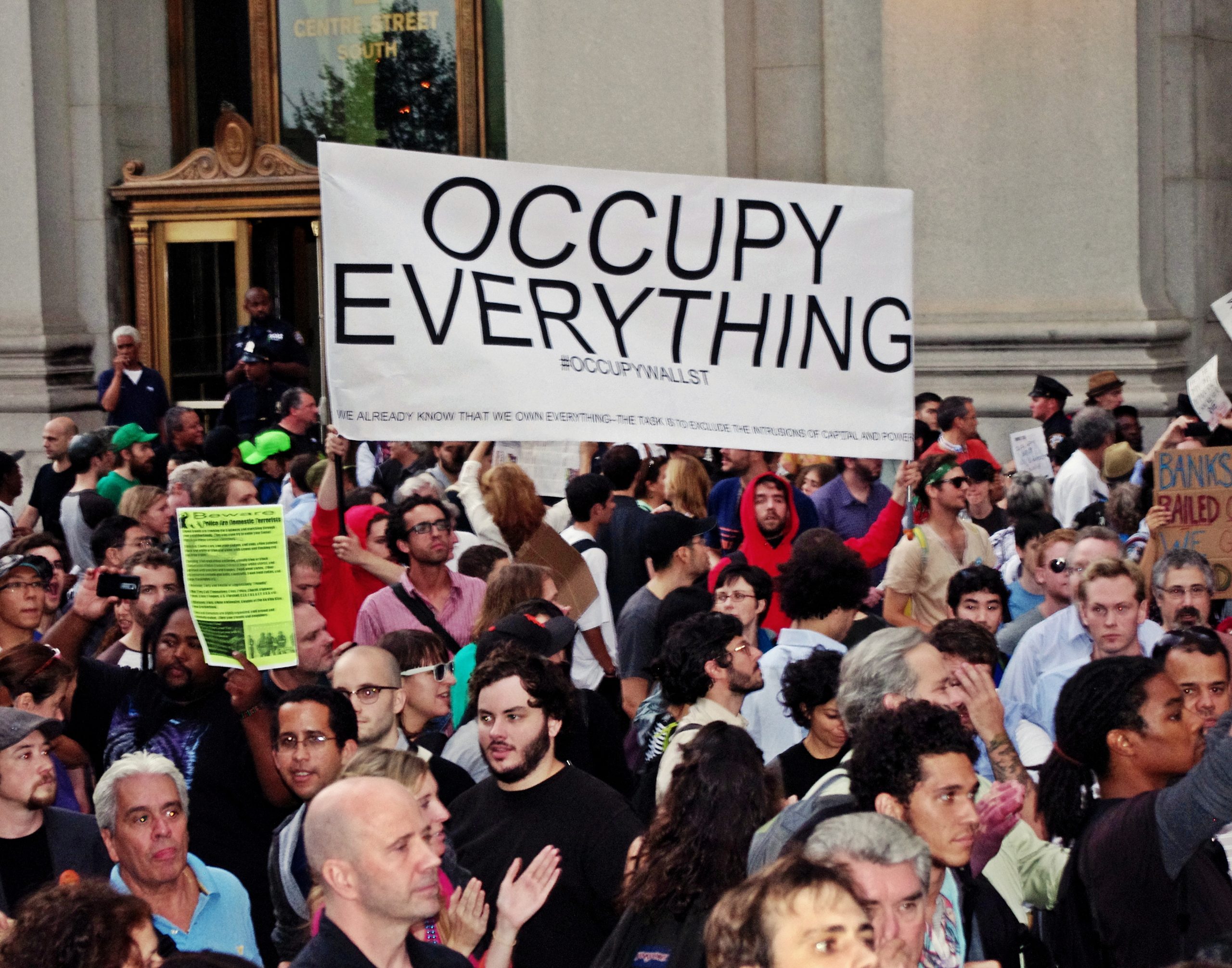
“For Louder Days” opens in the middle of Occupy at its height, October 2011, when the occupation of Zuccotti Park was spreading nationally and getting buttressed by veteran organizers as it built a realignment of American politics in real time. With generosity, Marom crisply relates how he responded to a call from Spanish comrades for a global day of action, and helped lead the expansion of Occupy into an international project. He and his comrades had a clear hypothesis — that this action would capture the energy boiling over after an attempted eviction from the park and grow the movement far larger — and they worked, heads down, to test it.
He walks us through the meetings, coalitions, struggles and planning that made it possible. (I’ve never before read a book about meetings that I couldn’t put down.)
He captures the joy and dizzying hope that we’ve all felt at the denouement of those sweaty 20-hour days for weeks on end. He describes what it felt like on Oct. 15, 2011, with 80,000 in the street at Times Square and millions joining globally, to be in the center of the universe as Occupy went worldwide.
“I have been sobered by the history of revolutions that came before and my own small defeats at the hands of this opponent we’re squaring off against,” he writes. “But now — despite all of this good sense, despite my cynicism, despite the layers of armor I have put around my heart along the way — I can’t help but be swept away by this moment. I am completely under its spell.”
The global day of action was powerful and effective. Eighty countries saw supporting protests. Forty-five new occupations were launched around the United States, from big cities to suburbs to small, bright-red communities.
The group that came together to plan Oct. 15 was ready to plan the next escalation for Nov. 17. But when challenged by another faction inside Occupy’s leadership — because of course, there is leadership, even (especially!) in an ostensibly leaderless project and movement — Marom was pressured to shut down the ad hoc group inside Occupy that pulled off the day of action. He tells the all-too-familiar story of falling apart: how they lost time as they struggled with each other and with themselves, and lost momentum and membership, eventually leading to the end of the occupation after 57 days. He lays bare the battles whirling inside him as he made the choice to shut down that ad hoc group — a choice that contributed to the end of Occupy.
This account begins an incredible progression of chapters showing us what Marom learned in the next decade-plus as he advised, facilitated, flanked and organized with the leaders of many other movements. What he saw was a crucial common thread that he calls the “politics of powerlessness.”
The politics of powerlessness
Marom describes the politics of powerlessness as a deep ambivalence towards actually winning and holding power. When we attack or destroy leadership, weaponize hurt and identity, keep ourselves “enclosed and safe and comfortable,” and refuse risks, we are choosing powerlessness. When we avoid conflict, hide from the grief and loss inherent in making hard choices, or follow instinct and habit, we neither win nor grow. “[The politics of powerlessness are] reinforced by ideas that are easy to reach for, even if they are thin and by habit, and routine,” Marom writes. “It goes hand in hand with an instinct to turn away from the brokenness in each other rather than a commitment to turn toward each other whenever at all possible.”
Marom goes on to break down, with real compassion for all of us and for himself, the totally understandable and human reasons why organizers choose the politics of powerlessness, while making plain, story after story, the choices movements and their leaders have to make to actually get and keep power. That includes strategy that forces us to say no to almost everything so we can say yes to what we truly need to do to win. A reckoning with the rank that exists in all groups and what it means to hold leadership. Balancing an attention to organizational belonging with an uncompromising focus on purpose. A rekindling of our sense of deep love, for each other and for those we’ve hurt and who have hurt us, across all lines and borders, for the sake of the world we hunger to build.
Marom hasn’t written this book as a hectoring finger-wag at a movement that has lost its way and its right to lead. He wrote it because he has skin in the game, and he has earned a very grounded belief that we can feel, survive and get through that necessary grief in order to build the mature people, organizations and movements that we need.

ZNetwork is funded solely through the generosity of its readers.
Donate




