


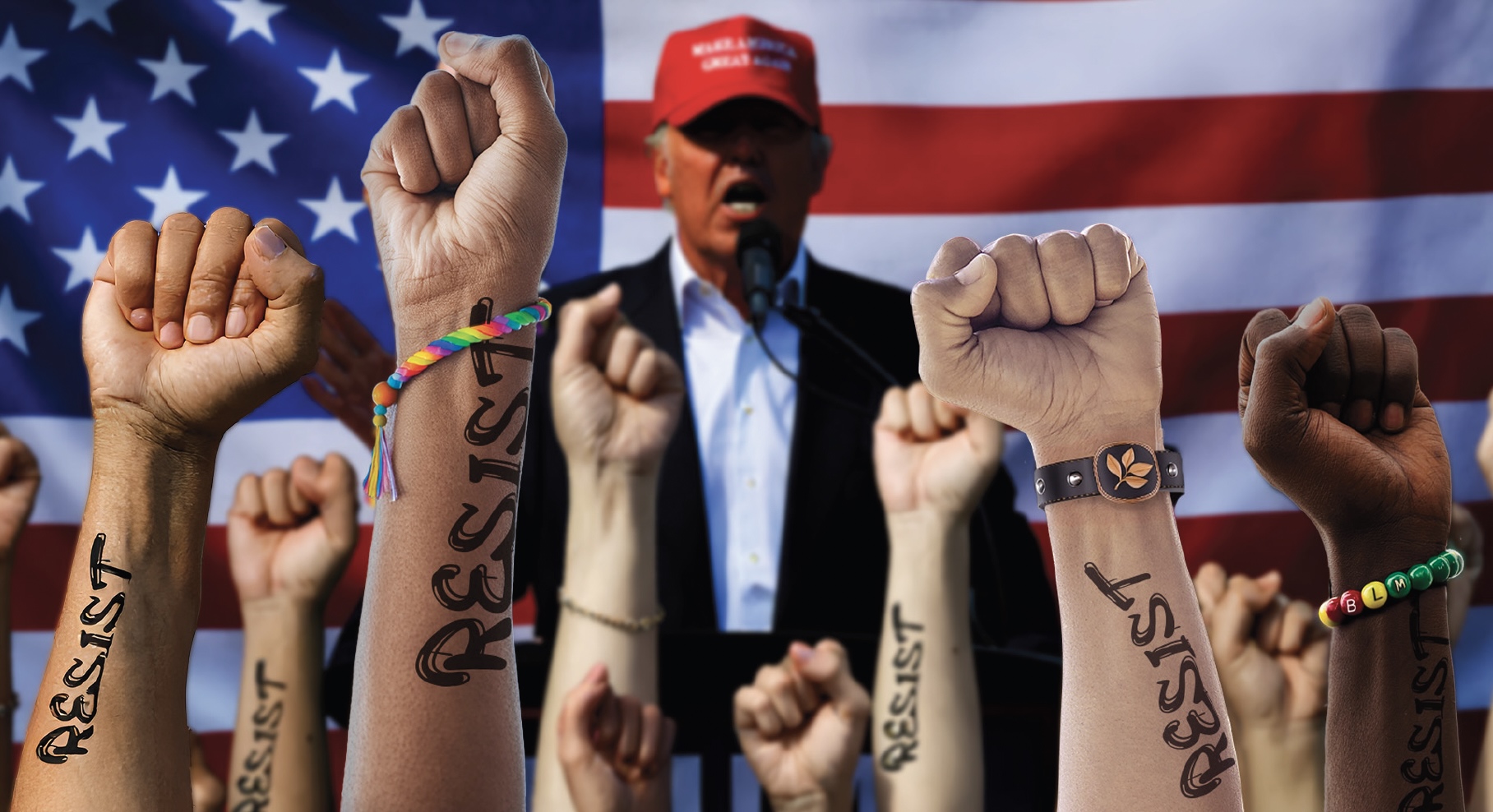
As President Donald Trump launches illegal armed attacks against American cities, peaceful civilians, and people in foreign countries that have not attacked the US, it may look like a sign of strength and a harbinger of a future of total domination. But Trump’s turn to such extreme forms of violence is less an expression of growing power than an attempt to distract from the growth of opposition, the loss of public support, and the splits within his own ranks. It is a sign not of strength but of weakness. This report lays out a strategy to take advantage of that weakness to defend society against Trump’s MAGA assaults.
A Movement-Based Opposition to Trump and MAGA is a report from the Labor Network for Sustainability, co-published by ZNetwork.org.
Read or download the full report PDF here.
Table Of Contents
I. Introduction
V. A Movement-Based Opposition
III. Trump’s Crumbling Juggernaut
VII. Movement-Based Opposition: A Successful American Example
II. Trump’s Trajectory
VI. Developing the Power of a Movement-Based Opposition
IV. The Emergence of Social Self-Defense
VIII. How a Movement-Based Opposition Defeated the First Trump Coup
IX. Some Guidelines for the Movement-Based Opposition
X. Three Ways to End the Trump Autocracy
Introduction
Resisting and eventually eliminating Trump and his MAGA tyranny requires more than his loss of popularity. It requires a concerted opposition that can rally powerful social forces to undermine his means of domination. In our two-party system the responsibility for opposition lies on the opposition party – the Democratic Party. Unfortunately, with a few outstanding exceptions, the leadership of the Democratic Party has so far failed in its duty to oppose Trump’s burgeoning autocracy.
In response to the intensifying attack on democracy, millions of people in thousands of locations have joined actions to oppose his juggernaut. In the absence of adequate resistance in the electoral arena, an alliance of popular movements is functioning as the primary opposition to Trump’s authoritarian rule.
This “movement-based opposition” has emerged rapidly during the first year of Trump’s presidency. It is represented by the mass nonviolent resistance to ICE in Los Angeles and elsewhere and the five million participants in No Kings Day and other national days of action. It is developing significant power as more and more people see and experience the harm the Trump administration and the MAGA Congress are inflicting on individuals, groups, and society as a whole. This movement-based opposition is no longer a marginal force but is now MAGA’s most powerful opponent.
Sometimes called a non-electoral or independent opposition, such a movement-based opposition is a convergence of social movements that performs some of the classic functions of an opposition party without the goal of itself taking power in government. It draws diverse constituencies out of their silos to combine their power, but uses direct action rather than electing candidates as its means to exercise that power. Like a political party, it brings together different constituencies around common interests, exposes the lies of those in power, and wins support for alternatives.
This movement-based opposition can mobilize popular rejection of the MAGA agenda, block Trump’s initiatives, prod Democratic politicians into action, split off Republicans, and help lay the groundwork for “people power” non-violent uprisings – aka “social strikes” — if they prove to be necessary to overcome authoritarian rule.
As I write in September, Trump’s authoritarian juggernaut is entering a more violent, militarized phase. At home, this includes the huge expansion of ICE, the military occupation of American cities, and the political repression using the assassination of Charlie Kirk as a pretext. Abroad, it means the bombing of Iran, the illegal, unprovoked attacks on Venezuelan boats, and on-going collusion with genocide in Gaza; who knows what else is in the works.
The opposition is also entering a new phase. This was heralded by the resistance to ICE and military occupation in Los Angeles. That included community-based support groups; constant identification, tracking, and filming of ICE agents; mutual aid support for targets of ICE attacks; ongoing opposition from state and city officials; refusal of the Dodgers to let ICE enter their stadium; and refusal of grand juries to indict — out of the 38 felony cases filed by Trump’s U.S. Attorney, only seven have resulted in indictments. Opinion polls indicate that such exposure of ICE abuses had led public opinion in California and nationwide to shift against Trump’s anti-immigrant policies.
Chicago, Washington, DC, New York, Memphis, and other cities are readying for similar resistance. An estimated 25,000 demonstrated in DC against the occupation of the city. The National Guard troops sent into Los Angeles and Washington, DC have been widely reported to be antagonistic to their assignments. The majority of Americans are opposed to Trump’s deployment of troops to American cities and feel their own rights and freedoms would be less secure as a result. The opposition to Trump’s plan to occupy Chicago with the National Guard met so much resistance from Chicago citizens and unions, the mayor of the city, and the governor of Illinois that he suddenly reversed himself and announced that he was not going to send the troops because a railroad executive had advised him, “’You’re gonna lose Chicago, sir. It’s a great city. You’re gonna lose Chicago.’”
As RFK, Jr. gutted America’s vaccine programs and other defenses against COVID and other health threats, major medical associations such as the American Academy of Pediatrics denounced the new policies and promulgated their own treatment standards. Top officials in the CDC and other health agencies publicly resigned in protest — and hundreds of CDC employees, including some in full service uniforms, gathered outside the agency, cheering and clapping for the three officials who had quit. Four states, flouting Trumpian policy, announced a “health alliance” that made its own, science-based, standards for vaccination. Florida’s plan to eliminate all vaccine mandates was reversed in just two days following a furious backlash from medical experts and political opponents.
Strangely enough, Trump’s efforts to block release of the evidence concerning Jeffrey Epstein has led to unprecedented splits among his own followers. That has been synergistic with the organizing and speaking out of scores of Epstein’s victims. As a result of such pressure, Trump’s “birthday book” message to Epstein has been publicly released with more revelations expected to follow.
This “Introduction” lays out the basic perspective of social self-defense and a movement-based opposition. Chapter 1, “Trump’s Trajectory,” explores what Trump’s actions so far indicate we need to prepare for. Chapter 2, “Trump’s Crumbling Juggernaut,” explores the weaknesses and vulnerabilities of Trump’s authoritarian project.
Chapter 3, “The Emergence of Social Self-Defense,” describes the rise of a diverse resistance to the Trump regime. Chapter 4, “A Movement-Based Opposition,” explains how an alliance of social movements acting in civil society can become MAGA’s leading antagonist. Chapter 5, “Developing the Power of a Movement-Based Opposition,” explores how a non-electoral opposition can effectively contest for power.
Chapter 6, “A Movement-Based Opposition: A Successful American Example,” tells the history of the Forward Together movement which brought together the “fourteen justice tribes” of North Carolina in a powerful coalition acting in civil society that turned the state’s politics upside down – providing many lessons for how such an alliance can serve as an opposition today. Chapter 7, “How a Movement-Based Opposition Defeated the First Trump Coup,” recounts the little-known story of the nationally coordinated alliance that saved the 2020 election.
Chapter 8, “Some Guidelines for the Movement-Based Opposition,” lays out avenues of organization and action for the defeat of MAGA. “Conclusion: Three Ways to End the Trump Autocracy,” summarizes three basic strategies for overcoming and eliminating Trump and Trumpism.
On January 1, 2025 I published a report called “Defending Society Against the MAGA Assault: A Prospectus for Action.” Since then I have written more than a dozen commentaries tracking the development of social self-defense. The purpose of this follow-up report, “A Movement-Based Opposition to Trump and MAGA,” is to take stock of what social self-defense has accomplished so far and propose the movement-based opposition as the next phase of the struggle to protect society against MAGA depredation.
Read or download the full report PDF here.
Trump’s Trajectory
Trump and his enablers are conducting an “administrative coup” against Congress, courts, and civil society. This assault is being conducted on multiple fronts. It seeks unlimited power, the demolition of any possible base to restrict its power, unlimited accumulation of wealth for its followers, and a cultural revolution to enshrine autocracy, repression, racism, sexism, hatred, cruelty, and disinhibition as internalized values of the American people. So far it has met significant but uneven resistance.
Trump’s actions have been and will most likely continue to be unpredictable, ill-considered, self-contradictory, and often self-destructive. The sheer incompetence and vacillation of Trump’s behavior make his future actions likely to have effects that contradict their intentions. Furthermore, his actions go out into a world order that was already deeply enmeshed in what has been called “the polycrisis,” marked by great power geopolitical struggle over control of lesser countries and global economic networks. Trump’s erratic behavior and the chaos of the polycrisis render any predictions uncertain.
A Trump presidency that successfully creates a new national and international order is one of the least likely outcomes. Also unlikely is a basic course correction that changes the overall thrust of the Trump administration so far. More likely is that Trump, in the face of declining power and support, will increasingly utilize repression and violence. Indeed, he already is doing so.
Internally this means a fuller suspension of civil liberties and the rule of law; a more brutal war on dissent; martial law; use of the military in domestic conflict; and a mobilization of violent MAGA supporters for direct vigilante action. Internationally it means escalating use of violence, leading to accidental or deliberate wars – not excluding accidental or intentional nuclear escalation. This is all happening in a context of global economic chaos that is already widely expected to lead to significant recession with the looming possibility of stagflation and/or depression.
Trump’s actions are already having harmful effects on a wide range of people. Some of these harms are specific, like the firing of federal employees and the destruction of the programs they administer that are depended on by tens of millions of people. Others affect almost everyone, like the stagflation emerging from tariff gyrations and the suspension of the rule of law that is making everyone, including everyday law-abiding citizens, vulnerable to arbitrary targeting and arrest. Given reasonable expectations about the future, these harms are destined to rapidly escalate.6
Where is all this leading? Trump may establish a lasting fascist dictatorship that demolishes all bases of effective opposition – the very definition of totalitarianism. Certainly this is possible if potential opposition forces are sufficiently intimidated and submissive.
Conversely, the growing opposition may develop the power to limit and ultimately overcome Trumpian tyranny. This could happen in any of several ways.
1) Growing opposition could interfere with Trump’s juggernaut by a variety of institutional and direct actions that would make it difficult or even impossible for the Trump regime to implement its objectives, creating a situation of deadlock or dual power.
2) If democratic institutions remain sufficiently robust, Trump’s supporters could be voted out of office in 2026 or thereafter; this could be followed by legislative reversal of Trump’s actions or even impeachment of top officials.
3) Unpopular dictatorial regimes have often been swept from the stage of history by mass “people power” uprisings or “social strikes” mobilizing the whole collective power of the people against the regime. We have seen this most recently in South Korea, where the president’s attempt to establish a dictatorship was rapidly defeated by mass mobilization of the people in the streets, supported by trade unions, parliament, and the courts.
Trump’s Crumbling Juggernaut
Trump appears to be on the offensive, as illustrated by his ordering federalized National Guards and Marines into Los Angeles and sending US bombers to attack Iran. But it’s a well-known maxim that when politicians or countries are losing, they tend to escalate. As Senator Alex Padilla put it after he was handcuffed, thrown to the ground, and arrested by ICE agents,
When Mr. Trump began to face a groundswell of criticism a few weeks ago for his unpopular Medicaid cuts, failed tariff wars and embarrassing public breakup with a billionaire adviser, I suspected that it wouldn’t be long before he broke out the same tired anti-immigrant tactics to distract the public. Raids intensified, detentions skyrocketed, and Mr. Trump’s narrative of crisis escalated in the hopes of diverting attention from his political failures.
The same desire to divert attention from his failures no doubt provided a similar motivation for launching his illegal war against Iran.
Trump’s escalations are largely a response to his failures, contradictions, loss of public support, and fracturing base. At the end of his first 100 days, Donald Trump had the lowest 100-day job approval rating of any president in the past 80 years. In a Reuters/ Ipsos poll published June 23, Trump’s approval rating had fallen to 42%; his disapproval rate had grown to 57%. 100 days later, his approval rating remains virtually unchanged.
Even more significant are the splits in his coalition and the growth of public opposition to his major initiatives. Trump’s claims to be a “peacemaker” who will rapidly end all current wars was severely eroded by the failure of his promises to end the wars in Ukraine and Gaza and his joining Israel’s war against Iran. His flirting with war against Iran put MAGA leaders at each other’s throats and undermined his support in the general public and even among the MAGA base, with MAGA pundits like Steve Bannon and Tucker Carlson trading insults with Ted Cruz. Immediately after the bombing, the Proud Boys posted a message simply saying, “Fuck this shit.”
As polling on Trump’s bombing of Iran came in, it was clear that the public opposed it – and war with Iran more broadly. For example, a CNN poll in the days following the bombing found that Americans disapprove of the strikes, 56% to 44%. 68% of those under 35 disapproved. 55% of Americans express little or no trust in Trump to make the right decisions about the US use of force in Iran. 65% of those polled say Trump should be required to get congressional approval for any further military action, with only 21% saying he should not.
Trump’s militarized ICE raids in Los Angeles and around the country, instead of rallying people against the immigrant menace, led to a growing disillusion not only with its specific abuses, but with his immigration policy as a whole – once his most popular position.
On June 20, CNN senior data correspondent Harry Enten analyzed poll data on public response to Trump’s sending troops into Los Angeles. Donald Trump has lost the political battle when it comes to what has happened out in Los Angeles! Donald Trump’s net approval rating on the Los Angeles process — look at this! Overall, way, way, way underwater at minus 15 points.
Among independents or those who don’t identify with either major party, minus 24 points on the net approval rating. This is happening on what should be the best issue for Donald Trump, immigration. And yet when it comes to these Los Angeles protests, 15 points underwater overall and 24 points underwater among independents. No good.
If the protesters’ idea was to focus the attention on Donald Trump and bring attention to his immigration policies and bring attention to the arrests that have been occurring of immigrants, it seems to me that those protests have been successful because 49% say Trump’s gone too far when it comes to the immigrant arrests compared to just 40% who say he’s not gone too far.
More ICE raids at workplaces. Workplaces where immigrants perhaps are here illegally. Look, 45% approve. But again, what’s the winner here? 54% disapprove of the idea of more ICE arrests. And this, again, goes to what these protests were all about in the first place. These ICE arrests at work. And it does seem, again, that the American people are with the protesters on this.
On inflation – a prime concern of those who voted for Trump in 2024 — by mid-June 64% of the public disapproved of him compared to 34% who approved.
The tariffs Trump touted as the solution to US economic problems have met deep concern from corporate America – a critical part of his base—as well as from the public at large.
Consumer sentiment went down for four straight months after Trump’s “Liberation Day” when his tariffs were first announced and reached the lowest level ever recorded except during the post-COVID inflation. The tariffs also split the MAGA coalition; for example, Leonard Leo, architect and longtime leader of the Federalist Society, has sued to block Trump’s claim to the authority to set tariffs without Congressional approval.
Trump’s “big beautiful” budget bill was and remained extremely unpopular. A Fox News poll found registered voters oppose it 59% to 38%, including 53% to 43% opposition among white men without a college degree, usually portrayed as Trump’s strongest demographic. In a poll by The Washington Post and Ipsos, 23% of adults support “the budget bill changing tax, spending and Medicaid policies,” while 42% oppose it. In an NBC News Decision Desk poll, 51% of Americans said “maintaining current spending levels on programs like Medicaid” mattered most to them, compared to 21% who chose “continuing and expanding income tax cuts and credits” enacted by Trump in 2017, and 28% who chose “ensuring that the national debt is reduced.” In mid-August, well after the bill was passed, a Pew poll found that 46% disapproved of the tax and spending law, while only 32% approved.
Finally, what about Trump’s assault on constitutional government and the rule of law? The most extensive polling on this came at the end of his first 100 days, when 56% said Trump had acted beyond his authority as president without justification and 55% doubted the Trump administration’s commitment to protecting citizens’ rights and freedoms. People said by a margin of 67%-31% that they thought the Trump administration was trying to avoid complying with court orders regarding its activities rather than trying to comply with those orders. And by 67%-31% they said federal judges should have the authority to block an administration policy until a trial if they think it will harm people and is probably illegal.
Storm-trooper-style action by ICE, bombing Iran without Congressional authorization, and military occupation of American cities may well have deepened public concern about Trump’s move to authoritarian rule. A mid-August poll found that 38% of Americans support using troops for law enforcement in Washington, compared to 46% opposed. It was supported by just 8% of Democrats and 28% of those who don’t identify with either party.
The Emergence of Social Self-Defense
“Social self-defense” is the defense of that which makes our life together possible. The goal of social self-defense in the Trump era is to make a persistent fascist dictatorship less likely and its restriction and elimination by direct counteraction, electoral repudiation, and/or social strike more likely.
Because of pervasive uncertainties, we can’t know precisely what process will achieve that objective. Fortunately, while different tactics can at times be in tension, efforts to change the balance of power in various ways are for the most part synergistic. We know that a chain will break at its weakest link, even if we don’t know what link that will be. Thus the overall strategy for social self-defense is to change the balance of power by strengthening the forces opposing the MAGA regime and putting increasing pressure on the regime and its allies.
A variety of polls show how the popular repudiation of Trump has developed so far. Trump’s overall approval ratings, already low on election day, fell sharply in his first hundred days in office, especially among independents and non-MAGA Republicans. More important, two-thirds of respondents viewed the Trump regime as “chaotic” and thought Trump was engaging in “overreach” of his legitimate powers in area after area. While a majority still supported the deportation of “illegal immigrants,” large numbers opposed the many publicized ICE abuses of due process. Large majorities said Trump must obey the courts. A majority feared the impact of Trump’s tariffs on inflation. Many feared or were already feeling the impact of Trump policies on them personally.
Over the course of Trump’s first months in office, participation in anti-Trump demonstrations increased from hundreds to millions. Their demands echoed broad popular concerns, drawing together fear of autocracy, opposition to billionaire domination of government, and direct personal impacts through gutting of government services and economic chaos. These mobilizations combined the specific concerns of specific constituencies, concerns shared by multiple constituencies, and broad, widely shared concerns about the destruction of democratic governance.
These massive national days of action were coordinated in two ways. Two very similar coalitions involving about 200 organizations initiated and promoted the Hands Off! And Mayday mobilizations. The 50501 actions and the Tesla Takedowns were organized on Reddit and other social media by self-organized groups.
Leadership for all of them primarily took the form of setting dates, framing raps, and communicating with local groups and activists. Coordination has focused on specific days of action.
While individual organizations have more extensive programs of action, so far the social self-defense movement as a whole is only beginning to develop means of continuous coordination and planning. Local groups, often drawing together or cutting across separate national organizations, initiate and recruit for both nationally and locally initiated activities.
Trump’s agenda is totalitarian in that it aims not only to devastate the constitutional order, but to destroy all bases of potential opposition in civil society. He has targeted universities and other educational institutions, medicine, law firms and the American Bar Association, media, courts, organized labor, and virtually every other institutional sphere of civic life.
Historical experience in many parts of the world shows that such civil society institutions can play a critical role in the resistance to authoritarianism. The response of these institutions in the Trump era has so far been vacillating and ambivalent – exemplified by Harvard’s effort to submit to Trumpian demands, followed by its statement of refusal and suit against government interference, then followed by its proposed new restrictions on freedom of expression, and most recently by the breakdown of negotiations between Harvard and the Trump administration.
There have been stirrings of collective resistance, however. For example, faculties at Big Ten universities voted for a Mutual Defense Compact to jointly resist and support each other. Business has been ambiguous, divided, and largely paralyzed, initially swinging to support Trump, then backing away, especially in the face of the ongoing tariff debacle. Future alignments will largely depend on the balance between outrage at Trump’s attacks on civil society and fear of his vengeance against those who oppose him.
The governance system has so far provided important but limited protection of society against the MAGA assault. Many rulings by lower courts have forbidden, or at least stayed, illegal and unconstitutional Trump initiatives. Supreme Court decisions have increasing legitimated Trump’s rubbishing of constitutional governance. The Republican-controlled Congress has forcefully abetted Trump’s attacks on law, the constitution, and people, with only a handful of legislators opposing even the most extreme measures and many more playing attack dogs against those whom Trump targets.
Most Democratic politicians have followed the dubious advice to try to work with Trump rather than take him on. A few members of Congress have made serious efforts to encourage a mass opposition to Trump and MAGA, exemplified by the large rallies held by Bernie Sanders and Alexandria Ocasio-Cortez. A slowly increasing number of Democratic politicians, under substantial pressure from enraged members of their own party, are starting to join them. Similarly, a few blue state governments have taken significant initiatives to challenge Trump’s depredations, while many of them and nearly all red states have acquiesced or furthered Trump’s agenda.
A Movement-Based Opposition
Resistance to the second Trump regime was slow to start but is now emerging in myriad forms. They range from communities organizing to protect immigrants, trans kids, and political dissenters to national days of action with millions of participants; from local mobilizations in more than two thousand communities to judges striking down unconstitutional Trump orders; from students and lawyers demanding their universities and law firms stand up to Trump to secret on-line resistance networks joined by hundreds of thousands of government workers and mass refusal to comply with DOGE orders by millions more. How can these promising but fragile beginnings become a powerful force that restrains, dismantles, and eventually eliminates the MAGA attack on society?
Unfortunately, the Democratic Party has so far proven not to be such a force. Despite exceptions, most of its leadership has deliberately acquiesced in Trump’s juggernaut. The Democrats’ deep dependence on corporate and fossil fuel monied interests has impeded any effort beyond rhetoric to appeal to the interests of ordinary Americans, let alone to stand up to the likes of Trump and his MAGA supporters. The result is that, as polls demonstrate, most people have increasingly regarded the Democratic Party with scorn.
A Washington Post-ABC News-Ipsos poll in late April found that nearly 70% of Americans view the Democratic party as out of touch “with the concerns of most people” – a higher share than said the same of either Trump or the Republican party. Just 40% of Democrats approved of the way their leaders in Congress were handling the job, compared with 49% who disapproved, according to a Quinnipiac University poll. In a Harvard survey, only 23% of the young Americans polled who voted for Vice President Kamala Harris approve of congressional Democrats’ performance.
This trend has continued to deepen. According to a Gallup poll at the end of July, the Democratic Party was regarded favorably by 34 percent — its lowest level ever in a Gallup poll. That was lower than Donald Trump and lower than the Republican Party. Before the election, 92 percent of Democrats approved of the Democratic Party. By the end of July, Democrats’ approval of their own party had fallen to 73 percent.
The Democratic Party, unless and until it makes significant changes, will be a poor vehicle for the anti-Trump resistance. But given the structure of America’s legally enforced two-party system, a progressive third-party challenge in the electoral arena, if it drew significant support, would most likely split and thereby weaken the anti-MAGA vote.
Historically, movement-based oppositions have arisen in many situations where large numbers of people felt that political parties were failing to address their needs. In the 1930s, the CIO functioned as a movement-based opposition, successfully opposing attacks on the growing power of workers and promoting a progressive program for labor rights, housing, peace, and social welfare. The civil rights movement similarly served as a movement-based opposition, challenging white supremacy and inequality more broadly in every sphere of American life. The 1968 Poor Peoples Campaign was creating a national movement-based opposition at the time that it was cut short by the assassination of Martin Luther King, Jr.
More recently, as we will see in Chapter 7, the North Carolina Forward Together movement, led by Rev. William Barber II, brought together what he called the “fourteen justice tribes in North Carolina” to support each other and make a consolidated attack on the state’s racism and inequality – and the virtual coup being conducted by its elite. And as we will see in Chapter 8, a movement-based opposition, the Democracy Defense Coalition, played a crucial if little-recognized role in defeating Trump’s 2020 attempted coup.
There are also many non-US examples of movement-based oppositions to learn from. The term “social self-defense” itself comes from the Committee for Social Self-Defense (KOR) of Polish activists, who constituted what they called an “independent opposition” which used direct action to defend dissidents against state repression and gave birth to the Solidarity union and eventually to the overthrow of Poland’s authoritarian regime. The dictatorial government of Slobodan Milosevic was removed from power by a continuing struggle by the non-electoral opposition Otpor which culminated in the successful defense of an election by a social strike. While our movement-based opposition can learn from all of these examples and many others, it is unlikely to closely resemble any of them. It will need to develop its own form.
Today’s movement-based opposition is developing from the convergence of diverse non-electoral initiatives at local, state, and national levels. It does not require a single national organization. It is not likely to be created by calling a convention and passing a resolution to start a new organization. But its builders need a vision of sustained cooperation for a continuous, publicly visible non-electoral opposition. Such an opposition is in fact emerging from the actions and forms of collaboration now under way. Its future depends on building on and further developing what has started.
Developing the Power of a Movement-Based Opposition
A movement-based opposition uses the tools of social movements to oppose those in power, draw together a wide range of forces, persuade large numbers of people to take action, and win a majority to oppose the ruling regime.
Such a movement-based opposition is already being built in action. The confluence of many diverse constituencies in Hands Off!, 50501, Mayday, No Kings Day, and Labor Day days of action has created a common opposition that draws together many of the forces that will be necessary to overcome Trump and MAGA. Future such actions will continue to play a critical role in the development of a movement-based opposition. So will the on-the-ground resistance to ICE raids and the occupation of American cities by the National Guard.
Such actions are already projecting themselves as expressions of an emerging if not yet defined entity. They are projecting an opposition voice that speaks for the need and capacity to fight the Trump juggernaut through the action of those it is harming. They are drawing together a wide range of constituencies and organizations into joint action. They are expanding their support and making their presence more continuous. And they are starting to define the movement-based opposition to itself and to the public, not just as an assortment of separate constituencies with unconnected beefs, but as a common front to defend society against Trumpian tyranny.
The movement for social self-defense is already performing, in a little-recognized way, the functions of an opposition. So far it does so only intermittently, with some reluctance to define itself as the leading protagonist of the struggle to defeat Trump’s assault on society. It is positioned, however, to acknowledge what it has become and start to act like a continuous, explicit opposition.
There is no way to know how or how fast the movement-based opposition will develop. Its progress is likely to be uneven, with leaps forward, delays, and periods of retreat, and with some sectors charging ahead while others are falling back. The real state of the movement, its opponents, and those in between will constantly change, and therefore so must the movement’s strategy.
That emerging movement-based opposition includes all those who participated in and those who called and coordinated Hands Off!, 50501, Telsa Takedown, Mayday, No Kings!, and similar actions locally and nationally. It also includes those who are resisting ICE raids and the occupation of American cities by the National Guard. It includes a wide swath of other people and organizations that are standing up to the Trump assault in myriad ways.
The elements of the movement-based opposition already include a significant infrastructure of communications, research, publicity, training, and member mobilization. This infrastructure has proven effective in the 2025 days of action. These groups cooperated with each other and developed an effective division of labor, for example with some providing de-escalation training, some guidance to local groups for media outreach, some training on legal dimensions of protest, and others helping with the nuts and bolts of posters, picket signs, food, water, and porta-potties.
Such cooperation can be extended and made continuous. For example, different partners can produce materials and organize actions focusing in rotation on their concerns and constituencies, with the other partners featuring and/or joining them. This is in large part what happened with the May Day and Labor Day days of action, with the wider movement turning out for events that were focused on workers and immigrants, as well as on the whole MAGA threat to democracy and human wellbeing. Partners can form a “shadow cabinet” of spokespeople from each participating sector who could amplify the concerns of each sector while providing a common voice for the movement-based opposition as a whole. All the activities of the movement-based opposition can support its individual elements while unifying them into a coordinated bloc.
Expanding the movement-based opposition is crucial for amassing the power to effectively counter MAGA. A crucial means is to focus attention on the harms that are being done to individuals, constituencies, and the people as a whole. This was central to the message of Hands Off!, 50501, and Mayday actions, which called out specific harms to Social Security, Medicare, and Medicaid recipients, veterans, federal employees, and other MAGA-targeted groups while relating them all to the MAGA attack on constitutional governance.
An important next step is to convey why supporting and joining the movement-based opposition is an effective way to fight against that harm. That involves developing the mass power needed to counter MAGA and to block particular harmful initiatives. The opposition needs to encourage and support harmed constituencies to organize themselves and participate in the wider movement. Such self-organization is illustrated by the federal workers cross-agency, cross-union organization Federal Unionists Network; the lawyers National Law Day of Action; and military veterans “Unite for Veterans, Unite for America” rally; and the outreach to workers growing out of the May Day actions. These constituencies are already to a considerable extent organized, for example the large proportion of veterans who are linked on-line through social media organized by military units and the seniors linked through senior centers and senior residence facilities.
There is a natural synergism between large national actions that draw public attention and demonstrate broad public support and frequent or continuous small actions that show the opposition to be more than occasional flashes in the pan. Such actions have been emerging locally, like regular small weekly demonstrations and large signs regularly displayed on highway overpasses.
The extraordinarily peaceful demonstrations for social self-defense have projected power and discipline while discouraging attempts at governmental or vigilante repression. Carefully designed civil disobedience actions, like those by union members in Philadelphia on May Day, can escalate the pressure without arousing public fears of even more chaos. Such actions can be a way of influencing and recruiting harmed constituencies. For example, sit-ins by present and future Social Security recipients could help mobilize large numbers of others to write letters, make phone calls, take part in demonstrations to protect Social Security, and join the wider movement. The intensification of direct action can go hand-in-hand with the outreach to wider constituencies.
A Movement-Based Opposition: A Successful American Example
Can an alliance of social movements defeat racist legislation and authoritarian takeover? What happened a decade ago in North Carolina provides inspiration for what we need to do in the US today.
Today’s movement-based opposition is using popular mobilization and nonviolent direct action to contest Trump’s initiatives and build the power to counter them. In an unprecedented and unpredictable landscape, it has developed primarily through experimentation and must continue to do so. However, there are historical examples of movement-based oppositions from which we can learn. The Forward Together movement in North Carolina is one of them.
In 2007, the North Carolina NAACP brought together a wide range of religious, labor, and justice organizations in a People’s Assembly and passed a program that included the primary issues of each group. They began a series of campaigns to support local labor struggles, fight the rightwing takeover of school systems, expand voting rights, fight repressive legislation, and roll back a MAGA-style takeover of state government. Their underlying principle was that different constituencies would speak for themselves, but they all would support each other. Their experience illustrates how a movement based outside the electoral arena can nonetheless have a significant impact on government and on the electoral arena itself.
Although a national movement faces problems different from those of a state movement, Forward Together has many lessons for today’s national movement to protect society from MAGA authoritarianism. Forward Together faced a combined attack on democracy and on the wellbeing of people. Many people in North Carolina wanted to oppose that attack, but they were diverse, disconnected, and sometimes divided. The Democratic Party, although it was the official opposition, was not effectively opposing the authoritarian takeover, let alone expanding the realm of justice. Forward Together does not provide an off-the-shelf model, but it does show how an alliance of social movements can use organizing and direct action to change government and society.
The story of what came to be called Forward Together is told by William Barber II, minister and leader of the North Carolina NAACP at the time. (Barber is currently co-chair of the national Poor People’s Campaign.) In 2007 the North Carolina NAACP convened a People’s Assembly with what it called the “fourteen justice tribes in North Carolina.” The assembly, held on Jones Street outside the statehouse, unanimously adopted a fourteen-point agenda representing the concerns of those fourteen “tribes.” It outlined eighty-one action steps. The People’s Assembly became an annual event. The movement it spawned came to be known as Historic Thousands on Jones Street or HKonJ.
HKonJ chose as one of its first actions support of workers at the Smithfield hog-butchering plant in Tar Heel, North Carolina, who had struggled for a decade to win a union. The coalition decided to “change the narrative” by “making the workers’ struggle a moral cause for our whole coalition.” Barber wrote that conversations about “fair wages” or “civil rights” could not be reduced to the self-interest of separate groups: “We were engaged together in a conversation about what kind of economy builds up the common good.” The coalition organized clergy and community leaders to make public statements at grocery stores across the state, asking them to stop carrying Smithfield meats. After months of struggle, Smithfield recognized the union and agreed to a contract. The HKonJ coalition’s relationship to the state’s beleaguered unions was solidified as well.
More direct political action followed. A right-wing takeover of the Wake County school board gutted guidelines promoting racial diversity and began to undermine public education. HKonJ held forums to alert the public to what the board was up to and spoke at school board meetings. “Our job was to shift the public conversation,” Barber wrote.
In response, the board banned protesters from its meetings. Barber says, “Like Bull Connor in Birmingham, they set the perfect stage for civil disobedience.” Coalition members were repeatedly arrested for trying to enter the meetings. At the same time, they mobilized voters for the next election. A year later every member of the school board who had tried to re-segregate the schools was voted out, and the right-wing candidate for state superintendent of schools was defeated.
HKonJ’s research indicated that the biggest reason low-income people didn’t vote was because they couldn’t leave their jobs to do so. In 2007 the coalition pressured the Democratic legislature and governor to pass a voting rights law to allow early voting and same-day registration. Then it mobilized its partner organizations for a voter registration and education campaign that added at least 185,000 new voters in the state. In 2008, all fifteen of North Carolina’s electoral college votes went to Barack Obama.
In the 2012 election a well-organized right-wing backlash took control of the North Carolina legislature and elected Pat McCrory governor. It passed new restrictions on voting rights, gay rights, abortion rights, environmental protection, unemployment compensation, medical care, and education, as well as other elements of the right-wing agenda. It passed a redistricting plan so gerrymandered that it was eventually blocked by federal courts as “unjustifiably discriminating.”
A group of college students with duct tape over their mouths filled the legislature’s observation area to protest voting rights restrictions and were arrested. HKonJ decided to follow suit. On Monday, April 29, 2013, seventeen protesters were arrested in the legislative gallery. The movement, soon to be rechristened Forward Together, decided to return in a week. Thus began North Carolina’s nationally publicized Moral Mondays. Over the next three months nearly a thousand protesters were arrested at the statehouse. Eighty thousand people joined the movement’s culminating demonstration. Barber called it a “popular uprising.” Many out-of-state organizations boycotted North Carolina; the NCAA banned holding national championships there.
As the Moral Mondays movement grew, Governor McCrory’s poll numbers fell. Before the 2016 election, Republicans tried to divide the movement, targeting black Christians in particular, through the so-called “bathroom bill” requiring that people use public restrooms matching their “biological gender”—a clear appeal to anti-trans bigotry. Barber and other ministers spoke at church meetings throughout North Carolina, saying that “the fundamental principle of equal protection under the law” was a “constitutional and moral principle” that had to be upheld. They pointed out that the bill wasn’t about bathrooms at all. In fact, it “attempted to codify discrimination, denied all North Carolinians the right to challenge employment discrimination in state court, and overrode the victories of municipal living-wage campaigns.” Once they understood what the bill really did, “workers stood with preachers and LGBTQ activists stood with the business community to oppose the bill.” At the next election McCrory became the first governor in North Carolina history to lose a bid for reelection.
Forward Together eventually became a coalition of 145 organizations representing Christians, Muslims, Jews, nonbelievers, blacks, Latinos, poor whites, unionists, civil rights activists, feminists and environmentalists, doctors and the uninsured, and businesspeople and the unemployed. It represented gay and straight, young and old, and documented and undocumented. This unity was based on a belief that “none of us would be free until all of us were free.” One principle that shaped Forward Together’s actions was simply “showing up to support any group in the state that was standing for justice.” In 2013, Forward Together supported the fight of Planned Parenthood and NARAL against new abortion restrictions. A few years later a hundred people filled a Durham church to demonstrate solidarity with a Durham-raised asylum seeker fighting deportation.
Forward Together sought “powerful images of solidarity” manifested in “daily acts of justice and community building.” Barber writes that “our most directly affected members would always speak to the issue closest to their own hearts. But they would never speak alone.” The movement existed so preachers can “fight for fifteen” and workers can say “black lives matter”; so a white woman can “stand with her black sister for voting rights”; so a black man can “stand for a woman’s right to health care”; so L.G.B.T.Q. folk can “stand for religious liberty”; so straight people can “stand up for queer people”; and a Muslim Imam can “stand with an undocumented worker.”
One journalist described the premise of the movement as a “universalist program” for health care, voting rights, reproductive choice, and higher wages, one beginning in “building coalitions among people whom politics have driven apart.” Amid a welter of issues, the defining common ground for Forward Together was a response to the needs of the poor and vulnerable. As Barber put it, “poor and hurting people were the capstone of our moral arch.”
Forward Together played some of the roles of an opposition political party, drawing together diverse constituencies around common interests, criticizing existing policies and institutions, and proposing alternatives. But it exercised power by direct rather than electoral action. Barber said that “effective work for justice in the real world” requires “real political power.” Yet “the battle, while deeply political, wasn’t fundamentally about campaigns and elections.” More than winning seats in the legislature, it was about “exposing the conspiracy of the governing elite to maintain absolute power through divide-and-conquer strategies” and reshaping “the stories that tell us who we are.” Unlike a political party or lobby, Forward Together eschewed running or supporting candidates for office. Yet it transformed North Carolina politics.
The most obvious application today of Forward Together’s approach lies at the local and state level. Groups in more than two thousand locations in every state participated in the massive Hands Off, May Day, and No Kings Day protests. Forward Together gives one example of ways to draw such people and organizations together into a powerful and effective opposition force. An opposition formed by an alliance of social movements, outside the electoral arena but impacting it through organization and direct action, will be critical for defeating the MAGA juggernaut both locally and nationally.
How a Movement-Based Opposition Defeated the First Trump Coup
A little-known alliance of social movements played a key role in blocking Trump’s attempted 2020 coup. Today, a diverse collection of forces, involving hundreds of different organizations and constituencies, is resisting Trump’s “administrative coup.” But how can such a sprawling opposition coordinate its action? And how can it effectively counter the attack on democracy when there is little effective opposition in Congress or the courts? The movement-based defeat of Trump’s attempted 2020 coup can provide inspiration and lessons for resistance to authoritarian takeover today and tomorrow.
Four years ago President Trump organized a coup and attempted to remain President. His attempted coup was defeated primarily by a little-recognized coalition of social movements anchored outside the electoral arena. That coalition was coordinated by an unpublicized, informal, but nonetheless effective network. While Trump’s current assault on democracy and the emerging fight against it are different in many ways from those of 2021, the movement-based opposition to his first coup can illuminate both the power of a non-electoral opposition and how it can be coordinated in the absence of formal organizational structures.
As the 2020 elections approached, the evidence grew that Donald Trump was planning to overturn the results if he lost. While the Democratic Party campaigned for Joe Biden, a Democracy Defense Coalition gradually assembled over 200 groups to prevent or overturn an anticipated Trump coup.
In September 2020, four activist experts on civil resistance issued a manual called Hold the Line: A Guide to Defending Democracy. Reminiscent of the Indivisible manual that helped launch the resistance to Trump in 2016, it presented a detailed plan for locally based resistance to a Trump coup. It laid out various scenarios in which Trump refused to leave office. It called for forming community-based “election protection” groups. These could start immediately with meetings by a small core group to develop a response plan and recruit others to participate in it. These groups would “hold the line” that all votes must be counted; all irregularities must be investigated impartially and remedied; and election results must be respected, regardless of who wins. Public officials could be called on in advance to state their commitment to these principles. Violation of these “red lines” by Trump or others would trigger these groups into action.
The guide provided sample meeting agendas, templates for “power maps” of forces to influence, “brainstorming sheets” for tactics, and other planning tools. It outlined targeted action to “undermine the pillars of support” for an illegal Trump regime. It called for mass popular mobilization based on disciplined nonviolence because “violence will backfire badly against the side that uses it.” It discussed tactics including displaying symbols of protest; engaging in demonstrations, marches, and nonviolent blockades; strikes of all kinds; deliberate work slowdowns; boycotts; divestment; tax refusal; and targeted disruption.
Trade unionists Bill Fletcher, Jr. and Jose La Luz made a related proposal for organized labor to establish “pro-democracy volunteer brigades” in preparation for the election.
We need volunteers who will assist with voter registration; mobilize in large numbers should law enforcement and right-wing militias show up at polling places in order to intimidate voters; block the right-wing from challenging legitimate voters and ballots; and lay the groundwork for massive civil disobedience should the Trump administration attempt to forestall the elections and/or refuse to recognize the results.
After his defeat in the 2020 election, Trump indeed attempted a violent but unsuccessful coup. Soon after its defeat, an article by Time journalist Molly Ball gave a detailed account of “The Secret History of the Shadow Campaign That Saved the 2020 Election.” It described a “vast, cross-partisan campaign to protect the election–an extraordinary shadow effort dedicated not to winning the vote but to ensuring it would be free and fair, credible and uncorrupted.” It was “separate from the Biden campaign and crossed ideological lines, with crucial contributions by nonpartisan and conservative actors.”
While no one individual or organization led the effort to ensure a free and fair election, informal coordination emerged. The Fight Back Table, a coalition of “resistance” organizations, gathered activists at the local and national level into a Democracy Defense Coalition. In April Mike Podhorzer, senior adviser to the president of the AFL-CIO, began hosting a weekly 2½-hour Zoom call. That became the center for “a constellation of operatives across the left who shared overlapping goals but didn’t usually work in concert.” The group had “no name, no leaders and no hierarchy,” but it kept its disparate participants in sync.
According to Ball, the effort “drew energy from the summer’s racial-justice protests,” many of whose leaders were a key part of the alliance. They wanted to “harness its momentum for the election without allowing it to be co-opted by politicians.” Their focus became to protect people’s ability to vote in the midst of the COVID pandemic. In Philadelphia, for example, advocates distributed “voting safety kits” containing masks, hand sanitizer, and informational brochures. “We had to get the message out that this is safe, reliable, and you can trust it,” said Hannah Fried of All Voting Is Local. Elsewhere activists recruited “election defenders” who were trained to use de-escalation techniques rather than calling the police. They surrounded lines of voters at urban polling places with a “joy to the polls” message that turned voting into a street party. Black organizers recruited thousands of poll workers to ensure polling places could stay open.
Black Lives Matter had shown that “people power could have a massive impact.” Activists prepared to revive that summer’s street demonstrations if Trump tried to steal the election. More than 150 groups, including the Women’s March, the Sierra Club, Color of Change, Democrats.com, and Democratic Socialists of America joined the “Protect the Results” coalition. The group’s website had a map listing 400 planned postelection demonstrations, to be activated via text message as soon as needed after the election.
Non-partisan election protection was not limited to the left. 22 Democrats and 22 Republicans formed the National Council on Election Integrity, met on Zoom once a week, and produced op eds, letters to the editor, and advertisements in battleground states and warned local officials about potential voting problems. Fearing “the potential for economy-disrupting civil disorder” in the wake of Black Lives Matter, The Chamber of Commerce, the Business Roundtable, other trade associations, the AFL-CIO, the National Association of Evangelicals, the National African American Clergy Network, and many other groups issued an election-day statement calling for election officials be given time to “count every vote in accordance with applicable law” without violence or intimidation.
When it became clear on election night that Trump would lose the election, Protect the Results announced it would “not be activating the entire national mobilization network today, but remains ready to activate if necessary.” Protect the Results then transformed the anticipated protests into a weekend of public celebration.
After the election came the count, the certification, the Electoral College, and the presidential transition. Again, movement-based popular action played a critical role in blocking Trump’s attempt at an electoral coup. In Michigan, for example, on election night a busload of Republican “election observers” arrived at Detroit’s TCF Center where votes were being counted. They crowded the vote-counting tables, refused to wear anti-COVID masks, and heckled the mostly Black workers. Within 45 minutes racial justice activists from Detroit Will Breathe, suburban women from Fems for Dems, and local elected officials arrived to protect the count.
As the election-certification process proceeded, Michigan election protectors flooded the Wayne County canvassing board’s certification meeting and testified at length on the right to vote; even the Republican board members voted to certify Detroit’s votes. When two Republican legislative leaders flew to Washington to meet with Trump to discuss having the Michigan legislature declaring him the winner, activists tracked down their flights and demonstrated at the airports to call attention to this devious plot. After the meeting, the legislators announced they’d pressed the President to deliver COVID relief for their constituents and informed him they saw no role for the legislature in the election process. When the state canvassing board met for the final step in certification, they were met by hours of testimony while Twitter and other media were flooded with thousands of messages with the hashtag “alleyesonmi.” Both Democrats and one Republican voted to certify; the other Republican abstained.
When on the morning of January 6 Trump supporters stormed the US Capitol, the “activist left” was “strenuously discouraging counter activity.” Instead of a battle between Trump’s coup army and leftist militants, Trump was allowed to paint a picture of himself and his supporters as the pathetic perpetrators of a failed coup, fighting not the left but democracy itself.
According to Ian Bassin, co-founder of Protect Democracy, in the end “every attempt to interfere with the proper outcome of the election was defeated.” While the particular strategy and tactics of this successful defense of democracy were adapted to the particular threat faced then and there, this experience shows that a movement-based opposition can indeed protect society against threats to democracy. They also show that an informal network of organizations and movement dedicated to a common purpose can resist authoritarian rule without a tightly organized centralized leadership.
The defeat of the first Trump coup is not an off-the-shelf model for resisting his current and future authoritarian power grabs. The specific dynamics of Trump’s current “executive usurpation” are very different. So must be the tactics necessary to block it. But it shows that popular resistance in civil society can be significant, even when political parties and Congress conduct only tepid resistance.
Some Guidelines for the Movement-Based Opposition
American society has made an unexpectedly powerful start at defending itself against the MAGA assault. Social Self-Defense is ranging from days of action with millions of participants in thousands of locations to mass nonviolent obstruction of ICE kidnappings and military occupations of American cities.
The movement-based opposition has called public attention to the present and future harms Trump and MAGA are doing by action in communities, workplaces, capitols, and the streets. Simply being made aware of Trump’s abuses can have a significant impact on people’s support for his policies. For example, a New York Times poll found that 54% of voters who had not heard about the Mahmoud Khalil case approved of Trump’s immigration policy, while only 40% of those who had heard about the case approved of the policy as a whole.
Demonstrations, community meetings, social and public media, and every other available vehicle can be used to highlight each of the harms Trump and MAGA are doing. They need to articulate how these harms are affecting individuals and constituencies. They need to show how people are already resisting them. And they need to provide a pathway for people to join that resistance.
The opposition needs to encourage and support harmed constituencies to organize themselves and participate in the wider movement. For example, 50501 Veterans has supported organizing by veterans to protect the Veterans Administration and other programs for veterans and helped develop the nationwide June 6 “Unite for Veterans, Unite for America” rallies.
Despite Trump’s pretense of irresistible power, social self-defense has blocked or rolled back his initiatives time after time. To take two examples among many, grassroots initiatives severely impeded his efforts to capture and deport millions of immigrants. In Nashville among many other cities, activists established a hotline for community members to call in and report any sign of immigration enforcement; volunteers alerted on social media then go to the site of the ICE activity and videotape the proceedings. Cathy Carillo of ReMIX Tennessee estimates that “if we weren’t out there documenting everything that they were doing, they would be doing double what they were doing, and they would be treating people worse.”
And in New York, Trump ordered the termination of a huge offshore wind project, then withdrew the order when Governor Kathy Hochul brought labor and business representatives to the table to demand its restoration. TACO — “Trump Always Chickens Out” – may currently be an exaggeration, but it is the task of the movement-based opposition to make it so.
Such campaigns provide a means to show that resistance is not futile. They also are an important way to recruit new constituencies into the opposition. When they succeed, the opposition should claim credit for Trump’s reverses. On an Indivisible call, for example, it was pointed out that the withdrawal of Elon Musk from Washington and the Trump administration should be counted as a significant victory of the Tesla Takedown and the broader opposition.
The peaceful, nonviolent character of social self-defense so far has been a great strength, ensuring that the broad public does not feel threatened by the movement, overcoming the fear that could prevent people from participating, and using disciplined “de-escalation” to foil attempts to provoke violence. However, to challenge MAGA effectively it also needs to escalate its tactics. A great model is provided by the sit-down highway blockade by Baltimore trade unionists during the May Day actions. Other forms of escalation might foreshadow a general strike, for example sick outs or “quicky” strikes.
The opposition should look for dramatic campaigns that can mobilize large numbers of people for a struggle against particular Trump initiatives. Freedom Rides and dramatic anti-segregation campaigns in cities like Montgomery and Birmingham played a crucial role in the civil rights movement. The campaign against the Keystone XL pipeline mobilized mass participation and dramatic direct action around the country for a decade. MayDayStrong is now encouraging the identification of enemies for such action in states and regions. For example, Bay Area activists are initiating an anti-Tech-Bros campaign.
The movement-based opposition should also look proactively for possible future threats and opportunities. For example, the American people overwhelmingly believe the President must obey the Supreme Court. If Trump directly defies a Supreme Court order, the movement-based opposition will have the opportunity to encourage an exponential expansion in the resistance.
As Trump dismantles the agencies responsible for disaster assistance, volunteers can conduct mutual aid relief in a way that dramatizes the abandonment of American communities by the Trump administration.
One of the successes of the movement-based opposition so far is constructing a narrative that combines wrongs to specific groups with general wrongs that harm everybody. The national days of action have combined the issues of tyranny and lawlessness with specific harms to children, the elderly, people of color, immigrants, workers, LGBTQ+, and other specific groups. These are all defined as the results of an administrative coup designed to provide vast gains for billionaires by robbing poor and working people.
An example at a state level: A dozen Connecticut local unions along with dozens of allied organizations endorsed a state-wide assembly to plan a Connecticut Civil Liberties Defense Mobilization. Its demands included Free Mahmoud Khalil and all targeted activists; Stop all attacks on the rights to protest, organize, and due process; Stop all attacks on queer and trans people; Stop RFK’s Autism registry; Protect and expand healthcare and social services; Protect and fund our schools and universities; and Hands off our unions. The Connecticut Civil Liberties Defense Mobilization went into action with a labor-community demonstration on the New Haven Green, contingents in Pride Day events in multiple cities led by union Pride caucuses, and a state-wide “educational rally-meeting.”
Actions opposing particular Trump outrages are proliferating. There are petitions, demonstrations, boycotts, days of action, and other initiatives by and for immigrants, teachers, government employees, women, and many other targets of MAGA attack. These are all attacks on all of us; ongoing support for each other’s actions is already constructing a common opposition. Such crossover support is crucial for building a movement-based opposition that unifies diverse constituencies. It can also be a crucial means of growing and diversifying the movement by drawing in new constituencies.
One useful technique for drawing together distinct constituencies is to hold actions with a rotating focus. Each such solidarity action can feature the demands of one group to demonstrate broad support from the rest of the opposition. This is already happening in practice: For example, the May Day and Labor Day actions focused on workers, especially immigrant workers, but were supported by the movement-based opposition as a whole. Similar actions have featured or could feature other broad constituencies, such as women, people of color, veterans, and Medicare beneficiaries.21
In Minneapolis, a week of action highlighted a variety of local worker struggles: On Sunday, unions and allies rallied at a local grocery store in support of thousands of grocery workers who are engaging in coordinated bargaining with local supermarkets. On Thursday, flight attendants, baggage handlers, and cleaners chanted and marched alongside hotel workers and rideshare drivers at the airport to demand the restoration of union rights for TSA and other federal employees. Then thousands of members of unions and immigrant rights groups gathered at the Minnesota state capitol for the May Day rally and march led by the Minnesota Immigrant Rights Action Committee (MIRAC). On Friday, hotel workers and allies gathered for a rally in front of the downtown Hilton hotel.
A chain will break at its weakest link. We don’t yet know what MAGA’s weakest link is, but we can increasingly identify weak links where the movement-based opposition can achieve good results by increasing the pressure it is already applying. Here are some overall means to do so:
- Make the opposition visible to its participants, the public, and its opponents
- Dramatize the harms the Trump regime is doing to people, society, and planet
- Block MAGA assaults on specific groups and the common good
- Rapidly expand participation
- Draw in new constituencies
- Encourage institutional resistance
- Build an overwhelming majority that repudiates Trump and MAGA and acts to eliminate them.
For a growing database of more than 500 organizations that seek volunteers for many forms of social self-defense, go to allofusdirectory.org.
How can this be achieved concretely? Here are some examples:
- Continue to highlight and contest Trump’s abuses of democracy, the rule of law, human and civil rights, and the Constitution. Continue to combine a focus on the destruction of democracy and the rule of law with the concrete human needs that are being destroyed by the MAGA assault.
- Encourage the popular opposition to a future war with Iran, support for genocide in Palestine, and future militarist adventures. For example, build them in as a central part of the messaging for local and national days of action. Portray it for what it is: Yet one more “executive usurpation” of the constitutional limits on executive power.
- Make the fight against ICE and the military occupation of American cities what Birmingham was for the civil rights movement and what the Keystone XL pipeline was for the climate movement: a dramatic, highly visible struggle between those in power and those opposing them. Highlight the abuses that are most abhorrent to the public, like the kidnapping of workers, the separation of families, deportations without due process, arrests of legal citizens, and arbitrary arrest of immigrants with no criminal records.
- Make an issue of every MAGA effort to attack their opponents with slander and violence. Insist on justice and restitution for those harmed by MAGA attacks. Demand exposure and prosecution of armed vigilante conspiracies.
- Expand the mass days of action that manifest growing disaffection from MAGA and the growing reach of the movement-based opposition. Use them to build and reinforce local organizing.
- Support and encourage the development of self-organization and protest among the huge constituencies Trump is harming like current and future Medicaid and Social Security recipients. A great example is the joint campaign by MoveOn, Working Families Power, Indivisible, Community Change Action, Public Citizen, and others to reach out to millions of Medicaid recipients to challenge cuts in their healthcare funding.
- Continue and expand the emphasis on MAGA policies as a product of billionaire control of government and the need to restore democracy as a means to make government serve the needs of working people and the poor.
- Use the tactics of the “Tesla Takedown” that drove Elon Musk out of Washington to excoriate and disempower the billionaires, especially the tech billionaires, who are such key “pillars of support” for the Trump administration and MAGA Republicans.
- Build “strange bedfellow” alliances with the institutional resistance represented by such groups as the American Medical Association and the American Bar Association.
How will we know if such actions are effective? If they are, the movement-based opposition will have:
- Come to be identified by participants, media, public, and opponents as a central antagonist of MAGA and Trump.
- Swung millions from support for Trump to neutrality.
- Swung additional millions from neutrality to opposition.
- Persuaded a majority that Trump, MAGA, and the MAGA Republicans are a threat to them personally, a threat to the groups of which they are part, and a threat to the future of our society and our planet.
- Won millions into supporting and participating in the movement-based opposition.
- Stimulated the emergence of large self-organizing constituencies like Veterans and Social Security recipients that actively oppose Trump on their own and increasingly support and coordinate with the movement-based opposition as a whole.
- Promoted the withdrawal of support and the growth of resistance by institutions like universities, schools, law firms, health care professionals, and many others.
These results will go a long way toward undermining MAGA’s power and bolstering the forces that can overcome it. They mark the road from protesting to contesting the MAGA juggernaut.
Three Ways to End the Trump Autocracy
In a drama or a war, there is a critical point where protagonist and antagonist meet and the battle has been joined. That point has arrived as MAGA and those defending society against MAGA have now come into direct conflict in the public arena. This could be seen in the confrontation in Los Angeles between the ICE agents dressed and acting like storm troopers and the nonviolently resisting workers and communities. And it could be seen in the contrast so often drawn between Trump’s pathetic military birthday parade and the historic No Kings Day actions by at least five million people at more than two thousand locations around the country. As the New York Times lead headline encapsulated it June 15, “Military Might, Protest Power: Two Visions of U.S. Take to the Streets.”
The movement-based opposition, so visible in resistance to ICE in Los Angeles and in the outpouring of millions around the country, is no longer operating in its own isolated niche, seemingly without direct engagement with its opponents. Donald Trump would like this to be seen as a battle of his forces against the immensely unpopular Democratic Party. (A Quinnipiac University poll conducted in early June found that seventy percent of those asked said they disapprove of how Democrats are handling their jobs in Congress, while only 21 percent approve.) At this point the opposition to Trump is far less the Democratic Party than the vast popular movement that is opposing his actions and undermining his power.
Beyond the movement represented in the streets there is an even wider swath of people and institutions, from medical and legal associations to teachers and government employees, defending society against the MAGA assault. The Times’ “Two Visions” represents an acknowledgement that the pivotal battle for the future of the United States is now between MAGA and the movement to defend society against it.
There are three mutually reinforcing strategies for the movement-based opposition’s struggle against Trump’s domination: nullifying his initiatives, voting his supporters out of office, and mass “social strikes” that mobilize the whole people to make his continued rule impossible.
While intended to increase his power, many of Trump’s actions have actually undermined it. To take one example, his threats to Canada have led to majority disapproval in the US electorate while provoking a wave of anti-US nationalism and the unexpected election of a prime minister dedicated to freeing Canada from US domination. At some points combined opposition from courts, powerful institutional actors, and the public have forced him to back down. Examples include withdrawal of the nomination of Matt Gaetz for attorney-general; the retreat of Elon Musk in the face of massive unpopularity and the economic harm done to Tesla by anti-MAGA protests and boycotts; the unexpected freeing of Mohsen Mahdawi; and Trump’s repeated backdown on parts of his tariff proposals in the face of massive business and consumer opposition. With sufficient mobilization and good targeting, social self-defense can defeat further Trump initiatives by mounting opposition that undermines his “pillars of support.” It can make his supporters quail and threaten to withdraw their support if he doesn’t back down. This process does not need to wait until Trump is removed from office. What is necessary is to make his initiatives undermine instead of increasing his power.
Trump’s plunging popularity means that if there are fair elections they are likely to end Republican dominance of Congress in 2026 and defeat Trump’s successor in 2028. The current electoral system is highly unequal, however, and MAGA is working hard to further distort it, among other things adopting measures that will simply exclude millions of citizens from the vote.
The weakness of electoral opposition is further augmented by the failure of the Democratic Party to mount an effective opposition that would mobilize large numbers of people and institutions to ensure fair elections and the defeat of all candidates who continue to support Trump. Although it does not run candidates for office, the movement-based opposition can have a major impact on the electoral process. It can dramatize the harmful effect of MAGA actions on millions of people. It can encourage them to register and vote. It can pressure Democrats to court their support by forcefully opposing MAGA. And it can dramatize and resist efforts to exclude people from voting and make the electoral system more unequal. Ending Republican control of even one house of Congress in the 2026 elections would put a significant brake on the Trump juggernaut.
In many parts of the world, when institutional democracy has been unable to overcome dictatorial regimes, people have turned to what has been variously called “people power” uprisings, general strikes, or “social strikes” – strikes by the people as a whole against the forces that threaten them. These involve mass withdrawal or acquiescence manifested in general strikes, occupations of capital cities, shutdowns of commerce, and other disruptions of everyday life. In cases like Poland, Tunesia, Brazil, and most recently South Korea these have successfully brought down dictatorial regimes.
Popular uprisings have recently been broached by such mainstream figures as New York Times columnist David Brooks and Illinois governor J.B. Pritzker. In the event that electoral and direct action techniques are not sufficient to defend US society against the MAGA assault, such social strikes may be necessary. A movement-based opposition can play a critical role in laying the groundwork for such actions. It can draw in mass participation from people in all walks of life; cultivate an understanding of the need for cooperation and solidarity; develop the ability to coordinate action; and organize escalating actions that can culminate in social strikes.
The emerging movement-based opposition aims to halt and undo the harm that has been done by the Trump regime, but it is not directed toward returning to the world as it existed before Trump. That is clearly not what the people want, and it offers little hope of solving our real problems. The movement-based opposition includes many different groups with different visions of the future. It is based on agreement about the immediate aim, plus agreement to disagree about other things. It should encourage discussion of areas of disagreement while bracketing them when they might interfere with immediately necessary collaboration. The process of working together and defining common interests itself can help identify new areas of agreement and encourage mutual acceptance of differences. Social self-defense against the MAGA juggernaut can be the starting point for creating the world we want beyond MAGA. As Abraham Lincoln said of the Civil War, it can become the means for a new birth of freedom.
A Movement-Based Opposition to Trump and MAGA is a report from the Labor Network for Sustainability, co-published by ZNetwork.org.
Read or download the full report PDF here.
For a growing database of more than 500 organizations that seek volunteers for many forms of social self-defense, go to allofusdirectory.org.
Jeremy Brecher is a co-founder and senior strategic advisor for the Labor Network for Sustainability. He is the author of more than a dozen books on labor and social movements, including Strike! Common Preservation in a Time of Mutual Destruction, and The Green New Deal from Below.
The mission of the Labor Network for Sustainability is to be a relentless force for urgent, science-based climate action by building a powerful labor-climate movement to secure an ecologically sustainable and economically just future where everyone can make a living on a living planet.
ZNetwork.org is a participatory platform to engage with educational content, vision, and strategic analysis that aims to assist activist efforts for a better future. Since 1977, we’ve produced a series of independent media projects that go beyond critique to explore and organize alternatives.


Jeremy Brecher is a historian, author, and co-founder of the Labor Network for Sustainability. He has been active in peace, labor, environmental, and other social movements for more than half a century. Brecher is the author of more than a dozen books on labor and social movements, including Strike! and Global Village or Global Pillage and the winner of five regional Emmy awards for his documentary movie work.
ZNetwork is funded solely through the generosity of its readers.
Donate




