


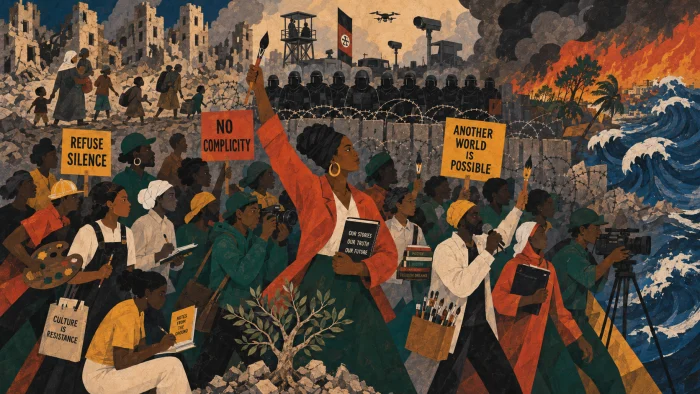
From education to politics and culture, corporate power is narrowing the spaces where people learn to question authority, imagine alternatives and act as democratic citizens.
“I think the job of the artist is to remind people of what they have chosen to forget.” — Arthur Miller
Moral witnessing has largely retreated into billboards, podcasts, a commodified and hate-filled media ecosystem, and relentless gestures of liberal empathy emptied of consequence. Too few artists, intellectuals, and cultural workers are willing to risk their careers by confronting the genocidal wars of our time and the governments and institutions that sustain them with weapons, money, and silence. Where are the voices for the children being slaughtered in Gaza and for those subjected to the horrors of war, displacement, and hunger in Iran, Lebanon, Sudan, and elsewhere? Where is the outrage against the masked thugs patrolling America’s streets, terrorizing communities, violating the law, and turning state violence into a spectacle of fear? Where is the international movement of artists, academics, and cultural workers willing to organize, strike, and refuse complicity with the corporate barbarians who flood the culture with hatred, purchase elections, and seize control of the commanding institutions of public life? Where is the collective outrage over what Joel Whitebook calls “humanity’s headlong race toward an ecological cliff and the accelerating global spread of neo-fascist movements”?
Under the reign of neoliberal trillionaire fascism, the planet burns, cities are militarized, inequality deepens, war becomes a governing principle of politics, racism returns as a celebrated language of power, and young people are robbed of both a future and a place in history. Cruelty is normalized, ignorance is weaponized, and the machinery of death is dressed up in the language of security, efficiency, and national greatness. Border madness feeds white nationalism and colonial fantasies. What once provoked shame is now performed as spectacle. What once demanded outrage is absorbed into the rhythms of everyday life.
This collapse of moral courage is nowhere more visible than among the liberal establishment of the Democratic Party, whose fear of an emerging democratic socialism among young people and an increasingly organized DSA appears at times more intense than its opposition to the militarized gangster capitalism of the Trump era. The contempt is revealing because it exposes what liberal centrism fears most: not authoritarian power, but a politics willing to challenge the economic order on which that power feeds. Even the liberal press often reproduces this panic, framing the resurgence of democratic socialism less as a response to grotesque inequality, corporate rule, and the political exhaustion of neoliberalism than as a threat to the Democratic Party itself.
The question posed by Rolling Stone, whether the democratic socialist surge might “doom the party,” gets the crisis exactly backward: the more urgent question is whether a party wedded to corporate power, militarism, and neoliberal capitalism has already forfeited its capacity to speak to millions of young people who no longer believe the existing order has a future. This fear is manufactured through a sterile self-serving ideological language. In Rolling Stone, Bernie Sanders becomes a “Trojan horse” who “infiltrated” the Democratic Party, democratic socialism is associated with Animal Farm and a “bitter worldview,” while Trump’s politics, despite its acknowledged racism and cruelty, is described as “eminently salable.” Democratic socialism is treated as a pathology to be contained, while authoritarian politics is translated into the bloodless language of electoral viability.
Jon Cowan and Matt Bennett, co-founders of the centrist group Third Way, declared in a Washington Post op-ed that the DSA’s ideas are “electoral poison.” But what exactly is the poison they fear? A politics that demands economic equality, universal social protections, racial justice, democratic control over concentrated wealth, and an end to a political order in which billionaires purchase elections while the poor and working class are abandoned and public life is hollowed out. This political betrayal runs through the Clinton and Obama years, when the Democratic establishment made its peace with neoliberalism, Wall Street, corporate power, and the permanent war state, leaving it increasingly incapable of confronting the economic forces that nourish authoritarianism.
What haunts the party’s centrists is not simply the DSA but the return of a radical democratic tradition they had hoped history had buried: the ghosts of Eugene Debs, Michael Harrington, Stanley Aronowitz, and, more recently, the insurgent democratic socialist politics associated with Zohran Mamdani. This tradition invokes a language the liberal guardians of the existing order find increasingly intolerable: class power, economic justice, solidarity, public goods, racial capitalism, and the radical democratization of wealth and power.
At a moment when fascism is gathering force and ecological catastrophe is accelerating, defending capitalism against those demanding a more just society is not political realism. It is moral surrender dressed in respectable suits and cowardice repackaged by the media as common sense. And nowhere is this moral bankruptcy more grotesque than in the continued flow of American weapons to Israel as tens of thousands of Palestinian children have been killed or wounded in Gaza. The centrists who recoil at democratic socialism as “electoral poison” have remarkably little difficulty accommodating themselves to a political order in which children are bombed, starved, and buried beneath rubble. Apparently, demanding economic justice is considered too radical; underwriting mass death and militarized gangster capitalism is not.
At a moment when silence has become a form of complicity, where are the voices willing to make power tremble? Where are the heirs to W. E. B. Du Bois, Arthur Miller, James Baldwin, I. F. Stone, and Angela Davis, alongside contemporary artists such as Roger Waters and Javier Bardem, who understand that art and intellectual work surrender their moral force when they turn away from human suffering? The question is no longer simply who will speak. It is who is willing to risk something by speaking, to refuse the safety of silence, and to transform moral witnessing into collective resistance and outrage into organized power. The task is no longer merely to bear witness to the darkness, but to build the movements capable of confronting and defeating the forces producing it.


Henry Giroux (born 1943) is an internationally renowned writer and cultural critic, Professor Henry Giroux has authored, or co-authored over 65 books, written several hundred scholarly articles, delivered more than 250 public lectures, been a regular contributor to print, television, and radio news media outlets, and is one of the most cited Canadian academics working in any area of Humanities research. In 2002, he was named as one of the top fifty educational thinkers of the modern period in Fifty Modern Thinkers on Education: From Piaget to the Present as part of Routledge’s Key Guides Publication Series.
ZNetwork is funded solely through the generosity of its readers.
Donate




