


A study by an elite European government-funded think tank found that, while the United States and Europe are growing closer together, the West is increasingly out of touch politically with the rest of the world.
The report, from the EU member state-financed European Council on Foreign Relations, conceded that the system of “American global supremacy” is in rapid decline, and many people in the Global South want a new “multipolar world”.
The series of polls concluded that NATO’s proxy war in “Ukraine confirmed the renewed centrality of American power to Europe”, uniting the West under Washington’s leadership. Today, Europeans and North Americans “hold many views in common about major global questions”.
But this “consolidation of the West is taking place in an increasingly divided post-Western world”, the study acknowledged. The Global South is moving in the opposite direction.
It described “a wide gap between the West and the ‘rest’ when it comes to their desired outcomes for the war and differing understandings of why the US and Europe support Ukraine”.
The report admitted that, even if Ukraine somehow managed to win the NATO proxy war with Russia, “it is highly unlikely to restore a US-led global liberal order”, and, instead, “the West will have to live, as one pole of a multipolar world”.
The 13% of the global population in the West is out of touch with the ‘rest’ of the world
This study was conducted by the European Council on Foreign Relations (ECFR), a notoriously hawkish think tank that expresses overt anti-Russia and anti-China bias.
The ECFR is funded by the European Parliament and numerous European governments, including Germany, France, Italy, Spain, Belgium, Ireland, Norway, Denmark, Finland, and the Czech Republic, as well as key Western ally Japan.
For the report, the ECFR commissioned polling in:
- China
- India
- Türkiye
- Russia
- United States
- Britain
It also surveyed people in nine major European Union member states, which it referred to collectively as the EU9:
- Denmark
- Estonia
- France
- Germany
- Italy
- Poland
- Portugal
- Romania
- Spain
The pollsters interviewed a total of 19,765 adults in late December 2022 and early January 2023.
The sample of participants in the West was representative of the general population. But the study disclosed that, in China, India, and Russia, the people surveyed in the polling only came from large cities, meaning the results may not reflect the views of those living in rural areas.
The study suffered from bias. This slant was clear when the report misleadingly referred to the NATO-Russia proxy war in Ukraine facilely as “Putin’s war” and “Russian aggression”, as if the West did not play a fundamental role in starting the conflict in the first place by sponsoring a violent coup d’etat in Kiev in 2014, repeatedly violating promises not to expand NATO east after the 1990 reunification of Germany, sabotaging the Minsk accords and peace talks, and ignoring Moscow’s 2021 request for security guarantees.
But despite the ECFR study’s many flaws, its results convey an unmistakable message: The West is out of touch with the rest of the world.
The report acknowledged this, choosing as its title: “United West, divided from the rest“.
The Western nations surveyed in the study have a combined population of nearly 1 billion – approximately 13% of the global population of 8 billion.
This is a mere fraction of the populations of China (1.41 billion), India (1.39 billion), Russia (142 million), and Türkiye (83 million).
Together, these countries have a population of just over 3 billion – making up around 38% of the total global population.
The ECFR polling shows how significantly the public opinion of the 13% in the West differs from that of the Eurasian powers.
The West’s view of the Ukraine war is not shared by the rest of the world
In its report, the European Council on Foreign Relations stated that the proxy war in “Ukraine marks both the consolidation of the West and the emergence of the long-heralded post-Western international order”.
“Many in China state that American and European support for Ukraine is driven by the desire to protect Western dominance”, the study acknowledged.
“And for the vast majority of Chinese and Turks, Western support for Ukraine is motivated by reasons other than a defence of Ukraine’s territorial integrity or of its democracy”, it added.
45% of people surveyed in China, 38% in Russia, 30% in Türkiye, and 23% in India said the US is supporting Ukraine simply in order “to defend Western dominance”.

A plurality in these Eurasian nations thinks the same about Brussels.
40% of people surveyed in China, 46% in Russia, 27% in Türkiye, and 23% in India said Europe is supporting Ukraine in order “to defend Western dominance”.

The report admitted that “people in non-Western countries possess a clear preference for the war to end now – even if it means Ukraine having to give up territory”.
54% of people surveyed in India, 48% in Türkiye, 44% in Russia, and 42% in China think “the conflict between Russia and Ukraine needs to stop as soon as possible, even if it means Ukraine giving control of areas to Russia”.
Despite biased wording from the pollsters, an additional 12% of people in India, 8% in Türkiye, 29% in Russia, and 12% in China said “Western dominance of the world needs to be pushed back, even if it means accepting Russian territorial aggression against Ukraine”.

While a majority of people in the United States, Britain, and EU consider Russia to be an “adversary with which we are in conflict”, the situation is the opposite in India, China, and Türkiye.
In India, 80% of people surveyed see Russia as an ally or partner (51% as an “ally that shares our interests and values” and 29% as a “necessary partner with which we must strategically cooperate”).
In China, 79% of people surveyed see Russia as an ally or partner (35% as an ally and 44% as a necessary partner).
In Türkiye, 69% of people surveyed see Russia as an ally or partner (14% as an ally and 55% as a necessary partner).

Another question in the poll showed how Western media propaganda has manipulated public opinion.
The proxy war in Ukraine has made Russia seem stronger in India, Türkiye, China, and the country itself, whereas people across the West now see Moscow as weaker.
This was another example of where Western views were the exact opposite of those in the Global South.

The ECFR report admitted that, while US “President Joe Biden has framed the war [in Ukraine] as a struggle between democracy and authoritarianism”, this is not how people in the Global South see it.
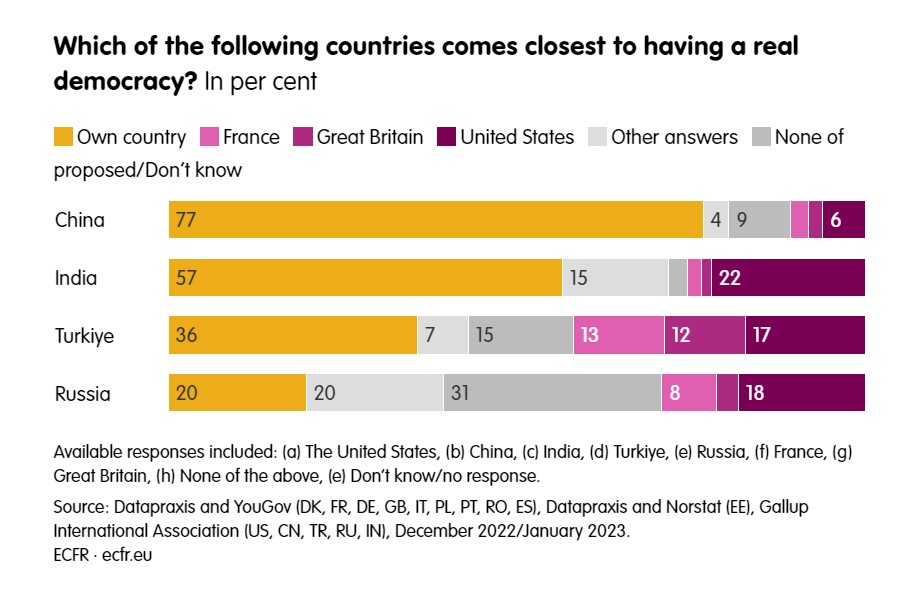
The pollsters asked participants which country they consider “comes closest to having a real democracy”. This question, again, reflected the bias of the study, turning the survey into a contest to see which country is supposedly the most democratic of all.
Yet despite these limitations, more than three-quarters of people surveyed in China (77%) considered their country to “come closest to having a real democracy”.
A separate study conducted in 2022 by another Western government-backed organization, the NATO-linked Alliance of Democracies Foundation, found that 83% of people in China consider their government a democracy, and 91% said they value democracy as important. (In the United States, on the other hand, just 49% of people said their government is a democracy.)
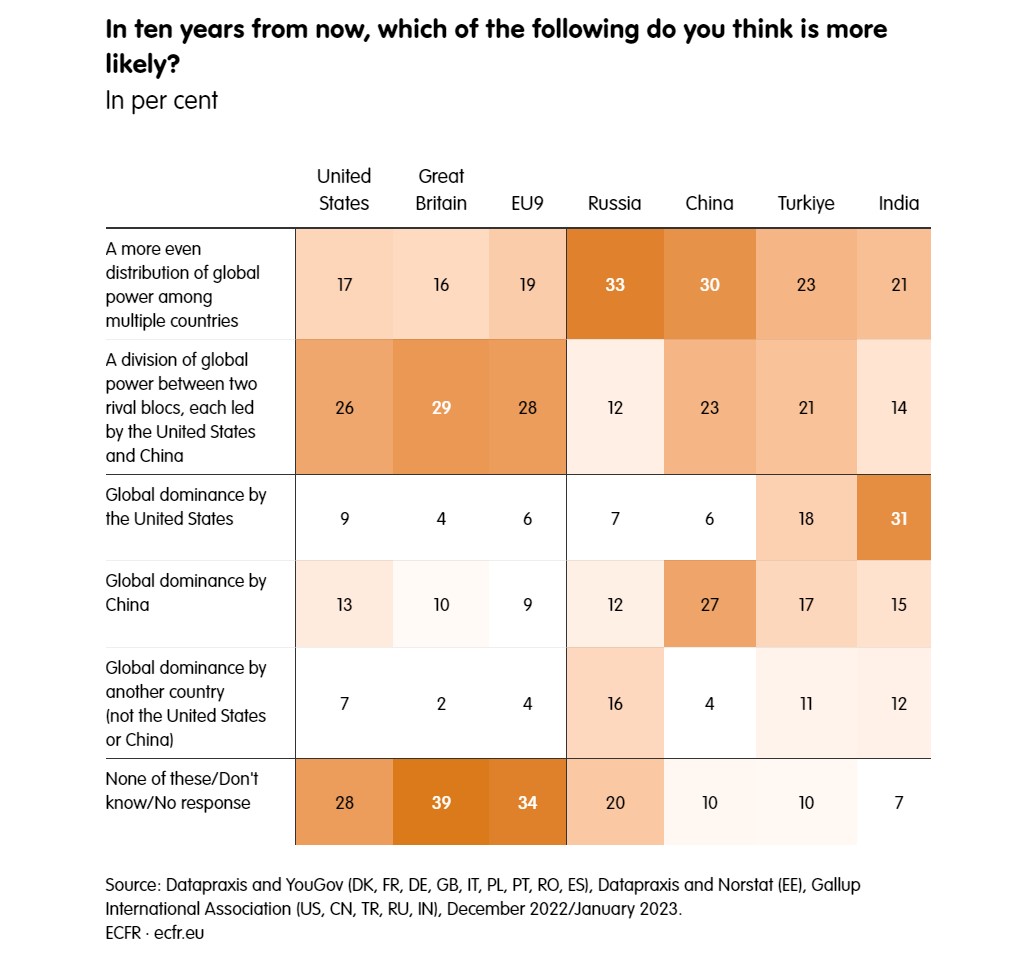
The ECFR study also acknowledged, “Most people in major non-Western countries such as China, India, Turkiye, and Russia predict the West will soon be just one global pole among several. The West may still be the strongest party but it will not be hegemonic”.
A plurality of people surveyed in China (30%) and Russia (33%) think the world will become increasingly multipolar.
This is in stark contrast to the plurality of those surveyed in Britain (29%), the EU (28%), and the US (26%), who see the world returning to a bipolar system of cold war competition between a US-led bloc and a China-led bloc.
The ECFR wrote:
The West may be more consolidated now, but it is not necessarily more influential in global politics. The paradox is that this newfound unity is coinciding with the emergence of a post-Western world. The West has not disintegrated, but its consolidation has come at a moment when other powers will not simply do as it wishes.
ZNetwork is funded solely through the generosity of its readers.
Donate