
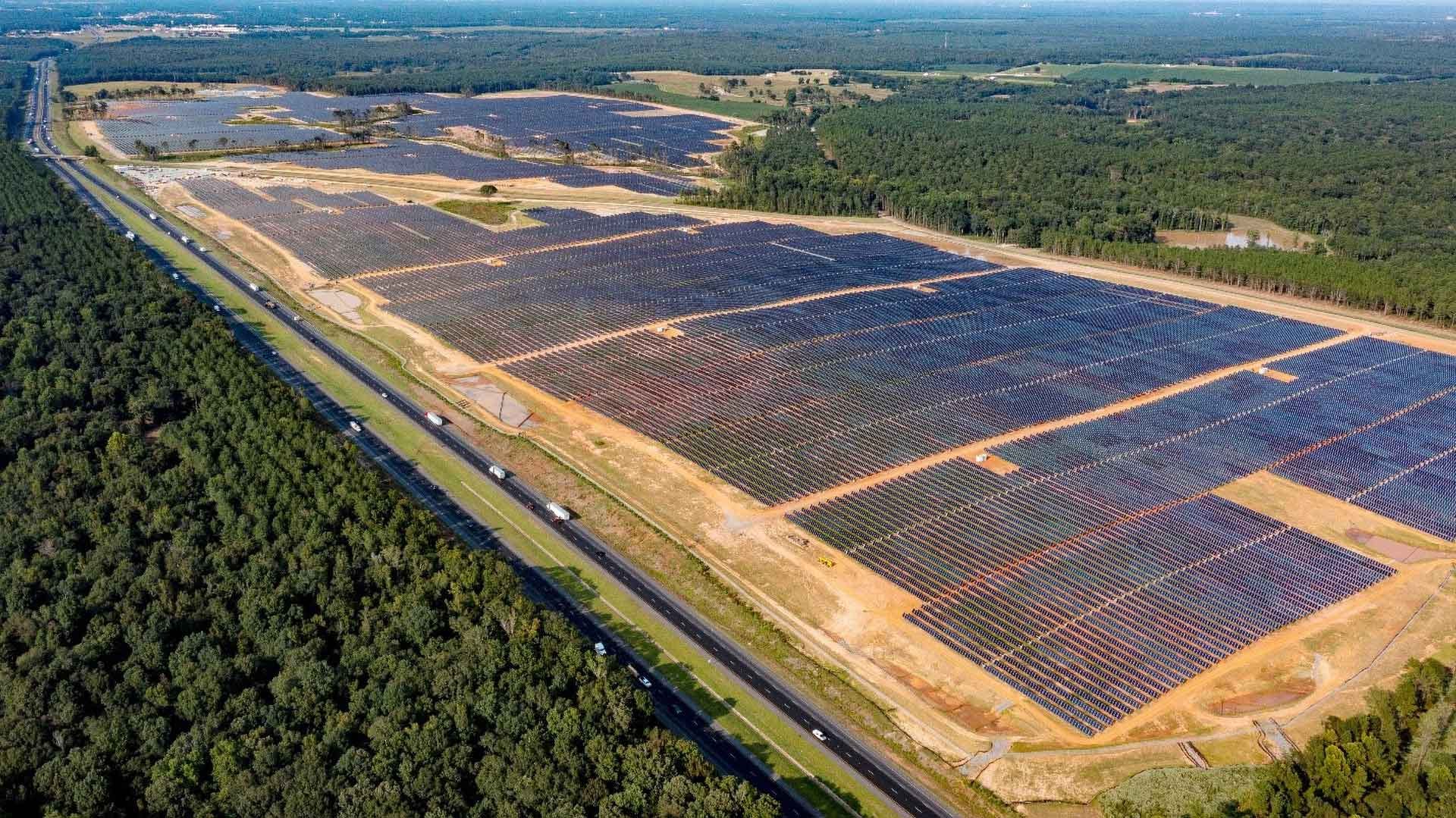
The claim is ubiquitous: if we’re to meet our climate goals, we need a mass buildout of renewable energy production. But this claim is false, and worse yet, attempting it will accelerate climate collapse.
Let’s start with the assumptions baked into this claim: 1) Demand is natural and untouchable, 2) Renewable energy production reduces greenhouse gas emissions.
Both are untrue.
The first assumption posits that all demand is good and essential; it’s an inevitability that must be met. Any reduction in demand represents a decline in quality of life and rising demand is natural. The second assumption flows from the first: if demand isn’t met by renewable energy, it must then be met by fossil fuels.
In this second assumption, the point is not that renewable energy reduces greenhouse gas emissions in an absolute sense but that it does so relatively: the greenhouse gas emissions created by renewable energy production–such as the mountains of coal burned to produce solar panels, the carbon-sequestering forests and deserts bulldozed for their installation, the F-gases (which are ~20,000 more potent than CO2) released by wind energy infrastructure, and so on–are lower than if this sacred demand were instead met by fossil fuels.
So in plain language, here is the actual claim: “We have no choice but to meet all electricity demands and doing so via renewable energy increases greenhouse gas emissions by a lesser amount than fossil fuels.”
Now that we have clarity on the actual claim, we can break it down. The reality is this: 1) We absolutely do have a choice because demand is politically, economically, and socially constructed, and 2) The choice between renewables and fossil fuels is a false binary, like telling a healthy person they must chose between losing an arm or a leg.
If we accept this reality, the solution becomes obvious: reduce demand and thus production. The benefits of doing so are not relative to fossil fuels, they are absolute: not fewer GHGs than something worse, but a real reduction. The same goes for the various forms of pollution, land destruction, labor exploitation, and so on, which are fundamental realities of both renewable energy and fossil fuel production.
We don’t need to settle for relative improvements and doing so would only sends us further down the path of ecological collapse, albeit at a slightly different pace and in slightly different ways (an accelerated collapse of biodiversity in exchange for a slightly slower pace of global heating, for instance.)
The next false assumption is that reducing demand would lead to a decline in quality of life. The reality is quite the opposite: a great deal of what drives demand makes our quality of life worse or has no effect at all.
To illustrate this point, let’s take a look at the state of New York, which has a legal mandate to achieve 70% renewable energy production by 2030. The state’s progress toward these goals is widely considered a failure, allegedly because it has not expanded renewable energy production fast enough (legally defined “renewable” energy sources currently supply about 28% of the state’s electricity.) Socialists and progressives have responded to this by campaigning for “the biggest buildout of public renewable energy in history”–without so much as a word about demand.
As we’ve seen, this response rests on the assumptions above: that we must meet demand and that the negative externalities are worth it (if they’re acknowledged at all.) This, to me, is completely insane.
By way of example, here are some demands whose total elimination would significantly help the state to meet its 70% renewable energy goal immediately without installing a single solar panel: cryptocurrency mining and arbitrage, high-speed trading, AI data centers, climate-controlled empty office towers and retail spaces, always-on second homes, powered advertising, after-hours commercial lighting, and idling server farms.
These demands either serve the interests of the financial elite or no one at all, while creating significant harm. (After-hours lighting, for example, is a major threat to biodiversity.)
Something that’s important to understand about electricity production is that it’s built for peak demand, not typical demand. It’s the same principle that has blanketed America in giant empty parking lots built exclusively for Black Friday. Due to their variable production, renewables make this problem even worse: you either have to build enormous amounts of battery storage–which is insanely expensive and prone to toxic fires–or you have to overbuild production capacity by ~400%. Both of those approaches come with massive and unavoidable costs, both financial and ecological; reducing demand, however, does not.
Crucially, very high peak loads have no relationship to quality of life, despite what some people claim. You and I do not experience any benefit when the Manhattan’s 70 data centers or the billboards in Times Square suck up ungodly amounts of electricity at the same time we’re trying to avoid dying in a heatwave. The fact that those data centers and billboards are allowed to make socially harmful demands regardless of competing socially useful demands is a policy choice, not a natural phenomenon. To call for a mass renewable buildout that doesn’t challenge that policy choice is a moral, political, and technical failure.
There are, in fact, many other electricity demands that don’t improve quality of life at all: an entire universe of devices in standby mode; humming forests of server racks idling 24/7; ceaselessly running routers, switches, signal repeaters, firewalls, and WiFi systems; empty retail stores, office buildings, and warehouses that are immaculately climate-controlled and lit up like a Christmas tree; vacant parking lots, building perimeters, and storage yards bathed in flood lights; an all-encompassing web of cameras and surveillance technology filming empty streets; the list goes on and on.
In total, buildings make up 40% of global energy demand but 26-65% of their energy is used when NO ONE IS THERE. It is beyond irresponsible to demand ANY new negative externalities while such profligate waste persists.
And then there are huge demands that are easily fixed, like old buildings using constant-speed–rather than variable speed–pumps to recirculate hot water. There’s a good reason you’ve probably never heard of this: it doesn’t effect your experience. But inefficiencies like this are repeated across our built environment, and they add up to a lot of juice.
Calling for a renewable energy buildout without addressing demand is saying that we must accept a slew of new negative externalities in order to maintain waste and inequality. The heated driveways of the Hamptons are sacred. We must burn coal, level forests, pollute waterways, and exploit slave labor to keep Tribeca pied-à-terres at 74 degrees in the winter. We must lay the legal groundwork for clearcutting the Catskills, so that crypto farms can continue humming along.
That’s the situation at the top. But what about at the bottom? The reality is that there are many gratuitous demands at the bottom which represent an unnecessarily low quality of life. Living in a poorly-insulated, drafty home with the heat and A/C cranking constantly is not luxurious and powering such an arrangement with renewable energy isn’t a real solution.
Fixing wasteful demands at the bottom represent a huge source of potential savings, but in New York, as elsewhere, the state is taking an extremely tepid approach to this problem via subsidized efficiency upgrades. However, the scale, manner, and speed of this process is laughably inadequate and unequal. (My own experience is instructive: I applied for the state’s home efficiency upgrade program, and after months of calls and wrangling, they ultimately said they wouldn’t make pay for any upgrades because the home wasn’t in good enough condition. Unable to afford the efficiency upgrades or to renovate my home, I simply continued running my oil boiler, electric baseboard heaters, and wood stove as usual.) My neighbors–some of whom are renters and thus don’t qualify–have never even heard of these programs.
An approach to home efficiency that actually works would aim for universal weatherization via a free, automatic service: a program representative would just show up at your house and work with you to schedule the insulation, window repair, duct sealing, boiler replacement, etc., no wrangling necessary. Other free improvements would rely on proven techniques like load controls that shift demand to off-peak hours (e.g. your dishwasher would default to running overnight rather than after dinner), displays showing real-time electricity costs, free removal of redundant appliances, more efficient default thermostat settings and deadbands, and vampire load reduction measures.
This is a very incomplete list, but you get the point. None of it exotic, and all of it would be experienced as neutral or positive in quality of life terms. And by improving the living conditions of the working class, it would tie climate action to the struggle for greater equality.
So given that, why is there so much enthusiasm for an eye-wateringly expensive and ecologically destructive renewable energy buildout? Because when it’s deployed in this manner, renewable energy avoids class struggle and ecological education. It appears to be a silver bullet that pleases everyone: nothing fundamentally changes, but the climate crisis is magically solved. For people on the left who are both ecologically illiterate and politically myopic, this is the obvious choice.
But any solution to climate change that doesn’t account for inequality–both of wealth and energy–is doomed to fail. Fortunately, there’s a way to make this process a real engine for redistribution while reducing demand: steeply progressive pricing of electricity. Allocating a cheap, reliable 10-15 kWh per day, per primary residence–enough for refrigeration, heating/cooling, cooking, lighting, electronics, and more–would allow everyone to meet their core needs at a lower cost than they do today. Above that, tiered pricing would function as a redistributive tax on the rich, while socially harmful uses like crypto would be banned outright.
If people were unable to meet their core needs within the 10-15 kWh per day range due to issues like poorly insulated homes, the necessary upgrades would be paid for via the “tax” on the rich. The rich would reduce their exorbitant demand because the highest pricing tiers would be expensive enough to disincentive it. That means the tiers would have to increase exponentially, to the point where paying them would lead to the user no longer being rich. This is by design: for an energy transition to succeed, it must have powerful incentives and disincentives, while also redistributing wealth.
Commercial and industrial users would be treated similarly: socially useful functions and public goods like health care, public service, and education would be granted a cheap guaranteed baseline, while steeply-tiered pricing would disincentivize waste. Harmful users would be banned entirely (or at least face such steep pricing that their model would no longer be profitable), and efficiency improvements would be subsidized by the higher tiers.
Taken together, these measures would allow New York to hit its 70% renewable goal without adding any additional production. In fact, there’s zero chance it meets the 70% goal by 2030 any other way.
For the average person, this whole process would represent not just a reduction in the cost of living, but an increase in quality of life. Their home would be more comfortable, inequality would be reduced, environmental disasters would be less frequent, the night sky would be darker, the fireflies more abundant.
And it would incentivize exactly the kind of innovation we actually need: innovation that increases efficiency.
By way of example, if you wanted your home to be warmer without crossing into a higher electricity price tier, you might spend the weekend building a passive solar air heater or a Jean Pain system or a rocket mass heater or a mechanical windmill. If you wanted it to be cooler, you might increase indoor thermal mass or plant a shade tree or install a windcatcher or build an earth tube or a low-tech adiabatic cooling system. If you wanted more refrigerator space, you might build a root cellar or use a zeer pot. And so on.
All of these techniques already work, but they can undoubtedly be improved. And there are entirely new inventions awaiting our ingenuity, the same ingenuity we’re currently wasting on mind-numbing bullshit like crypto and advertising and AI.
Such innovation would allow us to push past the arbitrary climate goals we’ve set and move into the realm of real regeneration: not merely staving off collapse, but truly making our lives sustainable, in every sense of the word.
ZNetwork is funded solely through the generosity of its readers.
Donate
2 Comments
Probably pointless to say so since the NY Times and others oppose, but the world could, with enough quality effort, be powered primarily by thorium/uranium-233 molten salt nuclear reactors that produce massive quantities of heat from which electricity can be produced via turbines and hydrogen fuel via that electricity and water (electrolysis) and/or by “cracking” water directly using the intense heat produced by the reactors— reactors that are very safe and efficient. The hydrogen could be used to power vehicles, by both internal combustion and fuel cell types. As well, assuming efficient distribution of the hydrogen, fuel cells could be used to quietly power onsite electricity generators at all buildings, etc., and the electrical grid eliminated. Materials like steel, aluminum, copper and such that presently make up the grid could be recycled into the economy. No more wires all over the place, high or low, needed in the environment. And it is all just so, so clean!
you are giving no real numbers. How much of the solar panel production is/can be done using renewable energy for fuel? Coal vs renewables needs more concrete data. I am not necessarily disagreeing but you do too much hand waving.