
In autumn of 2012, the code of silence was very much in the news in Chicago. The trial of the civil suit brought against the city by Karolina Obrycka, the bartender struck and kicked by off-duty Officer Anthony Abbate in 2007, was unfolding before a jury in the federal courtroom of Judge Amy St. Eve.
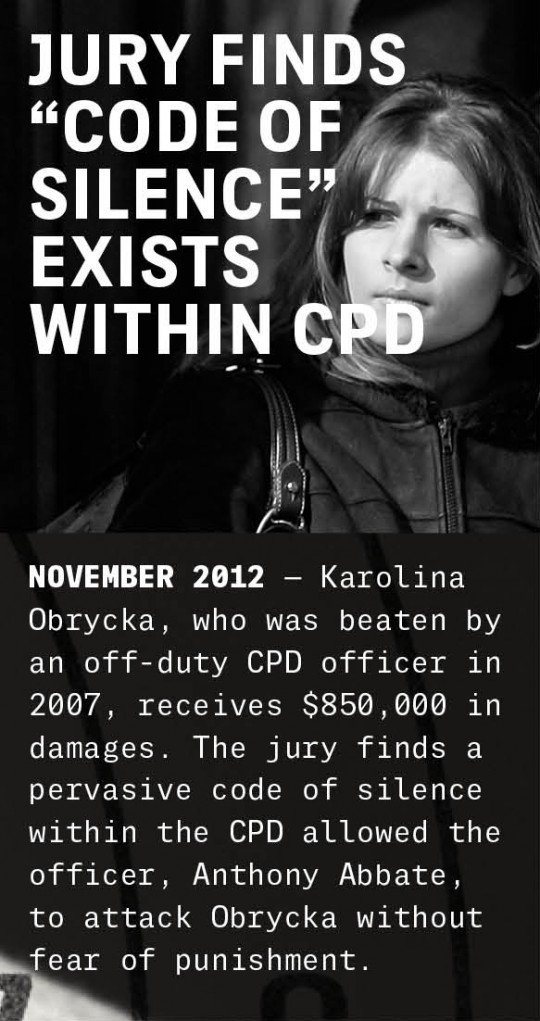
One of Obrycka’s central claims was that Abbate assaulted her, secure in the knowledge he would be protected by the code of silence within the Chicago Police Department. In support of this claim, her lawyers presented expert testimony to demonstrate the department’s failure to adequately investigate and discipline police misconduct. On November 13, 2012, the jury returned a verdict in Obrycka’s favor. It awarded her $850,000 in damages and found that a pervasive code of silence within the CPD had allowed Abbate to attack her without fear of punishment.
Mayor Rahm Emanuel was in his second year in office. In retrospect, the Obrycka verdict afforded him an opportunity to pivot away from Daley-era abuses and declare a new day for police accountability in Chicago. Instead, his administration, in an unusual move, sought to erase the precedent represented by the jury’s finding that a code of silence exists within the CPD. The city entered into an agreement with Obrycka under which it would not appeal the verdict and would pay the award and attorney’s fees immediately. Obrycka, in turn, joined the city in asking the judge to vacate the code of silence judgment.
The joint motion created a situation in which the public interest was unrepresented. Two law professors who specialize in police abuse cases — Craig Futterman of the University of Chicago and Locke Bowman of Northwestern University — intervened on behalf of the public. They argued that if the city was allowed to “buy its way out of” the judgment, it would have no incentive to make the necessary reforms. Judge St. Eve ruled against the city, holding that the jury verdict regarding the code of silence “has a social value to the judicial system and public at large.”
In their effort to have the code of silence verdict set aside, city lawyers argued that the CPD had enacted significant reforms since the 2007 bar incident. And they emphasized that the department was now led by a new superintendent who would not permit such behavior to go unpunished.
Superintendent Garry McCarthy reinforced the point by issuing a statement in which he asserted with characteristic bluntness, “I will never tolerate a code of silence in a department for which I am responsible.”
Two weeks before McCarthy uttered those words, Shannon Spalding and Danny Echeverria filed a whistleblower suit, claiming they had suffered retaliation for reporting and investigating criminal activity within the department. The defendants named in the lawsuit included CPD brass serving directly under McCarthy, among them, Nick Roti, chief of the organized crime bureau; James O’Grady, commander of the narcotics division; and Juan Rivera, chief of the internal affairs division.
The common understanding of the code of silence is that it is a peer-to-peer phenomenon — I’ve got your back, you’ve got mine — within the rank and file. Senior officials are implicated to the extent they do not take affirmative steps to discourage operation of the code. The thesis of the Spalding case, by contrast, is that high-ranking officials ordered retaliation against the officers for violating the code.
When Spalding and Echeverria filed their lawsuit in the fall of 2012, they had an immediate aim. They hoped that, whatever the ultimate outcome of the suit, the fact of a pending case would serve to deter the retaliation against them that had only intensified after the conclusion of Operation Brass Tax, a joint investigation conducted with the FBI into a drug ring controlled by longtime Chicago police officer Ronald Watts.
After Watts and his partner, Kallatt Mohammed, were indicted, Spalding and Echeverria had returned to the inspections unit where they continued to be ostracized and denied meaningful work. IAD Chief Juan Rivera again refused to file a retaliation complaint on their behalf. (As noted earlier, Rivera in his deposition denied that he ever received a formal request from Spalding and Echeverrria. )
Barred by Chief Roti from returning to any unit in organized crime, they met with Thomas Byrne, chief of detectives, for whom they had worked when he was commander of the 1st District. A year or so earlier, he had asked them to come work for him in the fugitive apprehension unit, but they had been unable to do so because Rivera said they were still needed for the Watts investigation. Now fugitives seemed like a good fit. Both Rivera and Tina Skahill provided letters of recommendation for them. Byrne said he would place them on the U.S. Marshals Task Force Team and that as soon as spots opened up they would be deputized as U.S. Marshals. He assured them they would not encounter retaliation in his unit.
On March 20, 2012, they joined the U.S. Marshals Task Force Team. Despite all they had been through, said Spalding, “all we wanted to do was get back to doing real police work.”
It wasn’t to be. “We’re not there for 15 minutes,” recalled Spalding, “and we’re called IAD rats.”
From the start at the fugitives unit, they were in a Catch-22. They were taken off major cases and given low-level assignments like finding unknown turnstile jumpers or people who had been drunk in public. They were told to do only their assigned cases — a limited number of relatively trivial cases — and then were told they were not producing. When they reported to Rivera what was happening, said Spalding, he observed that “that’s what they do”: They give you dead-end work you can’t do, then blame you for not doing it.
Spalding said Rivera advised them to “record, record, record,” but again refused to issue a complaint register for retaliation or intervene on their behalf.
Amid the hostility in the fugitives unit, there was one seemingly sympathetic presence — Sgt. Thomas Mills, who had been in the confidential section of IAD when Rivera was a lieutenant there. Rivera told Spalding and Echeverria to have Mills call him. Mills later reported to them that Rivera had told him they were great officers. Mills reflected back at Spalding the seriousness of her situation.
“The only thing,” he said, “between those bosses and federal prison is you. If I were you, I’d wear my vest at all times, even coming and going to work.”
By way of illustrating the political realities at internal affairs, Spalding recounted a story Mills had told them. Soon after he came to the confidential section, he was given the assignment of investigating a deputy superintendent. The allegation was that the official lived outside the city. Mills worked on the case for months and concluded the allegation was true. He produced a thick file in support of that conclusion and presented it to his supervisor. The next day, the file came back to him. There was a yellow Post-it on it with the handwritten message: “Make it unfounded.”
Upset, he took the matter up with his supervisor, who replied that he should have known how to handle the investigation “because of who it was.” In other words: The outcome should have been clear, because the accused was a boss with clout.
“From now on,” Mills told the supervisor, “just give me my assignment with the Post-it note already on it telling me what the outcome is before I waste my time.”
After recounting this story, Spalding observed, “It’s like Mike Barz said about the bosses: ‘It’s your job to report to them. It’s their job to say what happened.’ Our problem is that we took the investigation seriously. We never saw the Post-it.”
Spalding and Echeverria’s account of the retaliation they endured after joining the fugitive apprehension unit is corroborated by an affidavit and deposition provided in their case by Officer Janet Hanna. Now retired, Hanna was the personal administrator for Cmdr. Joseph Salemme and Lt. Robert Cesario of fugitives. She stated that before Spalding and Echeverria joined fugitives, Cesario warned his administrative staff in the unit that they were “IAD rats” and should not be trusted. He told sergeants under his command, in her words, “to instruct their teams of officers to not provide any backup for Shannon or Danny and to not work with them at all.” Further, Hanna stated that Cesario ordered her to give them only dead-end cases that would not result in arrests, that he personally reviewed their assignments, and that he instructed her to destroy their overtime requests. She also testified that they were denied access to the databases required to do their jobs.
On June 20, 2012, Spalding and Echeverria were ordered to meet with their direct supervisors — Sgt. Maurice Barnes, Cesario, and Salemme. Cesario informed them they were being taken off the task force because they had too few arrests and priority cases. When Spalding and Echeverria challenged Cesario about their lack of activity, Spalding recounted to me, Salemme demanded to know whether they were working for internal affairs. “You brought this baggage on yourselves,” he said. “You want to investigate bosses, you want to put bosses in jail, you should have known this would happen to you.”
“It’s a safety issue,” said Barnes, addressing himself to Spalding. “I don’t want to tell your daughter you’re coming home in a box because the team won’t help you on the street.”
Cesario spelled it out for them: They were being shifted from days to nights and reassigned to a nighttime fugitive apprehension team on the North Side. They would never be deputized by the U.S. Marshals, get a take-home car, or overtime pay.
“That will never happen for you,” he said to Spalding.
At the end of the meeting, Spalding asked, “If we had never worked on an internal corruption investigation with the FBI, would any of this be happening right now?”
“No,” replied Salemme.
Again they asked Rivera to issue a CR. Again he refused.
“I can’t help you anymore,” he said. “The ship is sinking. The bell has rung. It’s over. You have to make it work at fugitives. This is your last stop. There’s nowhere else in CPD for you.”
Spalding and Echeverria had hoped that by filing their whistleblower lawsuit they would gain the protection of the Illinois Whistleblower Act and the abuse would relent. If anything, it intensified. The one person within fugitives they believed to be an ally, Mills, also turned against them. He rode Spalding hard.
“This is a numbers unit, and you’re not producing,” he told her. “There is no way you can redeem yourself.”
“I could have come in with Jimmy Hoffa,” Spalding observed, “and it wouldn’t have made any difference.”
Mills spoke openly about their lawsuit to other officers in front of Spalding and Echeverria. “I don’t know why they left you in this unit after you filed,” he said. “They should have launched you.”
“This isn’t good for you,” he warned Spalding. “God forbid you should have to shoot someone out there.” He pointed to Cesario’s office. “He’s your lieutenant. How do you think that’s going to go for you? He’s going to screw you. It’s dangerous for you to remain here. The bosses are actively working against you. You need to consider your options.”
She interpreted this as a suggestion she leave the department for her own safety.
“I began second-guessing everything I did,” she said.
On one occasion, as she and Echeverria set out in pursuit of a fugitive who had to be tased three times to subdue him the last time he had been brought in, they were told by Mills that the team would be there to back them up. When no one showed up, Spalding contacted Mills. He responded with a text: “Be careful.”
“My worst fear was now my reality,” Spalding recalled. “I was an officer without a department.”
When it seemed things could not get worse, they did. On April 11, 2013, Sgt. Barz and Sgt. Robert Muscolino of internal affairs came to the fugitives unit and arrested Spalding. They took her into a room, closed the door, and held her for over half an hour. Barz read her constitutional rights and informed her that she was the subject of a criminal investigation on federal eavesdropping charges. He said they had an eyewitness who stated that she recorded conversations with Mills and then played them for others.
She would later learn from Janet Hanna that the complaint against her stated that Hanna was the person for whom she played the recording of Mills. In her affidavit, Hanna recounted being pressed by Muscolino to confirm the complaint. “I repeated that the complaint was untrue,” she stated, “that the alleged conversation never happened, and that at no time ever did Shannon play for me any recording from her phone.”
Spalding was distraught. Having failed to protect her, IAD was now, she realized, turning its investigative machinery against her and actively participating in the retaliation.
Barz suggested that the charges would go away if she dropped her lawsuit.
“This is retaliation,” she said. “What are you guys doing about Watts?”
“They can’t let him go to trial,” he said. “It’s not in the best interest of the department. They’ll make him an offer he can’t refuse.”
“Yeah,” said Spalding, “and I’m going to jail on trumped-up charges.”
He tried to mollify her. “This is all going to disappear,” he said. “None of it happened.”
(In an interview, Barz vigorously contested Spalding’s account. Specifically, he asserted that there was no arrest and that he never said the CR was “going to disappear.”)
After the IAD officers left, Spalding said, Echeverria walked her to her car. In his deposition, Echeverria recalled how agitated she was. “It was hard to have a conversation with her immediately because she was not in the right frame of mind to speak. She was very upset,” he testified. “She was crying. Shit, it made me want to cry.”
Spalding had never understood why it was that Chewbacca and countless others pleaded guilty and cut deals when falsely arrested by the likes of Watts. Now she grasped what it was like to be caught in the machinery of a system, indifferent to your welfare and to the truth, that was dedicated to imposing its own version of reality. The collapse of her faith in the institution to which she had pledged her life was now complete.
Looking back, Spalding sees this as the moment she broke. “When you work undercover,” she told me at the time, “you learn to keep it together, even when someone has a gun to your head. I’m keeping it together on the outside, but I’m dying inside.”
The next day, she initiated the process of going on medical leave, as did Echeverria. In May 2013, both went on medical leave. After seven months, Echeverria returned to the fugitives unit. Spalding remained on leave. She has been diagnosed by a psychiatrist for the city, as well as her own therapists, as suffering from post-traumatic stress disorder due to the trauma of having her identity exposed within the department. This condition prevents her from working in law enforcement.
On June 6, 2014, Spalding turned in her badge and gun. It was, she said at the time, “the saddest day of my life.” Two years later, she speaks with raw emotion of being denied her “calling,” while some of those they investigated are still on the force. “I can’t be on the job, but they are.”
“I’m grieving a loss like a death. When they took my badge, they took my soul.”
Spalding’s story, as it unfolds, gathers force and gains credibility, through its complexity, coherence, and detail, as well as our knowledge of what the telling has cost her. It is a challenging narrative, because the consequences of believing it are so demanding. It is also incomplete. Things she knows with absolute certainty shade into things she can only speculate about. Understandably, she inhabits an existential space where it’s tempting to organize all available data around thesis and plot: to make things cohere more tightly than messy reality allows. In my interviews with her, she has consistently resisted that temptation. She remains aware of contingencies, what-ifs, competing explanations. She continues to work the puzzle she is enmeshed in. It’s not hard to see why she is a good investigator.
While there is much we do not yet know about the dynamics that determined the course of the Watts investigation and the fate of the investigators, what is clear are certain outcomes:
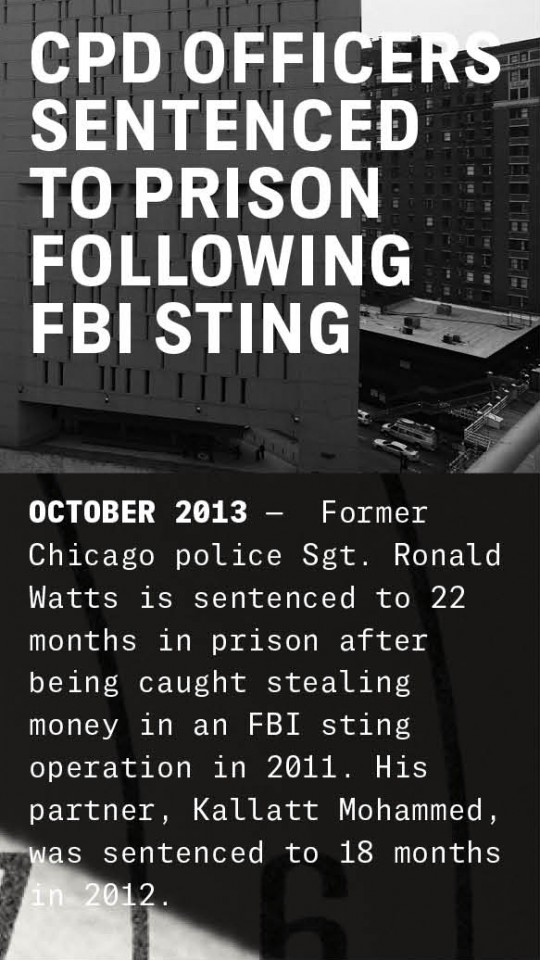
Kallatt Mohammed, Watts’s partner, pleaded guilty in August 2012 and was sentenced to 18 months. He admitted in his plea agreement that he extorted protection money from drug dealers at the Ida B. Wells development “beginning no later than December 11, 2007, and continuing through at least May 22, 2008” — six months out of his long career working with Watts. He said he acted under orders from Watts. In the spring of 2014, Mohammed emerged from prison, having served his sentence.
Ronald Watts initially pleaded not guilty. Then, on July 19, 2013, on the eve of trial, he changed his plea to guilty to one count of theft of government funds. Nothing is known about the substance of negotiations with prosecutors, if any; and there is no indication in the public record that he provided any information about members of his team and others within the department who participated in his crimes.
On October 9, 2013, Watts came before Judge Sharon Johnson Coleman for sentencing. The courtroom gallery was sparsely populated — a few reporters, a couple of family members. Broad shouldered and stocky, the expressionless Watts sat at the defendant’s table in a dark business suit with his fingers tightly laced in front of him.
Judge Coleman was severely constrained in what she could do within the framework presented to her. Although the maximum possible sentence was 10 years in prison and a $250,000 fine, a sentence of 10-16 months was indicated under the federal guidelines. The government asked for 36 months. The defense asked for a sentence in line with the federal guidelines.
Watts’s lawyer, Thomas Glasgow, emphasized his client’s military service, his long career of public service, his role in his family, and the fact that he had no criminal record. In a remarkable passage in the sentencing memorandum he submitted to the court, Glasgow argued that Watts’s crime should, for the purpose of sentencing, be treated as less grave than “pick pocketing or non-forcible purse snatching” because it was not “a theft from another person against that person’s will” and did not involve “increased risk of physical injury” due to the fact that “the ‘taking’ was both discussed and agreed upon” by Watts and Chewbacca prior to it occurring.
By contrast, the government lawyer used strong language to describe the harms that flowed from Watts’s criminal enterprise. Citing Mohammed’s plea statement, she said that Watts had committed crimes such as the one he was charged with many times.
Judge Coleman gave Watts an opportunity to address the court. He declined.
Coleman characterized Watts’s crimes as “unconscionable” and “a betrayal.” She seized on the government’s description of the Wells development as a community “plagued” with crime, drug dealing, and gang activity: “The place was rampant with poverty, unemployment, addictions. The crime stuff comes after. … You were there to protect those people, and you didn’t.”
She also spoke of the impact corrupt officers such as Watts have on children in the community. “They’re taught not to respect anything,” she said. “What else are they supposed to think?”
After a long pause, Coleman announced a sentence of 22 months, followed by one year of mandatory supervision, and restitution of $5,200 — the amount Watts had taken in the sting.
Watts left the courtroom smiling broadly.
He has since served his sentence and relocated to Las Vegas. Apart from the $5,200 from the final sting, he retained all assets he may have obtained through criminal activities.
The other members of Watts’s team — Al Jones, Brian Bolton, and Bobby Gonzalez — remain on the force. Not long after the arrest of Watts and Mohammed, Jones was promoted to sergeant. (Spalding: “They promote you for your silence.”) Gonzalez has been in the news recently due to his involvement in three separate police shootings of young black men over the last two years. None of the officers responded to requests for comment.
As the whistleblower lawsuit moved forward in court, various of the “bosses” named as defendants or alleged to have conspired with Watts retired from the CPD, claimed their six-figure pensions, and in most instances, moved on to other positions in law enforcement. James O’Grady and Nick Roti took leadership positions with the Illinois State Police. Ernie Brown became police chief of Darien, Illinois, and is now executive director of the Cook County Department of Homeland Security and Emergency Management. Debra Kirby took a job with the Garda Siochana Inspectorate, the Irish police, and now works for a Chicago-based risk management firm. And Juan Rivera took his leave in the fall of 2015, as the whistleblower suit moved toward trial.
By virtue of Chicago’s demolition of its public housing developments, the scene of the crimes committed by Watts and his team has disappeared. So too have most of their victims as characterized by Judge Coleman at Watts’s sentencing hearing — the vulnerable public housing residents the team exploited rather than protecting, including children in the community who grew up seeing them as the face of civil authority — “invisible people,” as Spalding puts it, whose lack of standing as citizens is a major factor conferring impunity on predatory officers such as Watts.
At various points in this story, individuals have emerged from that invisible world — a world abandoned then, obliterated now — intent on bringing down the criminal enterprise of Watts & Co. Above all, Chewbacca. Also, Spalding and Echeverria’s informant from the Ickes Homes. Perhaps, too, Big Shorty and Monk Fears.
More recently, a man named Ben Baker, against long odds, established to the satisfaction of the judge who had tried him and the State’s Attorney’s Office that had prosecuted him that he had been wrongly convicted, having been falsely arrested by members of Watts’s team.
On January 14 of this year, having served 10 years of a 14-year sentence, Baker was released from prison, after the state’s attorney dropped all charges against him for possession of a controlled substance. At his trial in 2006, Baker had testified that the Watts team planted drugs on him and falsely arrested him, because he had refused to pay them off. At the time, the judge did not find credible Baker’s description of the protection racket the Watts team operated at the Ida B. Wells development.
With help and guidance from Spalding, attorney Josh Tepfer of the Exoneration Project successfully challenged Baker’s conviction on the grounds that Baker’s allegations against the Watts team were corroborated by investigative materials available at the time of his trial but withheld from his attorneys. Tepfer supported this claim with FBI documents obtained via the Freedom of Information Act. Although heavily redacted, these documents establish that the FBI, IAD, and State’s Attorney’s Office were engaged in an “ongoing joint investigation” of Watts and his team for more than a decade.
Beyond achieving a measure of justice for Baker, the case is important for what it portends. Tepfer and his colleagues have brought a lawsuit against the FBI challenging the redactions under the Freedom of Information Act. They have also brought a civil suit on behalf of Ben Baker. And they are representing a man named Lionel White who is seeking to have his conviction vacated on the ground that he was framed by Watts’s team. Given the evidence that the team routinely used the threat of false arrest to coerce cooperation, how many others have shared Ben Baker’s fate of being wrongfully convicted?
Nine years after contacting the FBI, six years after being outed within the department, and 4 1/2 years after filing their lawsuit, Spalding and Echeverria finally approached their day in court. The trial was set to begin on May 31.
As the day approached, Spalding was a singular combination of strength and fragility. Financially ruined, emotionally depleted, and grief-stricken over loss of the job that gave her life purpose and used every part of her, she prepared to tell her story in court in the face of the mutually reinforcing denials of the city and the individual defendants.
Moments before the trial was to begin, the judge announced from the bench that the parties had reached a settlement. Addressing the press in the lobby of the federal courthouse, Spalding expressed the hope that the impact of the case would be that no other officer “has to walk one day in our shoes.”
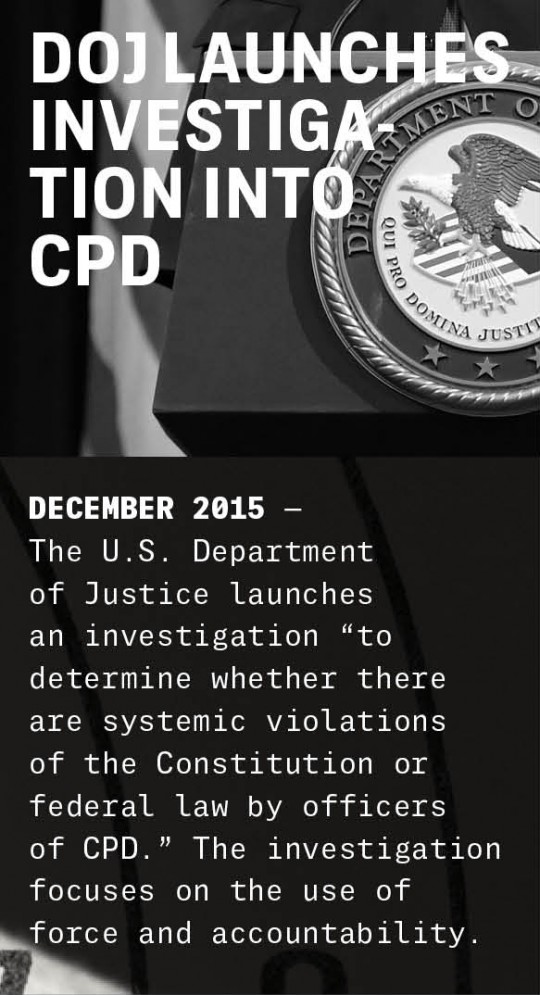
The settlement means the issues presented by the case will not be adjudicated. It does not resolve those issues. If anything, it sharpens them. At a time when the Department of Justice is investigating the Chicago Police Department, a time when debate about how best to achieve fundamental police reform dominates Chicago politics, the questions bequeathed by the case demand sustained attention.
One set of questions relates to the criminal careers of Watts and his alleged co-conspirators. For the better part of those careers, they were under investigation by internal affairs and the FBI, as well as other law enforcement agencies (the Drug Enforcement Administration, the State’s Attorney’s Office). How is it that all there is to show for those multi-target investigations over more than a decade are the convictions of Watts and Mohammed on a single count of stealing government funds in the amount of $5,200? Was this an instance of investigation-as-cover-up? Was the prosecution the capstone of a massive cover-up, designed not to secure information about Watts’s crimes and co-conspirators but to buy his silence? The DOJ team has the means to answer these questions. It can also assess how it is that members of Watts’s team — Al Jones, Brian Bolton, Bobby Gonzalez, and others — remain on the force. Did the investigation in fact clear them? More generally, what can be learned from the history of the Watts investigation for the purpose of diagnosing the changes required in the operation of internal affairs?
Another set of questions centers on the nature of the code of silence. The city has now irreversibly passed over a threshold: The code of silence about the code of silence has been broken. No longer can police officials on the witness stand or in depositions dismiss the term as “TV and movie related” or, in a favorite formulation oft repeated over the years, as “the title of a Chuck Norris movie.”
Mayor Emanuel in his speech to the City Council last December spoke of the code as a problem “at the very heart of the policing profession.” Then several months later, a police accountability task force he had appointed described “a deeply entrenched code of silence supported not just by individual officers, but by the very institution itself.” Elsewhere in the report, the task force called the code “official policy.”

Yet the city in the Spalding-Echeverria case sought to retreat from the implications of those conclusions. As the trial approached, city lawyers, in an effort to avoid having the mayor testify, offered to admit to the existence of the code of silence, but then qualified the statement by adding that police cover-ups are “not pervasive, widespread, well-settled custom or practice to which the city’s chief policymakers have been indifferent.”
Similarly, Corporation Counsel Steve Patton in announcing the $2 million settlement acknowledged the code of silence even as he minimized it. It’s a problem that must be addressed, he said, even if only a few officers engage in such behavior.
Putting aside the logical puzzle of how the code of silence can be said to exist if practiced only by a few, the city’s formulation raises a question essential to the diagnostic clarity on which meaningful reform hinges: Is the code of silence occasional aberrant behavior or standard operating procedure? If Spalding’s account is accurate, then the defendants, including some of the most senior officials in the department, lied under oath and did so in concert. (Again, their denials are available here.) If she is telling the truth, then the city of Chicago in this post-Laquan McDonald era of police reform was prepared to present a defense against claims of retaliation due to the code of silence that was itself a classic exercise in the code of silence.
For her part, Shannon Spalding has no doubt about the answer.
“The code of silence is only silent to the outside world,” she told me recently. “For cops, it’s a constant ringing in your ears from the day you enter the academy to the day you retire.”
She paused, reflecting perhaps on what fidelity to the truth has cost her and what it has brought her.
“But I’m deaf to it now.”
ZNetwork is funded solely through the generosity of its readers.
Donate