

The world is waking up to the cold, calculated realities behind global suffering.
Israel’s land-grabbing genocide in Palestine has shaken people everywhere. And the U.S. has been exposed in tandem. By providing weapons of mass destruction to Israel and neighboring states, Washington enables the region’s endless wars and humanitarian emergencies. The biggest powers in the European Union are also complicit.
As crises spiral, working people increasingly realize that behind each specific instance of ruin is an international system: imperialism, the competition for profit among enormous corporations and their state benefactors.
The United States occupies first place among rivals. In the Middle East, its agenda is far larger than just holding Zionist Israel together. It has put together a web of interlocking regional allies which Trump is expanding and tightening. Understanding its goals and relationships is key to building a strong and effective movement to challenge its predations.
Oil is the tip of the geyser
The central prize of the Middle East, obviously, is the great planetary polluter — oil.
As the globe’s indispensable fuel, the present international economic system cannot survive without it. The world runs on oil. And most countries import it from the Middle East.
Five of the world’s top 10 exporters are Middle Eastern countries. Saudi Arabia alone generates nearly 15% of global output. And U.S.-based multinationals like ExxonMobil, Chevron, and ConocoPhillips are major players as importers, investors and partners in joint ventures.
As significant as oil remains, U.S. economic interests in the Gulf go far beyond it.
Google and Amazon, for example, have each invested $5 billion to build AI and data centers in Saudi Arabia. In the United Arab Emirates (UAE), Boeing, IBM, Microsoft, and Google have major stakes in aerospace, technology, and manufacturing. In 2024, U.S. corporate investment there was $34.4 billion.
In May, Trump took time off from destroying democratic rights at home to forge stronger military and financial alliances with the monarchies of Qatar, Saudi Arabia, and the UAE. The White House claims to have made deals worth over $2 trillion. UAE pledged to sink $1.4 trillion into the U.S. AI sector over the coming decade. Sales of weapons and Boeing airplanes amounted to hundreds of billions of dollars.
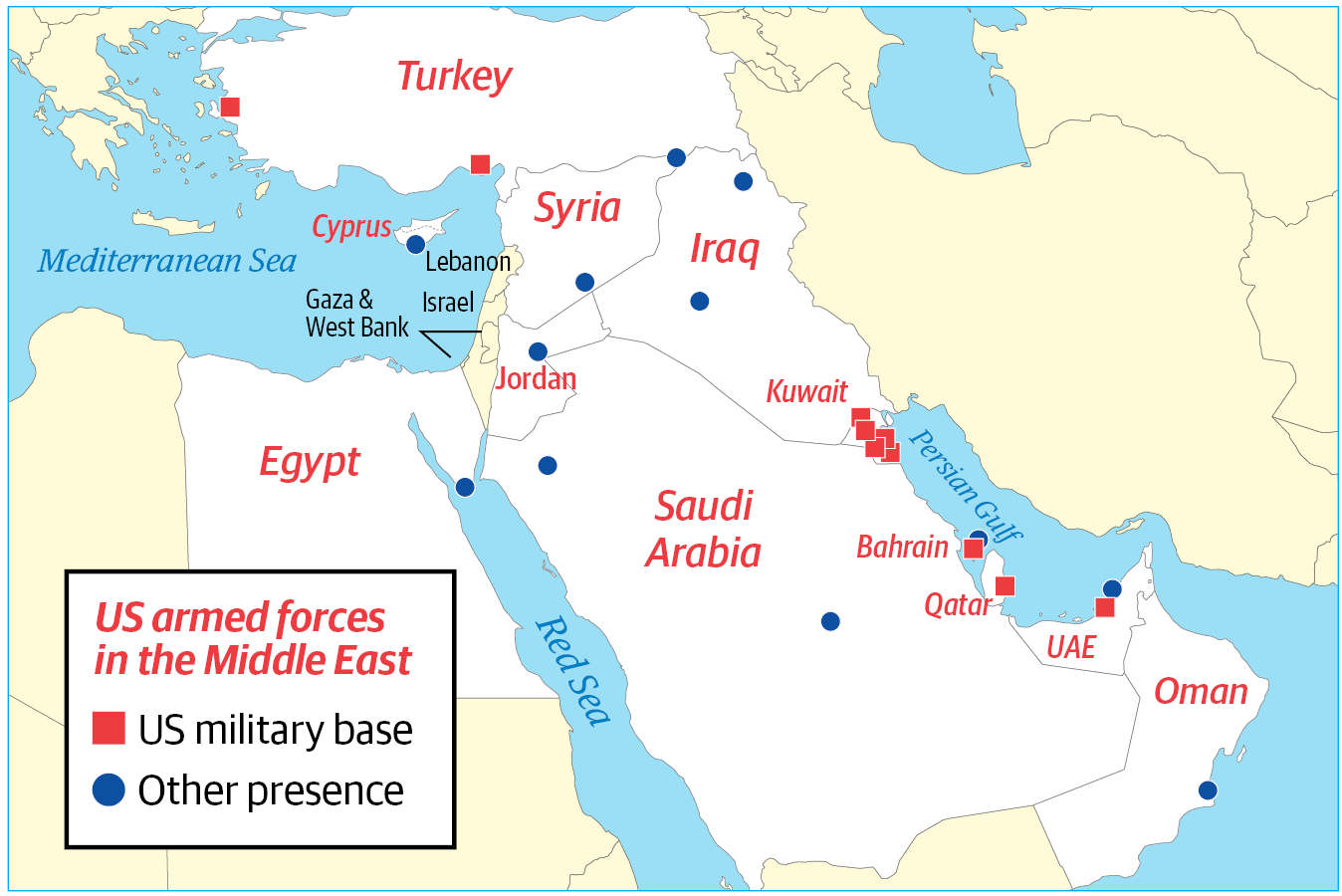
It’s well known that the U.S. provides billions of dollars each year in military assistance to Israel, its power base in the region. But, through sales and aid, the U.S. also heavily arms Saudi Arabia, Egypt, Jordan, UAE, and Iraq. And it maintains 19 military bases in the Middle East with 40,000 personnel.
Washington hopes with all this firepower to maintain control over oil resources and stave off popular rebellions. The U.S. understands that, ultimately, the main threat to all imperialist control is the revolutionary potential of the masses of working people. In any case, the weaponization of the region contributes to the uninterrupted military spending at home that keeps the U.S. economy afloat.
Key threats: China and Iran
Threats to Washington’s hegemony in the Middle East are several and serious.
China is a key obstacle to U.S. economic leadership. It has replaced the European Union as the leading trade partner for Bahrain, Kuwait, Oman, Qatar, Saudi Arabia, and the UAE. It has billions of dollars invested in digital technology and infrastructure. Trump’s deal-making trip in May was largely motivated by China’s encroachment. However, it comes on top of longtime U.S. support for various oppressive and undemocratic dynasties in the Middle East.
China also props up Iran’s economy, which is collapsing in the face of Washington’s bipartisan sanctions, by buying up 90% of Iran’s exported oil. It helps Russia in this way as well. By forging deeper ties with Iran and Russia, China is fortifying its own position relative to the U.S.
So, in June, when the U.S. backed and joined into Israel’s attacks on Iran, Washington’s deadly aggression was about more than nuclear sites or oil fields. It was part of a high-stakes competition over who holds sway in the Middle East.
Change begins with demands at home
To alter the deadly course of things in the Middle East, it’s necessary to build the worldwide movement against the imperialist appetite for environmentally devastating energy sources. The U.S. military is the world’s largest fossil fuel polluter. The logic of the climate change movement is to challenge Western power.
Also key to change is active solidarity with the Gulf’s abused and exploited women, national minorities, immigrants, and workers.
At the same time, it’s crucial to organize to demand that the U.S. and other Israel supporters stop providing military and any other kind of assistance to the genocidal regime — immediately.
These struggles, already underway, are more urgent than ever.
ZNetwork is funded solely through the generosity of its readers.
Donate
