
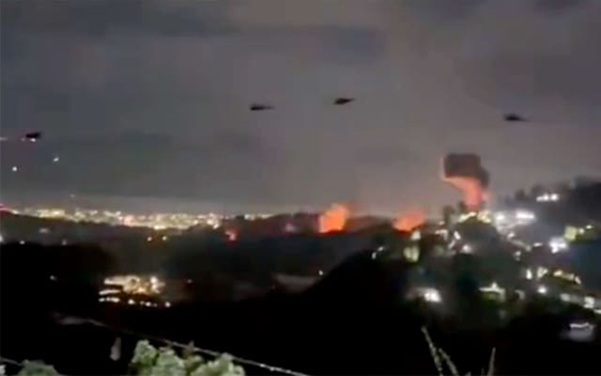
In the kidnapping of Venezuelan President Nicolás Maduro and his wife, lawyer Celia Flores, neither the ‘rule of law’ (if ever relevant to the United States), nor Venezuelan oil is the key issue. Rather, it is a desperate act on the part of a declining power in Latin America and the Caribbean (LAC), and an act of ‘narcoterrorism.’
US President Donald Trump and Secretary of State Marco Rubio have accused Maduro of ‘narcoterrorism’, but the US Justice Department admits Maduro is not head of the ‘Cartel de los Soles’ and that it does not even exist. The phrase “Cartel of the Suns” (in English) emerged in the 1990s, when Venezuelan General Ramón Guillén Davila was indicted on charges of drug trafficking. Venezuelan military generals wear sun-shaped insignia on their uniforms to denote their rank. Federal prosecutors alleged that, while heading Venezuela’s anti-drug unit, Guillén smuggled more than 22 tons of Colombian cocaine into the US and Europe for the Calí and Bogotá cartels. The Venezuelan General, like Manuel Noriega of Panama, worked for the CIA. In 1989, under US President George H.W. Bush, the US invaded Panama to arrest Noriega on charges of drug trafficking. ‘Trumped-up’ charges against Maduro and his wife are expected to follow their abduction.
The ’narco-terrorism’ label is essentially a right-wing phenomenon and refers to the intersection of drug trafficking and terrorism, where violent actions by drug traffickers are aimed at influencing government officials through intimidation and violence. It is also a US policy that can be traced back to US President Ronald Reagan’s efforts in the 1980s to link leftist guerrilla movements in Central and South America to leftist states and drug traffickers. Throughout the ‘cocaine decade’, the CIA and its right-wing allies flooded US cities with Colombian cocaine to fund various covert operations and to profit from drug trafficking. The most well-known operation, the so-called ‘Iran-Contra Scandal’ helped depose the left-wing Sandinista government in Nicaragua.
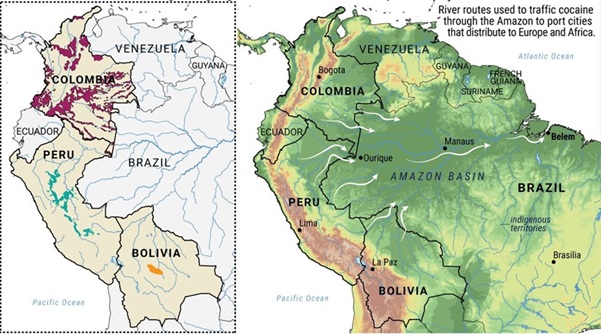
US narcoterrorism across LAC created the ‘Crystal Triangle’ of Colombia, Bolivia and Peru and neighbouring Ecuador, deeply tied to the river networks of the Amazon Basin, a history documented in Cocaine, Death Squads and the War on Terror: US Imperialism and Class struggle in Colombia. In recent narco-politics, Daniel Noboa, Ecuadorean President and Trump ally has been implicated in cocaine trafficking per police documents. Last year, Trump pardoned Juan Orlando Hernández, the former President of Honduras in support of his right-wing National party, despite his being sentenced to 45 years in a US prison for cocaine trafficking and weapons conspiracy. The Delta Force team that kidnapped Maduro is widely regarded as operating a large drug cartel and is stationed at Fort Bragg, North Carolina.
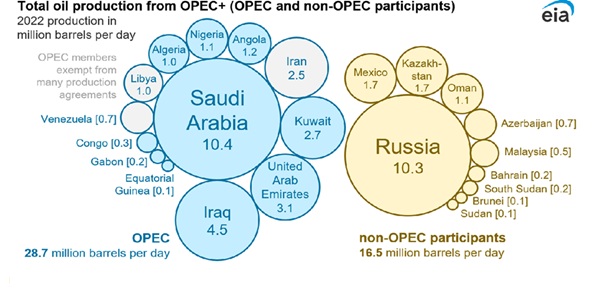
The events in Venezuela are for now front and centre in global politics and energy markets. Nobody has much of an idea what is coming next, but it is widely assumed that the kidnapping is a major negative for China who is the largest purchaser of Venezuelan crude oil, and that other oil suppliers will need to be found. Contrary to popular belief, Venezuela simply does not produce enough crude oil and China is well insulated for any supply side shocks at all.
Whilst trade and energy links, crippling US sanctions and internal contradictions such as Venezuela’s historical dependency on oil are important factors, the question remains whether the interim Venezuelan president Delcy Rodríguez or any alternative leader will prove to be a reliable comprador. In any event, it would be foolish for the US to take the path of invasion, especially when considering Trump’s waning popularity among the US electorate, including his MAGA base.
China is not desperate for oil, nor does it need to fire a shot, just emerge as the ‘adult in the room’ through diplomacy, infrastructure, loans and projects which now counts 22 countries in LAC through its Belt and Road Initiative. China’s upward trajectory as a superpower requires peace and stability. The US, on the other hand, is addicted to the largest sectors of global trade: drugs, oil and war with Trump now ready to “come to the rescue” in Iran. Many forget that it was drug money worth billions of dollars which kept the financial system afloat during the Global Financial Crisis of 2008, according to the United Nations Office on Drugs and Crime (UNODC).
It remains unclear what will follow and whether Trump’s actions will serve to unify, rather than disintegrate, Venezuela. Or, whether the region will descend into conflict or “business as usual.” A return to the death squads of the 1980s is not far-fetched and in Colombia, the narcobourgeoisie still runs the show. In an interview with Madrid based newspaper El Pais, Colombian President Gustavo Petro acknowledged: “We have not conquered power, we have conquered an administrative government cornered by other powers and by economic interest, including those of the press.”
There are also global implications, as it could embolden China and Russia in the ongoing and dangerous ‘great power competition’, with the US keen to reverse its declining power with acts of criminality and right-wing narcoterrorism by state actors and criminal organisations.
The following scenarios from the political imagination are plausible- Netanyahu on a plane to the International Criminal Court or Zelensky appearing in Moscow, or a conflict breaking out over the Chinese island of Taiwan. In this era of 21st century imperialism, anything is possible and realistically dangerous. We can debate the issues, but the realities of US power and that of rising China is reasonably clear. However, the debate about whether the US is an imperialist power is well and truly over.
ZNetwork is funded solely through the generosity of its readers.
Donate