

For workers to survive Trump’s MAGA moment and build a fighting labor movement for the future, both electoral politics (something old) and militant actions to disrupt business as usual (something new for many unions) will be key.
ELECTORAL POLITICS
Though some activists are dismissive of electoral politics, building a Democratic majority in the House of Representatives (or Senate) will be essential to putting the brakes on the worst of Trump’s initiatives. We can’t take it for granted, especially with the unpopularity of the current Democratic Party leadership. But based on past history, the midterms will hopefully deprive Trump of a majority in the House.
The current battle over redistricting sets the stage in Texas and California. California’s “Election Rigging Response Act” (Prop 50), which will be on the November 4 ballot, gives unions an opportunity to mobilize 3 million California members to counter Trump and the Republican Party’s Texas gerrymandering. This is an opportunity for many new leaders and activists to emerge and be inspired to organize and carry forward their skills to the 2026 midterms. It is an essential part of the continuing “block and build” effort to defeat the right-wing Republicans at the ballot box while at the same time building the independent power of grassroots progressive groups, including unions.
Equally important are the Democratic primaries, where a number of working-class warriors will face off against “go along to get along” corporate Democrats. Putting pro-worker, populist Democrats up against MAGA Republicans may be a fruitful strategy for winning tough seats and could push the party in a more pro-labor direction. Think oyster farmer Graham Platner in Maine, mechanic and Kellogg’s strike leader Dan Osborn in Nebraska (running as an independent), and community organizer Zack Shrewsbury in West Virginia, who are all running for Senate seats in 2026. Osborn ran in 2024 and came within 6 points of beating a Republican incumbent senator in a state Kamala Harris lost by 20 percent.
In New York, the campaign to elect Zohran Mamdani is providing the labor movement a local focus on capturing power in America’s largest city and using that power to push more organizing. After Mamdani’s victory in the Democratic primary, most of New York’s labor movement (unlike the Democratic Party) quickly united around his campaign. Labor for Zohran has emerged to engage rank-and-file members to push their unions to do more on the campaign and prepare to fight for policy objectives like freezing rents and providing fare-free buses if he wins.
DISRUPT BUSINESS AS USUAL
In the same way that union members confront a bad boss, the way to stop an authoritarian takeover is with continued, escalating collective action. Early on in Trump’s second term, veteran union organizer Stephen Lerner made that recommendation, urging labor to throw caution to the wind and take bold action against Trump’s attacks.
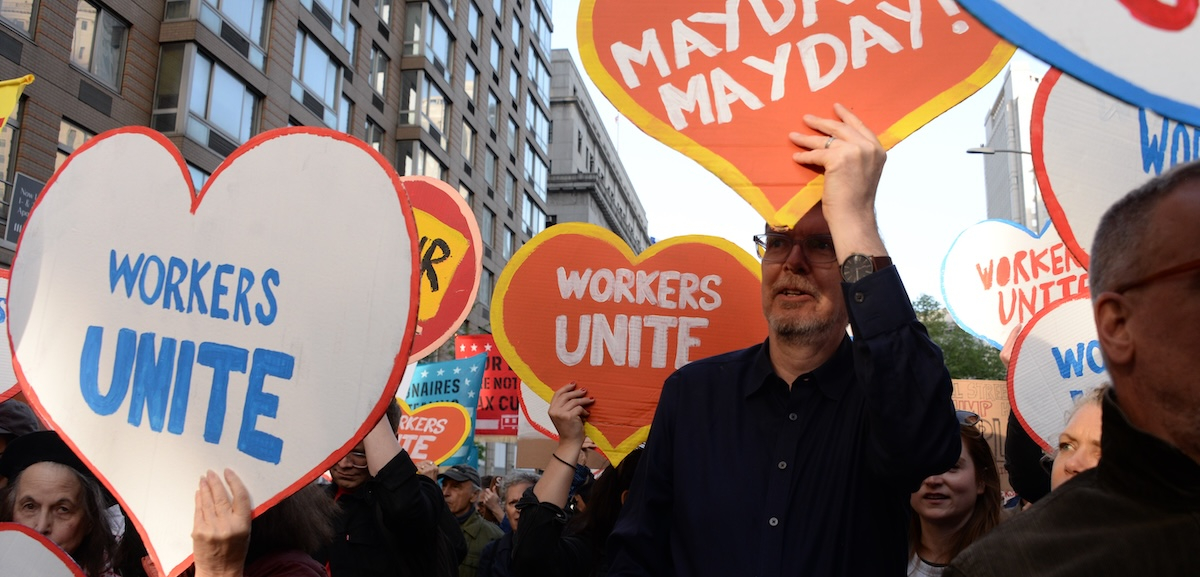
While unions have filed lawsuits that have slowed down some of Trump’s plans, they have yet to figure out an effective strategy of resistance. It’s encouraging to see more unions mobilizing members for demonstrations like No Kings Day on October 18. On Labor Day, the May Day Strong coalition documented over 500 events, involving a half-million people, across the country, demanding an end to the billionaire takeover. But these rallies, while important, still do not meet the need for immediate militant action in the workplace and in the streets.
There are a wide variety of responses to Trump’s attacks in the labor movement. Some unions, like the Teamsters, have attempted to curry favor with the administration and build alliances with Republican politicians. Other union leaders in the building trades and elsewhere are still trying to avoid Trump’s wrath, although a number of construction unions have strongly condemned Trump’s attacks on offshore wind projects and infrastructure funding, which put hundreds of thousands of good union jobs at risk. And Sean McGarvey, president of North America’s Building Trades Unions, called Trump’s budget “the biggest job-killing bill in the history of this country… threatening an estimated 1.75 million construction jobs… to make room for more tax breaks for the wealthiest corporations and individuals in America.” The Sheet Metal Workers and the Machinists have also denounced ICE detentions of members.
The response by federal unions to Trump’s attacks has been largely limited to the filing of lawsuits. It has been heartening to see the formation of the Federal Unionists Network (FUN), a new rank-and-file organization that has engaged in bolder activity and in some cases succeeded in moving federal union leaders to take a more militant stand.
The occupations by military troops in Los Angeles, Washington, D.C., and Chicago are provoking vigorous resistance from many unions. The teachers’ and service workers’ unions have been the most outspoken and active. In July, 1,400 people flooded the L.A. Convention Center for “non-violent direct action training” principally sponsored by the Los Angeles County Federation of Labor. In D.C., the Metro Washington Labor Council sponsored a “Solidarity Season Labor Day Rally and March” on August 28.
Targeting Trump’s corporate backers can be a key part of our strategy. The Tesla Takedown, which organized rallies outside the carmaker’s showrooms nationwide, had a powerful immediate effect on Musk and his involvement with DOGE. Are there similar targets that could give us visibility and leverage, especially if we could link to union efforts to organize at those companies?
In July, Free DC took similar actions around Amazon-owned Whole Foods stores in Washington, D.C., to protest the cloud computing services the company provides to ICE. The Athena coalition is linking broad anti-Bezos activities to building power for workers at Amazon warehouses. For unionists like us who believe that winning collective bargaining at Amazon is an essential task for the labor movement, this is a positive development that needs to be amplified.
CREATIVE SOLIDARITY
U.S. unions have seldom employed strikes for political goals like saving the Social Security retirement age, as unions in Western Europe do. Thus union membership lacks the experience, and our leaders are too timid, so the possibilities for nationally coordinated, militant direct action by labor are not great. A bright spot is the organizing around May 1, 2028 that is inspiring many activists—but that’s two and a half years away. (Check out the Labor Notes resource page at may2028.org.)
Yet labor does not have to be paralyzed in the face of Trump: there is plenty of room for action that strikes at the MAGA billionaire boys club and becomes a problem for Trump’s sponsors.
In major cities where union density is relatively high, the labor movement has the opportunity for creative direct action. For instance, imagine when SEIU California President David Huerta, who was arrested in June for defending his members from ICE, goes to trial on federal charges. Perhaps buildings in downtown Los Angeles and other cities where unionized janitors clean could be shut down.
Something similar could be done at buildings where Amazon has offices or at other companies in the Trump business constellation. Janitors are vulnerable because most are Latinos, but they could go home for the day while other unions could step up to donate money for their compensation and picket in their stead.
Think of the visuals and what a great message of class solidarity. Imagine if hard hats and longshore workers were doing informational picketing at the tallest building in L.A. in support of workers’ rights and against ICE. It would be like the 2004 film “A Day Without a Mexican” on steroids. Similar protest actions could unfold in other sectors of high immigrant employment, like hotels and agriculture.
While it might sound fanciful, these are the types of creative—and courageous—actions that it is going to take for the resistance to Trump to begin to develop some momentum and overcome the feelings of helplessness and fear that are holding us back. With millions of members under attack, unions have a big role to play in nurturing and supporting these actions and puncturing the narrative that Trump’s actions are supported by working people.
Despite the unevenness of labor’s response to MAGA, this is no time for caution. Labor leaders and activists need to find points of strength and synergy to step up. No business as usual while this bad boss rules.
ZNetwork is funded solely through the generosity of its readers.
Donate




