

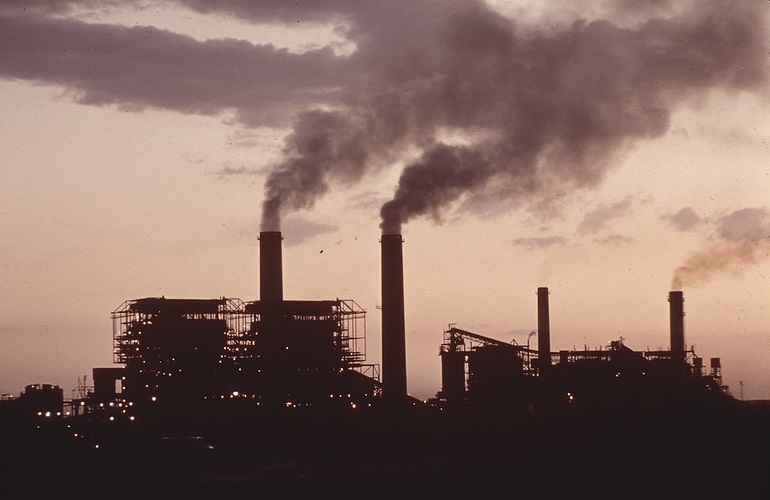
Enforcement against polluters in the United States plunged in the first year of President Donald Trump’s second term, a far bigger drop than in the same period of his first term, according to a new report from a watchdog group.
By analyzing a range of federal court and administrative data, the nonprofit Environmental Integrity Project found that civil lawsuits filed by the U.S. Department of Justice in cases referred by the Environmental Protection Agency dropped to just 16 in the first 12 months after Trump’s inauguration on Jan. 20, 2025. That is 76 percent less than in the first year of the Biden administration.
Trump’s first administration filed 86 such cases in its first year, which was in turn a drop from the Obama administration’s 127 four years earlier.
“Our nation’s landmark environmental laws are meaningless when EPA does not enforce the rules,” Jen Duggan, executive director of the Environmental Integrity Project, said in a statement.
The findings echo two recent analyses from the nonprofits Public Employees for Environmental Responsibility and Earthjustice, which both documented dwindling environmental enforcement under Trump.
From day one of Trump’s second term, the administration has pursued an aggressive deregulatory agenda, scaling back regulations and health safeguards across the federal government that protect water, air and other parts of the environment. This push to streamline industry activities has been particularly favorable for fossil fuel companies. Trump declared an “energy emergency” immediately after his inauguration.
At the EPA, Administrator Lee Zeldin launched in March what the administration called the “biggest deregulatory action in U.S. history”: 31 separate efforts to roll back restrictions on air and water pollution; to hand over more authority to states, some of which have a long history of supporting lax enforcement; and to relinquish EPA’s mandate to act on climate change under the Clean Air Act.
The new report suggests the agency is also relaxing enforcement of existing law. Neither the White House nor the EPA responded to a request for comment.
A “Compliance First” Approach
Part of the decline in lawsuits against polluters could be due to the lack of staff to carry them out, experts say. According to an analysis from E&E News, at least a third of lawyers in the Justice Department’s environment division have left in the past year. Meanwhile, the EPA in 2025 laid off hundreds of employees who monitored pollution that could hurt human health.
Top agency officials are also directing staff to issue fewer violation notices and reduce other enforcement actions. In December, the EPA formalized a new “compliance first” enforcement policy that stresses working with suspected violators to correct problems before launching any formal action that could lead to fines or mandatory correction measures.
“Formal enforcement … is appropriate only when compliance assurance or informal enforcement is inapplicable or insufficient to achieve rapid compliance,” wrote Craig Pritzlaff, who is now a principal deputy assistant EPA administrator, in a Dec. 5 memo to all enforcement officials and regional offices.
Only in rare cases involving an immediate hazard should enforcers use traditional case tools, Pritzlaff said. “Immediate formal enforcement may be required in certain circumstances, such as when there is an emergency that presents significant harm to human health and the environment,” he wrote.
Federal agencies like the EPA, with staffs far outmatched in size compared to the vast sectors of the economy they oversee, typically have used enforcement actions not only to deal with violators but to deter other companies from breaking the law. Environmental advocates worry that without environmental cops visible on the beat, compliance will erode.
Pritzlaff joined the EPA last fall after five years heading up enforcement for the Texas Commission on Environmental Quality, where nonprofit watchdog group Public Citizen noted that he was known as a “reluctant regulator.” Public Citizen and other advocacy groups criticized TCEQ under Pritzlaff’s leadership for its reticence to take decisive action against repeat violators.
One example: An INEOS chemical plant had racked up close to 100 violations over a decade before a 2023 explosion that sent one worker to the hospital, temporarily shut down the Houston Ship Channel and sparked a fire that burned for an hour. Public Citizen said it was told by TCEQ officials that the agency allowed violations to accumulate over the years, arguing it was more efficient to handle multiple issues in a single enforcement action.
“But that proved to be untrue, instead creating a complex backlog of cases that the agency is still struggling to resolve,” Public Citizen wrote last fall after Pritzlaff joined the EPA. “That’s not efficiency, it’s failure.”
Early last year, TCEQ fined INEOS $2.3 million for an extensive list of violations that occurred between 2016 and 2021.
“A Slap on the Wrist”
The EPA doesn’t always take entities to court when they violate environmental laws. At times, the agency can resolve these issues through less-formal administrative cases, which actually increased during the first eight months of Trump’s second term when compared to the same period in the Biden administration, according to the new report.
However, most of these administrative actions involved violations of requirements for risk management plans under the Clean Air Act or municipalities’ violations of the Safe Drinking Water Act. The Trump administration did not increase administrative cases that involve pollution from industrial operations, Environmental Integrity Project spokesperson Tom Pelton said over email.
Another signal of declining enforcement: Through September of last year, the EPA issued $41 million in penalties—$8 million less than the same period in the first year of the Biden administration, after adjusting for inflation. This suggests “the Trump Administration may be letting more polluters get by with a slap on the wrist when the Administration does take enforcement action,” the report reads.
Combined, the lack of lawsuits, penalties and other enforcement actions for environmental violations could impact communities across the country, said Erika Kranz, a senior staff attorney in the Environmental and Energy Law Program at Harvard Law School, who was not involved in the report.
“We’ve been seeing the administration deregulate by repealing rules and extending compliance deadlines, and this decline in enforcement action seems like yet another mechanism that the administration is using to de-emphasize environmental and public health protections,” Kranz said. “It all appears to be connected, and if you’re a person in the U.S. who is worried about your health and the health of your neighbors generally, this certainly could have effects.”
The report notes that many court cases last longer than a year, so it will take time to get a clearer sense of how environmental enforcement is changing under the Trump administration. However, the early data compiled by the Environmental Integrity Project and other nonprofits shows a clear and steep shift away from legal actions against polluters.
Historically, administrations have a “lot of leeway on making enforcement decisions,” Kranz said. But this stark of a drop could prompt lawsuits against the Trump administration, she added.
“Given these big changes and trends, you might see groups arguing that this is more than just an exercise of discretion or choosing priorities [and] this is more of an abdication of an agency’s core mission and its statutory duties,” Kranz said. “I think it’s going to be interesting to see if groups make those arguments, and if they do, how courts look at them.”
ZNetwork is funded solely through the generosity of its readers.
Donate




