


Kilmar Abrego Garcia was returned to the United States on June 6, after being wrongly deported to El Salvador almost three months earlier. Abrego Garcia had been detained in El Salvador’s Terrorism Confinement Center since March 15, along with more than 250 other immigrants accused of belonging to the Latin American gangs Tren de Aragua and MS-13.
Abrego Garcia’s case drew particular media attention, due to the admission by Immigration and Customs Enforcement (ICE) that his deportation and subsequent imprisonment were a result of an “administrative error.” For weeks, however, both the Trump administration and the Salvadoran government insisted they were powerless to return Abrego Garcia to the United States.
After months of protests from Abrego Garcia’s Maryland community and legal challenges from his lawyers, the father of three was finally returned to the US. But there was a caveat: He would face criminal charges related to an immigrant-smuggling operation that the Department of Justice alleges Abrego Garcia took part in as a member of MS-13.
Though there are plenty of reasons to cast doubt on the charges made against Abrego Garcia, in the seven articles published in the wake of his return, the New York Times (6/6/25, 6/6/25, 6/6/25, 6/8/25) and Wall Street Journal (6/6/25, 6/7/25, 6/8/25) present them mostly at face value. Given that the publications are the top two largest newspapers in America, their deficient coverage of one of the most important immigration cases of the second Trump administration is noteworthy.
Unreliable sources
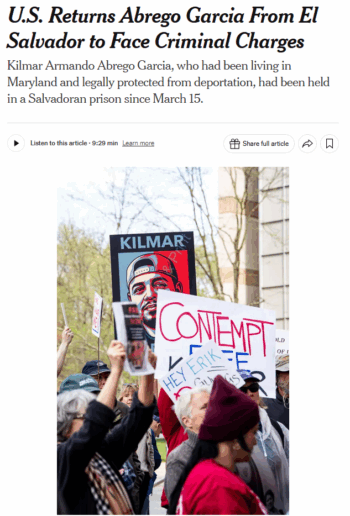
The main New York Times story (6/6/25) on Kilmar Abrego Garcia’s return from El Salvador consists largely of Trump administration officials accusing him of crimes—with no quotes from Abrego Garcia’s lawyers contesting those charges.
Only two of the articles (New York Times, 6/6/25; Wall Street Journal, 6/7/25) mentioned that the charges against Abrego Garcia stem from recent information supplied by jailhouse informants. The articles failed to note that such testimony is notoriously unreliable, as documented by research, and frequently results in wrongful convictions.
Though there are six unnamed co-conspirators listed in the indictment, it appears as though the majority of the charges rely on the testimony of one or two of these individuals. Simon Sandoval-Moshenberg, one of Abrego Garcia’s attorneys, told CNN’s Erin Burnett (6/6/25), “The very first question I’m going to be asking is, what were those two people offered to make up these really fantastic, hyperbolic allegations against Mr. Abrego Garcia?”
The DoJ’s stonewalling of Abrego Garcia’s lawyers in his civil case should raise further suspicion about why these jailhouse informants decided to come forward now, despite the DoJ’s allegation that Abrego Garcia has been involved with immigrant smuggling since 2016. None of the articles mention that Abrego Garcia had been attending yearly check-ins with ICE since 2019, and that these allegations had not come up during the six years that ICE had been monitoring him, nor were they mentioned during the trial that resulted in a judge granting him withholding of removal.
In their New York Times piece (6/6/25), reporters Devlin Barrett, Alan Feuer and Glenn Thrush dedicated two paragraphs to a 2022 traffic stop involving Abrego Garcia that the indictment cites as evidence of a smuggling operation, while curiously omitting the fact that he was not charged with a crime at the time of the incident.
None of the articles mentioned that Abrego Garcia had been in ICE detention for seven months in 2019, at the same time that the DoJ alleges he was leading an immigrant smuggling operation. Also missing in the Times and Journal’s coverage was the fact that the police officer who authored the 2019 report was later terminated for sharing “sensitive and confidential information about an ongoing police investigation with a commercial sex worker” (USA Today, 4/17/25).
Sidelining advocates
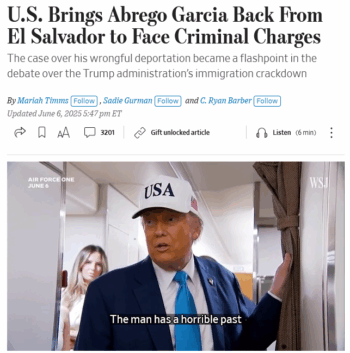
The Wall Street Journal (6/6/25) published several paragraphs alleging crimes by Abrego Garcia with no rebuttal.
Two articles omitted comments from Abrego Garcia’s legal team altogether (New York Times 6/6/25; Wall Street Journal, 6/7/25). While the other articles do quote Abrego Garcia’s lawyers, they cited them only about his initial deportation and his return, but not about the criminal charges. Three articles (New York Times, 6/6/25, 6/6/25; Wall Street Journal, 6/6/25) include the same sole quote from Andrew Rossman, another one of Abrego Garcia’s lawyers:
Today’s action proves what we’ve known all along—that the administration had the ability to bring him back and just refused to do so…. It’s now up to our judicial system to see that Mr. Abrego Garcia receives the due process that the Constitution guarantees to all persons.
When given the chance to comment on the criminal allegations, Abrego Garcia’s lawyers have been clear that these charges are “preposterous.” Sandoval-Moshenberg told CBS affiliate WUSA9 (6/6/25), “What happened today is the exact opposite of due process, because due process means the opportunity to defend yourself before you’re punished, not afterwards.”
Another one of his lawyers, Chris Newman, who is also the legal director of the National Day Laborer Organizing Network, told WUSA9 (6/6/25) in the same conference:
This administration has shown amazing disregard for the Constitution, for due process and for basic decency. It is engaged in an unprecedented campaign of disinformation, defamation and cruelty directed at Kilmar’s family.
Another member of Abrego Garcia’s legal team, Brian Murray, told MSNBC’s Alex Witt (6/7/25), “Anyone who’s been looking at this case and has been watching this play out would agree this is a political and vindictive prosecution.”
In the days since Abrego Garcia’s release, his legal team has frequently made themselves available to media to speak about the criminal charges and ongoing constitutional issues surrounding his case. At a time when immigrants’ rights to free speech are under attack, the New York Times and Wall Street Journal chose to sideline the voices of their advocates.
ZNetwork is funded solely through the generosity of its readers.
Donate