

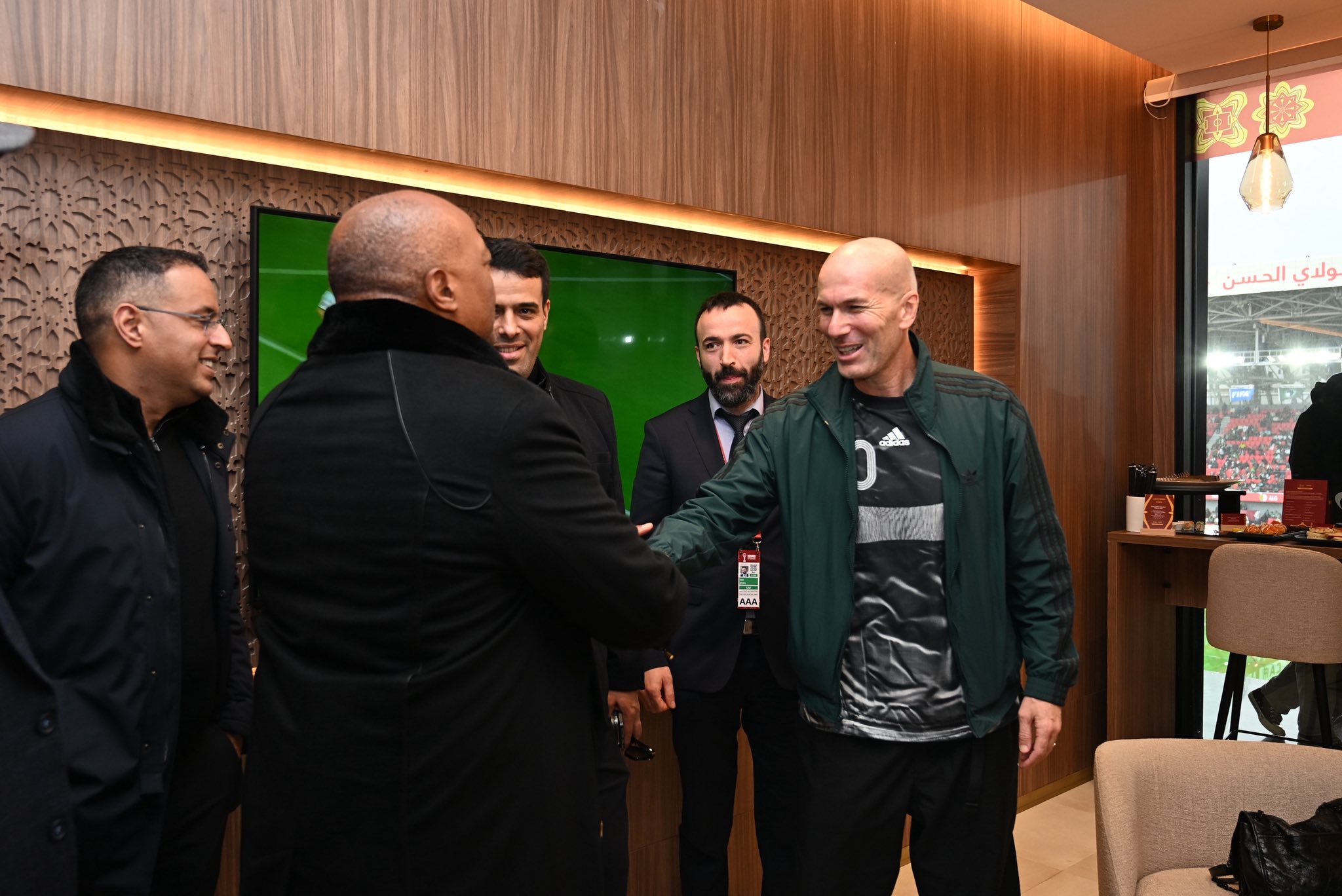
Zinedine Zidane, Kylian Mbappé and Riyad Mahrez walking into the same stadium sounds like the opening line of a bad joke, yet it is exactly what the Africa Cup of Nations is bracing for on Sunday night, when Algeria face Burkina Faso at the Stade Moulay Hassan.
Mahrez will be there as Algeria’s captain, the standard-bearer for a team riding his early-tournament brilliance. Zidane will take his seat in the stands as a father first, watching his son Luca marshal Algeria’s defence from goal. Mbappé, in Morocco during the La Liga winter break, is there to support his closest friend, Achraf Hakimi, but his presence will also be felt in solidarity with Les Fennecs.
Together, the three form a bizarre Venn diagram of footballing excellence, shared origins and divergent paths.
Zidane and Mahrez were late bloomers who rose to mythic status for their respective footballing nations. Mahrez and Mbappé are products of the greater Parisian suburbs, part of a generation that reshaped French football in its own image. Zidane and Mbappé, both born to proud Kabyle families, were the gravitational centres of France’s World Cup triumphs in 1998 and 2018.
And yet, beneath these commonalities lie stories that could not be more different.
Zinedine Zidane’s journey is well-known. His father, Smail, arrived in France in the 1970s as part of the wave of Algerian labour migration that helped rebuild the country’s postwar economy. That journey was made possible by the 1968 Franco-Algerian accords – a legal framework that has recently become a political target for France’s resurgent right.
Mbappé belongs to another generation entirely. His mother, Fayza Lamari, was born in France, and his story reflects the experience of a generation raised in the banlieues after the 2005 Paris riots. A generation of kids increasingly alienated from the idea of France as a benevolent republic and distanced from its political elite.
One of the most revealing moments from Mbappé’s childhood came during a television interview at his academy. Long before he became the poster child of French football, he answered a question about football in the banlieues with disarming clarity: “In any case, it’s clear that the best players are all ‘black’ or ‘Arab.’” It wasn’t a sociological thesis, just a kid repeating what everyone was saying in Bondy.
Mahrez grew up 20 kilometres away in Sarcelles, another Parisian suburb, shaped by the same communities and codes. But the reason his family arrived in France is what hasn’t been reported on and it sets his story apart. Mahrez’s father, Ahmed, did not migrate in search of work, but in search of survival. His family originates from El Khemis, an Amazigh enclave near Tlemcen that has clung fiercely to its ancestral traditions. When I visited El Khemis years ago, one of Ahmed’s closest friends, Djilali, recounted the journey that would ultimately define Mahrez’s life.
Ahmed had been a gifted amateur footballer for NR Beni Snous, but after his playing days he developed severe heart problems. The surgery he needed was simply not accessible in Algeria at the time.
“I told him, ‘My friend, if you want to live, get a passport—we’ll escape to France, and I’ll figure it out,’” Djilali said.
“We went through Oujda, then Tangier. One night, I thought he had died. I tried to wake him and couldn’t until I threw water on his face. He was in a terrible state until we reached Paris.”
In France, Ahmed Mahrez received urgent, life-saving care despite having no legal status. He then settled in the Parisian suburbs where Riyad was later born. His story is one of migration driven by necessity, shaped by the infrastructural limits of post-independence Africa, but also one that stands as a credit to the French social system, which is also under attack by the far-right in recent years.
On the pitch, the results of these intertwined histories are undeniable. African migration has been a net positive for both French and Algerian football. When Algeria line-up against Burkina Faso, as many as seven starters will be the children of immigrants. It is this reality that has helped turn Algeria, Morocco and Tunisia into continental forces.
Off the pitch, images of Zidane and Mbappé in the stands will go viral on social media. If Mahrez continues his luminous form, his play will help rack up millions of views, pushing the Africa Cup of Nations further into the global imagination.
Zidane, Mbappé and Mahrez will never share the same pitch, but their convergence at the AFCON tells a deeper story. It is one that shows how football reveals the ways identities overlap and intertwine, and how, where politics so often insists on division, the game still finds a way to bring people together.
Maher Mezahi is a football journalist and host of the Africa Five-a-side podcast. Based in Algiers, he is a contributing editor for Africa Is a Country.
ZNetwork is funded solely through the generosity of its readers.
Donate
