

Rwanda’s de facto dictator Paul Kagame is notorious for imprisoning his rivals (the less lucky ones are murdered). But why would he oversee Rwandan state sponsorship of Arsenal, one of the top sides in the English Premier League, ranked in eighth place on the Forbes list of the world’s most valuable football clubs?
This is hardly the first example of “sportswashing,” so it’s worth asking some broader questions as well. Why do companies, individuals, and states seek to link their names to sporting clubs and events? What benefits do they expect to gain from it? And how should sports fans respond?
Bridgeheads
Starting with the question of “why,” two different sets of motivations were on display at this year’s European Champions League final between Paris Saint-Germain (PSG) and Inter Milan. It was a difference encapsulated in a Guardian headline — “Despotism v Capitalism.”
Inter are owned by Oaktree Capital, a US firm specializing in “distressed debt.” They acquired the club when the previous owners defaulted on loan repayments and are keen to make money from it, pure and simple. PSG, on the other hand, were acquired by the government of Qatar in 2011 and have had vast amounts of money pumped into them by various arms of the Qatari state, culminating in the victory over Inter and their first ever Champions League trophy.
Clearly, for both Qatar and PSG, the motivational factors behind ownership and sponsorship are not reducible to the immediate making of money. Indeed, injecting cash into PSG may have been a deliberate loss-making move by Qatar. It initially formed part of an incentive package (some would call it a bribe) that persuaded the French government to back Qatar’s bid to host the 2022 men’s World Cup.Rwanda’s de facto dictator Paul Kagame is notorious for imprisoning his rivals (the less lucky ones are murdered).
There might be a longer-term economic “bridgehead” strategy at work here on the part of Qatar, whose neighbor and sometime rival, the United Arab Emirates (UAE), had already acquired Manchester City Football Club and begun turning it into an enormously successful sporting powerhouse. UAE ownership of the club has prompted massive investment by agents of Abu Dhabi, the UAE’s capital, in Manchester construction and property development. This has included gaining access to public land on very favorable and lucrative terms.
The UAE has leveraged the goodwill generated by the delivery of sporting success into a wider strategy of regional economic penetration. Qatar might have similar plans for Paris; it certainly does not hesitate to strategically deploy large amounts of cash in pursuit of long-term favor and gain, as witnessed by its gift of a luxury airliner to Donald Trump.
Sportswashing
Qatar’s hosting of the World Cup is commonly cited as a classic example of sportswashing — sports sponsorship in order to burnish a reputation more or less for its own sake. As journalist Miguel Delaney puts it in his book States of Play, “association with something so popular brings influence and legitimacy.” It can, in theory at least, cover up a multitude of less benign associations. In the words of Jules Boykoff, it offers a route to “reputational refurbishment.”Qatar’s hosting of the World Cup is commonly cited as a classic example of sportswashing.
However, in the case of the 2022 World Cup, the PR gains to Qatar may have been more than outweighed by criticism of the host country’s deeply abusive treatment of the migrant workers who had built the tournament infrastructure. Negative PR also ensued from preposterous (and subsequently debunked) claims that the tournament was carbon neutral, coming from a country whose wealth is overwhelmingly based on the extraction of fossil fuels and the acceleration of global warming.
Sportswashing may also have partially backfired in the case of another Middle Eastern dictatorship, Saudi Arabia, whose sponsorship of the breakaway LIV Golf Tour only drew attention to the very abuses the regime was seeking to obscure. Saudi hosting of the men’s football World Cup in 2034 has already generated controversy over a range of issues, again including the exploitation of migrant laborers (of whom there are thirteen million).
The USA is cohosting (with Canada and Mexico) the 2026 men’s tournament, and it has already hosted this year’s inaugural Club World Cup, The 2026 event will potentially confer political capital on Trump, even though senior administration officials have joked about deporting visiting football fans who overstay their visas, while players and staff from countries subject to travel bans and restrictions will have to apply for exemptions to participate.
Sociologists Heba Gowayed and Nicholas Occhiuto have called for a boycott of the 2026 tournament, noting how Trump already used the Club World Cup to boost his prestige:
No country should send their team to play when the citizens of 12 among them are banned. No person is safe when agents roam the country and its stadiums masked, asking people to show their papers based on the color of their skin.
Democratic socialist mayoral candidate for New York City (and longtime football fan) Zohran Mamdani has spoken about how many fans will fear going to matches because of the threat of immigration police taking the opportunity to round up suspects.
While a boycott seems unlikely, the MAGA-boosting strategy might end up backfiring, at least in part. Trump can try to deport students who condemn Israeli genocide, but what could he do to a star footballer who took the opportunity to speak out about the issue, or about the brutalization of migrants?
Furthermore, Trump’s predictable narcissistic self-promotion at every opportunity will inevitably invite global derision. After all, the Club World Cup ended with the comic sight of the US president celebrating with the players and refusing to leave the podium after presenting the winners with the trophy.
Arsenal and Rwanda
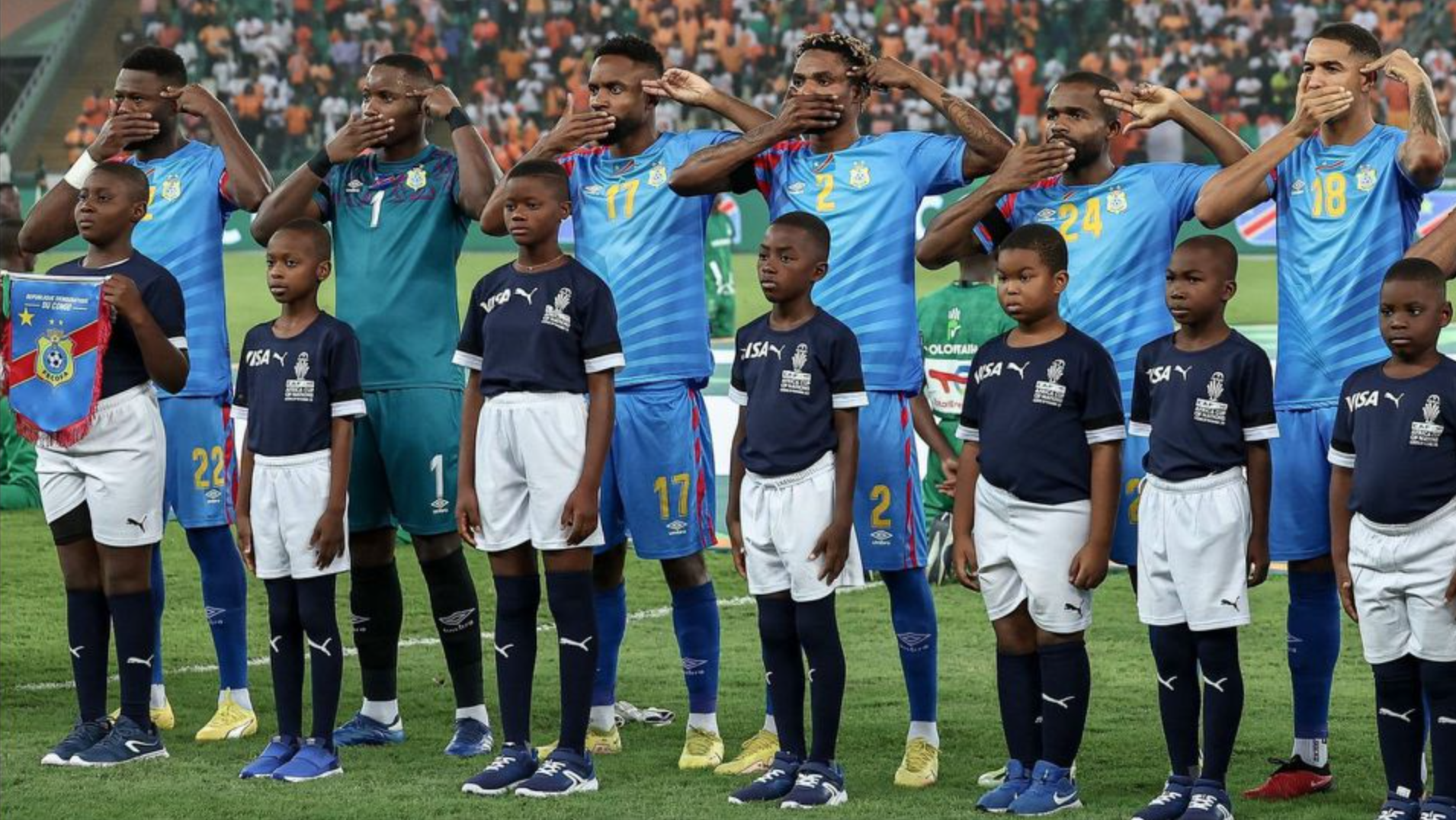
Sportswashing is not always well received even by its apparent beneficiaries, as we can see with Arsenal, whose shirts now bear the slogan “Visit Rwanda.” The issue here is not merely the promotion of a repressive regime that murders and imprisons its opponents. It is also a question of the sponsorship money itself and how it was acquired — through theft and the fomentation of conflict and humanitarian disaster in the Democratic Republic of Congo (DRC).
In the early months of 2025, attacks by the Rwanda-backed rebel militia M23 in the eastern DRC led to an estimated three thousand deaths (mostly civilians), the displacement of over seven hundred thousand people, and sharp upticks in the incidence of summary executions, rape and sexual violence, and abduction of people (including children) for forced labor. Millions were left without access to food, clean water, and medical care, prompting upsurges in diseases such as malaria and measles.A variety of external actors have played their parts in the DRC’s conflicts, but neighboring Rwanda has been foremost among them.
This was the latest stage in the conflicts that have afflicted the DRC since at least 1996, resulting in the deaths of some six million people and the displacement from their homes of almost seven million. A variety of external actors have played their parts in those conflicts, but neighboring Rwanda has been foremost among them. This has included directly supporting M23 in exchange for minerals like coltan (used in a range of electronic devices), tungsten, and gold. Rwanda passes off DRC resources stolen in this manner as its own exports.
Against that backdrop, the DRC foreign minister has described Arsenal’s Rwanda promotion as a “bloodstained sponsorship deal.” A group of Arsenal fans have come together to oppose it, calling themselves “Gunners for Peace” (“Gunners” being the Arsenal nickname).
They mischievously suggested replacing the “Visit Rwanda” slogan with “Visit Tottenham,” in reference to Arsenal’s bitter North London rivals — the implication being that it would be better to visit even your worst enemy than to promote tourism to Rwanda. As a spokesperson for the fans said: “We don’t want our club to sell its soul to the highest bidder.”
The United Arab Emirates
Unfortunately, Rwanda is not the only such bidder — and the bids have been accepted. Arsenal are also sponsored (though not owned outright, as in the case of Manchester City) by the UAE government, through the state-owned Emirates Airlines company. The Emirates logo is displayed on the Arsenal shirt (much more prominently than the Rwanda tourism promotion), and Arsenal’s home games are played at the Emirates Stadium.
A spokesperson for Amnesty International has described the UAE as “the most brutal police state in the Middle East” — quite an accolade given the Saudi record. Its ruling elite has recently entered into a corrupt multibillion dollar cryptocurrency deal with the Trump family. Like Rwanda, the UAE is deeply implicated in an African conflict that is wreaking massive human, environmental and economic damage. The conflict in question is in Sudan.The latest phase of the war in Sudan has left a staggering one hundred fifty thousand dead in just two years and thirteen million people displaced from their homes.
The latest phase of the war in Sudan has left a staggering one hundred fifty thousand dead in just two years and thirteen million people displaced from their homes. Two-thirds of the population — over thirty million people, including sixteen million children — are dependent on inadequate humanitarian assistance. Twenty-five million are suffering extreme food insecurity. Trump’s aid cuts, leading to the closure of emergency food kitchens, have worsened an already dire situation.
The UAE is the major supporter of one of the two main groups waging the civil war, the Rapid Support Forces (RSF). The RSF slaughtered more than fifteen hundred civilians in a single attack on the largest displacement camp in Sudan in April of this year, one of many such atrocities. The UAE supplies this murderous militia with weapons, money, and political support in exchange for looted Sudanese gold, and with a view to acquiring potentially lucrative agricultural land as well as a port on the Red Sea.
As Joshua Craze notes, “Emirati petrodollars grease the wheels of business networks: every country in its sphere of influence benefits from the gold leaving Sudan, almost all of which flows to the UAE.” In a breathtaking display of cynicism and venality, the UAE also buys gold from the UAE’s main rival, the official Sudanese army.
This is where the link with sportswashing comes into sharp focus, since one could reasonably add “every football club” to the list of beneficiaries. It is no exaggeration to say that the extravagant transfer fees and wages of star players for Manchester City and Arsenal are partly funded by gold looted from Sudan.
The Role of the Fans
As Miguel Delaney chronicles, many sports fans have unfortunately turned into unquestioning cheerleaders for the regimes pumping money into their teams, regardless of how much blood stains that money. Being able to draw on the passionate support of such cheerleaders is, of course, one of the reasons those regimes engage in sportswashing to begin with.The powerful companies and governments that sell weapons to Saudi Arabia are far more morally culpable for that regime’s crimes than Newcastle United or its fans.
But not all are cheerleaders. Just as some Arsenal fans are angry to see the club they love accept Rwanda’s blood money, some Newcastle fans (albeit a minority) are also protesting the use of their team to airbrush the reputation of Saudi Arabia’s vile dictatorship, an arm of which now owns a majority stake in the club. How much responsibility can fans be reasonably expected to assume here?
Not the biggest share, certainly. The European Union, having negotiated a grubby deal to secure its access to vital raw materials, bears far more responsibility for Rwanda’s crimes in the DRC than Arsenal Football Club. The gold that the UAE rips out of Sudan enriches individuals and institutions well beyond (and above) Manchester City. The powerful companies and governments that sell weapons to Saudi Arabia are far more morally culpable for that regime’s crimes than Newcastle United or its fans.
The point is not to claim that football supporters bear some special responsibility — it is rather to highlight how inextricably sport is entwined with the most violent and exploitative forms of politics. We can surely expect football fans to be at the very least aware of that, in the same way that they should be aware of (and opposed to) sexism, racism, and homophobia within sport itself.
Eduardo Galeano, the Uruguayan socialist historian, poet, and football fanatic, once remarked that “football never stops being astonishing”:
The more the technocrats programme it down to the smallest detail, the more the powerful manipulate it, football continues to be the art of the unforeseeable. When you least expect it, the impossible occurs: the dwarf teaches the giant a lesson.
It is too much to expect ordinary fans alone to reclaim football from the clutches of the monsters that currently dominate and exploit it. But even though such a transformation might appear unforeseeable at present, as Galeano says, sometimes the impossible occurs — both on and off the field.
In the meantime, opportunities always arise for acts of resistance and protest. In the midst of PSG’s Champions League triumph, fans of the club unveiled banners supporting Gaza and chanted condemnations of Israel’s genocide. They took advantage of their team’s newfound profile and success to amplify messages of solidarity with those at the receiving end of imperial violence: chants of “Nous sommes tous les enfants de Gaza” (“We are all the children of Gaza”) could be heard throughout the stadium in Munich.
Some might accuse PSG supporters of hypocrisy for not also protesting the human rights abuses and environmental destruction perpetrated by their own club’s sponsor, Qatar. Yet we should still applaud them for prioritizing an urgent issue that desperately needs to be highlighted at every opportunity (and one that, in fairness, the Qatari government was seeking to resolve or alleviate through mediation, before Israel bombed its territory to sabotage negotiations). It was an uneven and imperfect action on the part of PSG fans, but that is how political progress is typically made, and it was, in its own way, a profoundly sporting gesture.
ZNetwork is funded solely through the generosity of its readers.
Donate




