

Today is Ida Lowe Blocker’s 93rd birthday. It is also five days after the Supreme Court struck down the last major enforcement tool of the 1965 Voting Rights Act (VRA).
I am talking with Blocker about land, railways, and the right to vote.
Blocker grew up on a cotton farm in Culverton, a thriving Black community in Hancock County, Ga., built by people who had been enslaved on the same soil. Her home, and those of several others in Sparta, the county seat, are now at stake because a railroad company — owned by a descendant of a white man who once enslaved people here — wants to take the land. It is a move supported by Sparta’s white mayor, R. Allen Haywood, who was first elected in 2015. That same year, a majority-white election board attempted to purge nearly 180 voters — almost all of them Black — from the rolls.
The train tracks would cross Blocker’s land as well as a cemetery a short walk from her house, opposite the remains of a church that was started by her great-grandmother. The cemetery was used as a burial ground for enslaved people. Blocker’s grandmother, mother, and other relatives are buried there.
“When you think about a train running over our ancestors,” says Blocker, “well, that’ll impact me greatly.”
The graves hold more than her people’s bodies. They hold everything this country refused to let them do.
“That’s the richest place in the world — it’s the graveyard. Poems that haven’t been written. Votes that haven’t been cast,” says Blocker.
Blocker has seen the sacrifices made for Black people to vote safely. She remembers when she was a child in the 1940s and the pastor of her church was “hung upside down in the woods” for trying to help people register. In the 1960s, Blocker was part of Dr. Martin Luther King Jr.’s movement, canvassing in Washington, D.C., and working on voter registration. The Supreme Court has now undone the very act that made it possible for her, for the first time in her life, to do the same.
The threat to Blocker’s land and the gutting of the Voting Rights Act are part of the same story — a deliberate, decades-long effort to take from Black communities what they have built and fought to win.
The April 29 ruling in Louisiana v. Callais was the third major blow in the Supreme Court’s recent dismantling of the VRA, part of a conservative backlash that began immediately after the law was passed. The law survived intact until 2013, when Shelby County v. Holder effectively ended preclearance, one of the VRA’s most powerful and ingenious tools. Instead of forcing voters to challenge discriminatory rules after the damage was done, it required states and localities with histories of discrimination to get federal approval before changing election rules. In 2021, Brnovich v. Democratic National Committee narrowed the VRA again, with SCOTUS upholding two Arizona laws that the DNC had argued were racially discriminatory. Callais stripped much of what remained, making it harder to challenge gerrymandered maps that dilute Black voting power unless plaintiffs can prove lawmakers drew them with racist intent.
The response to the Callais decision has been swift.
“Callais has unleashed an assortment of whack-a-mole executive and legislative shenanigans that the ACLU of Louisiana is trying to wrap its arms around, both in the courthouse and also at the statehouse,” says Alanah Odoms, executive director of the ACLU of Louisiana.
On the same day the Supreme Court released the ruling, Florida lawmakers approved a new congressional map that could give Republicans as many as four additional U.S. House seats. The court said in Callais that Louisiana had relied too heavily on race when it created a second district where Black voters could elect their preferred candidate, so Louisiana attempted to suspend its May 16 primaries for U.S. House seats — after some absentee votes had already been cast — so lawmakers could redraw their maps. At the end of May, the Republican-controlled legislature approved a new map that eliminated that second majority-Black district. Tennessee Republicans called a special session and on May 7 passed a new map that dismantles the state’s only Democratic-held, majority-Black congressional district, splitting Memphis into multiple Republican-leaning districts.
The Supreme Court cases that dismantled the VRA are one front of a multipronged effort. Lauren Groh-Wargo, CEO of the national voting rights organization Fair Fight Action, says that voter suppression is “now not just a side hustle of the Republican Party; it’s the central organizing principle.”
She points to the Safeguard American Voter Eligibility (SAVE) Act, which has passed the House and is now before the Senate, and would require people to show birth certificates or other proof of citizenship to register to vote in federal elections — a paperwork barrier that would fall hardest on Black, brown, and low-income voters, who are less likely than their white or higher-income counterparts to have ready access to such documents and less able to absorb the cost and time of obtaining them. The Election Integrity Network, led by Donald Trump ally Cleta Mitchell, is recruiting activists nationally to monitor election offices and challenge voter rolls, ostensibly in the name of fighting fraud. Yet there is no evidence of widespread voter fraud in the U.S. Heather Honey, one of the most high-profile deniers of Trump’s loss in the 2020 election, was appointed to the new position of deputy assistant secretary of elections integrity in the U.S. Department of Homeland Security.
“There’s currently underway the most advanced, professionalized, 50-state and also centralized effort to remake American elections into an autocratic model,” says Groh-Wargo. “And the language they use — we could be going back in time to talk about the ‘right’ people being able to vote. You hear this from Trump and [Steve] Bannon and Cleta and then all the way down to the local activists about the voter rolls not being ‘clean.’ This is the same exact language that was used to try to stop Black people from full enfranchisement.”
But suppression has never gone unanswered. And the response to this strategic restriction of Black political power is the same one that got the VRA passed in the first place: refusing to surrender just because the law has made it harder to win.
“There are a lot of ways to fight this battle. We haven’t always had the courts on our side, and people still fought for their rights,” says Stuart Naifeh, who argued the Callais case before the Supreme Court and is manager of the Redistricting Project at the NAACP Legal Defense & Educational Fund (LDF). “The next phase of the civil rights struggle might look more like past phases than the more recent past, but that doesn’t mean that it’s over.”
That work is often less dramatic than a court ruling but more durable: knocking on doors, sitting in living rooms, listening before asking anything of people.
It is the work done by organizations like Black Voters Matter, which since 2016 has engaged more than 10 million voters across 25 states.
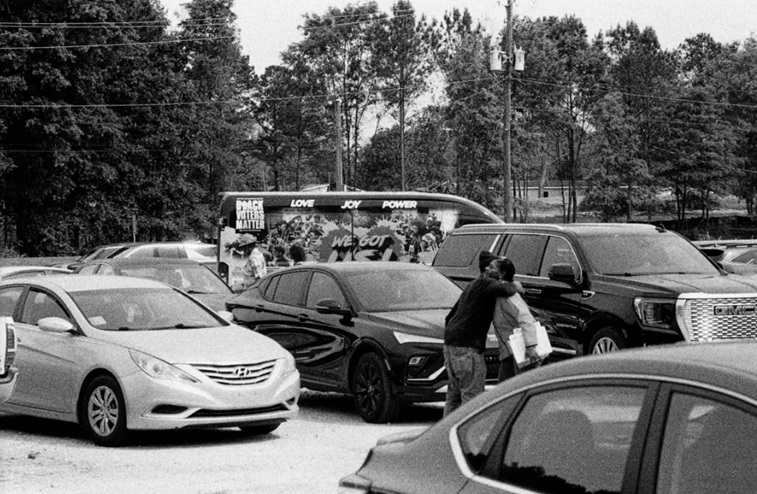
This is how I met Blocker — riding through rural Georgia in mid-April with BVM as its organizers spent four days listening to people in Sparta, Quitman, and other stops between Atlanta and Savannah. The vehicle that carried us is affectionately nicknamed the “Blackest Bus in America.”
BVM typically spends the first part of the year going to communities simply to hear their concerns and letting them know that often the way to remedy them is to vote.
Callais has forced BVM and other organizations into rapid-response mode.
This spring, BVM was able to call on people it had engaged across the South to travel by bus to state legislatures in Alabama, Louisiana, and Tennessee. While BVM co-founder and executive director Cliff Albright did not have exact figures, he estimated that emergency mobilization alone cost at least $100,000.
BVM, LDF, Fair Fight Action, the National Coalition on Black Civic Participation, and Live Free helped mobilize more than 275 organizations for the May 16 All Roads Lead to the South march in Montgomery, Ala., which drew close to 6,000 people, including the Rev. Bernice King, Senator Cory Booker, and Representative Alexandria Ocasio-Cortez.
Ida Gary, lead organizer for BVM, spent the weeks after the Callais decision supporting teams in Alabama, Mississippi, South Carolina, and Tennessee. She called the Supreme Court ruling disheartening but also empowering, as it mobilizes the people she organizes: “It was a call to action like never before. They keep saying, Don’t poke the bear; leave it alone. What they’ve done is they’ve poked the bear.”
As with Callais, Southern states and localities moved quickly after Shelby to do what the federal government had for almost 50 years prevented them from doing: making it harder for Black people to vote.
In Hancock County, this meant purging voter rolls, which led to a federal lawsuit and a 2018 consent decree.
Before then, Hancock County had been a stalwart of Black power.
In the late 1800s, Black residents started amassing thousands of acres of land, establishing an economic foundation that made them less beholden to white landowners than their neighbors in other Black Belt counties. Amanda America Dickson inherited the bulk of a 17,000-acre estate from her white father, David Dickson, after his death in 1885. Her mother was enslaved by her father’s family, and reports indicate that Amanda’s birth was the result of rape. David Dickson’s white relatives challenged the will, but the Georgia Supreme Court upheld it, making Amanda Dickson one of the wealthiest Black women in the country.
In the early 1900s, Black families purchased land using what was earned picking cotton on the same land on which white planters enslaved their foreparents.
Blocker says she worked in the fields every day as a child and can’t remember a time in her life when she wasn’t picking cotton.
“I suppose I was born out there,” she says of the cotton fields, describing how when she was two months old, her mother would bundle her up and lay her on the ground while she picked.
Blocker described the Sparta of her early childhood as a self-contained universe of Black flourishing. “We had our own communities. We had our own churches. We had our own schools,” she says.
Janet Paige Smith and David Mark Smith (who goes by his middle name) live in Sparta on 600 acres of land, about a ten-minute drive away from Blocker. Mark Smith’s grandfather James Blaine Smith used what he earned from picking cotton to buy the land in 1926.
Mark Smith’s father, James Adolph Smith, was elected Hancock County commissioner in 1966 — a feat so remarkable that The New York Times covered it in an article, “Rural Deep South Elects 10 Negroes.”
James Adolph Smith was self-employed, growing cotton, peas, and butter beans on the land his father had purchased. Some of the Black residents of Sparta encouraged him to run.
“He was a Black man, he ran his own business, and he wasn’t beholden to anyone,” says Mark Smith, 67. “Before that [politics] was all white. That’s why they asked Daddy to run, because we needed some Black representation here.”
John McCown, a civil rights organizer with the Southern Christian Leadership Conference, arrived in Hancock County in 1966. He played a crucial role in registering Black residents to vote, fought against intimidation at the polls, and aspired to build Black political control. His tactics were often confrontational and controversial, but they had an impact.
In 1968, Hancock County became the first county in the U.S. since Reconstruction to have a predominantly Black political power structure. McCown was elected county commissioner that year. By 1974, African Americans held almost every elected or appointed position in the county, with the exceptions of sheriff and tax commissioner.
Hancock County was, during this period, about 75 percent Black. Sparta, the county seat, was majority white, and the white residents resisted ceding political power to Black people. In 1971, in response to protests in Sparta calling for the desegregation of schools, Mayor Buck Patterson announced that the town had purchased ten submachine guns for the police out of concern for the safety of Sparta’s residents. In response, McCown bought 30, arguing that the county as a whole would need such protection. Then Gov. Jimmy Carter had to intervene amid fears the confrontation would become violent.
After McCown’s death in a 1976 plane crash, the local Black Power movement lost one of its chief organizers and a major source of funding; through his community development corporation, the East Central Committee for Opportunity, McCown had brought millions of dollars in private and federal grants into the county. Still, many offices remained in Black hands.
Throughout the 1990s, white elected officials repeatedly attempted to change that. The VRA was an impediment. In 1992, the U.S. Department of Justice blocked Sparta from changing its city council elections in a way federal officials said would make it harder for Black residents to vote for their candidate of choice.
In 2011, two years before the SCOTUS ruling in Shelby gutted federal oversight, Georgia Republicans began chipping away at Black electoral power. State Senator Johnny Grant sponsored a bill creating a new Hancock County Board of Elections and Registration, transferring election powers from the county’s Board of Registrars and elected probate judge to a five-member board, most of whom would be appointed by county-level party executives.
In 2015, this majority-white board removed at least 53 and challenged 174 of Sparta’s approximately 980 registered voters, almost all of them Black; attempted to eliminate nine out of the 10 voting precincts in Hancock County; and fired two longtime Black county elections officials. That November, voters elected Haywood, the first white mayor of Sparta in 32 years. Though he didn’t take office until 2019 — a judge ruled him ineligible to serve due to a previously undisclosed felony conviction — his win helped clear the path for the railroad expansion. Haywood also serves as executive director of the Sparta-Hancock Development Authority.
In April 2022, the Smiths received a letter from Ben Tarbutton III, president of the Sandersville Railroad Company. It began: “The Sandersville Railroad plans to build a new railroad track from near Sparta southward to the Hanson Aggregates Sparta Quarry. I am sending you this letter because some of your property will be required as right of way for this new project. I want this process to be as minimally invasive to you as possible.” The plan to build tracks right across their property was presented as more of a fait accompli than a request.
Mark Smith says that when Tarbutton’s attorney asked how much it would take for him to sell, he said there was no amount. In order to access the other, mostly smaller properties, including Blocker’s, the railway line would first have to cross the Smiths’.
“For you to get to their property, you got to get through mine, and I’m not allowing you,” says Mark Smith. “It’s not about me. There’s nothing you can offer me to hand them over to you.”
In 2024, the Georgia Public Service Commission voted unanimously to let Tarbutton take the land of 18 Sparta property owners through eminent domain. Haywood called the project “a generational opportunity for our community” that would create jobs over time.
The Smiths and other property owners went to the Hancock County commissioners for help. “The answer was: We can’t get involved,” says Janet Smith, 67. “Well, what good are you? What good are you if you can’t get involved?”
While the county commissioners did not vote on whether the land could be taken by eminent domain, the landowners believe that they knew about and quietly supported Tarbutton’s proposal.
The Smiths realized that in order to stop Tarbutton, they would have to identify a potential candidate who would support them, and then get that person elected to the Hancock County Board of Commissioners. It would also mean persuading a community still carrying the memory of 2015, when sheriff’s deputies went to people’s homes and questioned whether they were eligible to remain on the rolls, to vote.
For nearly a century after the 15th Amendment, Southern states suppressed the Black vote through poll taxes, literacy tests, grandfather clauses, intimidation, and violence. The VRA did not end those efforts — it just blocked thousands of attempts to violate the law and dramatically increased Black voter registration. In the seven Southern states most directly covered by the law’s strongest provisions, there were fewer than 72 Black elected officials before the VRA; by 1968, there were 156, and by 1974, 963.
Post-Callais, the threat is to the representation that the VRA helped build, and the ruling’s reach extends well beyond Congress. Around half of all past Section 2 cases targeted at-large elections for local bodies — city councils, school boards, county commissions — where decisions about land, schools, policing, and polling places are made. It is at this level, largely out of national view, where voting rights advocates say the damage may be most severe and hardest to fight.
In Alabama, the Supreme Court has allowed the state to revert to a map with only one majority-Black district instead of two (out of seven districts), putting at risk a district that helped elect Representative Shomari Figures and gave Alabama two Black members of Congress for the first time. The state’s population is more than a quarter Black. In Mississippi, the Republican state auditor openly discussed dismantling Representative Bennie Thompson’s majority-Black 2nd District, which would leave the state with no Black member of Congress despite its population being nearly 38 percent Black.
The foundation for the current national voter suppression efforts is in part the lie that the 2020 elections were stolen. Of the more than 60 court cases filed to challenge the results, nearly all were thrown out as baseless. Still, the Trump administration and others have claimed that the SAVE Act and other measures are needed to protect “election integrity.”
In January, the FBI raided the Fulton County, Ga., election office, seizing hundreds of boxes of ballots, voter rolls, and other election materials as part of a criminal investigation into alleged 2020 election irregularities.
“The most basic thing about Fulton County is that Georgia is a state in the traditional South that voted for a Democrat in 2020, and Trump became obsessed with it,” says Groh-Wargo of Fair Fight Action. “And Georgia is the most African American battleground state. Atlanta is our largest city. It’s predominantly Black. The racial overtones are not overtones — they’re direct.”
Groh-Wargo says that because Georgia flipped in the 2020 election, due in part to high Black voter turnout, a question arose: “How can all these Black people tip an election?”
Black voters tip elections when they are organized before anyone is counting votes — when someone they trust has made the stakes plain and shown them that their ballots can change who holds power.
For BVM, building trust means meeting people where they are — at homes, in community centers, under trees. “That’s real big here in the South, where you will have people under a large pecan tree smack-dab in the middle of the community, and they’re playing chess, they’re playing checkers. It might be a spades game that’s going on,” says Gary. “I have sat down under trees and played chess and checkers. I have attended spades tournaments in Macon County. I have picked pecans with people. I have sat in barber shops and gotten a lineup.”
Woke Vote started doing similar work in Alabama in 2017. Founder DeJuana Thompson said that in just six weeks, Woke Vote organized more than 100,000 Black voters before Alabama’s special U.S. Senate election. Democrat Doug Jones defeated Republican Roy Moore, becoming Alabama’s first Democratic U.S. senator in 25 years.
“We never communicated Democrat or Republican; we never even used candidates’ names when we organized for that election,” says Thompson. “What we told people was that this was an opportunity to prove not just to Southern political leadership but to national political leadership that there was power when you organize the Black vote.”
Thompson said that organizers had been expecting the Callais Supreme Court vote to go the way it did and had been preparing for it. “What I think no one could anticipate was such a significant, immediate desire to disenfranchise voters who were already voting,” she says.
Albright says that the speed with which Southern states are trying to redistrict is part of a strategy. “When you look at these Confederate states, they’re always trying to do something quick,” he says, “to do something by surprise, to keep there from being any type of public participation or civic engagement, and to disrupt.”
He points to the parallels between what’s happening now and Jim Crow voter suppression, likening the SAVE Act’s demand for a birth certificate or passport to having to “show your papers,” and the threat of ICE at polling places to having sheriffs intimidate Black voters.
The difference is that rather than this being the effort of individual states, suppression is now the work of the federal government. Before, even presidents who might have been somewhat sympathetic to Southern states’ racist causes followed the law. After the Supreme Court ruled in 1954 that schools should be desegregated and Arkansas refused to comply, President Dwight Eisenhower sent the National Guard to make sure it did.
Voting rights advocates say that the fact that the Trump administration and Republicans are doing so much to suppress the Black vote demonstrates its power.
“Nobody cheats when they are winning,” says Albright. “Nobody reneges in spades when you feel comfortable about the hand that you have.”
I suspect that if Tarbutton had met Janet Smith before he’d embarked on his railway expansion quest, he might have reconsidered. She moves with indefatigable energy, walking briskly over her property, past a garden fenced off with barbed wire marked with a “No Railroad in our Community” sign, and bears the mettle of an Army veteran. She also has an enduring faith. On a whiteboard in her kitchen, under a small American flag, is a list of 12 prayers. Number 4 is “God, stop the railroad and close down the Heidelberg Quarry”; 5 is “Bring our community together to fight for themselves.”
Janet Smith had not really been politically involved until Tarbutton tried to take her family’s land. She voted but paid more attention to state and national elections than local ones.
In 2022, the Smiths and their neighbors formed a coalition, No Railroad in Our Community, and enlisted the help of the Southern Poverty Law Center. In 2024, the coalition recruited Adrick Ingram, the county’s coroner, to run for chair of the Hancock County Board of Commissioners. He had not been planning to run before they convinced him. “I felt like there was a void in leadership, and I felt like people were not being listened to or being served, and one group was those No Railroad coalition members,” he says.
Janet Smith went door to door registering people to vote, sometimes going to a dozen homes in a single day. She did not tell them which candidates to support; instead she said that simply by voting, they could change Hancock County for the better.
“This is as grassroots as you could get,” Janet Smith says. “We had no political affiliation. We were not a nonprofit. We had no money. We’re not wealthy. We’re retired veterans.”
Elvis Watts was sitting on the porch with some friends when Janet Smith came to his home. She asked if they were registered to vote. Watts, 64, had never voted before. He’d thought about it when he was 21 but didn’t know how to register and was ashamed to ask, because he says he didn’t know how to read and write back then.
Watts has a chronic lung disease and is on a breathing machine. Janet Smith helped him register to vote by absentee ballot, and he voted for the first time in November 2024. He regrets that he’d never voted before. “I missed out on things, and I could have made a difference, you know,” he says. “I was just trying to look for better days in Hancock County. You got a lot of Black folks in the county, but you got a bunch of white folks still calling the shot. They don’t want us to get no higher than what we are.”
Tristian McCrary, 21, said he hadn’t considered voting until Janet Smith asked him if he was registered: “It wasn’t really something I would do because I didn’t feel like my voice was being heard by voting.” But then Janet Smith broke down the local electoral system for him and explained how the things he wanted to see in his community — like a recreational center for young people — could be and had been obtained by voting. He believed her because, he says, “The stuff she was voting for, it was passed!” McCrary convinced four of his friends to register. Janet Smith drove them to vote.
In November 2024, Hancock County elected Ingram. He’d first had to unseat the incumbent, Helen “Sistie” Hudson, in a primary. Hudson was a longtime Hancock County political figure who had served on the Sparta City Council, as mayor of Sparta, in the Georgia House of Representatives, and as a county commissioner before becoming chair.
“If [Hudson] had been here, it would have all been over. The train would have been here right now,” says Mark Smith. “We had to remove her from office. We had to change the political atmosphere.”
The Smiths and their neighbors are still at risk. Both Fulton County Superior Court and the Georgia Court of Appeals have upheld the commission’s vote to allow the Sandersville Railroad to take their land through eminent domain. But construction has remained on hold under a court stay while the landowners appeal.
The court stay has bought them time. The election bought them leverage. The coalition that made this happen included both Black and white residents, because the train threatens both. But the power they used was built over generations by Black voters in Hancock County, and it is precisely the power voter suppression seeks to destroy.
I’d imagined that after nearly a century of watching the state try to erase Black political existence, Blocker would be tired. She is not.
“We have to fight ’til we die,” she says.
She has been a pastor since 1990, and part of her ministry is getting people to vote. What frustrates her, she says, is that people don’t always recognize the power they hold.
“You really think if Black folks said, ‘We’re done. Enough,’ that we could change everything?” I ask her.
“We could if we wanted to. Tomorrow,” she says. “We really could — if we just get up and vote.”
That is the charge organizers say they are carrying now — not nostalgia for the civil rights movement but its unfinished work.
BVM, Woke Vote, and other groups are returning to the methods that helped win the VRA: buses, churches, door-knocking, voter registration, statehouse pressure, and conversations with people who have been told, directly and indirectly, that their votes do not and will not matter.
Thompson says that last year, Woke Vote and former Student Nonviolent Coordinating Committee leaders met for what she now sees as preparation for this moment. The coalition that launched All Roads Lead to the South is continuing with Freedom Summer 2026, a series of events in Atlanta, New York City, and other cities the week of Juneteenth.
In Louisiana, Odoms is still fighting to defend what Callais has threatened to end: fair representation for Black voters in a state where nearly one-third of the residents are Black.
She points out this is the work John Lewis said belonged to every generation.
“The Reconstruction amendments are our greatest expression of unfinished love in the law. For generations, Black people have heard the promise of what the Constitution reflects, and then over many decades of litigating and organizing and communicating and lobbying made the law answer for it,” she says. “None of this was given to us. It has always been our ingenuity and creativity and intelligence and tenacity and perseverance and love that has made us make the law into what it’s supposed to be, and, by extension, make this democracy what it’s supposed to be.”
ZNetwork is funded solely through the generosity of its readers.
Donate




