
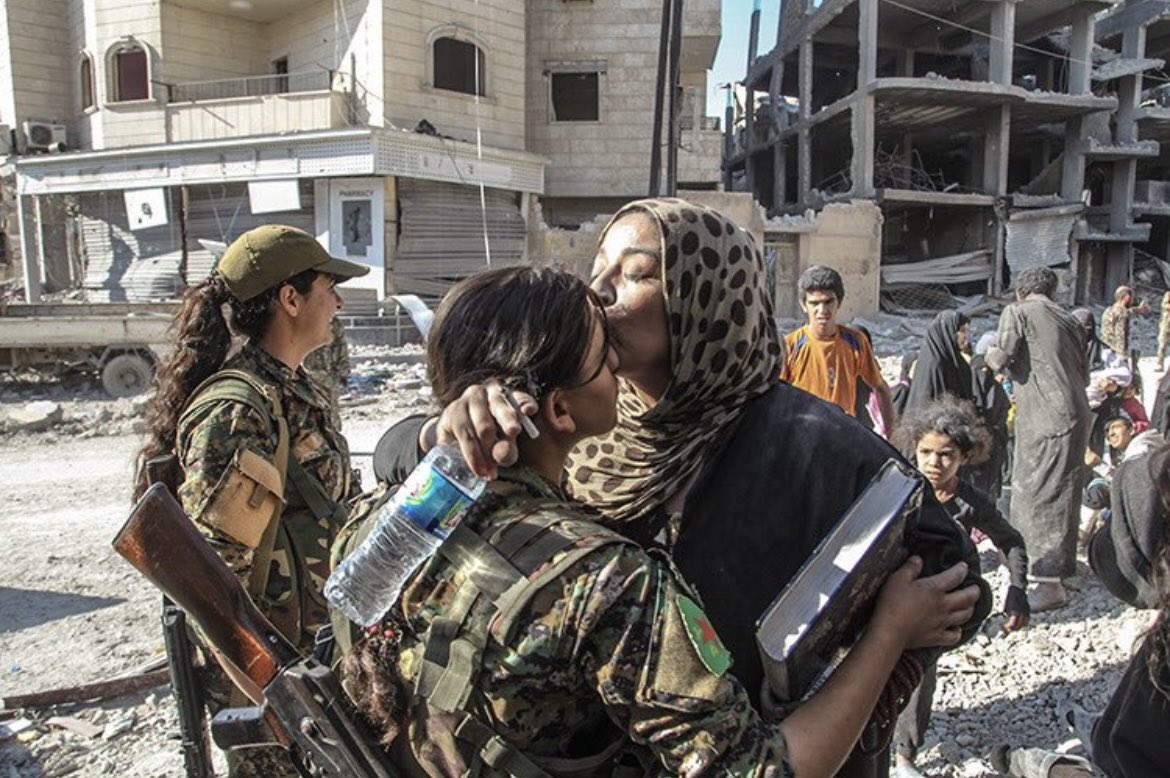
“The model we aim to develop is neither a woman dissolved within the man nor a structure that is entirely anti-male. On the contrary, it necessitates a framework that secures both her freedom and a free life with equality through appropriate means.”
— Kurdish People’s Leader Abdullah Öcalan
This striking observation by Kurdish People’s Leader Abdullah Öcalan does more than just summarize a political movement’s approach to the women’s issue; it points to the core of a profound philosophical and political paradigm that confronts a global civilizational crisis.
These words illuminate the radical and universal alternative that the Kurdish Freedom Movement’s “Democratic, Ecological, and Women’s Liberation Society” paradigm offers to the most pressing problems of the contemporary world.
The model proposed by Öcalan allows no room for the woman ‘in the man’s shadow’ under the patriarchal system, nor for an ‘anti-male’ figure confined by the narrow limits of identity politics.
Instead, it offers a unique philosophy of co-existence (hevjiyan) that cements individual freedom with social equality and institutional guarantees.
THE SOURCE OF SEXISM AND THE PHILOSOPHY OF “FREE LIFE”
The Kurdish Freedom Movement’s approach to women’s liberation goes far beyond a superficial reform effort. Öcalan asserts that the current capitalist modernity and state-centric civilization are rooted in 5,000 years of male power, and that the woman was the first to be colonized.
According to this view, the initial form of class, nation, and state domination is gender slavery. Consequently, genuine social liberation is only possible by eliminating this historical slavery.
Based on this analysis, the Kurdistan Freedom Movement elevates women’s freedom from being a mere human rights struggle to being the cornerstone of a democratic society and a free life.
In Öcalan’s words, “Society cannot be liberated until the woman is liberated.” This is not just a slogan; it is a call for a Revolution of Mentality.
Jin, Jiyan, Azadî (Woman, Life, Freedom): This slogan, which spread from the Rojava Revolution to global protests, is the essence of the Kurdish women’s paradigm. Jin (Woman) represents not just biological gender but also the sociability and culture that is the source of Jiyan (Life), while Azadî (Freedom) expresses this life form, cleansed of domination.
The Theory of Rupture (Killing the Man): Öcalan argues that for the woman to be liberated, the man must kill the 5,000-year-old dominant mindset, the codes of power and violence, within himself. This is not a biological annihilation but a call for radical cultural and psychological transformation; it means the man shedding his “god-king” status to become an individual ready for a free co-existence.
POLITICAL AND INSTITUTIONAL GUARANTEES OF THE PARADIGM
The “framework that secures equality and a free life through appropriate means” in Öcalan’s definition is reflected in the practical policies of the Kurdish Freedom Movement. This framework is not limited to legal equality. It aims for the institutionalization of women’s power in the public sphere.
The Co-Chairmanship System: This system is not merely a quota application but a political necessity designed to break male dominance in decision-making mechanisms. Having one woman and one man serve with equal authority at every level ensures that the female perspective is included in every decision.
Unique Women’s Organizations: The Kurdish Women’s Movement has established autonomous organizations in every field, from politics to military defense, from academia to diplomacy (YPJ, HPJ, YJA-STAR, KJK, PAJK, Jineology Academy, etc.). This autonomy enables women to empower themselves and lead social transformation based on their own will, independent of interference from the male system.
Jineology (Women’s Science): Developed from the idea that the male-centric understanding of science (positivism) provides an incomplete account of society and history, Jineology is a discipline that aims to re-read social and historical reality from a female perspective. By uncovering the woman’s fundamental role in society, it forms the theoretical basis for cultural and mental transformation.
UNIVERSAL IMPLICATIONS: ROJAVA AND GLOBAL RESISTANCE
This paradigm is more than a theoretical abstraction; it has been materialized through the practical Revolution in North and East Syria (Rojava).
In Rojava, women have not only provided military leadership against radical jihadist, Islamist, and reactionary forces like DAESH gangs, but have also built an autonomous, democratic, ecological, and pluralistic governance model. This experience has proven that women’s freedom is the only true guarantee of social peace and democracy.
Öcalan’s philosophy has echoed from the women’s uprising in Iran to feminist movements worldwide with the slogan “Jin Jiyan Azadî,” becoming a global symbol of resistance and hope. This is the strongest evidence that the Kurdistan Freedom Movement’s women’s paradigm has moved beyond being a local struggle to become a universal solution for all of humanity.
A CALL FOR A FREE LIFE CONTRACT
The women’s liberation paradigm put forward by Kurdish People’s Leader Abdullah Öcalan is a proposal for a New Social Contract against the crisis of modern society.
This proposal is neither limited to a power-centric opposition nor a narrow definition of identity politics. On the contrary, it centers the ideal of a stateless and domination-free life that unites the free individual (the woman) with social equality.
This philosophy offers a roadmap for all progressive, democratic, and ecological movements standing against today’s oppressive regimes, rising fascism, and capitalist exploitation. The Kurdistan Revolution, led by women, aims to confront every form of power and domination, which is the most fundamental problem of the 21st century.
The path to true freedom passes through the freedom of the woman.
ZNetwork is funded solely through the generosity of its readers.
Donate