

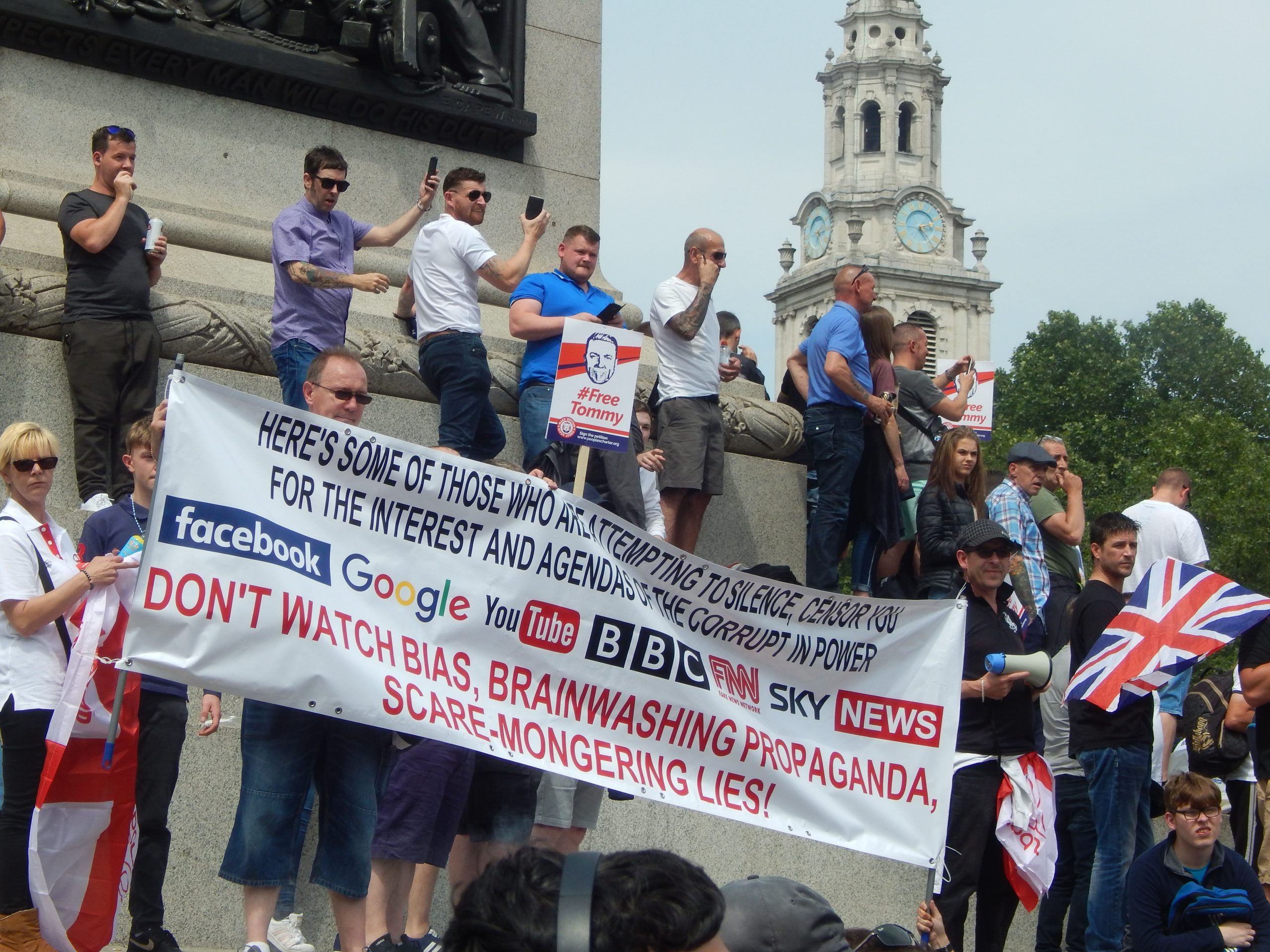
At the end of May, Greg Bovino, the former chief of the US Border Patrol, was the keynote speaker at a “Remigration Summit” in Portugal. There, he won applause from neo-Nazis for a program that ends in the forced removal of immigrants, legal residents, even citizens. A week later, US Vice-President JD Vance used a British teenager’s murder to attack the country’s immigration policy.
Neither man is British, yet both are helping to engineer Britain’s next Brexit.
The comfortable story is that this is a domestic argument: a homegrown mood and a country internally debating immigration. But Brits told themselves something similar in 2016, when American money, Cambridge Analytica data, and foreign social media operations turbocharged a fringe idea into a referendum result before anyone grasped what had happened.
Remigration is the same playbook. Except now, it runs out in the open.
Look at who is doing the talking. In May, the White House posted an image of Donald Trump crossing out “replacement migration” and writing “remigration”, a word with white-nationalist roots in Europe. Only last week Vance pinned 18-year-old Henry Nowak’s murder on a “mass invasion of migrants”, though the perpetrator was a British citizen. Downing Street has itself warned of outside attempts to interfere in British democracy and stir up division. Vance and Elon Musk are not amplifying a British movement so much as manufacturing one, with Muslim communities as the target and Reform as the vehicle.
The communities on the receiving end feel it deeply. A survey by Opinium for transatlantic thinktank The Concordia Forum found that more than half of British Muslims are more frightened of anti-Muslim violence than a year ago, and roughly a third have changed their routines to avoid certain places. Nearly half fear that they or someone close to them will be harmed.
What makes this so dangerous is that Britain is now less equipped to resist. In March, the government stripped the term “Islamophobia” and the framing of anti-Muslim hatred as racism from its official definition. The same day, it launched a social cohesion plan, with an incoming anti-Muslim hostility “tsar” expected to make that narrower definition permanent. That is a government chasing Reform’s voters, as Labour chased UKIP’s in 2015, and they should realize how that strategy ends: not with the threat contained, but with the mainstream redrawn around it.
The ground has already shifted under our feet. A Hope Not Hate survey this year found that 54% of Reform members want non-white citizens born abroad removed or encouraged to leave – not a fringe grumble about migration, but a majority position, inside a party leading the polls, that some British citizens do not truly belong.
I have seen how this works in my own country. For years, Sweden treated the Quran burnings on its streets mainly as a matter of public order and free speech, arguing over permits and police powers rather than naming the anti-Muslim hatred behind them. One of the men who staged them, Salwan Momika, was eventually shot dead. A government that will not name this hatred as racism loses the power to fight it, and the hostility keeps spreading without ever having to admit what it is.
Yet even Sweden is walking into the same trap again on remigration. Aggressive deportations of teenagers and proposals to pay refugees to leave have focused public debate on how many non-white or Muslim Swedes should be in Sweden, and invited the most hateful to participate. Our once proudly open society risks closing, and threatens the core values that make Swedish and European democracy work.
Some will say this is overblown, that worrying about immigration is legitimate and “social cohesion” is a worthy goal. It is. But a cohesion strategy that deletes the very word for the racism it claims to confront is not building cohesion; it is managing the people it has already decided are a problem. The danger is not only what anti-Muslim racism does to Muslims; it is also about what it does to democratic societies. When a society begins to treat the belonging of one group as conditional, it weakens the principle of equal citizenship for everyone. Historically, exclusion rarely stops with a single group.
And the premise underneath all of it, that Muslims are unassimilated and a threat to Western values, falls apart on contact with the evidence. In that same Concordia poll, British Muslims backed democracy more strongly than the general public – 85% to 71% – and 94% said everyone should be treated equally under the law, against 80% of the wider population.
Naming anti-Muslim racism as racism does not shut down debate; it is a precondition for an honest one, and for protecting every citizen equally. I wrote the Council of Europe’s 2022 report defining Islamophobia as anti-Muslim racism. In doing so, I hoped to give governments across Europe the tools to identify and confront discrimination before it shakes the foundations of European democracy. Britain risks throwing those tools away.
If nothing changes, the cost will not be only trade deals and wasted years, as it was with Brexit. It will be millions of British citizens being told that their place here is conditional, and a party system reorganized around the question of who counts as truly British.
The way to resist is simple. Keep the language. Keep Muslim organizations in the room. Hold the line institutionally and refuse to let the meaning of racism be quietly rewritten under pressure from the same forces that brought us Brexit. In 2016, Britain did not see the interference coming. This time, nobody can say they were not warned.
Momodou Malcolm Jallow is a Swedish MP, the first person of African descent to chair a parliamentary committee in Sweden, and author of the Council of Europe’s 2022 report defining Islamophobia as anti-Muslim racism.
ZNetwork is funded solely through the generosity of its readers.
Donate




