

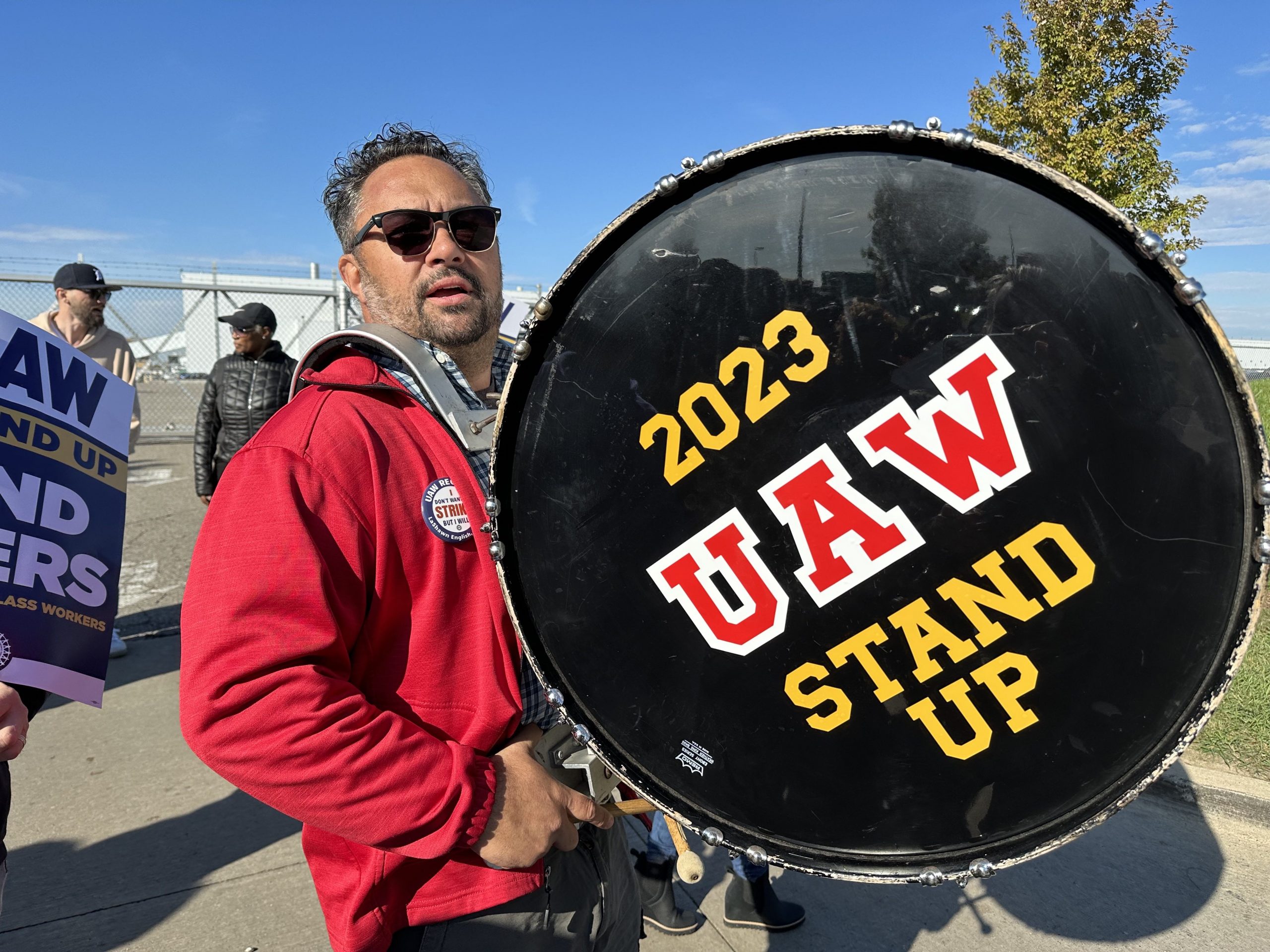
After a six-week rolling strike across the auto industry that garnered international attention, the United Auto Workers has reached tentative agreements with all of the automakers that make up the Big Three: Ford, Stellantis and General Motors. Now the union’s members are voting on whether to accept the deal.
“Everything we’ve won, we’ve won together. Our union just showed the world what’s possible when workers unite to fight for more. We’ve created the threat of a good example, and now we’re going to build on it,” said Shawn Fain, the union’s president, during a live stream.
Fain, who took office only six months before the walkout, has called the agreements “an astonishing victory” for the Big Three’s more than 145,000 workers. This was the first time the UAW has called a strike against all three companies simultaneously.
In 2008, amid the nation’s economic collapse, the UAW agreed to major concessions during contract negotiations, and it has struggled to fully recover. The union was also hampered by corruption, with more than a dozen officials caught reportedly embezzling millions of dollars in union funds between the early 2000s and as recently as 2021. But those scandals helped pave the way for these monumental new agreements the UAW just secured. That’s largely because before this most recent union election, union officers had been chosen by convention delegates instead of directly by members. Fed up with business as usual, members organizing within a reform caucus, Unite All Workers for Democracy (UAWD), fought hard to pass a one-member-one-vote policy, which allowed workers to directly elect their officers. In the subsequent election, Fain narrowly won after a runoff. His victory was not only a win for him but a referendum on the overall direction of the union, with many members organizing and hoping for a more transparent and militant organization, especially in negotiations with the Big Three.
Stefan Marken, a member of Local 600 in Dearborn, Mich., and an activist with UAWD, says Ford and the UAW have shaped his life. His great-grandparents, uncles, aunts and father all worked for the company, and he’s been there almost nine years. Before Fain, this past strike and the current agreement, Marken says all he knew “was corruption.”
“My first contract in 2015 was corruption, 2019 was corruption, all the UAW presidents got indicted, Marken says. “This is the first time since I’ve been a member of the UAW that I have faith and that I believe in our union.”
Marken says he’s excited to vote to ratify the new agreement, which includes a 25% pay increase over the life of the contract, with an 11% increase upon ratification; the restoration of the cost-of-living adjustment (COLA); two weeks of paid parental leave; the right to strike over plant closures; and improvements to the retirement plan, both for those with pensions and those with a 401(k). Marken, who says he proudly voted for Fain, calls the agreement “a winning contract for the UAW.”
“It’s huge for the temporary employees. There’s been a wage gap between legacy and temporary employees, and a tier system. There’s still a little bit of a tier system with pensions and post-retirement health care, but the wage tier system is closed,” says Marken. Voting on the deal with Ford will conclude on November 17, but results from different locals have already started rolling in, with the first plant to go out on strike voting overwhelmingly to ratify — 82% of workers there voted yes. But not everyone is happy with the deal: 55% of production workers at Ford’s Louisville, Ky., assembly and Kentucky truck plants voted down the agreement.
Ford was the first of the Big Three to reach a deal with the UAW, and that was announced on October 25, but Stellantis and General Motors (GM) were not far behind. All three contracts look similar, with workers getting raises; a cost-of-living allowance (COLA); $5,000 ratification bonuses; and for workers hired after 2007 without defined benefit pensions, a 10% annual company contribution to their 401(k). The UAW also secured a demand that Stellantis reopen the Belvidere plant in Illinois, which the company idled in February 2023, laying off 1,200 workers. Stellantis is now planning to invest nearly $5 billion into Belvidere—with the aim of not just reopening the shuttered parts distribution center but also building a new assembly and battery plant, the first effort of its kind. If the agreement is ratified, any future battery plant workers will be covered under the UAW’s Master Agreement with the Big Three. (UAW members at Belvidere overwhelmingly voted in favor of the agreement.)
Torice Sawyer, a member of Local 7 in Detroit who has worked for Stellantis since 1996, went on strike for the first time this year. She voted for Fain and his entire slate and is planning to vote to ratify this agreement, but she also says, “I was hoping to get a raise, and if this TA passes, I’ll get an 11% raise up front. [But] I can’t lie, I was hoping it would have been more.” Sawyer says she recognizes there were a lot of different interests and needs to factor into these contract negotiations and that the leadership team had to “balance the retirees, the legacy workers and the temporary part-time or supplemental workers.”
“But I’m going to vote yes on this contract. I feel comfortable enough. Our leadership will do their best for us,” she says. UAW members at Stellantis will finish voting on the deal by November 19.
Many workers at GM say they felt prepared for this strike because they’ve already been through something like this when they walked out in 2019 when an agreement could not be reached. Raina Shoemaker, whose father was an electrician at GM, has been at her parts distribution plant outside Philadelphia for nearly nine years. She voted no on the last contract and is planning to vote no on this one. Her big sticking point, and reason for voting no, is the lack of pensions and post-retirement healthcare for non-legacy workers, which she believes is only setting them up for another strike when this contract ends. Marken agrees that “the next big fight will be post-retirement healthcare,” and also believes that “pensions will be a tough one” to win. (Only 15% of private sector workers in the United States have a pension.) Sawyer, a legacy employee, will receive a pension and healthcare after retirement, and also agrees that this is the next frontier of negotiations because “all workers deserve them.”
But despite not voting to ratify the deal, Shoemaker thinks the UAW put up a good fight. “I think [Fain] did a good job in this contract. He met the goal for bringing home more money and higher hourly wages,” she says.
Similar to Ford and Stellantis, GM’s agreement includes the right to strike over plant closures; improvements for future retirees; and reinstatement of COLA. It also includes payments to current retirees and their spouses, and most significantly, it brings two groups of workers at Ultium Cells and GM Subsystems LLC into the UAW’s Master Agreement, which GM management had previously said would never happen. And just like Ford and Stellantis, the deal with GM also brings an end to wage tiers, which Shoemaker says she’s “very happy about.” If this contract is ratified, she’ll be receiving a raise of “$10 and change per hour, right off the bat.”
If UAW members ratify these deals, the contracts will expire on April 30, 2028, allowing workers the right to strike on May Day if no new agreement is reached. While negotiations are always a compromise between management and workers, the new leadership of the UAW is committed to fighting for better jobs — and for more jobs, in the case of battery workers at Stellantis and GM. Sawyer tells In These Times, “The CEOs are not used to Shawn Fain. They were accustomed to our former leadership, taking bribes. They weren’t accustomed to anyone fighting for us.”
ZNetwork is funded solely through the generosity of its readers.
Donate