


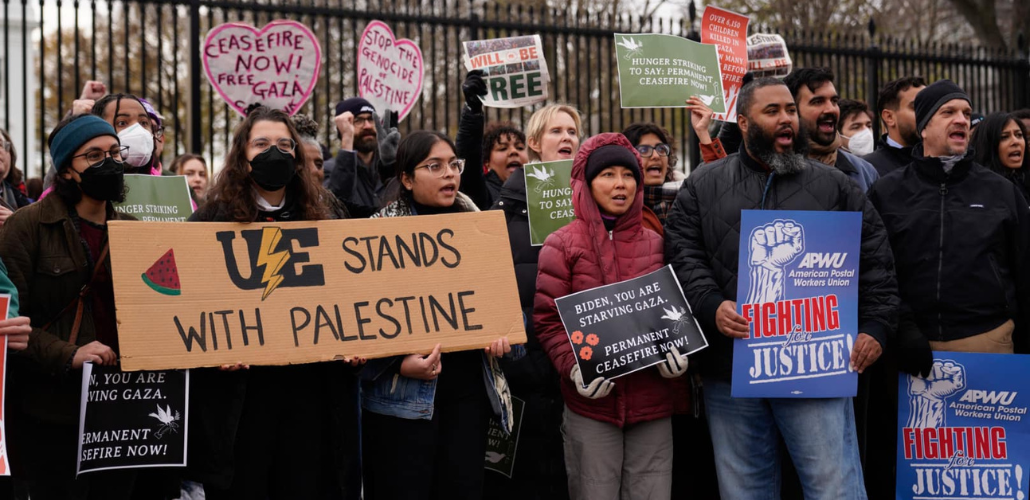
Although the U.S. labor movement is sometimes depicted as hawkish and xenophobic, this characterization ignores its repeated attempts to grapple with the global problem of war.
On June 9, 2026, for example, delegates at the annual national convention of the AFL-CIO, the 15-million member labor federation with which most American unions are affiliated, voted to adopt Resolution 9, “We Want a Just and Peaceful World.”
Declaring that “working people must never be treated as pawns in geopolitical power struggles,” the resolution promises that “we will stand with workers and communities harmed by war” and “will advocate for an end to wars that threaten workers’ livelihoods, security and rights.”
“In Gaza,” notes the AFL-CIO statement, “we demand an immediate and permanent ceasefire; full, safe and sustained humanitarian access; a halt to arms transfers that may facilitate violations of international law by all parties; and a credible political process grounded in international law and UN resolutions to achieve a just and lasting peace.”
Furthermore, it declares, the AFL-CIO “will engage forcefully in international institutions,” such as the United Nations and the International Labor Organization, and “will advocate for continued U.S. government and labor engagement in international negotiations,” including those focused on climate change and energy under the UN Framework Convention on Climate Change and the Paris Agreement.
Assailing demagogic “efforts to divide working people through fear, exclusion, and racist anti-migrant rhetoric,” the labor federation opposed “discriminatory travel bans and migration policies,” denounced “the abandonment of refugee and asylum commitments under international law,” and demanded “due process for all.” It promised to “seek . . . foreign policies that promote peace and halt support for repressive governments.”
Three months earlier, rebuking the U.S. and Israeli governments for initiating a war with Iran, the AFL-CIO issued a statement calling for an end to the conflict and demanding “strict respect for international law, the United Nations Charter, and the U.S. Constitution that call[s] for the people’s voice through Congress in any war authorization.”
Of course, organized labor’s expressions of support for peace and international cooperation are not always accompanied by major labor movement campaigns to secure them. Within the U.S. labor movement, domestic policy concerns, which have a direct impact upon American workers, tend to outweigh foreign policy concerns.
Furthermore, during most of the Cold War, much of the AFL-CIO leadership was, in fact, quite hawkish, rallying around the flag and supporting U.S. military intervention in Asia, Latin America, and Africa. AFL-CIO president George Meany worked vigorously and successfully to get the labor federation to give “unqualified support” to the U.S. war in Vietnam and, in 1972, to reject backing the peace candidacy of Senator George McGovern, the Democratic nominee for President.
Even so, for more than a century, a significant number of prominent American union leaders have been peace proponents. These include Eugene Debs (president, American Railway Union), a sharp critic of the Spanish-American War and of World War I, who, thanks to this stance, became the nation’s best-known political prisoner. Another was “Big Bill” Haywood (leader of the Industrial Workers of the World), who condemned World War I and, to escape Debs’s fate, fled the country.
In later years, peace-oriented labor leaders included Walter Reuther (president, United Auto Workers and vice president of the AFL-CIO), a world federalist who also served on the board of the National Committee for a Sane Nuclear Policy (better-known as SANE) and opposed Meany’s hawkish approach during the Cold War. Another, William Winpisinger (president, International Association of Machinists), became co-chair of SANE, as well as a champion of conversion from a military to a peacetime economy.
Indeed, Samuel Gompers, the founder and long-time president of the American Federation of Labor, began his labor career as a strong advocate of peace. In 1893, answering the question “What does labor want?” Gompers replied: “We want more schoolhouses and less jails; more books and less arsenals.” A few years later, he sharply criticized America’s imperialist role in the Philippines.
On numerous occasions, American labor activists expressed similar views.
Even during the Vietnam War, when the AFL-CIO leadership and numerous unions voiced hawkish sentiments, substantial dissent grew within the labor movement. Several large unions broke with AFL-CIO policy and, by 1970, the leaders of 22 U.S. unions had joined a call for the withdrawal of U.S. military forces from Vietnam.
Antiwar activism within labor’s ranks flared up again in the 1980s. A National Labor Committee in Support of Democracy and Human Rights in El Salvador emerged and denounced the Reagan administration’s military aid to rightwing, repressive governments battling leftwing rebels in Central America. Responding to such pressure, the delegates at the 1985 AFL-CIO national convention voted overwhelmingly for a resolution that challenged U.S. government policy by calling for “a negotiated settlement, rather than a military victory” in the region. Also, by 1986, well over half of the AFL-CIO’s affiliated unions backed the U.S. peace movement’s Nuclear Freeze campaign, which called for a halt to the nuclear arms race.
The Iraq War triggered another surge of peace activism within the labor movement. In January 2003, as a U.S. military invasion of Iraq loomed, some 125 delegates from various labor unions met at Teamsters local 705 hall in Chicago and formed U.S. Labor Against the War (USLAW). After the invasion began that March, the new organization grew quickly and became a powerful voice within union locals, individual unions, and the AFL-CIO’s state affiliates. It grew so powerful, in fact, that, at the labor federation’s 2005 convention, the delegates voted overwhelmingly for a resolution demanding the “rapid withdrawal” of U.S. troops from the conflict.
Consequently, this June’s AFL-CIO call for a just and peaceful world is in line with much of labor’s past. And the labor movement shouldn’t be written off as a force for peace and international cooperation in the future.


Lawrence ("Larry") Wittner was born and raised in Brooklyn, NY, and attended Columbia College, the University of Wisconsin, and Columbia University, where he received his Ph.D. in history in 1967. Thereafter, he taught history at Hampton Institute, at Vassar College, at Japanese universities (under the Fulbright program), and at SUNY/Albany. In 2010, he retired as professor of history emeritus. A writer on peace and foreign policy issues, he is the author or editor of twelve books and hundreds of published articles and book reviews and a former president of the Peace History Society. Since 1961, he has been active in the peace, racial equality, and labor movements, and currently serves as a national board member of Peace Action (America's largest grassroots peace organization) and as executive secretary of the Albany County Central Federation of Labor, AFL-CIO. On occasion, he helps to fan the flames of discontent by performing vocally and on the banjo with the Solidarity Singers. His latest book is Working for Peace and Justice: Memoirs of an Activist Intellectual (University of Tennessee Press). More information about him can be found at his website: http://lawrenceswittner.com.
ZNetwork is funded solely through the generosity of its readers.
Donate




