

The problem of centralized power
The United States is broken, and it’s time to think about what comes next.
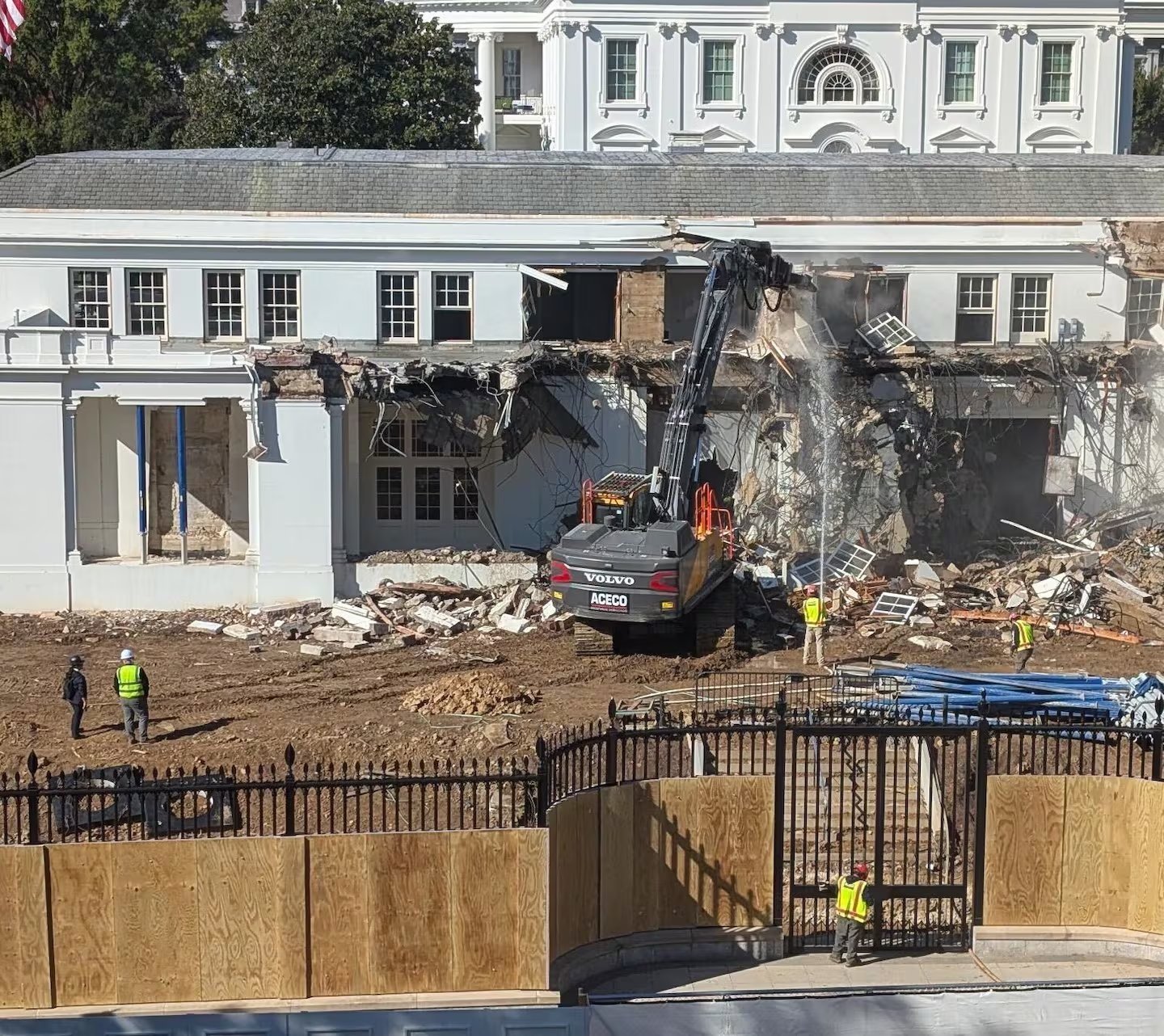
Images of the White House East Wing demolition that have filled our eyes in recent days are a visual expression of a broader reality. The constitutional order of the U.S. is shattered. A lawless president backed by a feckless Congress and a Supreme Court tipped far to the right has upset what balance of powers remained under the constitutional system. That he could order the destruction of a national landmark with no public notice or review to build his ballroom signals his dictatorial intent.
But the roots of this run far deeper, to the Constitution itself. The U.S. started as a loose alliance of states under the Articles of Confederation. They had significant autonomy. But the financial classes centered in the large Northeast cities had a big problem with that. They were owed war debts and demanded payment in gold and silver. But states, where a measure of democracy existed, wanted to use paper money. When farmers in western Massachusetts staged Shay’s Rebellion against taxes needed to pay the debts, the ruling classes were alarmed. Led by Alexander Hamilton, they convened the Constitutional Convention to create a powerful federal government that could control the states and further expansion on the western frontier.
Over the century to come, the federal government mounted military campaigns to conquer the natives, and subsidized railroad construction. These were crucial to build a continental empire. Once that was filled out, the U.S. moved out into the world to build the greatest global empire in history, sustained by the centralized federal power created by the Constitution.
Power has been centralizing in the U.S. for its entire history, to the point we have reached today where a president has seemingly breached all limits, as exhibited by the East Wing demolition in violation of law and custom. What is going to pull us back from this?
A vision for a continental confederation
Historian William Appleman Williams well knew the course toward increasingly centralized power. Emerging in the 1950s, he led a school known as the revisionists who debunked the idea the U.S. was exceptional. Instead, argued the revisionists, the U.S. was an empire much as any other, dedicated to its own expansion. The Constitution was the instrument that made it possible.
In the latter stages of his career, Williams proposed a way beyond empire. He suggested that the U.S. to return to its decentralized roots and re-create itself as a confederation of regional commonwealths. They would build self-sustaining economies devoted to serving social needs. I wrote an extensive series on his vision several years back. It starts here.
In light of what has occurred since, I share this extended quote from the first part.
“While the centralization of power created by the Constitution may have been necessary for the early survival of the United States, it came, wrote Williams, ‘at the price of institutionalizing domestic and global empire, and internalizing empire as a way of thought and life (italics Williams) . . . ‘ To move away from this and back to a future grounded in democracy, Williams had a modest proposal, lined out in his 1976 book, America Confronts a Revolutionary World.
“’We must return . . . to the Articles of Confederation. That document offers us a base from which to begin our voyage into a human future; a model of government grounded in the idea and the ideal of self-determined communities coming together as equals when and as necessary to combine forces to honor common values and realize common objectives.’ We must ‘create an American commonwealth of regional communities.’
“At a time when democracy, to whatever extent we have it in the U.S., is under threat of succumbing to an authoritarian tide enshrining minority rule through vote suppression, gerrymandering, a majority right-wing Supreme Court, and a consolidation of hard right forces in the Republican Party, Williams’ vision for restoring democracy from the regional ground up has particular cogency. It is likely that in the next several years all three branches of the federal government will be taken over by a rightist, authoritarian government that will do everything it can to seal permanent rule. We will need a ground on which to consolidate our own progressive forces, and offer a different vision of how we might live here. That is the places we live, the regional ground.”
Focusing our efforts on states and cities
I wrote those words in 2021. Now we are here. The thrust for consolidation of authoritarian power is well under way. It is indeed seeking “to seal permanent rule.” This gives fresh relevance to the vision put forward by Williams for a decentralized order in which power is more widely distributed.
The degree to which power is distributed is all that is stemming the authoritarian tide. States such as California, Oregon and Illinois are resisting deployment of federalized troops in their cities. Many state attorney generals have filed suit against administration policies that clearly violate the law. We can be thankful we still have something of a federal system. But Trump is threatening to override the states with the Insurrection Act. And we still have not seen most state lawsuits reach the Supreme Court. Rulings in Trump’s favor are likely to increase the centrifugal tendencies in the U.S., perhaps spurring outright state denial of federal authority.
Something like 7 million people came out for No Kings Day last weekend. The question is where all that energy is going to go. Of course, simply to restore some balance of power, returning one or two houses of Congress to the Democrats is important. But that won’t address the deeper structural problems of overcentralized power that have brought us to this point.
The logical course, as I wrote back in 2021 and often since, is to concentrate forces on taking power in cities and states, to build progressive power and agendas. The hard work of organizing at on a grassroots level, and developing agendas to meet people’s needs, must be undertaken. Without abandoning efforts to restore some balance at the federal level, we must build new power in cities and states, communities and bioregions.
The vision put forward by Williams for a continental confederation of regional commonwealths may seem far from the reality we face. But we need vision to carry us forward, even if we only reach part of the way. The United States is broken. We should consider a more decentralized democratic order as what comes next.
ZNetwork is funded solely through the generosity of its readers.
Donate




