

In the midst of all of his trials, in a moment pregnant with irony, Donald Trump recently claimed that if he was reelected he would seize direct control of Washington, DC because, he said, crime there was out of control.
“We’re going to federalize it,” Trump told attendees to a Las Vegas rally. “We’re gonna have the toughest law enforcement in the country. We’re not going to have any more crime and it’s going to look beautiful.”
As usual, Trump doesn’t know what he’s talking about.
Most people think crime (particularly property crime) is caused by poverty, like the poor people portrayed in Les Misérables stealing food for their children. But Louis XVI’s policies created poverty in France while massively increasing his own wealth and that of his friends.
(Treasury Secretary Alexander Hamilton, himself born into poverty, accused the French king of “crimes and extravagancies” that led to the French Revolution in a response to George Washington’s question of his cabinet about whether America should remain neutral in the conflict.)
Yes, the French poor were poor, but during that time the rich got vastly richer. There was poverty, and even periodic famines in France, but (outside of stealing food) that wasn’t what was driving crime and ultimately the 18th century French revolution: it was inequality.
Hold that thought. Because our entire popular understanding of the cause of much crime—enough to “tipping point” a society into crisis—is usually wrong.
I’ve seen this dynamic at work in multiple countries, often among very, very poor people and even in the midst of famines.
In late November 1980 I went into Uganda at the tail end of the Tanzanian invasion that overthrew Idi Amin. As Amin fled to Saudi Arabia where he was feted with a palace for himself and his wives by the Saudi government, his soldiers went on a killing and looting rampage, particularly in the northern region against the Karamojong people.
In one large region, they killed most all the men and boys older than toddlers and raped the women; by the time we got there the region was filled with thousands of starving women and babies (my contemporaneous diary of that trip is here). Skeletal adults and big-bellied children moaned in pain from starvation as they died before our eyes.
Thursday of that week the special on NPR’s All Things Considered show was an 18-minute conversation between Sanford Ungar and me (on a satellite phone from Uganda) as I was describing the famine we were trying to address, with hundreds of people dying every day, live on the radio as Americans were sitting down to Thanksgiving dinner.
And yet, in the midst of all that, there was no crime; people formed community.
I worked in Bogota, Colombia a year or so later in one of that city’s massive barrios built on hillsides out of cardboard and scrap wood with streams of raw sewage running to an open sewer in the valley below. I worked in the Klong Toey slum of Bangkok where the Duang Prateep Foundation was putting in non-flammable sidewalks and organizing regular trash removal because the giant Japanese corporation that owned the swamp the slum was built over kept hiring local organized crime families to burn out and kill the slum-dwellers.
When I was in The Philippines in 1985, Father Ben Carreon, an activist priest and the author of a popular column for the Manila Times, took me to one of that city’s massive garbage dumps. The smell was awful, the air thick with insects, as mountains of rotted garbage stretched off into the distance.
We stood in the hot afternoon sun, and Father Ben said, “Look carefully at the piles of garbage.” I squinted in the bright light, looking at the distant piles, and noticed something. “They’re moving!” I said. “No, it’s children on them that are moving,” he said. “Thousands of them. Their families live all around here, and the children spend their days scavenging for garbage that their families can sell or eat.”
People in Uganda were dying of famine in Mbale and across the Karamoja region, and hunger stalked the “big city” of Kampala, but there was little crime because the rich people had all left the country. Instead, there was a shared sense of solidarity; while poor people did prey on each other, it was more the exception than the rule and entire communities would rise up against thieves.
I found the same thing working in the slums of Thailand, Peru, India, Colombia, South Sudan and other countries; the biggest crime I personally experienced was having my wallet and pocket computer stolen on a flight from South Sudan to Kenya while I was asleep. Truly poor people don’t buy airplane tickets.
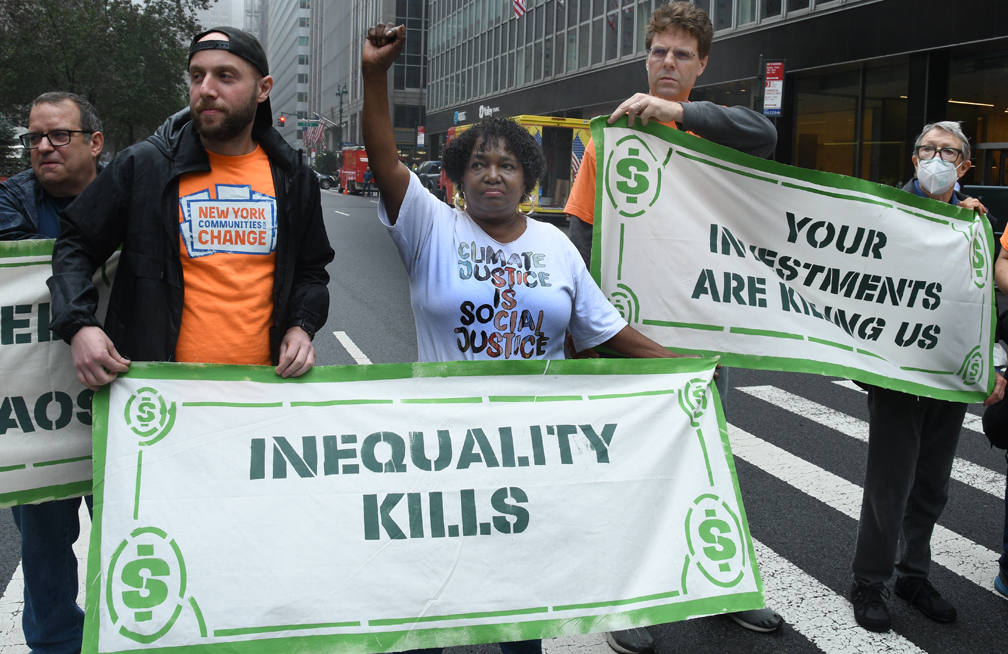
Poverty doesn’t cause the societal disintegration that leads to most crime, it turns out: inequality does. And America is now, far and away, the most unequal developed country in the entire world.
While billionaires who pay less in federal income tax rates than you do blast themselves into space on giant penis-shaped rockets, the majority of Americans are struggling to get by. I say “the majority” because a decade ago the number of Americans who could call themselves “middle class” slipped below 50 percent for the first time since the Eisenhower era.
Last November, I mentioned that we’d experienced an attempted break-in. Our neighborhood’s burglar wasn’t hungry; she was young, healthy, and well-fed, as was the small dog she walked to blend into the community. America is not experiencing a surge of crimes related to starvation-level survival, even among our homeless communities.
So how does inequality provoke criminality? The research on the topic is pretty exhaustive, albeit poorly publicized, and the simplest explanation is among the most easily understood: humans are wired to rebel against unfairness. Unfairness thus destroys social trust.
Walk into a preschool class and give one child a pile of cookies while giving everybody else only one each and see what happens. In fact, it’s not just humans; this holds true across all mammalian species from rats to dogs to apes.
As research across 33 nations published in Oxford’s European Journal of Public Health found, inequality devastates social trust among people, opening the door to antisocial crime, including violent crime (although you could argue that stealing is also a form of interpersonal violence provoked by inequality).
We’re social animals and evolution has fine-tuned that socialization instinct—necessary for survival in a hostile world—so well that in virtually ever pre-literate and/or pre-agricultural society in the world (and there are still many left) the number one way to gain status in most such societies is to give things away.
In North America, that’s the origin of the Native America Potlatch, a feast where everybody brings food and shares as much as they can. (The first Thanksgiving of lore was probably an east-coast variation on the Potlatch.)
In fact, as I learned in Uganda working through that famine, the more people have their backs to the wall, the more they become cooperative and concerned with each other. Look at the people making it through the many climate-driven natural disasters we’re experiencing these days: community forming and re-forming, rather than looting, is the norm.
Shared hardship—even collectively facing death—fosters community. Read the stories from Holocaust survivors or listen to the stories coming out of Ukraine today.
This isn’t to romanticize poverty; it’s tough, and crime is a problem in barrios and slums around the world. But crime isn’t sweeping the cities of Europe, Japan, South Korea or Taiwan the way it is American cities because in those countries the very wealthy are appropriately taxed and therefore average people are still well within the parameters of the middle class.
Their social contract is largely intact. (There are exceptions, and they produce a criminal political class—fascists—as we’re seeing right now in Sweden and Italy in response to those countries taking in more refugees than they can reasonably assimilate, but that’s a separate argument for another day.)
Research published in the Oxford Economic Papers found that not only does inequality cause increases in crime (including violent crime), but the main variable is people’s perception of inequality: When the morbidly rich are conspicuous in their consumption, crime explodes faster than when they’re discreet.
“Using variation within US states over time, we document a robust association between the distribution of conspicuous consumption and violent crime,” authors Daniel and Joan Hicks noted.
A study published in The Review of Economics and Statistics (Harvard/MIT) came to the same conclusion: inequality causes crime, not just poverty.
The World Economic Forum published a paper that looked at the relationship between inequality and crime in Mexico:
“Our key finding is that, in fact, municipalities with lower inequality saw lower rates of crime. In other words, while the overall national data reveals an apparent paradox; broken down by smaller geographical regions, the paradox does not hold — less economic disparity does lead to less crime.”
A study of 148,000 people across 142 countries found a similar association all over the world. The Economist magazine titled their review of it:
“The stark relationship between income inequality and crime.”
Research published by the Equality Trust in the UK, which studies the impacts of economic and social inequality, found:
“Small permanent decreases in inequality — such as reducing inequality from the level found in Spain to that in Canada — would reduce homicides by 20% and lead to a 23% long-term reduction in robberies.”
Inequality causes crime because it destroys social trust, the core fabric of any society. It essentially makes us crazy. Without social trust, empathy and shared values weaken and culture begins to disintegrate.
We see examples of this across the Third World in countries that have been essentially raped by their morbidly rich ruling class for decades. We think the problem is poverty, but really it’s the capture of government by corrupt oligarchs who are stealing everything that’s not nailed down.
Beyond a certain point—which we have long passed since the introduction of neoliberal Reaganomics—inequality becomes an actual poison to society itself.
Inequality, it turns out, is what’s driving much American crime while actively tearing our nation apart.
Which brings us to the GOP. The Republican Party is so committed to making morbidly rich people even richer (and keeping them that way) that former Republican Senator Rob Portman once bragged that the GOP wouldn’t go along with funding a bipartisan infrastructure bill because it let the IRS hire more auditors to catch rich tax cheats. Seriously.
That’s their position and they held to it through the vote. They’re still complaining: Republican Senator Ron Johnson recently warned that the IRS’s “jackbooted thugs” are coming for average Americans at the request of President Biden.
Republican Senator John Barrasso of Wyoming told Axios that:
“…spending $40 billion to super-size the IRS is very concerning. … Law-abiding Americans deserve better from their government than an army of bureaucrats snooping through their bank statements.”
Republican Senator Ted Cruz said:
“Throwing billions more taxpayer dollars at the IRS will only hurt Americans struggling to recover after waves of devastating lockdowns. … Instead of increasing funding for the IRS, we should abolish the damn place.”
Republican tax policies, starting with Reaganomics in the 1980s (and continuing to this very day) have both gutted the American working class and exploded inequality in this nation, all while making a few hundred thousand Americans obscenely rich.
We’ve even exceeded the worse inequality gap we’d ever seen in 1929 at the tail end of the “Roaring 20s” and the beginning of the Republican Great Depression (yes, they called it that until the early 1950s).
If we want to get crime under control and restore social cohesion to our society, we must tackle inequality. And that means to tax the morbidly rich who today typically pay less than 3 percent of their income in income taxes.
For most of the 20th century the top tax rate on income over around $5 million a year in today’s dollars was between 74 percent and 91 percent. The result was that CEOs only took 20 or 30 times as much as their average employees and typically lived in the same communities as their workers.
Today’s CEOs make hundreds to thousands of times what their workers make (depending on the industry) and live in 30-room mansions with servants quarters, yachts, and private jets.
Three men now own more wealth than the bottom half of Americans. This is a prescription for social and cultural disaster, and we’re seeing just that played out today right in front of us.
Donald Trump ran for president in 2016 saying he was going to raise taxes on the rich so much that his friends would refuse to talk to him. He said he was going to bring our factories back home from China and Mexico and restore the bargaining power of unions. He said he was going to give everybody in America health insurance “better than Obamacare” at a lower cost.
He ran—and won—on rebalancing wealth in this country. He was lying, of course, as Trump always does, but that experience should show how ready Americans are to leave behind Reaganomics and see billionaires once again pay the kind of tax rates that existed before the neoliberal Reagan Revolution.
Americans don’t know the actual statistics, but most people know in their gut that something is terribly wrong in this country.
And now that the Supreme Court has legalized political bribery with their Citizens United decision, the morbidly rich are using their pocket change to further corrupt our political system to keep things the way they are by pouring billions into the campaigns of friendly politicians.
Community policing and a variety of other solutions are important, but if we don’t address the core problem of inequality in our society, they’re merely band-aids on the cancer of this social crisis.
If we’re serious about reducing crime in America, it’s time to reduce inequality by taxing the rich and our nation’s largest corporations, the majority of which pay virtually nothing in income taxes.
This article was produced by Economy for All, a project of the Independent Media Institute
ZNetwork is funded solely through the generosity of its readers.
Donate