
Facing the strategic challenges in Algeria’s Southwest — water security, sustainable resource management, territorial stability, and socio-economic development — it is essential to complement major national projects with integrated approaches capable of amplifying their long-term benefits.
This contribution aims to do just that. It offers a complementary perspective on a state-led infrastructure project, exploring how a strategic investment can also become a lever for ecological regeneration, local wealth creation, and the sustainable strengthening of national food security.
In a context marked by heavy dependence on hydrocarbons — and soon, mineral resources — alongside regional water dynamics beyond our control, it is timely to exercise territorial intelligence. Designing resilient ecosystems capable of capturing, retaining, and valorizing water is key to enhancing the productive autonomy of local territories.
The Southwest of Algeria faces a paradox: a land rich in minerals and naturally capable of regeneration, yet increasingly dependent on agricultural imports from the North and extremely vulnerable to climate extremes. Droughts and floods alternate, access to fresh products is limited, and the cost of meat continues to rise. At worst, the country risks selling iron and hydrocarbons to import what this very land could produce locally — through its soil, water, and thousands of hands, especially those of its youth. Reversing this absurd cycle has become a necessity.
This reflection arises from years of observing the mega iron-mining project at Ghar Djebilat and its transport to Béchar, successfully managed by the national company Cosider. It proposes expanding the project’s scope by viewing it as a lever for regenerative development, integrating ecological, economic, and social dimensions.
Water: the true treasure at the heart of everything
The project could be called “The Train of Regeneration for Green Peace in the Sahara.” It is not only about extraction but about giving back. The real treasure lies not beneath the surface, but above it — falling from the sky: water.
We sell non-renewable resources to fund desalination plants, while we could instead capture the rain that currently flows to the sea or evaporates in the desert. We cannot continue to import this vital resource indirectly; we must learn to retain it in our soils with intelligence and humility.
Desertification: reversing the logic with pragmatic solutions
Desertification is not inevitable. It manifests primarily through bare, eroded soils depleted of microbial life. Combating it requires genuine hydration of the land, maintaining soil moisture through simple, proven methods adapted to arid environments.
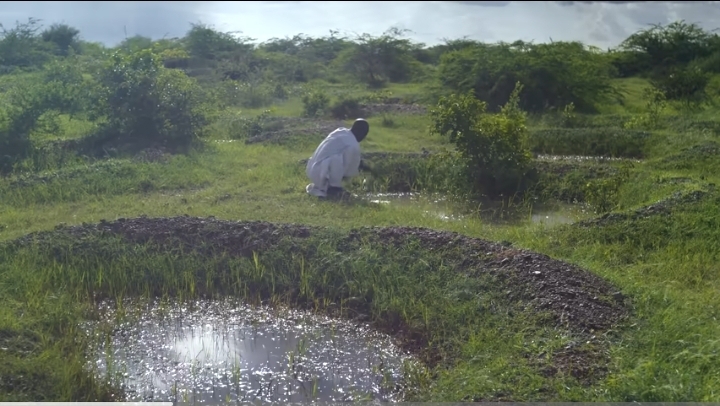
Water-retention half-moons, scientifically validated over thirty years by pioneering hydrologists like Michal Kravčík and successfully implemented by NGOs across Africa, are particularly suitable for this goal.
The operational capacity exists for large-scale deployment. Cosider, leveraging its logistics, machinery, and experience with the railway project, has the workforce, equipment, and field bases needed for excavation and light earthworks over a corridor exceeding 1,000 km. This workload plan could reconcile strategic infrastructure with ecological restoration while showcasing proven national expertise.
Pastures and livestock: towards strengthened food sovereignty
This greening process goes beyond soil stabilization and water-cycle improvement. It also allows for the reconstitution of natural pastures, essential for reviving camel herding and extensive sheep grazing, historically adapted to Saharan and pre-Saharan territories.
Restoring these pastoral areas reconnects livestock to local resources — soil, vegetation, and water — gradually reducing dependence on meat imports. Ultimately, this approach contributes to national food security, even during high-demand periods such as religious festivals, while fostering a sustainable pastoral economy that generates local income.
A concrete plan in two axes: from mining corridor to corridor of life
1. Hydrate the route, regenerate the soil: Excavate millions of half-moons (5 m diameter, 60 cm depth) perpendicular to water flows along the railway corridor. These basins will capture water, protect the track from floods, hydrate the soil, and enable pioneer vegetation to grow. Through evapotranspiration, this vegetation will generate atmospheric moisture, triggering a virtuous cycle of micro-rains.
2. Plant the future: In these water-filled basins, plant trees perfectly suited to arid conditions: argan, tamarisk, acacia, pistachio, fenugreek… These plantations will revive pastoralism, create new economic sectors, and stabilize the soil.
Revitalize the existing: oases as the starting point
Why build a new ecosystem when millennia-old ones are dying from neglect? The real starting point is revitalizing the existing oases along the Oued Saoura, hydro-agricultural masterpieces today threatened by wastewater discharge.
The first step is to reconnect the palmeries via a continuous route and restore their water supply. From Beni Ounif to Gsabi, passing through Taghit and Igli, along Oued Zouzfana and then Oued Saoura, the principle is the same: retain water. The same logic applies to Oued Guir and Daoura, all at risk of drying out.
A network of small perpendicular dams will slow floods, encourage infiltration, and recharge aquifers. This soft-retention approach should also guide protection of urban areas like Béchar against floods, far more efficiently than costly post-disaster repairs.
In complement to the agricultural projects initiated by the State over the past 20 years — where each farm had its well and basin — every farm should now have rainwater retention measures integrated on site.
A civilizational project reconciling time and territory
This plan is more than a technical intervention; it is a civilizational project, harmonizing temporalities and territories:
Short-term economic: The State can invest part of the mine’s revenue into regeneration over its lifetime.
Medium-term social: Thousands of low-skilled jobs are created in excavation, planting, and maintenance.
Long-term ecological and economic: Reduced meat and milk imports, new wealth through medicinal plants, and revived pastoralism.
It is also a matter of reconciliation. This region has endured, even after independence, nuclear and biological testing. Its residents, resilient guardians of desert life, bequeathed oases and traditional knowledge. Each palmerie must become a station on the train of regeneration — connecting communities, reactivating craftsmanship, and offering hope for self-sufficiency.
Choosing territorial intelligence
The overconfidence of modernity has resulted in endless drilling and wastewater discharge into these palmeries. Wisdom today lies in the small and the multiple: tiny dams, small half-moons, simple measures replicated millions of times.
Ignoring this path condemns the Southwest to dependency and costly disasters. Embracing it turns the territory into a living sponge, where every drop counts to make the desert green again.
Green Peace with the Sahara is not a dream. It is a concrete, pragmatic, and profoundly human plan, placing water, life, and territorial intelligence at the center of development. The Train of Regeneration is at the station — it only awaits political will to depart.
Pragmatic vision
Phasing:
Year 1: phase across 50 km of the railway corridor to demonstrate effectiveness, leveraging Cosider’s capabilities.
Years 2–5: Gradual deployment across the corridor’s width.
Years 5–10: Expansion to the entire region, with new economic sectors.
Benefits for all:
State: Protects mining and railway investments, reduces emergency costs (floods, imports), and demonstrates integrated, visionary development.
Population: Immediate local employment, village revitalization, pastoral revival, improved living conditions.
Environment: Concrete fight against desertification, soil restoration, reactivated water cycle, microclimate creation.
Economy: Diversification beyond extractives, export of medicinal plants, reduced food dependency.
A promising future:
Short-term (0–3 years): Jobs in earthworks and planting; first signs of vegetation.
Medium-term (3–10 years): Reduced agricultural imports, emergence of new economic sectors, gradual aquifer recharge.
Long-term (10+ years): Revitalized oases, food autonomy, a green, resilient, prosperous Southwest.
Our message
The Train of Regeneration is not a utopia. It is a realistic, actionable plan funded by local resources and driven by proven national expertise.
The advantages are clear:
- Logistics already in place
- Evident needs
- Proven techniques
- Available workforce
- Strategic timing
What remains is political will to launch the first phase.
This project embodies a new approach to development: not “extract and leave,” but “invest and regenerate.” It promises Green Peace in our Sahara, a fertile, prosperous South, and a future for the next generation.
ZNetwork is funded solely through the generosity of its readers.
Donate