
Before arriving at UMass Amherst last fall, Chancellor Javier Reyes was already notorious for his cavalier approach to critics. But few foresaw what he did on May 7.
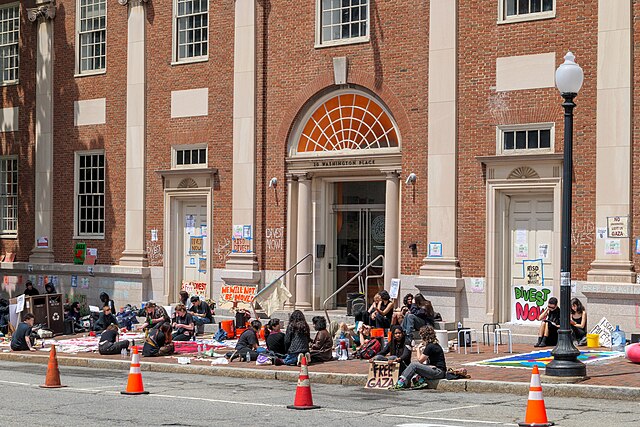
Earlier that day, organizers from a coalition of campus solidarity groups had erected tents on a small section of the lawn by W.E.B. Du Bois Library. Like virtually all the recent encampments in this country, there was no hint of violence from the campers.
It was the latest tactic in a seven-month campaign to end UMass’s complicity with the US-Israeli war on Gaza. The organizers had four demands: that UMass disclose its financial ties to weapons makers and corporations with links to Israel, that it divest from those corporations, that it end study abroad programs in Israel, and that it drop all charges and sanctions against the students arrested in a peaceful building occupation last October.
Instead, Chancellor Reyes summoned the police, citing an alleged threat to campus safety. As the sun went down, UMass PD and State Police in riot helmets began arresting faculty, students, alums, and community supporters. By 1 AM, they had arrested 134 people. Journalists counted 117 police vehicles.
Faculty members in orange vests were arrested first. Then the gloves came off. Numerous arrestees were held prone on the ground and zip-cuffed. Many protesters standing nearby were also arrested. Police reportedly covered up their badges. Videos show armored police tackling unarmed people, kneeling on prone arrestees, attacking video journalists, and charging into groups of protesters.
One graduate student I know was thrown to the ground and a police officer “landed with full force on my lower back, which caused me to lose my breath.” The officer got up briefly but then “came back and stomped on my back.” After the arrest, the student was zip-cuffed and kept in an airless police wagon for three hours, then taken to the campus hockey arena all night, where he was denied access to water “until eight or nine hours in.” When “we told the officer our zip ties were too tight and we were in pain and losing circulation,” the officer replied that “we should have thought about the consequences beforehand.”
The five biggest campus unions condemned the repression. The Student Government Association and graduate workers’ union, followed by faculties and librarians, all issued votes of no-confidence in Chancellor Reyes. Commencement speaker Colson Whitehead withdrew in protest.
Meanwhile, the higher-ups doubled down. Reyes claimed that “involving law enforcement [had been] the absolute last resort,” given that students had “rejected” his offers and had engaged in “confrontations and outright violations of university policy and the law.” He later told the Faculty Senate that deploying police was simply “something we had to do.”
UMass system President Marty Meehan and board of trustees chair Stephen Karam likewise claimed, in nearly identical statements, that “Chancellor Reyes and his team have engaged in good faith discussions, offered meaningful paths to a resolution, and done everything within their power to engage sincerely and protect students’ rights to free speech.” The state’s Democratic governor Maura Healey implied that the protesters were violent and antisemitic, saying that “there’s no place for hate or for violence or threats of violence on our college campuses.”
None of these officials provided any evidence for their claims. As one reporter noted on May 9, “UMass has not pointed to any incidents of violence among the protesters or specific threats that warranted involving law enforcement.”
Attorney Rachel Weber, who teaches part-time at UMass and belongs to Jewish Voice for Peace, has witnessed the administration’s repression of protesters all year. Students “have been stonewalled, vilified, betrayed, and punished by the administration since October for demanding that their tuition money not be spent on genocide. Their arguments have been well-researched and well-articulated.”
Administrators’ arguments, not so much. They’ve followed what Weber calls a “decades-old playbook about how to discredit dissent”—and not a very sophisticated playbook at that. One strategy is blaming so-called outside agitators. Yet on May 7 “the only outside agitators, the only violent actors, were the police.”
As a faculty witness to the May 7 negotiations meeting between students and administrators, I am in a position to counter some of the administrators’ public claims about that day.
Two of their lies are particularly egregious. First is that calling the police was the “last resort.” Reyes had already ordered police to begin amassing near the encampment when he entered the negotiations around 4:30 PM—not exactly a good-faith gesture. When student negotiators cited examples of campuses where leaders have negotiated with students in good faith or at least declined to order their arrest, Reyes and his team dodged.
Reyes’s claim in the meeting that “there’s nothing that I can do” to meet student demands is also a lie. Although the chancellor cannot simply decree divestment, he could advocate for it publicly, and he could unilaterally fulfill many of the students’ other demands. When pressed to advocate for divestment, he finally admitted he just didn’t want to, because it would upset some people.
On that last point, at least, he was correct. And that’s the deeper problem. Javier Reyes is particularly unsavory, but he also reflects a systemic sickness in higher education. As public universities are defunded, they increasingly cater to wealthy donors, corporations, and the Pentagon. Financial dependency on those entities necessitates autocratic governance; democracy could upset the sponsors. At UMass Amherst, 73 percent of undergraduate student voters support divestment. Suppressing such impulses requires that university boards be stacked with plutocrats, who naturally prefer administrators like Reyes.
UMass student organizers insist on holding Chancellor Reyes accountable, but they also realize he’s a tool of bigger forces. The profound anti-Palestinian racism of most university leaders is but one symptom of authoritarian governance. Whether our aim is confronting war profiteers, ending campus carbon emissions, or cutting financial ties to polluters, we’d have a much easier time winning if we had a democratic university governance structure accountable to students, workers, and the public. That’s true at higher levels too: If either the United States or the United Nations functioned democratically, both the slaughter in Gaza and the underlying Israeli occupation would have ended long ago.
Democracy is the only genuine threat posed by the encampments.
ZNetwork is funded solely through the generosity of its readers.
Donate