
Source: Red Pepper

Photo by Tinxi/Shutterstock.com
Modern military games have long blurred the line between jingoistic fiction and violent, cinematic realism. Public response has typically fluctuated between huge sales and vocal outrage.
Last year, the latest instalment of Activision’s popular first-person shooter, Call of Duty: Modern Warfare, came under fire for attributing US war crimes in the Middle East to Russia. Activision said the game is ultimately set in a fictional country. Despite receiving terrible reviews and a backlash among Russian gamers, Modern Warfare topped $600 million in global sales in its first three days on shelves. The franchise’s overall sales have now surpassed the box office earnings of Disney’s Marvel Cinematic Universe, and doubled that of Star Wars, two of the most profitable film series ever made. Similar military title such as Halo, Gears of War and Counterstrike also regularly top the charts.
For anyone critical of the military-industrial complex, the global popularity of military games may seem alarming. It may also seem expected: video games have long been popularly constructed as ‘low culture’ forms of entertainment and gamer communities as purveyors of toxic masculinity who enjoy ‘shoot-‘em up’ style action.
These stereotypes have led us to overlook the immense social and political power of video games, enabling military institutions to quietly build on this knowledge for decades. Today, this multibillion-dollar ‘military-entertainment complex‘, a term coined by science fiction writer Bruce Sterling, operates in nuanced and often contradictory ways.
The military-entertainment complex
In the US, the military has always been a key driving force of research and development for new technologies, especially in times of conflict. According to Corey Mead, author of War Play, ‘Without the largesse of such agencies as DARPA [Defences Advanced Research Project Agency], the technological foundation on which the commercial game industry rests would not exist’. DARPA was created during the cold war in direct response to the Soviet Union’s Sputnik satellite. Capturing the space race zeitgeist, the first-ever video game release was the military simulation Spacewar!, developed by a group of Pentagon-funded MIT engineers in 1962.
The relationship between the video game industry and the military has been synergistic from the outset. It was a US defence contractor that developed the first commercially viable console, the Magnavox Odyssey, in 1972 as a military training tool. It came equipped with a ‘light gun’ players could fire at the TV screen.
Gaming is entrenched in every aspect of modern warfare – from recruitment and training to combat and post-trauma therapy
Digital games were soon seen by the military as a potentially low-cost way to train recruits. When arcade giant Atari released the 3D game Battlezone in 1980, the army jumped at the chance to have it modified for the purposes of tactical training. A decade later, the US marine corps commissioned Marine Doom, a spin on an iconic and wildly popular 1994 sci-fi game. While neither Battlezone nor Marine Doom were ultimately used to train soldiers, digital combat simulators have been employed – and deemed ‘successful’ – since the first Gulf war.
The games industry has followed in the footsteps of Hollywood in terms of quid pro quo military cooperation. The Oscar-winning 1927 film Wings, for example, was largely produced and funded by the US government. By the 1960s, Walt Disney was making propaganda films for every branch of the military.
To build even stronger partnerships with entertainment and academia, the army founded the Institute for Creative Technologies in 1999 at the University of Southern California. Into the 2000s, the CIA ‘worked with’ the scriptwriter of Zero Dark Thirty and the US Navy was listed ‘producer’ on four 2012 big-budget releases. Such synergy means reduced production budgets for studios, including low-cost access to military locations and high-end technology. In return, the military can inject pro-war and pro-nationalist framings into scripts.
Modern gaming for modern warfare
Decades of robust military-entertainment complex building have ensured that gaming today is entrenched in every aspect of modern warfare – from recruitment to combat and post-trauma therapy. In 2018, following rapidly declining enlistment numbers, the US Army announced that it would enter an official team into ‘esports’ competitive gaming industry events. According to Business Insider, esports is projected to become a $1.5 billion industry by 2023. Already, online streaming platforms such as Twitch and Mixer host tens of thousands of gaming broadcasts daily and run competitions offering multimillion-dollar prizes.
More than 6,500 soldiers applied to join the US Army team, now competing in top gaming circuits for titles such as Overwatch, Fortnite and Call of Duty. The team was explicitly intended to help ‘make our soldiers more visible and relatable to today’s youth’. Recruitment officers accompany the team at all events.
The British Army has also attempted to capitalise on gamer culture. Last year, a controversial advertising campaign developed by private contractor Capita encouraged ‘snowflakes’, ‘binge gamers’ and ‘phone zombies’ to join their ranks. To the outrage of many parents, the army also packaged a 66-page military magazine called The Locker as a free add-on to the PlayStation magazine February 2019 issue. The issue announced: ‘Unlock Your Game Glow: Why the army loves your non-stop button-mashing skills’. Despite ‘going viral’ for the wrong reasons, Capita touted the campaign as a success.
There is little evidence that such on-the-nose marketing actually works on gamers, however. More successful recruitment efforts have come from military games that have developed cult followings over the long term. For example, in the early 2000s, on the heels of 9/11 and the ‘war on terror’, the US military ramped up production of training simulators in collaboration with game developers. Now, hundreds are commercially available for public download, teaching casual gamers and soldiers alike how to drive a tank or pilot an aircraft.
Some titles are directly funded by the US government. The first-person shooter America’s Army, released in 2002, is one of the most popular. Developed for training, the army chose to make it available for free public download to give potential recruits ‘a taste of things to come in basic training’, according to US army captain and recruitment officer Brian Stanley.
The game periodically receives public, academic and veterans’ backlash, as it continues to be displayed regularly at recruitment events. In 2007, for example, 90 members of Iraq Veterans Against the War protested against recruiters using the game to target black youth at a major career expo in Missouri.
The UK released its own commercial recruitment game in 2009, Start Thinking Soldier. The Advertising Standards Agency soon received complaints that the game ‘makes war look like a video game’ and was therefore ‘misleading’. The ASA disagreed, and chose not to investigate the campaign.
Yet franchises like Call of Duty invest significant resources to make war games look ‘real’, even when the storylines are implausible. Publishers frequently pay licensing fees to gun manufacturers to replicate specific weapons, and military veterans often advise on games as consultants to ensure authenticity. ‘The result is that every gun, vehicle and aircraft in the game has a basis in current weapons research,’ says the Guardian’s Keith Stuart. In turn, figures such as Dave Anthony, writer and producer on Call of Duty, advise the US government on ‘the future of warfare’.
Laying the groundwork
Despite aiming to be seen as unerringly real, these games do not replicate combat situations or teach players how to shoot real weapons. Instead, they lay the groundwork for understanding military logistics. As Captain Stanley told Ars Technica in 2008: ‘Kids know more about the army than we do… And a lot of that knowledge comes from video games.’
Game hardware similarly bridges real and virtual worlds. Gamepads like Nintendo’s Wiimote and Microsoft’s Xbox 360 Controller have been used by the US and British militaries to pilot drones and operate mobile robots used for bomb disposal since at least 2008. It makes sense: the technology is already commercially available and proven – following extensive testing by gaming companies – to be intuitive. In fact, people are now so accustomed to gaming architecture that most can learn to fly a drone in a surveillance mission (and not crash) in three minutes using a simple iPhone app, according to studies conducted by MIT associate professor Mary Cummings.
It was a US defence contractor that developed the first commercially viable gaming console, the Magavox Odyssey, in 1972 as a military training tool
No matter how gamified, war has real material consequences that resound beyond battlefields and combat zones. As historian Nick Turse has argued, the use of drones – and remote-controlled combat in general – distances combat from the public psyche and makes it more palatable, allowing for an ‘astonishing number of simultaneous wars’ to rage on at immense human cost.
For soldiers, that reality can mean suicide, disability and post-traumatic stress disorder (PTSD). Since the 1990s, researchers have experimented with virtual reality (VR) headsets combined with therapy to address PTSD among war veterans, with one programme dubbed ‘Virtual Vietnam’. More recently, psychologist Skip Rizzo, based at the Institute for Creative Studies, founded Virtual Iraq, which runs off a modified version of the commercial game Full Spectrum Warrior.
Although a number of independent studies have shown VR to be effective in treating PTSD, professor John Derby, of the University of Kansas, notes that Rizzo’s reports adopt an alarming position: that treating PTSD quickly and cheaply through VR could help soldiers be redeployed faster. Aside from the irony of military games being used to treat the impacts of war as well as to recruit and train soldiers in the first place, profit-making and cost-savings occur at both ends of the exchange.
Active heroes
By gamifying, simplifying and normalising war, video games allow the myth of US and by extension western military exceptionalism to thrive in the public imagination. It is not coincidental that since 9/11 there has been a boom in military first-person shooters invested in heroic and immersive journeys such as Call of Duty: Modern Warfare, which takes place ‘across Europe and the Middle East in order to stop the full-scale global war’.
Matthew Payne, author of Playing War: Military Video Games after 9/11, argues that military games assuage national anxieties and offer players a sense of control over ideological conflicts that seem unwieldy or unwinnable. ‘War films ask you to watch the combat on screen; war games ask you to play with the combat on screen,’ Payne explains. Players are thus transformed from passive bystanders in a national crisis into active heroes in the ‘war on terror’, leading the good guys (the west) and taking down the bad ones (Russia, the Middle East, ‘alien invaders’).
These ideological framings also work in domestically-oriented games. In Battlefield: Hardline, released shortly after Michael Brown was murdered by a police officer in Ferguson, kick-starting the Black Lives Matter movement, the good guys are militarised police officers fighting the ‘war on drugs’.
There is a global investment in these narratives, just as war is a global enterprise. In 2001, the Syrian game publisher Dar al-Fikr released first-person shooter Under Ash to challenge the portrayal of Arabs in western video games, while positioning Palestinians as the ‘good guy’ freedom fighters against the Israeli Defence Forces. In 2011, the Chinese government published Glorious Mission, a Call of Duty-style game with the enemy soldiers dressed in US military garb. These games offer only an illusion of choice, however. There is seemingly little appetite – or option – to stray beyond ‘us versus them’ storylines.
In 2010, for example, Medal of Honour announced that players would be able to control Taliban fighters in a modern-day Afghanistan-setting. The British military objected and then-defence secretary Liam Fox called on stores to ban the game. Even Full Spectrum Warrior, a game intended for military training purposes, was redesigned from its original east European setting after 9/11 and the invasion of Iraq, so that it had a ‘Middle East aesthetic’. The enemies are interchangeable; the heroes must remain the same.
Mainstream military games, which allow people to play war, are not equitable with the real-life atrocity of war. Neither are the links between military campaigns and the video game industry simplistic: they are deeply intertwined with profit-making and ideological rewards. At a time when xenophobia and far-right nationalism are on the rise globally, the moral doublespeak of games like Call of Duty make it simultaneously easier to dehumanise others while distancing us from very real battlefields.
Marzena Zukowska is a writer, organiser and researcher based in London. Follow her on Twitter @marzenazukowska
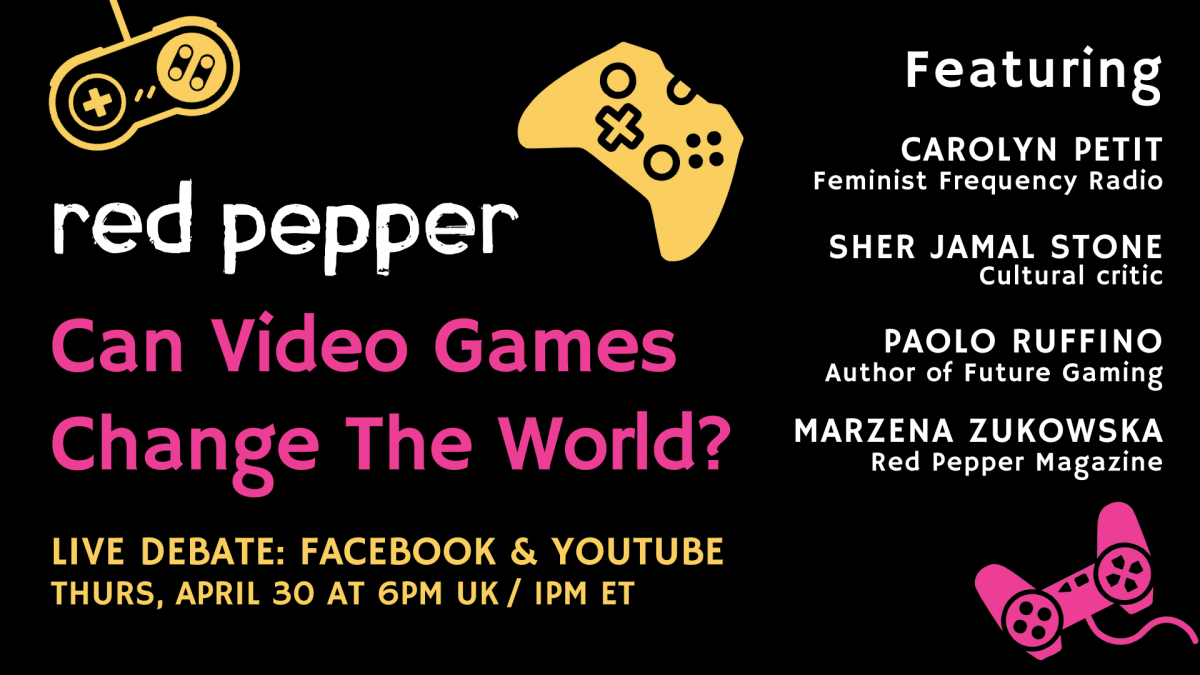
Join the series’ authors on April 30, 6pm, for a Lockdown Live debate: ‘Can Video Games Change the World?’ Streaming on Facebook and YouTube
ZNetwork is funded solely through the generosity of its readers.
Donate