
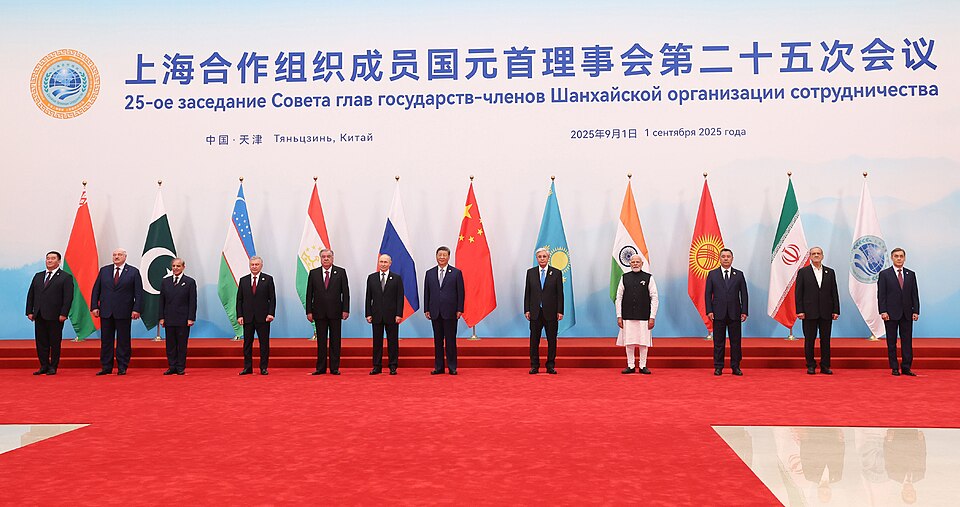
The recent Shanghai Cooperation Organization summit in Beijing, framed by a military parade and bold declarations of solidarity, was widely interpreted as a sign of China’s ascent and America’s decline. Much of the mainstream commentary fell into a familiar binary: the old hegemon losing power, a new one preparing to take its place. But this way of seeing the world reduces history to a game among elites, where ordinary people are spectators rather than participants. For those of us committed to justice and solidarity, the real question raised by the SCO summit is not whether Washington or Beijing dominates tomorrow. It is whether multipolarity can open space for peoples of the Global South to claim agency, or whether it will merely reproduce hierarchies under new banners.
For decades, the global financial system has been an arm of Western power. The IMF and World Bank imposed neoliberal “reforms” that privatized public goods, eroded social protections, and deepened dependency. The U.S. dollar became a weapon of coercion, allowing Washington to cut entire countries off from the global economy with the stroke of a sanction. From Cuba and Venezuela to Iran and Zimbabwe, millions have suffered because finance was subordinated to imperial geopolitics. This system was not about free markets or democracy; it was about control.
The SCO summit pointed toward resistance to that control. Proposals for an SCO Development Bank, calls to expand trade in local currencies, and coordination with BRICS initiatives all reflect a determination to erode Western financial monopoly. In theory, these initiatives could help countries borrow without surrendering sovereignty, trade without sanctions strangling them, and invest in infrastructure without austerity dictated from Washington. For many in the Global South, the very possibility of choice is already a breakthrough.
But here is where caution is required. Multipolarity is not automatically liberation. China and Russia are not altruistic actors; they pursue their interests with the same determination as the United States. Chinese infrastructure projects have brought roads and ports to Africa, but also fears of debt dependency and labor exploitation. Russia’s military presence in parts of Africa has raised questions of sovereignty and accountability. If multipolarity is reduced to the shifting balance of power among states, the lived experience of ordinary people may not change. Hierarchies can be reproduced under different flags.
What would make multipolarity transformative is the active role of people themselves. If governments in Africa, Asia, and Latin America use the cracks in Western dominance to demand fairer terms, strengthen regional cooperation, and prioritize social development, then multipolarity can be a tool of justice. But if elites use it merely to align with new patrons while maintaining their own privileges, then little will change. The SCO summit was not only a test of geopolitical will; it was a reminder of the stakes of people’s agency.
The United States is right to fear the decline of its unipolar moment, but the problem is not that multipolarity is dangerous. The problem is that Washington has relied on coercion rather than cooperation for too long. The overuse of sanctions, the imposition of neoliberal dogma, and endless military interventions have delegitimized its claims of leadership. If alternatives are now emerging, it is because the Global South has been pushed to the edge. Yet progressives should be equally wary of celebrating a “Chinese century” or a “Russian comeback.” We do not need a new hegemon. We need a system in which no single power dominates, and in which people, not elites, set the priorities.
This is why movements from below matter. Trade unions, grassroots organizations, and social movements in the Global South must see multipolarity as a battlefield, not a finished solution. They must pressure their governments to ensure that new financial institutions are transparent, democratic, and accountable. They must demand that economic cooperation is directed toward health, education, climate adaptation, and equitable development, not simply elite enrichment or geopolitical gamesmanship. Without this pressure, multipolarity risks becoming another chapter in the long history of dependency.
The SCO summit in Beijing will be remembered by some for its missiles and pageantry. But what should matter most to us is the reminder that unipolarity is cracking, and that history remains open. The task before us is to prevent multipolarity from becoming a competition among oligarchs and to make it an opportunity for people to claim their rights. The end of unipolarity is not liberation by itself. Liberation will come only if ordinary people force states, East and West alike, to put justice before domination.
ZNetwork is funded solely through the generosity of its readers.
Donate