
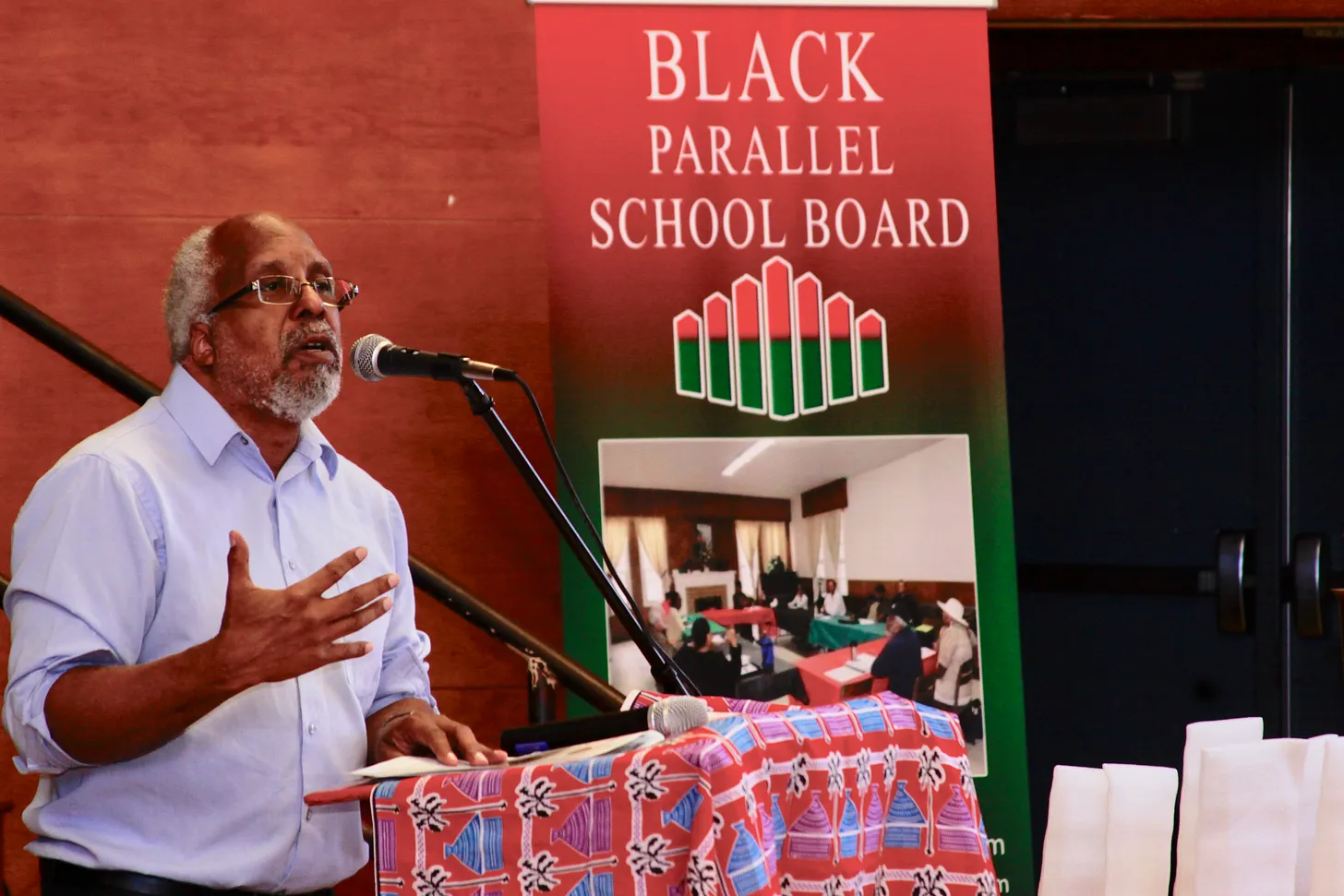
For nearly two decades, organizers in Sacramento have centered Black self-determination, community-based advocacy, and working-class parent empowerment to fight for a 21st-century multiracial learning community and a socialist vision for education.
In Sacramento, California, unless you were in the teachers’ union, education for many years was a graveyard for social justice activism. There have been many attempts to sustain a long-term struggle for education justice, but until recently all have been short-lived or co-opted. This is a story of community activists, organizers, and parents fighting for educational justice in Sacramento.
A short history of educational opportunities for African-descended peoples in the city of Sacramento begins in October 1854, when the Sacramento City Council created the Sacramento City School Board. When the School District was first created, it refused to admit Black students. It admitted them only after the Black community had established its own school for Black children. However, the community’s struggle for educational justice was long and arduous.
The Black Parallel School Board was born out of Sacramento State professor Otis Scott’s frustration with the quality of Black students’ education. At a Sacramento Area Black Caucus meeting in 2006, he forcefully expressed the severity of the problem and the need for Black people to address it, because the gap had been widely known for decades and was getting worse rather than better.
On June 14, 2007, the Sacramento Area Black Caucus and Councilwoman Lauren Hammond hosted a community forum on the State of Black Students’ Education. Many parents spoke of not being allowed to talk for more than two minutes at a Board meeting. No Board trustee responded to their concern, and the district provided no follow-up. For many parents, district meetings were disrespectful and hurtful. Organizers listened to the feedback, and one of the recommendations added to the report was for the Black community to establish a parallel school board targeting the Sacramento City Unified School District. In February 2008, the organizers founded the Sacramento Black Parallel School Board (BPSB).
The ideals of a parallel school board and the Black community’s right to self-determination were not new. In 1969, the Oakland Black Caucus, a coalition consisting of the NAACP, the Urban League, Black churches, a radical neighborhood-based group, and the Black Panther Party demanded input in the selection of a new superintendent for the Oakland District. However, they were locked out of the process. It became a central issue that many community groups could organize around. As a result, the Black Caucus proposed the “creation of an alternative educational regime—a people’s system,” and they established a parallel school board. They were highly structured with various educational departments. They successfully identified a superintendent and obtained district approval; however, that parallel school board didn’t survive afterward.
BPSB Approach to Serving Black Students and the Black Community
We at BPSB, as organizers, learned from past failures and were determined not to repeat them. Therefore we determined that:
- BPSB would be a community-based advocacy organization, not a service-oriented organization. It would work in parallel with the Sacramento City Unified School District–not take on district responsibilities–and would demand that the district support education equity.
- The organization would be broad-based, including teachers, parents, former superintendents, former principals, and community organizers. However, organizers and parents are the foundations of the organization.
- Also, the organizers would work to ensure that parents are not tokenized or singled out by districts, either by hiring BPSB’s own people or by acknowledging specific individuals.
- The organization would be grounded not as a 501(c)(3) nonprofit organization but as a grassroots activist formation.
BPSB aims to demonstrate how a parent- and community-controlled school board should function. The meetings are held monthly for the community to attend and speak for more than two minutes, and have someone to support them and their children. The meetings are open to anyone attending, but to participate as members of BPSB, individuals must take an oath:
“I, as a person of African Descent, hereby will promote the highest quality of education for children of African Descent. I will treat other members of the Black Parallel School Board with the respect due all very important people. I will also serve the African American Community with the highest honor and respect.”
The community has the power to make motions, the right to participate in voting, and the authority to make decisions for the Board. The Executive Council members are elected and required to implement the Board’s decisions. The Executive Council is a working body and reflects the diversity of community members and parents. BPSB wanted to change the power relationship between Board members and community members, not just make decisions, but also organize, educate, and fight for a 21st-century multicultural learning community.
BPSB is not a campaign-driven, single-issue, or limited-life organization. BPSB provides a space for parents and the community to present their concerns and gain a better understanding of the education system and its processes. It empowers parents, fights for educational justice, and works to close the opportunity gap. Parents are trained and engage in organizing. After the regular monthly session, the organization usually holds learning sessions on topics requested by parents. Some topics have included parental rights in the school system, how to ensure your child gets the services outlined in their individualized education program, how to read a school budget, what a school board does, and a parent’s role on a school site council. Board members and parent advocates help parents file complaints and accompany them to meetings with teachers and school administrators, often regarding individualized education programs or disciplinary actions. Members prepare parents for the meetings, explaining the educational terms and acronyms they might hear. The members also work with parents to ensure that the meeting is productive and that communication doesn’t break down.
There have been many requests for the Black Parallel School Board to take on issues in other school districts, and occasionally it does so when the problem is big enough. But the organization prefers to keep its focus on Sacramento City Unified, while helping to train and encourage parents in other communities to start their own organizations. Six years ago, they did just this for the Black parents of Merced, who established their own Merced Black Parallel School Board, and for the Latino Parallel School Board in Sacramento.
One of BPSB’s successes has been the adoption of ethnic studies as a graduation requirement. Also, in 2020, BPSB, in coalition with students, parents, the teachers’ union, and community organizations, led the fight to end the district’s discriminatory practice of policing. The school district terminated its contract with law enforcement and instituted the BPSB’s Reimagine School Safety Plan. BPSB developed this plan by drawing on the Oakland Unified School District’s Black Organizing Project’s George Floyd Safety Plan, and collaborating with Northern California Legal Services, Brown Issues, Sacramento Area Congregations Together, and the Sacramento City Teachers Union.
Lessons for Socialists in Education Justice
A key lesson for socialists active in this work is the importance of a two-tactic Leninist approach to education justice work—that is, elevating both the demand for a 21st-century multiracial education learning community and a vision for socialist liberatory education.
In the beginning, our demands for change were limited. We focused solely on closing the opportunity gap for Black students, but we lacked vision. Over time, the district would make concessions on particular items, but the community wanted to know why things didn’t change. We had to ground people with a vision of what a genuine public education should be, and the knowledge that the journey to it would require a fight for reform.
Socialists fully understand that the liberation of the working class and oppressed people for socialist liberatory education can only happen when the working class is conscious, organized, trained, and educated in an open struggle with the bourgeoisie. However, we don’t have a socialist movement in existence. In the current reactionary period, the neofascists (neo-confederates) are attempting the total dismantling of the public education that was built in the First (post-Civil War) and Second (Civil Rights) Reconstruction periods. Thus, socialists in this moment need to demand a 21st-century learning community (a Third Reconstruction education) in which an equitable education system equips all students. In other words, as scientific socialists, we use tactics that promote both reform and a socialist vision. We fight with both eyes open, one for our vision–when a new education system is constructed through people power–and the other for the current fight for the 21st-century education system.
Second, BPSB practice is grounded in the notion that only parents, teachers, and the community can bring about change–what Mao Tse-tung called the “mass line,” and what Ella Baker used as an organizing model for SNCC in the 1960s. BPSB works to build mass-based formations using a broad united front. We organize, build, and support entities in the community, civic organizations, social formations, cultural formations, and, if necessary, nationwide. Most importantly, we bring working-class politics to the struggle (mass work through mass lines), educate on the limits of reform, and bring socialist politics and analysis to parents, teachers, and community members.
Third, BPSB’s strategy is to build parent power by empowering parents with the knowledge and tools to address educational injustices in the district. We want parents and caregivers to lead in the BPSB Executive Council and District School Site Councils, Parent Advisory Committees, and School Boards. As scientific socialists, we seek to build a multiracial coalition that includes teachers and community members. Historically, districts have continued to divide parents and teachers along racial lines.
Fourth, socialists within educational justice bring a class analysis and practice to parents and teachers. We host forums and discussions on the connections between educational injustices and racial capitalism. BPSB also worked to move many of our local teachers’ unions from business unionism to social justice unionism, which respects parents and incorporates their voices in the struggle. We expanded the struggle from simply a teacher union struggle to a mass struggle.
Fifth, the left has worked in these mass-based formations for many years as individuals, struggling against the non-profit industrial complex mentality. Socialists could raise questions, but we know this would be a long and challenging dialectical process of theory and practice for key people in this work. BPSB had to struggle against the neoliberal charter movement, the test mentality, and the attack on parents.
In pushing back against the charter movement, BPSB found that a distinct Black voice was critical, as was drawing on elders to speak to the historical fight for public education (such as an activist professor and a former superintendent raised by coal-miner parents). BPSB did not stop the launch of one charter school; learning from this experience, the organizers felt that the teachers’ union should lead the struggle against charter schools. At the same time, the community would undertake a mass education effort. BPSB also requested that charter organizers attend our community meeting, and we demanded that, if they wanted a charter, they would have union teachers, accountable to community oversight, and open to all students. We wanted to give people tools to ask the right questions. Parents and students from the charter schools also came to testify about their experiences.
Lastly, we understand that petty bourgeois forces within the oppressed nationalities often advocate for justice but constantly seek to appease the institutionalists of bourgeois education. Although they are not the principal force to struggle against, these forces sometimes undermine our struggle and divide the mass base by gender and race. For example, BPSB struggled with some narrow nationalists who disparaged Latinos and eventually left the organization. Some members wanted us to be a 501(c)(3) that would provide a full-time staff and be under the influence of philanthropy; some pushed us to stop being a radical activist organization and become good partners to the district. We also had members who thought women should not lead the organization, but just take notes. This is a constant battle in the education justice movement, where men seek media attention or recognition within the power structure.
Through these struggles, the left in BPSB now understands that we need a long-term strategy for building an education justice movement that is wide, deep, and led by the working class.
ZNetwork is funded solely through the generosity of its readers.
Donate