
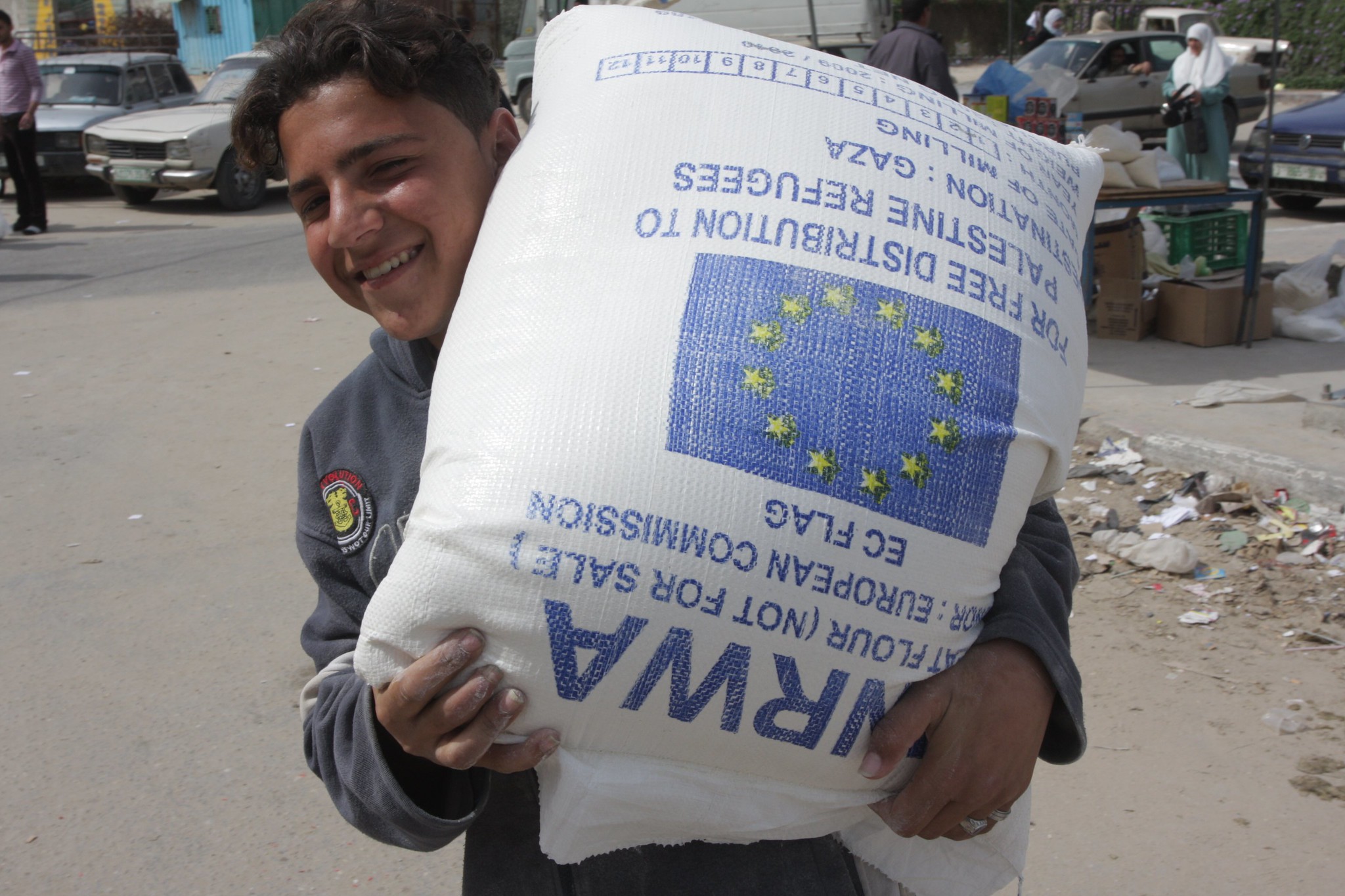
The fate of the UN agency responsible for providing relief to Palestinian refugees (UNRWA) is left uncertain after an Israeli law banning the organization from working in Israel came into effect last week. The law was originally passed in October 2024, giving the agency a three-month ultimatum to vacate its premises and banning any Israeli state worker or official from having any contact with the agency.
The agency evacuated its headquarters in the Palestinian neighborhood of Sheikh Jarrah in occupied East Jerusalem, where Israel has plans to establish an Israeli settlement, but other UNRWA establishments in East Jerusalem, including several schools, a clinic, and a vocational training center, continue to be functional.
UNRWA’s international staff also left the country, while the agency’s Palestinian workers continue to operate in Israel, the West Bank, and in the Gaza Strip, where UNRWA is playing a major role in the entry of humanitarian aid to the impoverished population. It remains unclear how the entry of UNRWA trucks to Gaza has been arranged with Israeli authorities given the ban.
“The visa duration of our international staff has been shortened [by Israel] until today [Thursday, January 29], which is the equivalent of deportation,” Jonathan Fowler, the UNRWA spokesperson, told the media. “This is why I and the rest of our international colleagues who were in Jerusalem today left for Amman.”
“Our compliance with the law stems from the fact that any person working for the UN must have a visa from the authorities of the country they work in. We don’t do our work in violation of the law…and this is the equivalent of declaring us persona non grata,” Fowler said.
“Our local staff, who are the majority of our employees, will not remain in the [original] headquarters because of the danger they might face, especially when there are demonstrations organized by different Israeli movements in East Jerusalem,” he went on.
In May 2024, Israeli extremists set the perimeter of UNRWA’s headquarters in Shiekh Jarrah on fire twice during a demonstration by Israeli settlers against UNRWA.
The banning of UNRWA comes amid Israel’s ongoing military offensive in the northern West Bank, which has escalated to the point of replicating some of the same military tactics Israel has used in Gaza, including the detonation of entire residential blocks and the sowing of mass destruction in refugee camps.
The attack on UNRWA also coincides with Israel’s push to annex the West Bank, with the expected support of the Trump administration. If approved, this would effectively mean that UNRWA’s work in the West Bank would also be banned.
In Gaza, the provision and distribution of humanitarian aid depends largely on UNRWA, which has the required infrastructure, the largest number of workers, and the longest experience in the Palestinian communities in the strip. If the UNRWA ban is upheld in Gaza, it would render the humanitarian stipulations of the current ceasefire agreement between Israel and Hamas impossible to implement.
The expulsion of UNRWA would not only be the removal of an international organization and its activities from Palestine. It would mean targeting a main component of the daily lives of Palestinians, which has been at the heart of the development of their reality for three-quarters of a century, destabilizing these communities and Palestinian society at large.
As old as the Palestinian refugee issue
UNRWA was established in 1949 by a UN General Assembly resolution to provide relief and work opportunities for Palestinian refugees until they are allowed to exercise their right to return. For 76 years, UNRWA has been a part of the lives of millions of Palestinian refugees in five locations: the Gaza Strip, the West Bank, Jordan, Syria, and Lebanon. The evolution of Palestinian refugees’ lives over four generations in Palestinian refugee camps has been deeply marked by UNRWA’s presence.
Luai Abdel Ghaffar, a researcher on UNRWA’s history and a resident of Dheisheh refugee camp in Bethlehem, spoke to Mondoweiss about the organization’s significance for Palestinian refugees.
“I knew UNRWA since my earliest days. I remember the monthly food distribution at the UNRWA center in the camp. People came and formed long lines to receive bags of flour, sugar, and meat. For many, UNRWA provided the only chance to eat regularly,” Abdel Ghaffar recalled. “There was a program for maternity and newborn children, and of course the school, which I attended as a child.”
“The UNRWA refugee card was and continues to be the document that allows people to access UNRWA’s services” he continues. “For the first and second generation of the Nakba, it was their identity card. It was what identified them as Palestinians who have a claim to their homes from which they were expelled. Some old people and those with little education continue to this day to carry their UNRWA card whenever they have to make any administrative procedure, or when they go to receive aid from NGOs that have nothing to do with the UN.”
Abdel Ghaffar explained that when the refugee camps were established right after the Nakba started, UNRWA rented the land where refugees could gather and receive aid and began to build one room for each family in the mid-1950s. “Some families refused to move to the built-up rooms for another ten years because it meant accepting that they weren’t returning soon to their homes,” Abdel Ghaffar said. “Then, after the mid-1970s, people began to build additional floors on top of the UNRWA rooms because the UNRWA-rented space was the only space available for them. That’s why our camps are so crowded today.”
‘The claim that UNRWA teaches radicalism is absurd‘
UNRWA’s place in Palestinian refugees’ lives isn’t limited to housing. Most importantly, UNRWA has provided education for several generations of refugees.
“UNRWA gave me the chance to have an education, and it is the only chance for many young Palestinians to have an education today,” Mahmoud Mubarak, the coordinator of the Refugee Camp Popular Services Committees in the West Bank, and the head of the local committee in Jalazon refugee camp north of Ramallah, told Mondoweiss.
“It was a good education, and it helped me and many of my peers to imagine an opportunity in life, which otherwise we would have never had,” Mubarak said. “When Israel accuses UNRWA of spreading Palestinian radicalism, it shows that they either lie or don’t know what they are talking about.”
Mubarak explained that UNRWA progressively began to become more restrictive of Palestinian national expression, and has always banned Palestinian flags in its schools. “Since the early 1980s, it began to ban patriotic student activities. So the claim that UNRWA teaches radicalism is absurd.”
“In addition to education, UNRWA became the synonym of medicine for refugees,” he added. “Growing up, I remember that the UNRWA health center was always busy with people coming to look for medicine, including mothers with sick children and elderly people. Today, we at the Popular Committees work with UNRWA to assess the need for medicine.”
If UNRWA goes away, ‘the camps will be left alone’
Today, UNRWA’s work in Palestinian camps is not limited to providing services. During the years of the Nakba, Palestinians in the camps developed their own ways of community organizing, and UNRWA developed its experience in working with them, as Mahmoud Mubarak explained.
“In the camps, our Popular Services’ Committees, which are elected bodies, work to develop services for the camp’s population, and we can’t do it without UNRWA,” he stressed. “In every project, we coordinate with the UNRWA local camp administration, whose employees are refugees from the camps, and through them, with UNRWA’s directors. They provide technical support and equipment, and help us find the funds for sewage systems, water reservoirs, streets, and social help.”
Mubarak believes that if UNRWA were to be dissolved, the Palestinian Authority would not be able to take its place. “UNRWA has been working with us for much longer than the PA’s entire period of existence, and the PA doesn’t have the capacity to run the refugee camps, which are much more complicated than a regular municipal unit,” Mubarak explained. “UNRWA works with the community itself, and if it goes away, the camps will be left alone.”
In the West Bank and Gaza, 600,000 children and teenagers attend UNRWA schools, all of them youth from Palestinian refugee camps. “These are youngsters whose only chance to climb out of the reality of refugeehood is education,” Mubarak said.
Beyond education, UNRWA also provides jobs for refugees, employing technicians, teachers, doctors, and other professionals. “Those who deliver UNRWA’s services are refugees themselves,” Mubarak explains. “And yet 40% to 50% of people in the refugee camps are unemployed. Imagine what it would be like if UNRWA goes away, and imagine what the social and political repercussions of that will be.”
A step toward annexation
The banning of UNRWA’s activities goes beyond its immediate effects on the lives of refugees. It has deeper political repercussions that Palestinians believe form the primary motivation for pushing the law.
According to Lubna Shomali, director of the Bethlehem-based Badil Legal Center for Refugee Rights, the real goal of banning UNRWA lies in the blow it can deal to the refugee question.
“The real goal behind banning UNRWA is not only weakening or decimating the refugee camps for what they represent as a living physical remembrance of the Nakba — there is a larger goal: to end the international presence in Palestine,” Shomali told Mondoweiss.
“When UNRWA was established in 1949, another UN body was also established; the UN Conciliation Commission for Palestine (UNCCP),” Shomali added. “Its goal was to ensure the implementation of UN Resolution 181, ruling that Palestinian refugees have the right to return and compensation. That is the legal part of the protection of refugees under International Law, which includes the Right to Return, reparations, property retribution, and the guarantee of non-repetition.”
Shomali explains that UNRWA is in charge of the humanitarian part of protection, including relief, aid, and services. “This is why the Israeli claim that UNRWA prolongs the refugee status and claim of their right of return is false, because that status and that right are separate from UNRWA’s existence.”
“Israel did to the UNCCP what it is doing to UNRWA today,” Shomali highlighted. “It banned it from working in Palestine and cut all ties to it until the UNCCP became a symbolic, non-effective body that is irrelevant. This is a repetition of history.”
But Shomali believes that this time, UNRWA’s liquidation would set a new precedent. Ousting a UN agency of that sice and physical presence would ease the banning of other civil society actors. “It would make the expulsion and banning of other international and Palestinian NGOs much easier, which would be a huge step to full annexation.”
Israel has argued that UNRWA is replaceable by other international and Palestinian organizations. But UNRWA, the UN, the PA, human rights groups, and a large number of UN member states insist that no other body has the expertise, the resources, or the physical presence necessary to replace UNRWA. In his first term, U.S. President Donald Trump cut all funds to UNRWA, causing an economic crisis. In the early aftermath of Israel’s accusations –after October 7 — that UNRWA was infiltrated by Hamas members, several countries cut funds to UNRWA, only to resume them after several independent investigations concluded that the Israeli claims were baseless.
“Cutting funds to UNRWA and giving them instead to other organizations is very dangerous because it would be the continuation of the Israeli effort to eliminate UNRWA through a legal ban,” Shomali pointed out, stressing that countries must oppose the Israeli attempt to eliminate the UN agency by increasing funding to UNRWA and refusing to replace it.
Last week, the UN Security Council held a special session to debate Israel’s ban on UNRWA. The Israeli representative, Dany Danon, repeated Israel’s accusations that UNRWA had breached its obligation of neutrality. UNRWA’s Commissioner General, Philippe Lazzarini, responded in detail, highlighting the agency’s measures to maintain neutrality.
“UNRWA constitutes half the emergency response, with all other entities delivering the other half,” Lazzarini said.
Lazzarini also said that UNRWA has brought in 60% of the food assistance entering Gaza and that its medical staff conducts over 17,000 daily consultations in the Strip, even as the entire health system has been destroyed by Israel.
UNRWA’s staff in Gaza includes over 13,000 employees, constituting the largest international body in Gaza. Since October 7, Israeli strikes have killed 273 UNRWA employees, marking the largest killing of UN staff in any other conflict.
ZNetwork is funded solely through the generosity of its readers.
Donate