
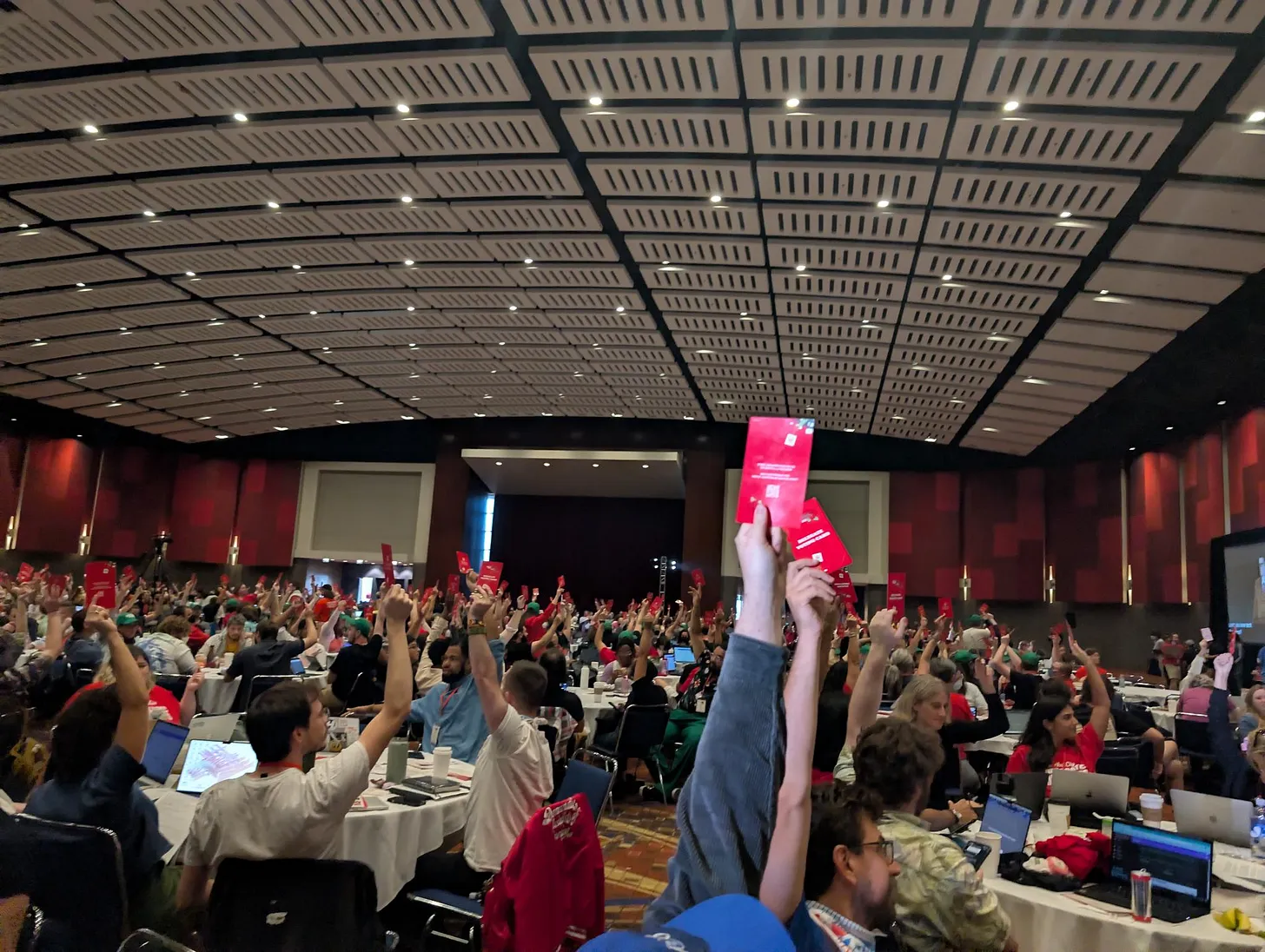
“Can We Meet the Moment?” The question posed by Tom Goodkind in his analysis of the 2025 DSA Convention spurred debate and discussion on the left. To sharpen our collective thinking, The New Liberator has published a series of responses, rejoinders, and hot takes. Here, Kolya Ludwig weighs in with his take on the theoretical questions at stake in this debate.
I am grateful for the rich exchange following Tom Goodkind’s reflections on DSA’s national convention this summer. Many of the key issues in DSA, which are a synecdoche for those of the left in general, have been brought to bear. Perhaps the present confluence of crises makes it possible to see them clearly for the first time.
In what follows, I will argue that the surface conflict between DSA’s mass political and ultraleft tendencies actually conceals an underlying agreement. Although the debate thus far operates at the level of strategy and tactics, it leaves undisturbed the theoretical assumptions shared on both sides. If followed faithfully, these commitments would indeed lead to ultraleftist political conclusions. It is therefore only the healthy instincts of the mass political pole—not its theoretical clarity—that enable its populist sensibilities. But this tendency remains caught in a state of ambivalence, and, if we wish to participate fully in local and national political life, a reappraisal of DSA’s lingering ultraleftism is in order.
Before proceeding with the present argument, it is worth revisiting the basic theses of Goodkind’s original article. He argues (i) that there are two tendential poles in DSA: the mass political pole and the ultraleft pole; (ii) that, if the ultraleft pole seizes a definitive influence over the direction of the organization, it would mark a disaster for it and for the left generally; and (iii) that the mass political pole is not acting resolutely enough to respond to the ultraleft, nor to meet the broader political moment, and that its characteristic missteps were made evident by the way things went at national convention.
Regarding the first point, Jane Slaughter and Connor Wright point out that Goodkind himself has left the definition of “mass politics” somewhat vague. In fact, the two poles identified are not as crystallized as they may appear. They are better understood as limit cases than as really existing political camps wholly committed to a “right” or a “left” position. (The matter of the puzzling R20 amendment, recounted by Goodkind, and the acceptance even among the left of Mamdani’s use of the Democratic ballot line are enough to confirm this.) It is fairly clear, though—and Goodkind spells this out—that what is meant by the mass political pole is more or less embodied in the Groundwork and Socialist Majority caucuses and their periphery. What gives them a mass political orientation? Broadly speaking, it is their engagement with a popular horizon of struggle, on the basis of the present balance of forces. A “horizon” in this case is not a particular reform or demand, but a collective sense of what is politically possible and necessary right now. What typifies an ultraleftist orientation, on the other hand—represented by various smaller caucuses and a broader ideological trend—is a devotion to far more ambitious political horizons, irrespective of their popular resonance, and a political intransigence bordering on moralism—the methodological foil for the DSA right’s realpolitik.
I will not spend time reaffirming Goodkind’s second thesis—that ultraleftist leadership of DSA would effectively sink the organization. Among the sensible Maoists and mature Marxists in this thread, the matter is uncontroversial: a self-imposed marginality is an unacceptable fate. We have seen the dismal returns on leftist phrase-making for a few generations now.
I want instead to elaborate on Goodkind’s third thesis: that the mass political pole in DSA is not living up to its responsibilities. Goodkind chronicles the disappointments at convention: the uncelebrated victories of mass political work, the sidelining of debates and resolutions that could have positioned DSA as a relevant force in fighting the far right, and so on. But what do these missteps really convey? Are they mere accidents—perhaps the effects of an unseasoned cohort of organizers, too removed from the socialist tradition to apply all the right lessons?
I want to argue in the negative. Instead, my diagnosis is that ultraleftism is not confined to a particular tendency, but is rather a pervasive symptom affecting every quarter, and is attributable to commonly held but unviable theoretical assumptions. This sort of deadlock was once referred to as “the crisis of Marxism.” I will not relitigate it here. I will instead focus on what I believe are the most important theoretical obstacles to effective mass political work today: the fuzziness in our distinctions between “the working class” and “the people,” in the first place, and between a “concept” and a “name,” in the second. We will approach these terms after first dealing with the theoretical foundations of the ultraleft from which, I believe, the mass political tendency has not yet escaped.
To the extent that the mass political and ultraleftist poles appear opposed, it is only because populist instincts actually defy the logic on which both tendencies base themselves. What this produces is contradictory strategic and tactical gestures by the DSA “right.” I will only suggest here three common forms that the distortion takes: using outdated socialist language even in broad coalitions and electoral work; betting on an organized-labor revival as the condition of possibility for socialist politics; and the reluctance to formally pursue class alliances despite acknowledging their necessity. This is all to say that, even in the DSA right, there is evidence of a party fetish, a worker fetish, and at least a weak teleology—three hallmark features of ultraleftism. These function within socialist politics as an a priori notion of organizational structure, an a priori notion of working-class political subjectivity, and the expectation that the revolutionary moment awaits us in a future clarifying crisis. Thus, the temptation is to imagine that, if only the working class understood its duties, we would be saved; of course, this is not yet the case, and this must be because we lack the appropriate structure to reach the class and demonstrate to it its ultimate responsibilities; and if the party is still too weak and the workers aren’t receiving the message, it must be because conditions are not yet ripe.
The term “fetish” is not intended to be incendiary; it is meant literally, in its technical sense. A fetish is an overinvestment signaling a traumatic lack or a failure of something to appear replete with consistency and meaning. A fetish is thus a metaphor for an absence. It is clear, for instance—despite all claims to the contrary—that there is no blueprint, no ultimate basis, for the correct party structure, the correct popular language, the correct class alliances, and so on, through which the historical bloc is to be constructed. The retreat into fetishism makes sense in the context of a political reality where we do not encounter a “working class,” but instead a tousled, disorderly mass; where there is not a “party,” but a left in disarray; and where there is no consciousness on the verge of revolution, but a fearful, if begrudging, complacency.
It is these unanswerable gaps that lead us back into ultraleftism, even when we know better. Here I agree with Ben Davis’s idea that ultraleftist retreat is rooted in political hopelessness. However, I would expand the scope of his claim from the desperate conditions of the small town to the only marginally more hopeful large cities and everywhere in between.
Thus, the effective slogan of the ultraleft—“political education and organization in advance of the crisis”—remains the perennial prescription for what is lacking. I would argue that some version of this formula provides the theoretical ground for the whole socialist left—and, until such time as the mass political pole challenges this logic, it will not mature as a strategic actor, and will remain a mere instinct bound by the shock collar of old dogmas.
This brings us to Max Elbaum’s framework, which points toward a more serious mass political commitment, and a more formidable ground for it, than the DSA right has thus far been willing to embrace. At its core is an open admission: that our immediate task is not a direct fight for socialism as such, but a struggle for conjunctural objectives (consistent democracy, equal rights, and so on), from within a bloc of allied forces. The goal is to shift the balance of power over time so that the working class may advance its overall hegemonic position against capital. There are strong nods to the Gramscian “war of position” here.
It is necessary to proceed further than this, however. With Elbaum we ultimately arrive at the two conceptual distinctions identified earlier: that between “the working class” and “the people,” and that between a “concept” and a “name.” By investigating these categories, we make the move that our ultraleftist forebears refused, but that a generation freed from the delusion that their failures can be dressed up in any other way may now entertain.
We have seen that the mass political pole instinctively recognizes that political relevance and power are attainable only if we deviate from our theoretical heritage; however, the old schemas continue to function since they are never replaced with new ones. This produces a kind of dual consciousness: we seek to organize a whole people (“the mass”) while continuing to speak of a singular “working class” (take, for instance, my own chapter’s functional slogan: “A Los Angeles for the Working Class”), and we raise popular banners like “Medicare for All” and “Affordability,” but never above that of “Socialism.” Despite DSA suffering from these vices the least among the socialist lot, they do remain vices.
What makes them vices? At first, it appears strange to question these practices. It would be hard to think of more sacrosanct terms in our historical vocabulary than “socialism” and “the working class.” But the crucial point is that these are jargon terms, not movement symbols.
In Marxist political economy, in which the notion of “working class” becomes conceptually viable, it does so only in the sense that we can identify a “worker” abstractly as a seller of “labor power.” This theoretical procedure, however, says very little about a human being in the world who happens to earn a wage. It counts as one mere miserable fact among the mélange of identities, struggles, and desires that comprise a person’s life. Among this complexity are the diversity of social antagonisms experienced throughout society, which far exceed the parameters of the wage relation—a fact which Marx himself understood perfectly well. We cannot expect a crisis in which the whole field of antagonisms becomes subsumed by what socialists call the “mode of production.” This was the case in not one revolution in history, and there is no indication it will be the case at any future point. This is why a revolutionary subject never appears to us simply as “the working class.” What emerges instead is always a people, united in their common antagonism with an oppressive system. It is this process of collective self-definition, not the activation of a fixed class identity, that produces the conditions for a historical rupture.
This rupture, therefore, is not the product of wage earners attempting to “balance the ledger” in an economistic sense, nor of a sudden clarity as to some eternal morality. It is instead an articulation of a set of ethical practices that run counter to those of the prevailing system. Capitalist society creates countless outrages that can only be understood as such by their antagonism with common-sense notions of justice: dignity, fairness, democracy, and so on. Any discussion of the capital–labor relation, for instance, must at some point resort to the language of ethics to explain why the relation is oppressive. The question then poses itself: of what sort of ethic are we speaking? Is it an Aristotelian template? Or is it a latent element in the contemporary common sense? As materialists we would have to admit that it is the latter. And it is the politicization of this kind of justice that signals the presence of a people’s movement.
At this point it might be asked where socialism disappears in this schematic. If by socialism we mean “ownership over production and the surplus by ‘the social,’” then socialism has not gone anywhere. What has changed is that “the social” can no longer be defined as “the working class.” It is now a people, whose ethical project proves incompatible with the destructive and parasitic prerogatives of a state. If the articulated ethic is taken seriously, and to its limit, then the political manifestations of capital (as well as those of a host of other governing institutions) are revealed as anti-social.
Let us take the Morena Party as a model—a particularly useful one, as it is favored by the caucuses of the DSA right, and has been harshly criticized only by some ultraleftist tendencies. The critique makes sense from the perspective of the leftist attachments: Where is the workers’ party in this project? Where is the signifier of “socialism” to announce its ultimate intentions? They are effectively absent. In their place we instead have national-popular symbols—Mexican Humanism, Moral Economy, and the Fourth Transformation—which are taken up by the majority of the country and embodied in various mass organizations.
In Morena, as in any circumstance in which real rupture becomes possible, it is a politically constituted people, not an a priori abstraction, that occupies the space of the social. What is the basis for rupture in this instance? It is the practices of a decrepit regime claiming to represent a society that has outgrown it. What emerges from such conditions is a project, in its own self-definition, drawing overwhelming support from the widest layers of society, in which no sector is assumed to possess some innate revolutionary essence.
Our solution is not yet complete, however, because “the people,” while open to more expansive content than “the working class,” remains too diffuse. Even if we accept that a people must be constructed out of the raw material of the conjuncture, we still need to grasp this process; and this requires an understanding of our second distinction. As we saw, the subject in Mexico was identified not as a concept, but as a name (“Mexican Humanism”), one which speaks to a moment in a nation’s history, and which is not selected from a pre-given theoretical vocabulary. A name, unlike a concept, has no necessary content—its content is an active site of social contestation. While a concept connotes a location in a scientific or philosophical system, a name is open to a surplus of social meaning and affect, and can cohere an array of social struggles around it. Therefore—and this is the key point—even if we use the name “socialism” in our popular messaging, it will exceed its conceptual definition as soon as it is mobilized as a name.
In fact, “socialism” has functioned in this way before, and, as we know, its application has not been limited to the left. Even if Marxists still understand a term’s theoretical meaning, the masses will only know it as a political metaphor. Thus the reason we still uphold the “socialism” of revolutionary Russia as a great triumph is that it assumed the form of a name, and exceeded its status as a mere concept. It became a movement symbol (among others) that rallied diverse forces to its cause, in a way that no concept is capable of doing. And the same is true of every name that comes to represent the social in its contestation for political power, including power over the production process and the surplus.
What follows is that the concept of socialism contains within it (in the place of “the social”) the necessity for the construction of a “people.” But this “people” does not come into being automatically. It can only take shape by way of a name—a metaphor on which real social struggles are projected. This is where the concept of fetishism becomes useful again. A name works as a kind of fetish—not in a negative sense, but as a way of concentrating meaning onto an ordinary identity, which can then stand in for a range of social demands. For example, “Affordability,” as a name, becomes an overdetermined object capable of representing the racialized displacement of families from the core of major cities, the grotesque investment of the social surplus in wars of extermination, social divestment from public transportation infrastructure, the exploitation of social reproductive labor by burdensome childcare costs, and so forth. It is only if we read a name in a purely literalist fashion that we overlook its potential to signify a whole movement.
If we adopt this conceptual expansion of socialism, the result is that the workerism and teleology that have become second nature now collapse as viable anchor points. A “worker,” as a seller of labor power, is trapped in a conceptual structure. By contrast, human beings struggling against exploitation define themselves as a moment in a new collective will. What makes the people’s movement socialist is that it leaves no stone unturned; in its audacity, it subjects the relations of production themselves to its ethical prerogatives.
We can now return to the Elbaum framework discussed earlier. There is nothing wrong with his strategic prescriptions. The problem is that he attempts an overthrow of the ultraleft on the grounds of strategic necessity, but does no damage to the left’s theoretical foundations. The argument thus proceeds as a simple strategic debate among comrades, and, on that basis, may be simply ignored. He writes:
“Socialists hope to get to a point where the fight between partisans of socialism and defenders of capitalism is the main axis of politics. But that is not the state of politics in the US (or almost any other country) today. And it is where battle lines in society are actually drawn—not where we wish them to be drawn—that needs to shape our political strategy. Right now, the main axis of conflict in the US is between a MAGA bloc driving toward fascism and a larger but more politically and organizationally fragmented opposition. The central task of socialists is to unite and galvanize the anti-MAGA majority so that it defeats the MAGA bloc and moves the country to terrain more favorable for working-class advance.”
This quote represents a superb articulation of a mass political analysis, but still maintains a basic affinity to the theoretical assumptions of the ultraleft. As presented—that is, as it is presented in the form of a strategy—it opens the space for a reply that it cannot deny: Okay, you would like us to work within the current battle lines. But what if both sides of these lines are saturated with a capitalist hegemony that cannot be decisively contested at this time? Aren’t we in this case walking back into the slaughter?
Because Elbaum’s framework shares this idea that the real battle—that between workers and capital—still lies ahead, even if by a more circuitous path, the validity of his strategic aims is subject to a rebuttal on his own theoretical grounds. In his model, the working class retains its status as a political talisman, while the people function as a means to an end. The only difference is that, for the ultraleft, the people is simply discarded as too troublesome to be trusted even as a pawn in a larger hegemonic game (we find this logic at work in the discourse of “social fascism,” for example). It is clear how the workerist fetish reappears here: only the working class has “objective” interests that guarantee its ultimate opposition to the capitalist system, and sooner or later, the thing will be left up to them. “Interests,” from this perspective, are not constructed through articulation; they are merely recognized as fact. What we have shown, however, is that interests are not beholden to any established conceptuality. For example, a small-business owner might be interested in preserving a marginally more secure financial status than that of their employees. However, they may also have anxieties concerning climate collapse, an ongoing genocide, the loss of social and community bonds, and the descent into fascism. Therefore, any notion of the “objective interests” of a class must be weighed against the present scale of dislocation and dehumanization wrought by global capitalism.
A further problem with class schemas for revolutionary subjectivity is that the act of naming itself changes the identity of a movement and of its constitutive elements. There is no popular movement prior to its implication in a collective horizon. In a pre-political period, there can only be piecemeal reform and sectoral struggles against different forms of domination. These elements prove necessary for a political project to gain consistency, but are inadequate by themselves. It was Poulantzas who reminded us that classes do not exist before class struggle; we should add that there is no struggle to speak of without its own self-definition by way of a name. The old telos falls away here; the conjunctural identity of a people takes its place.
So where does this leave the questions of party and organization? If politics is about constructing a people through articulation, then an organizational model cannot be determined in advance. Different political tasks require different forms of organization, and structure has to follow a political strategy rather than precede it. From this perspective, the idea that we can simply rebuild a unified “working-class” institution—especially after the collapse of its industrial-era forms—no longer holds. If he permits me the invocation at this point in the argument, it is against this sort of operation that I believe Goodkind deploys the term “subjectivism.”
We have now made several claims that disturb the partyism, workerism, and teleology of the ultraleft, and provoke a rethinking of socialist mass politics. The key arguments can be summarized as follows:
- The revolutionary subject cannot be “the working class,” but will instead be a historically constituted “people.”
- Political subjectivity follows the logic of a name, not a concept.
- A name accumulates surplus meaning and affect as it comes to represent the condensation of wider social struggles.
- A name retroactively changes the identity of a movement such that its identity is not discernible a priori.
- The primal substance of antagonism is not a sociological conception of class positions, but the ethical practices of a people belied by a decadent state.
- Socialism is the understanding that the relations of production must themselves be subjected to the ethical project of a people.
By this logic, any gesture toward a return of the DSA, or any socialist body, to “real” Marxism is inadmissible. The reason is that Marxism does not give us a theory of hegemony. While it circumscribes powerful concepts, Marxism has nothing to say about a name, which is the basis for all political struggle. Attempting to mobilize Marxism as a political theory yields the counterproductive attachments we have just discussed, and inhibits the practice of mass politics. Only an adequate theory of hegemony can dismantle the strategic legitimacy of the ultraleft and the unviable political theory on which it is based. Of course, the move I am suggesting at the same time unsettles the theoretical ground of the DSA right, necessitating its reconstitution in a new body of thought. I have proposed the sketch of one here.
If we do not reject the preceding argument out of hand, the next temptation is to find an immediate use for it. I would caution against this reaction. The point of this intervention is to challenge the mass political tendency to pause and reconsider its premises. That being said, one clear takeaway is that there is no refuge from the battle over signification. If we retreat from the contested space of a name—for example, Affordability, because it is being appropriated by corporate Democrats—then we retreat from the political as such. In this circumstance, the socialists are reduced to a constituency; the strident wardens of the concept become a simple calculation in the grander schemes of politicians.
Lastly, if there is no movement absent a name, and if any fantasy of demonstrating to a class its conceptual interests is invalid, sectoral organizing is itself subject to the same processes of identification and metaphor as the movement in its totality. This does not mean we should not, for example, organize within labor or tenant unions. It means that the tasks involved in that process have changed from educational to articulative. The old slogan, “political education and organization in advance of the crisis,” is supplanted by another: construction of a people through political articulation.
Kolya Ludwig is an educator, organizer, and member of the Los Angeles Chapter of DSA.
ZNetwork is funded solely through the generosity of its readers.
Donate