

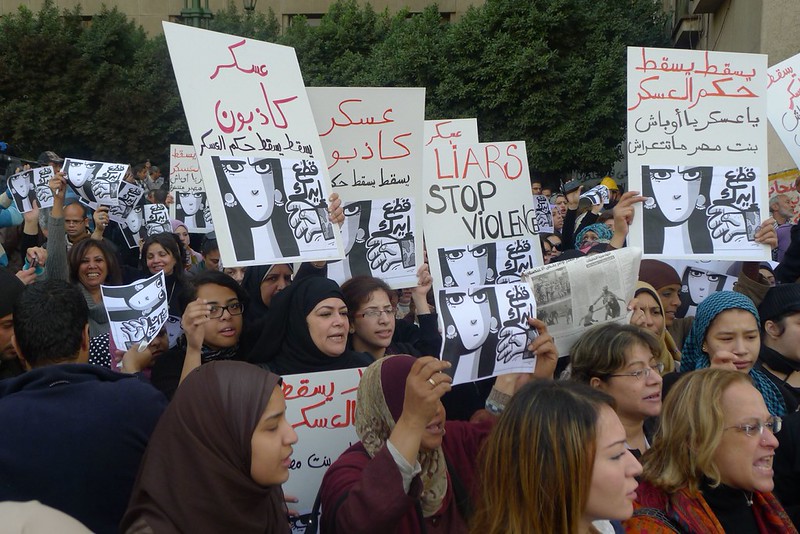
When public dissent is risky or impossible, resistance does not disappear. It often becomes quieter, more practical and harder to recognize. For many working-class women in Egypt, it takes shape not in slogans or demonstrations, but in the daily tactics they use to protect income, reduce dependence, share care work and move more safely through public space.
Samah, a worker in Cairo, offers one example. (The women featured in this article are identified by their first names only, with surnames omitted to protect their privacy.) On her way to work, she buys vegetables for dinner and carries them with her in a plastic bag. During breaks, she and her coworkers prepare the meal together, saving time later when she returns home to cook for her family. The routine is simple and may be entirely overlooked, but it helps her resist the exhaustion, time pressure and economic strain created by the double burden of paid work and unpaid domestic labor in a system that treats both as her sole responsibility.
Simple everyday acts of financial self-protection, mutual support and safer mobility can become forms of resistance when taking public action carries too high a cost or is out of reach. They are subtle, almost invisible in their execution, and precisely for that reason, they endure.
The invisible politics — and why invisibility is strategic
What Samah and her coworkers are doing can be easily dismissed as mere coping. Yet they belong to what political scientist James C. Scott describes as “everyday forms of resistance.” In contexts where openly confronting authority can be risky, costly or simply unthinkable, resistance rarely appears as dramatic dissent. It shows up instead as small, repeatable practices that shift how constraint is managed and how power is negotiated in ordinary life.
This resistance is not always directed at the state directly. More often, it operates within the wider informal systems through which domination is organized and reproduced, where women’s spending, mobility and respectability is routinely monitored and policed. For working-class women under scrutiny from employers, supervisors and family, overt confrontation can carry economic, reputational or physical costs. Autonomy is easily recast as deviance; small gains in money, time or independence can be questioned, moralized or withdrawn. Discretion, then, becomes both protection and strategy. By staying within the ordinary rather than stepping outside it, women carve out narrow margins of autonomy that are difficult to punish without revealing the very mechanisms of control that sustain them.
The quiet work concentrates in recurring arenas where pressure is constant and small shifts matter. What follows traces three stories from these arenas: financial autonomy within monitored household economies, informal networks of mutual support that reduce exposure to dependency, and everyday practices of safety that expand women’s movement through public space. Together, they show that resistance is not always loud, collective or publicly legible. It is often incremental, discreet and embedded in the daily management of money, risk and life.
Financial autonomy as resistance
At 23-years-old, Shahd works as a nail technician in a small salon. Her main financial challenge is not low income, but limited control over it once it enters the household. Her wages quickly enter a shared economy of obligation where groceries, utilities and family needs take priority and personal spending is weighed against collective responsibility.
“I once wanted to buy a jacket with my own money,” Shahd recalled. “I had the cash, but my father asked if it was really necessary when we still had other obligations, like my little brother’s lessons, so I gave the money to my mother instead.” Control is rarely dramatic. It works through quiet moral accounting that makes self-spending feel like something you have to justify, until you start policing yourself in advance. Visibility is where it tightens most. “If I leave cash in my wallet, it will disappear overnight. That’s normal,” she said, a reminder that cash is not treated as private savings so much as household money that can be absorbed without confrontation.
Her response is not refusal, but reconfiguration. Instead of keeping savings in visible cash or relying solely on bank transfers that are easily monitored, she quietly diverts small amounts into a separate Vodafone Cash — a secure e-wallet service — account that only she manages. It’s easy to set up, requires little documentation and leaves fewer household-facing traces than bank transfers. “I move small amounts somewhere no one thinks to check before they ultimately disappear,” Shahd said. The sums are modest, but they create a private margin with real consequences. It gives her a small reserve to cover needs as they arise, and even unused, it eases constraint by keeping options open and giving her a sense of control. “I’m not saving for something dramatic; I’m saving so I don’t have to depend on anyone,” she added.
The impact is less about dramatic transformation than about a gradual widening of what becomes doable under pressure. As these tactics spread, institutions begin to mirror them. For example, Vodafone Cash launched the Maaki initiative in July 2025 to train one million women in Upper Egypt in digital and technological skills. Likewise, the Central Bank of Egypt’s report that women’s financial inclusion reached 70 percent as of June 2025 points to a broader expansion in access to formal tools, and to the growing significance of mechanisms that women can deploy on their own terms.
This is what financial autonomy looks like as resistance, because it breaks the link between earning and control. Even small, privately-held reserves reduce dependence, widen what is possible under pressure and protect the ability to act without permission.
Networks as resistance
At 32-years-old, Noura works as an office secretary and raises her child alone. Her biggest challenge is not always money, but what happens when time and responsibility collide. A late meeting, a sick day, a school call can unravel the whole day if there is no one to hand things to.
So, she relies on an informal infrastructure of women who operate like an always-on relay. Someone steps in for pickup, another covers an hour, another brings food, another comes along to a clinic, another makes the calls and finds the workaround. Most of it is coordinated through WhatsApp, a steady stream of voice notes and quick asks that keep the day from falling apart. “I don’t have the option of doing everything alone,” she said. “If I try, I lose something, the job, the child or my mind.” This is not occasional help. It is a shared system of coverage that turns potential crises into manageable problems.
Money runs through the network too, and for Noura the gam‘eya is at its center, a rotating savings circle where women pay in monthly and take turns receiving a lump sum. Because it is predictable, she can plan for fees, rent gaps or emergencies without asking the wrong person at the wrong moment. “The gam‘eya is what saves us,” she said. “I know my date. And if an emergency hits early, the girls start a new one and I take the money first.”
Outside the circle, the urgent need for money can come with predatory lenders that require wosolat amana (trust receipts), which easily turn a missed payment into a legal threat. “You sign one paper and suddenly it’s not just debt, it’s a knife to your throat,” she said. “If you’re late once, you can end up in jail.” The gam‘eya keeps her out of that trap. For her, it is not about getting rich, it is about not being cornered.
Information moves too, with price intelligence, job leads, warnings and quiet knowledge-sharing that helps women navigate risk without generating a visible target. Through these overlapping exchanges, the network becomes a low-visibility welfare system, one that redistributes resources, absorbs shocks and builds a form of collective capacity.
The impact of this kind of networked resistance is quiet but immediate. It resists the everyday power that scarcity creates for those who control access, whether that is employers who can punish absence, intermediaries who profit from inflated prices and informal credit, or household dynamics that enforce dependence by making women ask, explain and wait.
These systems have been increasingly formalized in digital form, where platforms like MoneyFellows digitize gam‘eyat into app-based “money circles,” and initiatives like Tahweesha are designed to formalize women’s group savings and link them to banking services for rural women. These formalizations show that these circles are not a cultural leftover. They are an essential infrastructure that women built long before institutions learned how to name it.
Mobility as resistance
At 25-years-old, Salma works in an all-women clothes factory, and her shift ends at the hour when the city’s social contract quietly changes. Getting home is not a neutral transition between places so much as a second shift of calculation, where the price of a commute is not only time, but also attention, where routes are chosen for lighting and exits, and where a woman’s presence in public space is treated as negotiable. “The job finishes,” Salma said, “but the day doesn’t end until I close my door.”
To navigate that pressure, Salma relies on tactics designed to look ordinary enough to survive scrutiny. She makes herself “known” on purpose, greeting the building porter by name, buying small things from the same kiosk so the shopkeeper recognizes her, choosing drivers she trusts when she can, and arranging check-ins that last until she is indoors. “If something happens,” she said, “I don’t want to be a stranger in the street.” This is the steady refusal to disappear.
But these manoeuvres do more than reduce risk. In a context where harassment is normalized and women are expected to adjust their lives around it, they become a form of everyday resistance to the informal rules that try to shrink the women’s movement. The point is not only to avoid danger, but also to refuse the quiet curfew that says women should not be outside, should not be alone, should not be moving freely on their own terms.
Much of it is collective, because safety becomes sturdier when it is shared. Around the time the factory releases them, a WhatsApp thread starts moving with the kind of messages that sound casual until you realize they are building a distributed escort system with systemic check-ups. Meanwhile, a friend stays on the phone as Salma walks, a coworker waits for the double-check.
What they are producing is more than reassurance. It is witness, the small social infrastructure that makes harm costlier because a woman is less isolated even when she is physically alone. In a country where a U.N. Women study found that 99.3 percent of women and girls surveyed reported experiencing some form of sexual harassment, this web of recognition is not paranoia. It is adaptation under constraint.
While she is in transit, Salma also uses her phone to make her movements more visible to others and to create a record if something goes wrong. Sometimes she fakes a call and speaks loudly enough to imply that someone is tracking her route and expecting her; other times she quietly records, not to go viral but to make denial harder. “It’s not for drama, it’s so the person knows there will be a trace,” she said. In early 2026, when an Egyptian commuter filmed a man harassing her on a public bus and confronted him on camera, the clip went viral nationwide. Women watched, shared and repeated the lesson, turning filming into peer-to-peer knowledge and making harassment harder to erase.
The circulation of “self-protection hacks” on social media follows the same logic. In one widely shared TikTok, an Egyptian woman holds up a small spray bottle and explains that because pepper spray can be hard to obtain in Egypt, she carries a homemade substitute made from ordinary kitchen and cleaning items. The point is less the bottle than the reality it exposes: When formal protection is inaccessible, women improvise deterrence from whatever is already within reach and circulate that knowledge peer-to-peer.
This is why it counts as resistance. Salma is not only protecting herself. She is pushing back against the normalization of women’s vulnerability and the impunity that comes with it. She is refusing the idea that safety is an individual responsibility solved through silence, avoidance or self-blame. Through small, repeatable tactics, women like Salma convert safety into collective power, embedding themselves in networks of recognition so that harassment becomes riskier for the perpetrator than for the woman trying to get home.
Hope is a shared system
Shahd creates a private margin inside a monitored household economy, Noura builds welfare through women’s mutual infrastructure, and Salma creates more accountability in public space by staying connected to others and making harassment harder to deny. Their tactics do not overthrow systems in one decisive moment, but they alter the terms on which those systems extract, police and intimidate. The victories are modest and often temporary, yet they accumulate into something sturdier than they appear, a set of survival infrastructures that keep women moving, working, feeding their families and claiming space.

ZNetwork is funded solely through the generosity of its readers.
Donate




